Arlington City Council Special Meeting Summary – March 25, 2025
STREAMING COPY IN PREPARATION — RECORDING AVAILABLE FROM THE ORIGINAL SOURCE
Arlington City Council Special Meeting – March 25, 2025
The Arlington City Council convened a special meeting on March 25, 2025, starting at 11:30 a.m. with an executive session lasting until 3:15 p.m. The open session began at 4:40 p.m. and covered presentations on police use of force and a Unified Development Code (UDC) update, followed by committee reports, external conference updates, a legislative briefing, and a request for a future agenda item on animal breeding. The meeting adjourned at 5:34 p.m.
Discussion Items
-
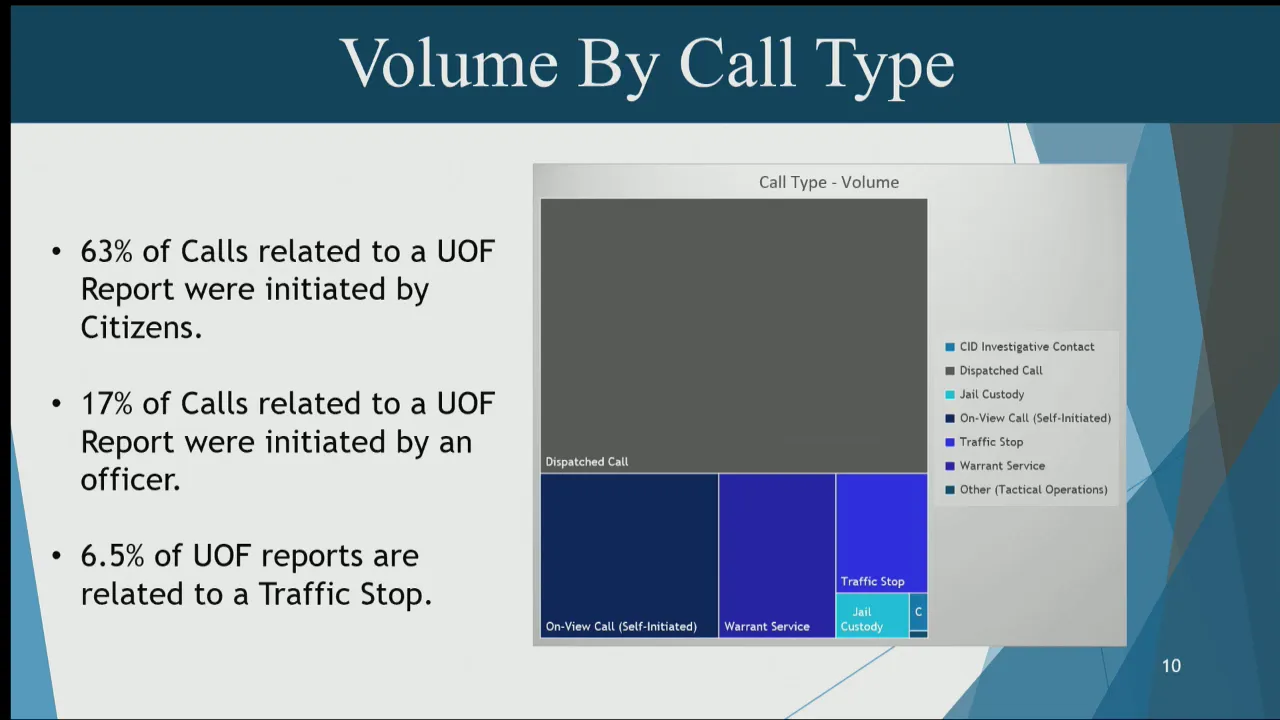
Arlington Police Department Use of Force Report – Police Chief Al Jones presented annual data for 2024. Key statistics: APD responded to over 241,000 calls for service (9.7% increase from 2023), with 1,235 use-of-force incidents involving 1,782 subjects (13.1% increase from 2023). Use-of-force incidents per 1,000 calls: 5.1, consistent with prior years. 99.5% of calls resulted in no force. 63% of force incidents were initiated by citizens calling for help. Among the top dispatch calls where force was applied, aggravated assaults and domestic assaults comprised 44%. Felony offenses accounted for 59% of force incidents. By race, force was most frequently applied to Black individuals, followed by Hispanic, then White. Dr. Jaya Davis from UTA provided independent analysis, noting that within incidents, subject race does not appear to dictate how force is handled. She recommended expanding drone-as-first-responder use and improving data collection. Councilmember Boxall noted a 19.1% increase in force against White females and 47% against Hispanic females; Chief Jones attributed this to rising domestic violence. Councilmember Odom-Wesley asked about abusive language training; Chief Jones stated APD policy is among the most stringent, documenting even unholstering a taser.
-
Unified Development Code (UDC) Annual Update 2025 – Richard Gertson, Assistant Director of Planning, presented 29 proposed amendments (4 clarifications, 9 corrections, 2 new definitions, 9 substantive changes, plus other items). Key changes: limits on short-term rental permits in apartment complexes (caps of 25 units or 15%, varied by zone); allowing vinyl/composite picket fences up to 3 feet in front yards; allowing a single 2-car garage door instead of two separated doors; setting a 15% maximum setback modification for small lots (AEC authority); requiring pre-application meetings for zoning board of adjustment appeals; streamlining historic demolition permits; and codifying drainage certifications. Councilmember Boxall expressed general support. The UDC update will proceed to Planning and Zoning Commission public hearing, then two council readings, with an effective date of July 1, 2025.
Committee Reports
-
Finance and Audit Committee (Councilmember Hunter, Chair) – The FY24 Single Audit and Annual Comprehensive Financial Report received an unmodified opinion, no financial audit findings, no unresolved issues, and no audit adjustments. Five major programs (three federal, two state) were audited with no findings. The city is considered low-risk with no material weaknesses and no audit findings for the past three years.
-
Community and Neighborhood Development Committee (Councilmember Boxall, Chair) – Discussion of PY2025 Action Plan and 2025-2029 Consolidated Plan for CDBG, ESG, and HOME grants. The committee requested more data on street outreach outcomes and recommended creating a homeless task force. Three public hearings will be held during the 30-day comment period. The committee will meet again on April 22 to review comments.
-
Arlington Housing Finance Corporation (Councilmember Hunter, Chair) – Approved a resolution retaining Chapman and Cutler LLP as bond counsel. Discussed a proposal from Dominion for 279 affordable housing units at 1801 Arkansas Lane. The board voted (not unanimous) to continue exploring, requiring the developer to engage with East Arlington Renewal to resolve concerns. Next steps include a resolution of no obligation for 4% tax credits, an MOU, zoning approval, and private activity bonds.
External Committee & Training Reports
- Regional Transportation Council (Councilmember Gonzalez) – Approvals included release of the draft Mobility 2050 plan, and 2025 Strategic Transportation Funding Program funding Arlington sidewalk improvements and parking lot H for World Cup preparations. Discussion of DART-related bills was tabled pending mediation.
- Civic I/O: The Mayors Summit at SXSW (Mayor Ross) – Participated in a panel on navigating new federal administration and served as a “shark” in a municipal AI startup competition. The winning company will present at the June NLC conference; follow-up meetings scheduled with Arlington staff.
- National League of Cities Congressional Cities Conference – Councilmembers Odom-Wesley and Gonzalez attended. Key topics: advocating for federal tax exemption on municipal bonds, mental health, housing stability, youth training, and veteran services. Councilmember Gonzalez noted a tool showing $400 billion in bonds used in 2023 for community improvements.
Legislative Update
- Natalie Raulston, Intergovernmental Relations Manager, reported: HB 21 (Arlington-supported housing finance corporation bill) heard in committee; HB 1585 (eliminating traveling HFC issue) also heard. Several property tax bills (capping appraisals) filed by Representative Turner. DEI bill SB 689 passed out of committee. HB 5280 filed affecting MWBE programs. Companion bills for IndyCar Grand Prix entering Major Events Reimbursement Program filed. HB 1893 (open records request for license plate data) to be heard tomorrow; Raulston to testify in support.
Key Outcomes
- No votes were taken during the work session; all items were presented for discussion and future action.
- Councilmember Boxall requested a future agenda item to explore creating a city ordinance regulating animal breeding (e.g., puppy mills), citing sporadic state enforcement.
- The UDC amendments will go to P&Z public hearing, then to council for two readings, targeting July 1, 2025 effective date.
- The AHFC board will continue discussions on the Arkansas Lane development and expects further negotiations.
- The CND Committee will convene March 22 to review public comments on the consolidated plan.
Appointments
- Two appointments to boards and commissions were noted for the evening agenda; no further discussion.
Meeting Transcript
Okay. Well, good morning, everybody. We're gonna go ahead and call the city council meeting to order. We have a full schedule this afternoon, so we're gonna get busy pursuing two VTCA Government Code chapter. Y'all get that rangers. Arlington Police Department use of force report, Chief Al Jones. Good afternoon, Mayor Council Al Jones, Chief of Police. I'm here today to present the department's annual use of force report for 2024. To guide our discussion today, we'll talk about our participation in the FBI National Use of Force Collection Project. Talk about the Arlington Police Department's use of force policy, our documentation and multi-tiered review process for all application of force. And I'll provide some highlights and key analysis of the report. So in 2015, the FBI has been collecting national level statistics on use of force. Participation has been voluntary, but Arlington Police Department has supported the initiative through our regular reporting process. Reportable incidents to the FBI must result in death or serious injury or serious body injury of a person, or the discharge of a firearm by law enforcement at or in direction of a person. And in 2024, Arlington reported six incidents to the FBI, which met these criteria. As you can see on this slide, there's a robust uh criteria for reporting uh useful force incidents which are codified in our policy and is consistent with industry standards and best practices. Our use of force policy governs the application of force in response to uh resistant level exhibited, uh de-escalation, after care, and the duty to intervene. Uh preserving the sanctity of life and human rights is at the forefront of the standard is reflected in our policy. Our policy also outlines required reporting, multi-level supervisory review requirements. Over the years we uh enhanced our operational and uh operations. Uh in 2022, uh the department began tracking resident residency information on subjects who our force was used against them. Uh to better, you know, to give us better data, uh, whether they're uh residents of Arlington, visitors, or unhoused individuals. Uh in 2023, we began the deployment of the 40 millimeter left le less lethal uh launcher system, which provided to uh which was provided to our patrol operations as another less lethal option. Uh prior to that year, uh SWAT was the only APD unit uh with the capability for the 40 millimeter launcher cap. Uh in 2024, we provided education on the proper utilized utilization of ballistic shields, instructing our officers on ways to carry it and deploying the shields, providing better protection to our officers and members of the community. Our uh use of force continual provides the framework and visual representation to employees when considering reasonable force options available to them. The total totality of circumstance model allows for reference points when comparing the subject's level of resistance to the available options to the officers. If you take note to the of the red uh highlighted box, the level of force which is detailed, uh the use of force report is where in uh supports of use of force report is required. And considering the severity of the offense, the immediacy of the threat, and the level of resistance or evading action of the subject. Each uh use of force in instance has a document review process and reviewed all the way up to the level of deputy chief to ensure that there is no deviation in policy during the use of force incident and that the officers are in compliance with training, best practices, and that is required by law. Uh, the information that is recreating uh collected uh during the report is the reason for the contact, the subject and resistance level, witnesses, all uh employees involved, type of force should, injuries resulting in use of force application, and the subject's disposition. Uh our uh force in tact assessment unit assigned to our training center also reviews each use of force report for trend analysis, training adjustments, and the process of improvement. So in uh 2024, officers uh we responded to roughly over 241 uh 240,000 calls for service, which is a 9.7 increase from the previous year. Uh, there was uh 1,235 use of force incidents involving 1,782 subjects, and six of those subjects were animals. Uh we saw a 13.1% increase in use of force incidents when you compare 23 to 24. The number of insulants uh incidents translate to 5.1 use of force incidents for every thousand calls for service, which is consistent uh with the previous years. This uh indicates that in 2024 we responded to over 21,000 additional calls for service, yet we did not see a significant uh increase in ratio of uh use of force incidents. Uh overall, um overall we saw and it was about a 99.5 percent of all the calls where there was no force being used by our officers. Uh in 2024, we experienced six officer-involved shootings, uh, five of those resulting in fatalities. As we evaluate our application of force, it's important to analyze uh the call volume types where force was used. In 2024, 63 percent of calls related to use of force report was initiated by our citizens. 17 percent of calls related to use of force report were initiated by officers, and 6.5 use of uh use of force reports were related to traffic stops. This illustrates that most calls involving use of force were initiated by someone calling the police for some help. Uh looking at the number of use of force incidents in 2024, we see that the vast majority of calls were dispatched to officers for a police response. This was highlighted in the previous slide. Uh again, please note that 63% of the calls, our citizens were calling us for help. As you'll see uh on the on-view call shows an increase which self-initiated calls based on officers' observation and proactive policing. Our office our uh warrant service calls are largely in part generated by our fugitive unit with actively uh involved engaging violent offenders throughout DFW metroplex. Uh, as we take a closer look at the top 10 uh calls for dispatch in 2004, where force was applied, you can see aggravated assaults and domestic assaults comprised of 44 percent of the top 10 calls for service. The chart on the left significantly shows that officers are responding to calls which are violent in nature.
openpublica.com