Aurora City Council Regular Meeting - August 11, 2026
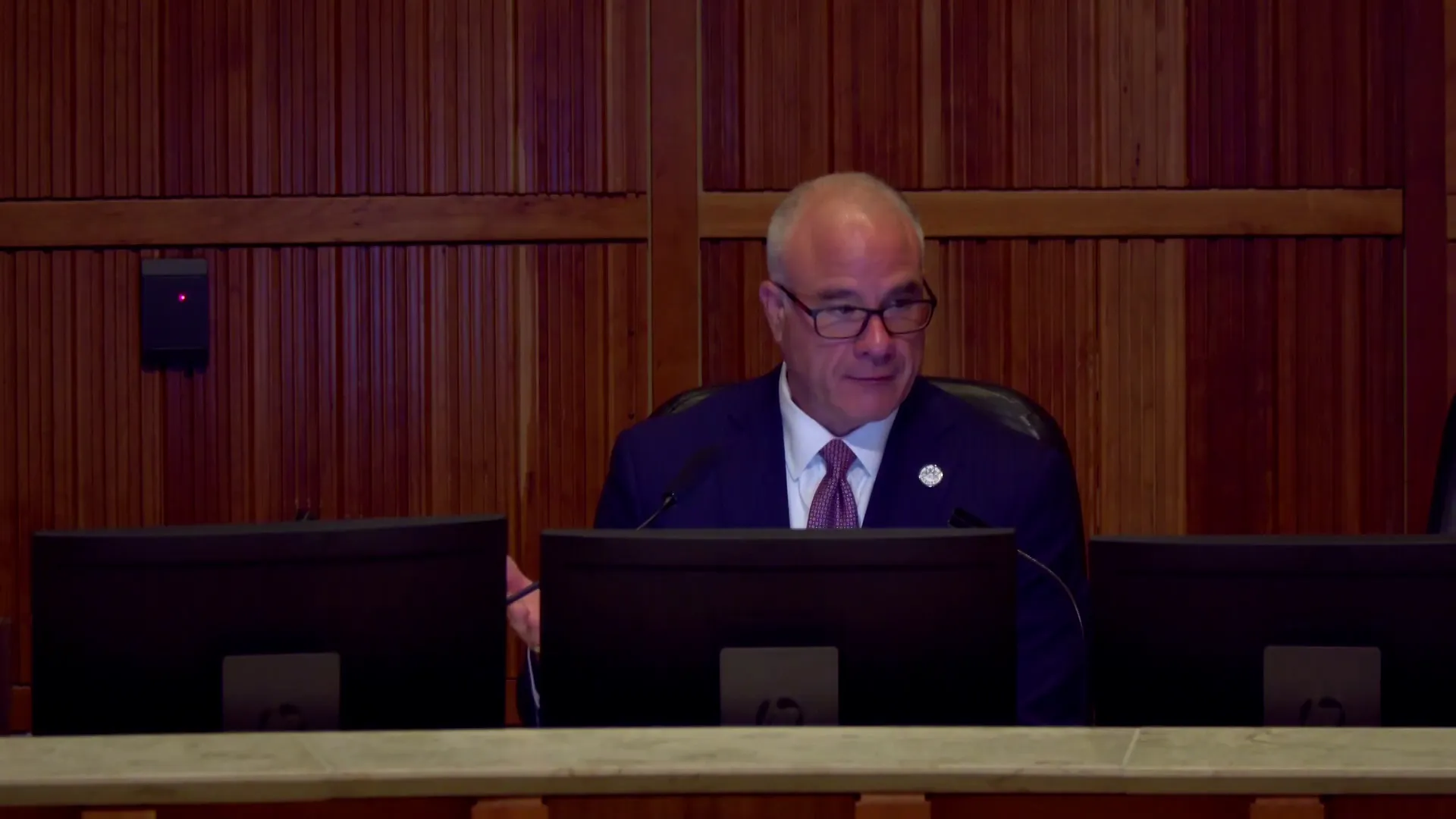
STREAMING COPY IN PREPARATION — RECORDING AVAILABLE FROM THE ORIGINAL SOURCE
Aurora City Council Regular Meeting - August 11, 2026
Note: The transcript listed the date as August 10, 2026, but the provided metadata indicates the meeting occurred on August 11, 2026. This summary uses the metadata date.
The Aurora City Council met on August 11, 2026, starting at approximately 6:00 PM. Key agenda items included approval of minutes, adoption of the consent calendar, a pair of competing resolutions on data center regulations (11A5 and 11A6), and a ballot measure to move municipal elections to even-numbered years (14A). The meeting featured extensive public comment on police accountability, environmental concerns, and community oversight. The council voted to reject a six-month data center moratorium resolution (11A5) on a tie vote, but passed a competing resolution (11A6) directing the city manager to propose data center regulations within 35 days. The ordinance to shift municipal elections to even years was approved and will be placed on the November 2026 ballot.
Consent Calendar
- Unanimously approved the minutes of July 27, 2026.
- Adopted the agenda with item 13A (a data center moratorium ordinance) removed after the city attorney noted significant amendments were needed.
- Adopted consent calendar on motions (10C1–10C3) unanimously.
- Adopted consent calendar on resolutions and ordinances (11A1–11B2) with items 11A5 and 11A6 pulled for separate discussion.
Public Comments & Testimony
First Session (Items not on the agenda)
- Medean Schaffner and others criticized the Aurora Police Department and Chief Todd Chamberlain, citing the death of Rajon Belt Stubblefield and the recent indictment of Officer Matthew Neely. Multiple speakers demanded Chamberlain’s firing, calling for accountability and community control over police.
- Della Jordan accused the city council of complicity in police killings and presented a “verdict” of guilty on several charges, including prioritizing police unions over accountability and treating black grief as disruption.
- Jeffrey McFarland raised concerns about the Geo Aurora ICE Processing Center, reporting a tuberculosis outbreak and the denial of entry to public health officials. He called for the facility to be shut down.
- Cassandra Hill (Denver Aurora Community Action Committee) celebrated the indictment of Officer Neely but demanded further action, including the dismissal of Chief Chamberlain and community oversight of police.
- Hashim Coates supported the indictment and urged a full conviction, while also criticizing surveillance and license plate readers.
- Kristen Mallory addressed disability access and criticized the city’s removal of turf at the Great Lawn, calling it wasteful during a drought.
- Aaron Futrell and Juan Marcano spoke about council rules changes, including removing the one-hour limit on public comment, eliminating remote participation restrictions, and ending security theater.
- Zachary Cotton urged the council to pressure the GEO Group over the tuberculosis investigation and questioned a $4 million contract with Integra.
- Jeff Brown (with an accommodation for extra time) criticized the city’s retail tax base and presented resolutions for reporting metrics.
- Adalika Shepard, Robert Lewis, Shardina Lewis, Paul Nelson, Tristan Hoost, Kyoa Lewis, and Laura McLaughlin all spoke about police violence, naming victims and demanding accountability, including the firing of Chief Chamberlain. Several expressed anger and grief over the deaths of family members.
Second Session (Item 11A1 and 11B2)
- Ayante Anderson and Medean Schaffner supported the accountability metrics resolution (11A1), citing testimony from Della Jordan about the Aurora Navigation Center.
- Hashim Coates spoke against the automated traffic enforcement system (11B2), warning about privacy concerns and the potential for misuse of license plate reader data.
Third Session (Items 11A5 and 11A6)
- Anita Cabrick, Ayante Anderson, Aditi Desai, Varang Desai, Arvin Martinez, Hashim Coates, Juan Marcano, Chad Johnson, Kristen Mallory, Kathleen Peterson, Christopher Fellows, and Nicholas Bedan spoke in favor of a moratorium or stricter regulations on data centers. They cited concerns about water usage, energy demands, noise, pollution, property devaluation, and environmental racism. Several expressed support for Councilmember Wiles’ resolution (11A5) and criticized Councilmember Gardner for not attending in person.
- Chad Johnson noted that the average medium-sized data center uses 300,000–500,000 gallons of water per day.
Fourth Session (Item 14A)
- Ayante Anderson, Hashim Coates, Kristen Mallory, and Juan Marcano spoke in favor of moving municipal elections to even-numbered years, arguing it would increase voter turnout, reduce political polarization, and improve democracy. They cited studies showing turnout can double when local elections coincide with state and federal races.
Discussion Items
Data Center Resolutions (11A5 and 11A6)
- Councilmember Wiles presented resolution 11A5, which would direct the city manager to not accept new data center applications during a six-month pause while the city develops updated regulations. She emphasized that the resolution was not anti-business but pro-responsible development, citing research showing potential property value decreases of 6–7% for homes within a quarter mile of hyperscale data centers. She noted that existing UDOs were not designed for modern hyperscale facilities and that a temporary pause would allow for proper standards.
- City Manager Jason Batchelor provided an overview of current data center regulations: they are allowed by right in five zone districts (I-1, I-2, AD, APZ, and mixed-use office/institutional). The city’s large water user guide effectively bans evaporative cooling, and existing data centers use only 0.3% of the city’s water annually. However, noise standards and setbacks are not specifically tailored for data centers.
- Councilmember Gardner presented resolution 11A6, which would direct the city manager to bring forward regulatory changes within 30 days (later amended to 35 days) without a moratorium. He argued that a moratorium creates uncertainty for businesses and that the city can address concerns through the normal legislative process.
- Councilmember Hancock questioned the need for a six-month moratorium, noting that the water department already effectively prohibits evaporative cooling and that staff could work on updates alongside existing applications.
- Councilmember Andrews expressed concerns about the process, saying the public had not been fully educated and that the city should tour data centers and visit reservoirs before making decisions.
- Mayor Pro Tem Coombs proposed an amendment to 11A5 to allow applications only if they meet a half-mile buffer from residential areas and use closed-loop cooling. The amendment failed on a tie vote (5-5), with Mayor Kaufman voting no, arguing that the buffer distance was not yet supported by data.
- A second amendment to 11A5 (adding pre-application meetings to the exemption) passed on a tie vote with Mayor Kaufman breaking the tie in favor.
- The final vote on 11A5 as amended resulted in a tie, and Mayor Kaufman voted no, causing the resolution to fail.
- For 11A6, the sponsor accepted friendly amendments to strike Section 2 (which had exempted certain applications) and extend the timeline to 35 days. A motion to continue the item to the August 24 study session failed (5-6). The resolution then passed on a 7-3 vote (Councilmembers Coombs, Jackson, and Medina dissenting).
Municipal Elections (Item 14A)
- Councilmember Jackson sponsored the ordinance to place on the November 2026 ballot a charter amendment to move municipal elections to even-numbered years. She argued that this would increase voter participation, reduce the influence of partisan rhetoric, and allow for better intergovernmental coordination.
- Councilmember Hancock opposed, stating that off-year elections give local issues the attention they deserve and that moving to even years would nationalize local politics.
- Mayor Pro Tem Coombs supported the change, noting that higher turnout is a hallmark of democracy.
- The ordinance passed 6-4, with Councilmembers Bergen, Gardner, Hancock, and Lawson voting no.
Key Outcomes
- Item 11A5 (Data Center Moratorium Resolution): Failed on a tie vote (5-5) with Mayor Kaufman breaking the tie by voting no.
- Item 11A6 (Data Center Regulations Resolution): Passed 7-3. The city manager is directed to bring forward proposed ordinances within 35 days, including a ban on evaporative cooling, and to study noise, setbacks, and other zoning issues. No moratorium is imposed.
- Item 14A (Municipal Elections Charter Amendment): Passed 6-4. The ordinance will be submitted to voters at the November 3, 2026 coordinated election.
- Consent Calendar: Approved unanimously.
- Council Reports: Several councilmembers reported on upcoming community events, including a town hall on the renaming of the Central Library (August 15), a housing strategy feedback session (August 20), and a water tour to inspect reservoirs.
Meeting Transcript
The regular meeting of the Royal City Council for Monday, August 10th, 2026 is called to order. With a clerk, please call the roll. Mayor Kaufman. Here. Councilmember Andrews. Councilmember Bergen. Here. Councilmember Coombs. Councilmember Gardner. Here. Councilmember Hancock. Councilmember Horton. Here. Councilmember Jackson. Councilmember Lawson? Here. Councilmember Medina. Here. Councilmember Wiles. Councilmember Wiles. Here. There's a quorum. Councilmember Jackson is excused. Please join me in an invocation. Our God and our Father. We come to you and we ask that you look upon this particular gathering tonight to keep us safe and guide us in our decisions. Bless our city with honorable citizens, industry, sound education, and good government. Unite our community together. Even though we come from different backgrounds, we pray that there will be justice and peace in our city. Give the city council and citizens the wisdom, direction, and sensitivity to the business and proceedings before us tonight. Hear us therefore as we commit this meeting to the help of our entire community. Oh man. Land acknowledgement. I'm sorry. Um please join me the Pledge of Allegiance. To the flag. For which it stands. One nation, under God, indivisible liberty and justice for all. Land acknowledgement, the City of Aurora acknowledges that we gather on the territories and ancestral homelands of the Cheyenne, U to Arapaho, and Lakota Peoples, pass and present. We also recognize the 48 contemporary tribal nations that are historically tied to the lands that make up this the state of Colorado. Indigenous peoples have remain committed to the stewardship of this land over many centuries. As these words of acknowledgement are spoken and heard, the ties that these nations have to their traditional homelands and to their vital place in the ecosystem are renewed and reaffirmed, and we are called upon to be better stewards of the land. We inhabit as we continue to work to meet the needs of our entire community. Move by uh Councilmember Hancock, seconded by Mayor Second. Second by Councilmember Lawson to approve the minutes for July 27th, 2026 discussion. See no discussion call for the question on approval of the minutes for July 27, 2026. Mayor Kaufman. Mayor votes yes. Oh, what did you say? Mayor Pro Tim.
openpublica.com