Fourth and Final Budget Hearing for 2026 Metropolitan Council Budget – December 3, 2025
STREAMING COPY IN PREPARATION — RECORDING AVAILABLE FROM THE ORIGINAL SOURCE
Fourth and Final Budget Hearing for 2026 Metropolitan Council Budget – December 3, 2025
The Metropolitan Council held its fourth and final budget hearing for the 2026 fiscal year on December 3, 2025. The hearing featured presentations from the East Baton Rouge Parish Criminal Justice Coordinating Council (CJCC), the Arts Council of Greater Baton Rouge, the City Constable’s Office, the East Baton Rouge Parish Library, and the Spanish Town Mardi Gras Parade organization. Each agency detailed proposed budget cuts, their operational impacts, and made appeals for reconsideration. Council members and the mayor acknowledged the difficult budget environment due to revenue shortfalls and the St. George incorporation, but signaled openness to some adjustments.
Public Comments & Testimony
- Charlie Spidell, a local attorney, spoke in support of the Constable’s Office, noting that reduced staffing in civil process service was driving some attorneys to file cases in district court instead of city court, reducing fee revenue to the city.
- Byron Come, from the American Legion, highlighted the charity work supported by the Spanish Town parade, including a dental van for veterans, and urged the council to preserve the parade funding.
- Lauren Least, chair of the Historic Spanish Town Civic Association, emphasized the parade’s role as a community-building event and the economic ripple effects for downtown businesses, and called for better communication ahead of changes.
Discussion Items
Criminal Justice Coordinating Council (CJCC)
- Executive Director Chris Anka presented, noting that the proposed 2026 budget reduces city funding by 54.4% (from $260,000 in 2025 to $125,000). He explained that the cut appears to conflate general city funding with separate opioid abatement funds. CJCC’s core operations (three staff salaries, rent, insurance) rely on city funding, while five program staff are fully grant-funded. Anka stated that a 10-12% cut would be manageable but 54% would force layoffs of one or two core staff.
- Board Chair Judge Don Johnson argued for a holistic approach to public safety, urging the council to fund courts, public defenders, and prosecutors proportionally, and said CJCC helps the courts act as “first responders” through early intervention.
- Chris Tell Slaughter from the mayor’s office acknowledged the difficulty but cited overall budget constraints. Council member Coleman called the cut “too deep” and asked the mayor’s office to revisit the figure.
Arts Council of Greater Baton Rouge
- President & CEO Jonathan Grimes described the Arts Council as the city’s official arts agency, operating with a $2.5 million budget. The proposed cut from $333,930 (FY25) to $250,000 (FY26) represents a 25% reduction, with a possible zero in FY27. The cut would eliminate programs like Sunday in the Park, reduce arts teachers in schools, and threaten maintenance of public art. Grimes cited research that arts reduce crime and noted a 10-year projected economic impact of $40 million.
- Council members questioned the economic impact and the share of city funding relative to total budget. Grimes stated the city’s contribution is about 13-15% but is crucial for leveraging grants and sustaining programs.
City Constable’s Office
- Constable Williams presented, objecting to an 11% cut, arguing that constables are POST-certified law enforcement and should be treated like BRPD and fire. She noted that the office already operates with 28 employees against 48 authorized positions, with 11 frozen vacancies. The cut would require freezing additional positions and potentially laying off 3-4 deputies.
- Mayor Broome affirmed he considers constables law enforcement but noted the budget crisis affects all agencies. Chief Murphy Morris clarified that overtime costs for BRPD are unsustainable and that special events contribute to a $4 million overtime overspend. Williams also raised an unfunded agreement to provide security at City Hall, which BRPD previously funded but has not paid for in two years. Council members suggested revisiting that funding arrangement.
- Finance director Angie explained that by freezing vacant positions (11 total), the Constable’s Office could meet the 11% cut without layoffs, but Constable Williams countered that would leave her severely understaffed.
East Baton Rouge Parish Library
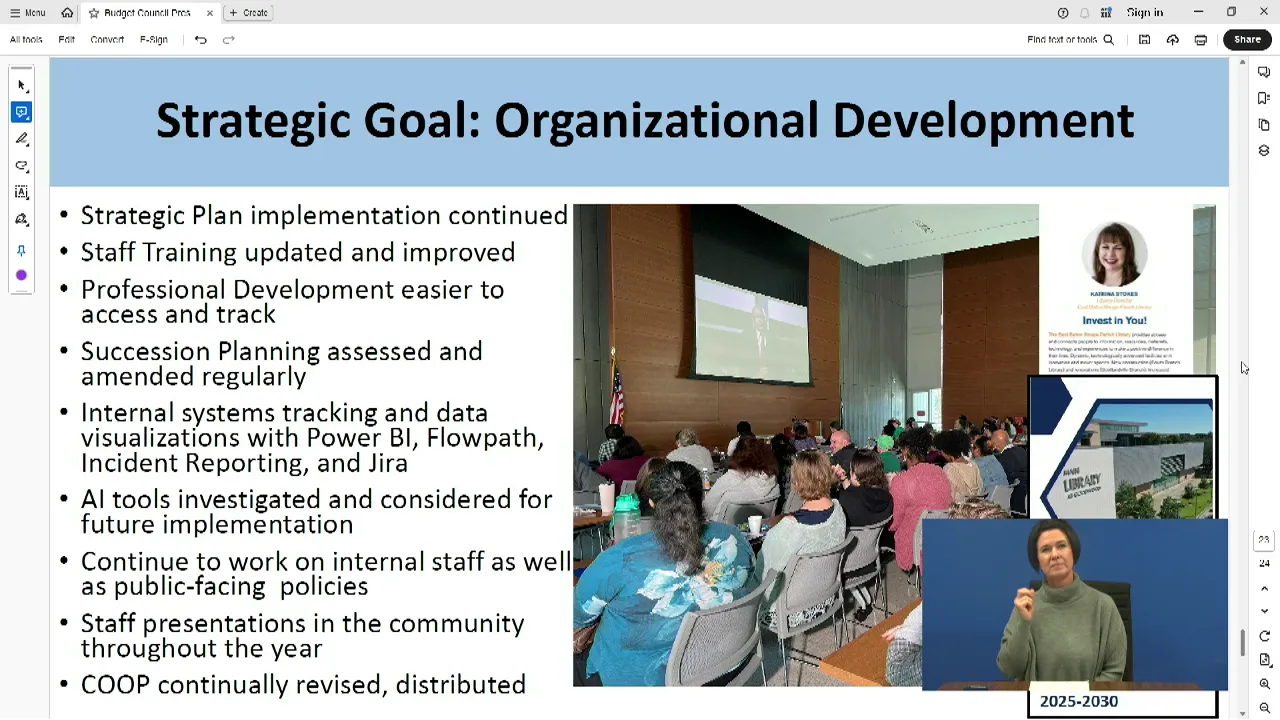
- Executive Director Katrina Stokes reported that the library failed to renew its 10-year dedicated tax in November 2025, forcing a reduced budget. The proposed FY26 budget is $53.9 million, down from previous levels, and relies on fund balances until new revenue (expected from a June 2026 election) arrives in 2027.
- To meet the reduced budget, the library froze 72 vacant positions, cut the book budget from 12% to 10.77%, and paused capital transfers. All 15 branches remain open, and services continue. Stokes highlighted that 68% of the parish holds library cards, and the library has already served 1.5 million visitors in 2025.
- Councilman Noel asked for clarification on active cardholder statistics. The library reported 122,000 active cardholders (used within 12 months), which is 27% of the parish population.
Spanish Town Mardi Gras Parade
- President Robert King and former President Bill Broomfield detailed the parade’s economic impact: estimated $4.65 million total, with $200,000 in direct city revenue from taxes. They were informed that the city might require the parade to pay $75,000–$80,000 for police overtime (110 officers at $75/hr), which they said would be unsustainable and force cuts to charitable donations.
- Councilman Dunn proposed developing a fair, criteria-based policy for all special events, using economic impact data from Visit Baton Rouge and the Downtown Development District. He acknowledged the current budget crisis and suggested long-term solutions rather than immediate charges.
- Chief Morris explained that BRPD’s overtime budget is overspent and that the department faces a “systematic culture” of expecting free police services for events. He suggested a per-officer rate of about $50–$55/hour would be more feasible and allow staffing to fill needed posts.
- Councilwoman Roca asked the mayor’s office to convene a meeting of all parade organizers to discuss options for the 2026 season, noting the Spanish Town parade is weeks away (Valentine’s Day). Christelle from the mayor’s office committed to working on a policy but indicated no immediate changes for this year.
Key Outcomes
- CJCC: Council member Coleman requested the mayor’s office revisit the 54.4% cut; the mayor’s representative agreed to do so. No final decision was made.
- Arts Council: Council members expressed support for the arts but took no immediate action. The budget remains subject to amendment.
- Constable’s Office: Mayor Broome affirmed constables are law enforcement. The finance director stated the 11% cut could be met by freezing vacant positions without layoffs, but Constable Williams argued that would exacerbate staffing shortages. A potential reallocation of City Hall security funding was discussed but not resolved.
- Library: The library’s proposed budget was presented without immediate objection. The council acknowledged the funding uncertainty and expressed support for the library’s efforts.
- Spanish Town Parade: The council did not vote on police funding. Councilman Dunn pledged to work on a special-events policy for future years, while Councilwoman Roca requested a meeting between parade organizers and the administration. The mayor’s office indicated that this year’s parade would likely proceed without major changes.
- General: Councilman Norris noted the structural budget crisis caused by dedicated taxes and the St. George incorporation, warning that service cuts will be necessary. The budget is subject to amendments in upcoming council meetings.
Meeting Transcript
Good afternoon and welcome to the fourth and final um budget hearings for the Metropolitan Council for the 2026 budget. Um thank you to everybody who came um today and thank you to everybody who is tuning in. Let's um let's get started this mor this afternoon. We have the East Butners Parish Criminal Justice Coordinating Council. Hi, how are you doing, Mr. Sanka? Hey, how are you guys? How's how's everyone doing? Good to see you. Thank you for joining us. We have I did email our presentation in. Was that able to get it up? Well, we did hand it out, made handouts too, just in case. Yeah, we'll get it, we'll get it at just takes a second. Okay. You had a good Thanksgiving? We we did. Good. That's not us. Uh-oh. I also have it on a thumb drive here if they're having trouble. There it is. There we go. There we go. Awesome. Okay. We're ready. We're ready. Thank you. Uh I appreciate having this chance to speak about the our upcoming budget in the two 2026 proposed budget. I'm Chris Anka, I'm the executive director of the Criminal Justice Coordinating Council. Uh just a little brief history. CJCC was established in 2019. It was a partnership with the Baton Rouge Area Foundation, with the City Parish, and with the MacArthur Foundation. And the whole purpose was to create a centralized collaborative body that focused on making a safer Baton Rouge and improving the criminal justice system. Our board of directors are all the public safety leaders within the parish. Uh we have representation from the mayor's office. We have representation. I'd like to point out a couple of our other board members that are in the audience, Mr. John Spain, who I refer to as a grandfather of the CJCC, because he really is the reason that we started this. Uh Jennifer Carwile, and then my great staff that's sitting behind us. Our mission is to foster collaboration among justice, municipal, and community leaders to enhance a criminal justice system. We do that through using data-driven decisions, inclusive dialogue, and innovative practices. We strive to promote public safety, ensure accountability, and create equitable outcomes for individuals going through the criminal justice system. We also work to improve the system for the people working within it. I will I will have you note that the CJCC is the only organization that works on the criminal justice process in a holistic, comprehensive method. All the other people that I mentioned, all our justice leaders, they're focused on working on their section of the criminal justice process. We bring them together to see how we can fix the system holistically from the beginning until the end. Yep. On slide two there, you're gonna see uh just some of the programs that we've started in the short time that we've been around the last seven years.
openpublica.com