Belgrade City Council Meeting - May 11, 2026: MS4 Compliance and Stormwater Utility
STREAMING COPY IN PREPARATION — RECORDING AVAILABLE FROM THE ORIGINAL SOURCE
Belgrade City Council Meeting - May 11, 2026
This meeting focused on upcoming federal and state stormwater regulations requiring the City of Belgrade to comply with the Municipal Separate Storm Sewer System (MS4) permit. Public Works Director Camry Yulia presented a detailed overview of the requirements, a proposed stormwater utility, and three budget scenarios. Council members discussed the options, balancing regulatory obligations with taxpayer impacts, and leaned toward a modified version of Scenario 2.
Discussion Items
-
MS4 Compliance Overview: Yulia explained that Belgrade will be designated as a discretionary MS4 by the Montana Department of Environmental Quality (DEQ) once its population exceeds 10,000 (confirmed by 2020 census). DEQ will include Belgrade in the 2027 general permit renewal. Key deadlines include a public hearing on May 22, 2026, formal notification expected in October 2026, and permit application due within 180 days (by March 2027).
-
Regulatory Requirements: The MS4 permit mandates six minimum control measures: public education, illicit discharge detection, construction site stormwater management, post-construction management, pollution prevention, and GIS mapping of all stormwater infrastructure within city limits and a one-mile buffer. Annual permit fee is approximately $8,000. Non-compliance risks include fines, third-party lawsuits, and hindered state development approvals.
-
Current Stormwater System: Belgrade lacks dedicated funding, relies on as-needed maintenance, and has many failing French drains. About half of the city has inadequate stormwater infrastructure. Newer subdivisions have centralized systems, but older areas lack curb and gutter.
-
Proposed Stormwater Utility: Yulia recommended a utility model (over a special improvement district) to provide dedicated funding. The rate structure uses a hybrid approach based on zoning and average impervious surface area, with an Equivalent Impact Factor (EIF). Rates are per acre; excluded city-owned properties and vacant parcels. Three budget scenarios were presented:
- Scenario 1 ($1.0M/year): Bare minimum staffing (4-person team + 2 operators, half FTEs), minimal equipment, no capital reserves. Example monthly residential rate: $8.68.
- Scenario 2 ($1.6M/year): Adds half FTE engineer, full-time permitting tech, new VAC jetter truck (3-year financing), professional services for rate study, impact fee study, and stormwater master plan, $100k/year capital reserve. Example residential rate: $13.81/month.
- Scenario 3 ($1.9M/year): Additional operator, mid-size excavator, robust repair budget, $250k/year capital reserve. Example residential rate: $16.17/month.
-
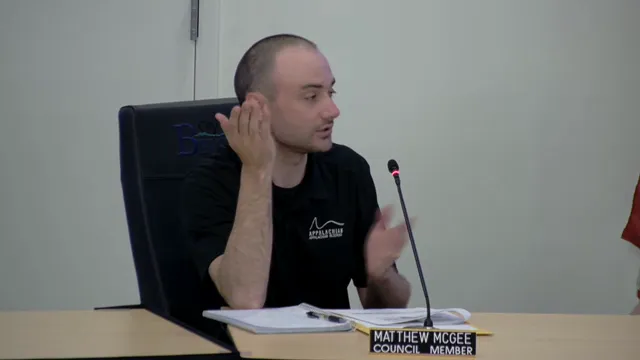
Council Deliberation: Council members expressed general support for Scenario 2, with several suggesting a "Scenario 1.5" to ease into higher rates while still providing adequate staffing and initial capital. Key concerns included taxpayer burden (referencing recent failed school levy), the need for public education, and equity between residential and commercial sectors. Councilmember McGee noted the city's per-capita water use is high and connected to stormwater quality. Councilmember Nicene emphasized clean drinking water and aquifer protection. Councilmember Guffey opposed bare-minimum Scenario 1. Mayor and City Manager suggested possible adjustments: delaying VAC truck purchase, using wastewater SLAR fund, or spreading equipment payments over 5 years.
-
Rate Equity Discussion: The initial rate spread was considered equitable by most council members, as it was based on average impervious area by zone. No strong support emerged for shifting more burden to commercial, given efforts to attract businesses. Councilmember McGee proposed a sliding scale per acre for larger commercial parcels, but City Manager noted legal constraints and potential inequities.
Key Outcomes
- The council directed staff to refine the utility proposal, aiming for a "Scenario 1.5" that retains three operators (safety minimum) and essential equipment but may defer capital purchases or reduce capital reserves.
- Staff will bring a revised rate structure and utility ordinance for a first reading in June 2026, with a public hearing in July 2026, and intended effective date of August 2026.
- A stormwater master plan and impact fee study are planned as part of professional services in the chosen scenario.
- Council emphasized the need for extensive public outreach to explain the regulatory mandate and benefits (protecting groundwater, avoiding fines).
- The city manager noted that creating the utility now, rather than waiting for regulatory enforcement, allows for proactive management.
Meeting Transcript
Thank you. I'd like to uh call the Belgrade City Council meeting to order. And please rise and follow me in the pledge. I pledge allegiance to the flag of the United States of America and to the Republic for which it stands. One nation under God. Indivisible with liberty and justice for all the roll calls, please. Jason Guppy? Here. Matthew McGee. Here. Jim Simon? Here. Michael Meese? Here. Christina Nicene. Here. Aaron Bell. Here. Renee Mm. Here. Thank you. All right. Next, moving on to our discussion agenda, and we just have the one tonight, MS4 compliance and stormwater utility discussion. All right. Good evening, uh Mayor and Council. I'm uh Camera Yulia, the director of public works, and thank you for joining us tonight to talk about um upcoming regulatory changes that Belgrade is facing in regards to stormwater. Um, and then the discussion regarding the creation of a stormwater utility. Um so you guys have probably heard the term um MS4, and what that stands for is municipal separate storm sewer system. Uh so there's a lengthy federal definition here, but basically it's any infrastructure that channels stormwater. It can include curbing gutters, ditches, swales, retention ponds, you know, underground, uh, water dissipation chambers. Uh we've got a feature here in Belgrade that we commonly refer to as the French drain. That was kind of the old style of handling things. That's uh that's actually classified as a class five injection well. Um so very technical term for a very not technical piece of infrastructure. Um, but any of those features are considered part of a storm sewer system. And uh so once uh communities get to a certain size, um, they're under federal law required to regulate for stormwater meet certain compliance requirements. And um so uh one distinction too I want to point out too. Stormwater is they they often will refer to it as a storm sewer. It is not like a sanitary sewer. They're separate systems. There are places that use combined sewers uh where they actually collect stormwater and wastewater um simultaneously in the same pipe. We have none of that in Belgrade. I'm very thankful for it. It brings a whole host of other regulatory and sanitation challenges, uh, but there are some of those in Montana still. Um but we have a separate storm sewer system in Belgrade, mostly relying on ground infiltration. Um another definition I just want to highlight here is uh this term state waters and also waters of the United States. Um so the reason storm discharges are regulated is those waters that come from storm runoff can enter what is called a state water or water of the United States. Um so at the federal level, waters of the United States are typically navigable waters, so this would be rivers and streams and wetlands. Um but in Montana, there's a little more broad of a definition. It can also include things like aquifers, um, can actually be regulated as a state water.
openpublica.com