Bend City Council Meeting - March 1, 2023: Budget Preview, Goal Framework, Annexations, and Housing Initiatives
STREAMING COPY IN PREPARATION — RECORDING AVAILABLE FROM THE ORIGINAL SOURCE
Bend City Council Meeting - March 1, 2023
This hybrid meeting of the Bend City Council included a work session on the 2023-2025 biennial budget and council goal framework, a legislative update, and a regular business session covering multiple annexations, sewer project contracts, right-of-way vacations, a behavioral health grant, and a city manager's report on the new camping code.
Budget Preview (Work Session)
- Finance Director Janet Townsend presented revenue and expenditure trends for the upcoming biennium. She noted that property tax revenue growth is constrained by state limits (Measure 5/50), while city expenses are rising with inflation (construction inflation >9% in 2022, wage increases ~10%). The general fund faces a widening gap between revenues and expenses, requiring either funding increases or service level reductions.
- For the current fiscal year (FY 2023), room tax collections softened in December and January, while gas tax remains strong. Development-related fees (building, planning, engineering) are slowing due to higher interest rates. Overall, total general fund revenue growth is projected at a modest 4% year-over-year.
- Townsend highlighted that the city's property tax assessed value (purple line on a graph) lags far behind market value (green line), creating structural pressure. Most city funds are balanced, but the general fund is under the most strain.
- A transportation fee or operating levy for fire are assumed in the proposed budget to maintain current service levels. Shelter operations are assumed to rely on state/federal revenues beyond this biennium.
Council Goal Framework
- City Manager Eric King presented a draft of the 2023-2025 council goals, slimmed down from the previous six goals/19 strategies/80 actions to four goals/13 strategies/48 actions. The four proposed goals are: (1) Accessible and Effective City Government, (2) Affordable Housing and Sustainable Development, (3) Public Safety, (4) Transportation and Infrastructure.
- Council discussed guiding principles, including equity, inclusive leadership, and partnership. Minor wording changes were suggested (e.g., “people are heard” instead of “feel heard”).
- Under Affordable Housing, staff reported that the city has met its goal of 1,001 deed-restricted affordable housing units (including pipeline). Discussion included adding “complete neighborhoods” to the growth strategy and explicitly mentioning transitional housing in the housing continuum.
- King proposed creating a fifth standalone goal for Environment and Climate, pulling together climate action, watershed protection, and emergency management. Council agreed to add this fifth goal.
- Regarding transportation, King noted that the Community Building Subcommittee will refine multimodal priorities, especially for one north-south and one east-west key route. Councilor Méndez emphasized that “connected and protected” should mean all ages and abilities (e.g., separate paths, not just painted lanes). Councilor Riley stressed safety and speeding concerns.
- King recommended repurposing a vacant position to the Equity Department for engagement and policy support, given resource constraints. Council endorsed this approach.
Legislative Update (Work Session)
- State lobbyist Eric Canceler reported on the 2023 long session. Key issues include: (1) Climate-Friendly and Equitable Communities (CFEC) rulemaking and Oregon Housing Needs Analysis (ONA) – ensuring both are implementable and aligned; (2) Shelter funding – the state has allocated $24 million statewide for shelter operations, but Bend’s need is high; the Governor’s executive order may add $12-14 million for Central Oregon, but applicability to existing shelters is unclear; (3) Infrastructure funding for housing – advocating for underground utilities; (4) HB 2705, a Bend-specific middle-income multifamily tax exemption bill; (5) Transportation bills: HB 2571 (e-bike rebate), HB 2095 (photo radar expansion), HB 2101 (ODOT funding exchange protection).
- Canceler noted that the legislature’s top priority is housing and homelessness, with a 60-day timeline on HB 2001. Additional shelter and infrastructure funding may come in the “end game” of session.
Consent Calendar
- Approved without objection: minutes of February 15, 2022 work session and regular session; OLCC Report; Monthly Financials.
Public Comments & Testimony
- Multiple speakers addressed the proposed safe parking/camping site on city-owned land south of Highway 97 (item related to Hunnell Road update). Speakers expressed concerns about public safety, crime, drug use, lack of community outreach, and inequitable distribution of homeless services (all in SE Bend). Some speakers urged more compassionate, housing-first solutions and questioned the effectiveness of moving encampments. Mayor Kebler clarified that the site would be supervised, with sanitation and security, and would prioritize medically fragile individuals.
- On the Ferguson annexation (item 8), Karen Johnson (Old Farm District Neighborhood Association) opposed the design due to lack of a park, traffic impacts on Ferguson Road, and poor open space configuration. Devin Jensen urged preserving quality green space.
- No public comment was offered on the Cooley Road annexation (items 6-7) or other consent items.
Discussion Items
- Cooley Road Annexation (Items 6 & 7): Staff presented the annexation of 1.9 acres of Cooley Road right-of-way between Brownrigg Lane and US 20. The annexation allows the road to be improved to city standards (with bike lanes and multi-use path) as part of the ODOT Highway 20/Cooley roundabout project. The jurisdictional transfer from Deschutes County to the city was also considered. Council approved both unanimously.
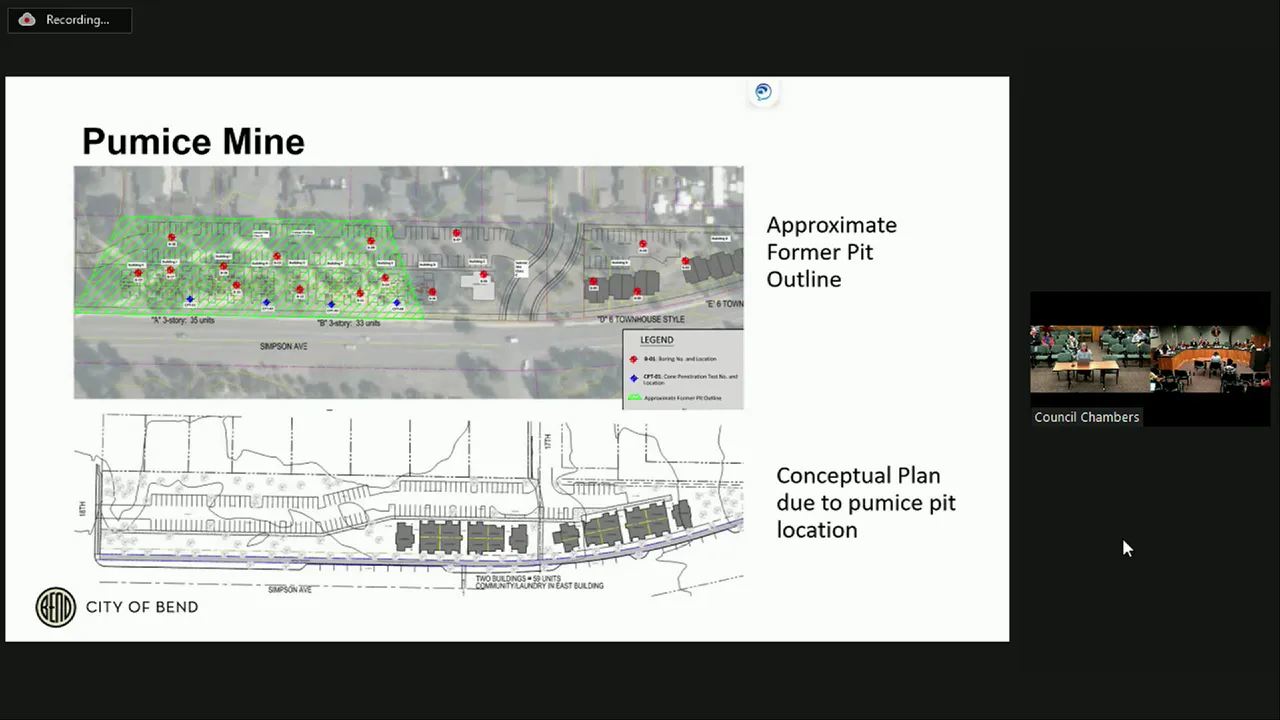
- Ferguson Annexation (Item 8): Staff presented the annexation of approximately 40 acres in the Southeast Area, the first annexation within the Southeast Area Plan. The property is zoned medium-density residential, high-density residential, and general commercial. Conceptual layout shows 138 townhomes, 264 multi-family units, and commercial space. The annexation agreement includes requirements for a 10% open space (3.824 acres), two roundabouts (at 27th/Ferguson and 15th/Ferguson) triggered by development trips, and water/sewer extensions. Council discussed the park district’s request for a park vs. open space, with staff noting that the open space requirement is met and future site plan review will address park negotiations. The applicant stated that parks had been notified of available land to the south for over a year. Council approved the annexation motion (Councilor Méndez’s attempt to condition on a park failed for lack of a second).
- Pettigrew and Bayou Sewer Project (Items 10 & 11): Staff presented a contract with Taylor Northwest, LLC for $1,460,576.55 (36% below estimate) for 3,425 feet of sewer main serving 35 properties in a septic-to-sewer conversion. Construction is scheduled May to September 2023, coordinated with the 15th/Wilson closure. The city also approved a Clean Water State Revolving Fund loan not to exceed $3.4 million at 2.1% interest.
- Right-of-Way Vacations (Items 12 & 13): Council initiated vacation processes for undeveloped portions of Sisemore Road (Skyline West Subdivision) and SW 17th Street (near OSU-Cascades) to clear title issues and enable affordable housing development. Public hearings will be scheduled.
- Behavioral Health Grant (Item 14): Council authorized a $405,000 three-year grant agreement with Deschutes County for an embedded behavioral health specialist at the Lighthouse Navigation Center. The position costs $135,000 annually and is required to access $1.5 million in state grant funds.
- Parkside Place Master Plan and Annexation (Items 15 & 16): Council approved second readings of ordinances creating the Parkside Place Master Planned Development (37.1 acres) and annexing 41.36 acres. Councilor Norris recused due to employment with Hayden Homes. The vote was 4-0.
- City Manager’s Report: King outlined administrative policies for the new camping code, emphasizing education and proactive enforcement. He reminded the public to use navigation apps during construction detours (Neff/Purcell, 15th/Wilson).
Key Outcomes
- Consent Agenda approved.
- Cooley Road Annexation (Items 6-7) approved unanimously: ordinance for first reading of annexation of 1.9 acres and resolution for jurisdictional transfer from Deschutes County.
- Ferguson Annexation (Item 8) approved 6-0 (Councilor Méndez voted in favor after his conditional motion did not receive a second).
- Pettigrew and Bayou Sewer Project (Items 10-11) approved: contract with Taylor Northwest for $1,460,576.55 and CWSRF loan up to $3.4 million.
- Right-of-Way Initiation for Sisemore Road (Item 12) approved: public hearing to be scheduled.
- Right-of-Way Initiation for SW 17th Street (Item 13) approved: public hearing to be scheduled.
- Behavioral Health Grant Agreement (Item 14) approved: $405,000 over three years to Deschutes County.
- Parkside Place Master Plan and Annexation (Items 15-16) approved 4-0.
- Property Purchase (Councilor Broadman’s motion): Council approved purchasing 174 NE Franklin Avenue for $750,000, with lease-back to current occupant for up to three years at $44,034 annually.
Council Reports
- Councilors reported on committee meetings including COIC, SDC stakeholder group, Core Area Advisory Board, accessibility advisory committee, MPO policy board, transportation bond oversight, and the Community Building Subcommittee. Councilor Riley attended an adult treatment court graduation. Councilor Norris visited the Stepping Stone Shelter dedication. Councilor Campbell noted escalating costs for the GO bond projects. Councilor Méndez highlighted MPO COVID relief funds for transportation. Mayor Kebler met with Redmond Mayor and testified on state housing and tree bills.
Meeting Transcript
Okay. All right, we're ready to begin our work session. Start with the budget review. Hi, hello, Janet Townsend, um, the finance director here at the city, and my pronouns are she and her. I'm gonna give you an update on our 2023-2025 biannual budget development process. Um, gonna give you uh just a brief update of kind of where we're at in the process, um, then cover some revenue and expenditure trends that we're seeing that are um uh impacting the upcoming biennium, uh, and then uh do a little bit of an overview on our general fund. See it moved again. Sorry, my presentation keeps keeps moving, and I swear I'm not touching it. Um and then um uh uh hand it off um to Eric who's gonna cover the council goal portion of the presentation. So where we're at uh in the process uh is uh our our process for our biennial budget development, so every two years really starts in the November time frame, goes all the way to June, and um really starts with the beginning that kind of budget process of of what we call our baseline budget, moves into council goal setting, which is the part that we are in right now. Um and um and then uh where we are at is uh really in that February March, that third box down, which I think optimistically has some tulips possibly. Um again, my presentation's jumping, I'm not sure how. But um uh but uh tulips, which we I think we're more like the picture up above right now, so I'm really hoping we actually get those tulips um to come up soon. But um the uh February March time frame is really when we incorporate council goals and priorities into our baseline budget. Um we do some review um as well uh and prepare the budget document uh and begin deliberations in the May and June with approval in the June time frame. So uh pivoting at this point to revenue and expenditure trends, giving you a brief update of where we're at in fiscal year 2023. So remember our fiscal year runs from July of every year to June. So this would be the period from July of 2022 uh through what we're projecting uh to be in June of 2023. Um so we are we've got about um these projections are based upon uh the January numbers and are um then essentially have actuals in here uh for seven of the months um and five of the months are a projection. The way that this graph is set up is um the zero line um is kind of the fourth or fifth line over. You can see um that uh items on the right-hand side, um, bars that are on the right hand side of the graph are are uh where we uh expect or project to come in ahead of budget, and the bars on the left hand side of the graph are where we expect to come in less than our budget or our forecast. Um so just kind of giving you a bit of the highlights which are in the bullets on the right hand side. Um our uh total assessed value, which is that top line of property taxes is coming in in line with our assumption. So it's um certainly uh the bulk of the revenue from a dollar standpoint is really that top line. Um and and most of that is on track and in line with our assumption. Room tax is coming in stronger. It was it was it was actually quite a bit stronger for the first five months of the year, but we did see lower collections in December and January and thus have adjusted our forecast out for the rest of the month to be consistent with that little bit of a lower trend. Gas tax has remained strong and um and and we do expect that to end ahead of the year. Starting with water SDC, sewer STC, transportation SDC, and then our in the kind of in the middle of our graph is the building planning and engineering. Each of those are highly dependent upon our development, you know, kind of community and activity in the city because each of those are fees that are assessed when houses or or other developments are built. And we are seeing some lower development activity, which is I think in line with a lot of what we're seeing and hearing around the kind of broader economic trends, particularly around interest rates and some other things that are causing some headwinds in that particular environment. And we're seeing the results of that. So overall, um, we're really seeing quite a bit of revenue pressures, um, modest kind of revenue growth forecast. I'm gonna have a slide a little bit later that goes through a bit more of these around kind of property taxes, but even population for the Bend area. Um, we use some uh state forecasts and and other figures that are really projecting something in kind of the modest growth range of uh, you know, kind of 2% range or so from a population standpoint, um uh property taxes and and the like are also uh projected to be fairly modest kind of year over year. We also are seeing some possible headwinds, um, like I just talked about with the housing and development uh activity slowing down, um, and it's really difficult to predict how those trends are going to translate to Benz. Benz sometimes can be in a bubble uh and um and and and trends that are in the larger even state kind of economic environment don't always translate to um to to exactly what we see. So it makes it really interesting to forecast revenue for two years out, which is really at this point kind of two and a half years out, if you think about it, right? I'm projecting all the way through to June of 2025 at this point. So you know, I think what what we tend to do is is really take what we think is an appropriate line on the trends, uh you know, something that is um you know not too aggressive, not too conservative. It's the it's the um, you know, it's the it's the middle version and uh the Goldilocks zone a bit, and uh and um it but you know each of those things come they are predictions in and of themselves uh and come with uh quite a bit of um estimation to them. I think this is also a helpful graph. Um it's it's one that you may remember seeing as part of the conversation around the transportation utility and the transportation funding conversation that happened at the work session two weeks ago. Um, and I think it's a really helpful one because the the kind of green line or the line that's on the top here is really the market value or kind of the price of your home if you want to think about it that way, or the price of any kind of developments, really that market value, what you could sell it for theoretically, right, is really that kind of green line. But our property taxes are assessed really on that kind of purple line down below. So you can see that really that green line is where we all live, right? It's where the people who work for the city live, it's where the city's kind of expenditures largely live, right? Um, if you think about the inflation and the and the things that we've been seeing, not just on housing, but in our larger kind of economic environment, particularly with the kind of the uptick that you're seeing in that 2021-2022 and that sharp kind of increase from 2022 to 2023, that's really uh indicative of where our expense line is going and where all of us in our personal pocketbooks are expense line is going, right? No different than it is for the city. Whereas our property tax revenue, which is a significant portion of our funding source, um, particularly for the general fund, um, it lives on that on that line that doesn't increase.
openpublica.com