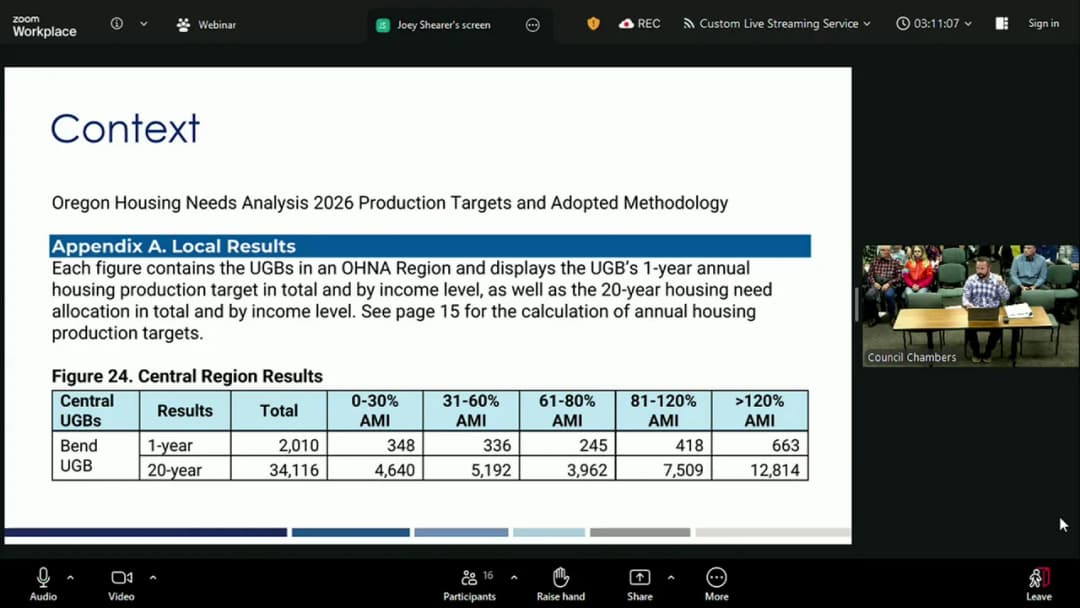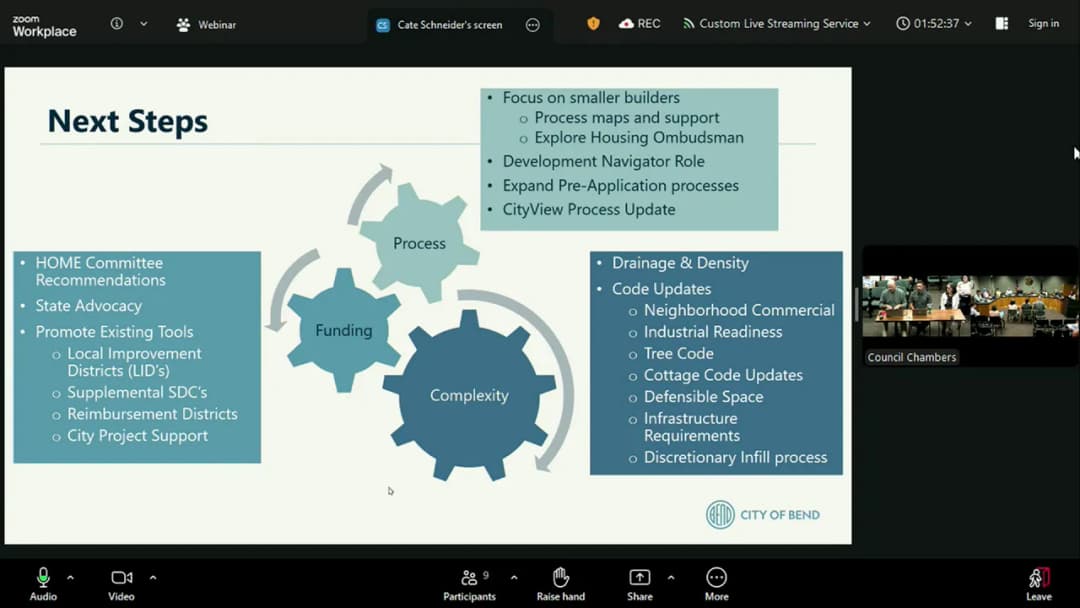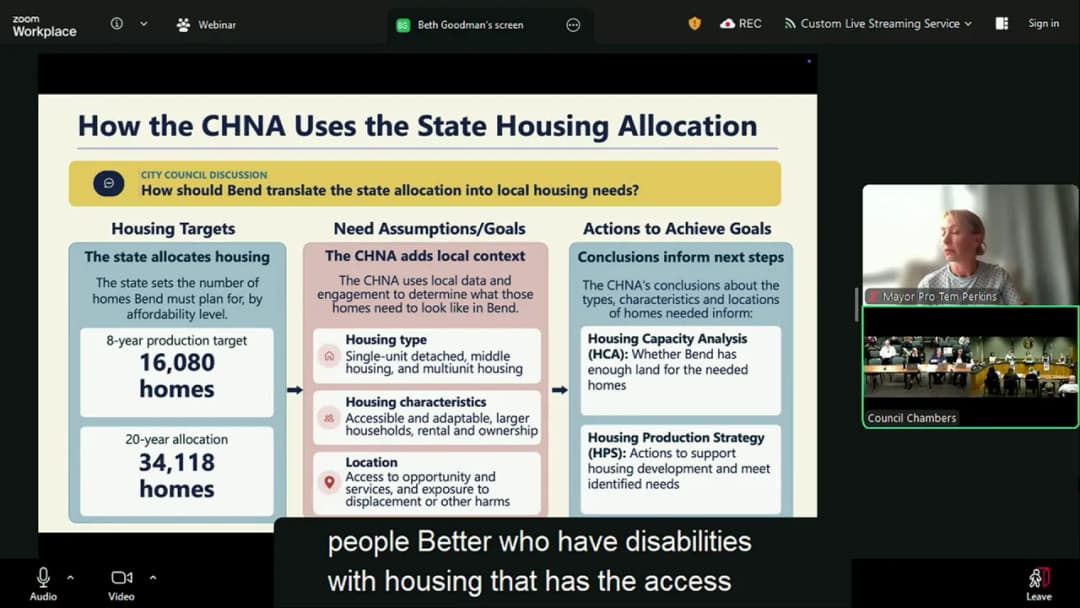
The Bend City Council held a Bend Made work session on October 28, 2026, to review the contextualized housing needs analysis and the economic opportunities analysis. Staff from growth management, economic development, housing, legal, and consulting presented data and safe-harbor options and asked the Council for planning direction. Councilor Mike Riley was excused. Public comment was not taken and no formal votes were cast; direction was given by consensus. The agenda listed the meeting as a 4:00 p.m. work session. Housing Needs: Process and Data - The work is part of the Bend Made growth management process. Staff recapped the timeline: September workshops launched visioning; large visioning workshops were moved to January through April and will occur about every two weeks; targeted engagement with service providers, affordable housing providers, residents, and high school students continues; joint committee working group appointments are expected in November; and the next Council touchpoint is January 20. - The September workshop summary was not posted in the packet; staff said it will be provided to the Council and reviewed on January 20. - The contextualized housing needs analysis will identify need by housing type, housing characteristics, and location, with emphasis on communities of color, low-income households, people with disabilities, and tribal communities. A community survey closed October 19; staff conducted about two dozen one-on-one conversations; tribes were notified. - Staff described the state housing allocation in three horizons: a 20-year allocation, an eight-year target of about 16,000 units, and a front-loaded one-year target of about 2,000 units. About 46% of the eight-year target is for households below 80% of area median income. - About 43% of Bend households have income above 120% of area median income. Staff said the analysis focuses on households below 120% of AMI and especially below 80% of AMI. - At 80% of AMI, a four-person household earns $96,000 and can afford about $2,400 per month in housing costs without being cost burdened. The typical home value of $738,000 becomes affordable around 85% of AMI; average two-bedroom rent is affordable just below 80% of AMI, while three-bedroom rent becomes affordable above 80% of AMI. - About 28% of Bend workers work from home, tending to be white-collar workers. Preliminary findings include housing costs outpacing local wages, a need for a broader mix of housing types and sizes, more middle housing, and fair housing issues such as discriminatory screening and weak enforcement. Housing Safe Harbors and Council Direction - Housing type: Staff recommended the state safe harbor of 40% multi-unit, 20% middle housing, and 40% single-unit detached, with the multi-unit and middle housing shares as floors. Councilors accepted the mix, while noting middle housing production would need to be roughly double recent trends and that some developers favor smaller detached units. Councilors agreed the how is a housing production strategy question, not a needs question. - Homeownership: The state safe harbor would apply a 66.7% ownership share and produce about 4,957 ownership units below 80% of AMI and about 5,700 above 80% of AMI. Existing ownership rates are about 46% below 80% of AMI and 69% above 80% of AMI. Staff recommended an alternative approach using AMI bands: substantial need from 60 to 120 percent of AMI, more limited need from 30 to 60 percent, and a below-30 percent band focused primarily on stable rental and supportive housing. Councilors supported the alternative, cited a Habitat for Humanity letter showing about 40 buyers under 60% of AMI over five years, emphasized homeownership as a path to generational wealth, and noted the subsidy trade-off: about $77,000 per ownership unit versus about $9,000 per rental unit. - Accessible housing: Staff recommended the safe harbor, which uses the ambulatory disability rate multiplied by 1.2 and translates to about 1,150 new accessible units over eight years, or about 145 per year compared with about 34 per year currently. Council agreed. - Adaptable housing: Staff recommended not using the safe harbor because it would require about 4,358 adaptable units. Instead, staff will use local data, count adaptable units already required in new multi-unit housing, and address retrofitting and aging in place. Council agreed. - Larger units: Staff recommended not using the safe harbor, which relies on family-household share and would classify about 61% of units as needing three or more bedrooms. Instead, staff will use household size, target about 16.9% of new rental units as three or more bedrooms, and plan for smaller ownership units and middle housing. Council agreed. Employment Needs Analysis and Growth Rate - The economic opportunities analysis is part of Goal 9 planning. Bend is a regional employment center with about 63,000 covered jobs in 2024; the six largest sectors account for about 70% of employment, with health care largest. The average wage is about $69,000, with health care, professional services, government, and construction above average and retail, accommodation, and food services below average. - From 2007 to 2024, Bend added nearly 18,000 jobs, about 2% annual growth. Health care accounted for about one-third of the growth. Jobs grew about 40% while population grew about 35%. - The EOA builds on Bend's target sectors: recreation and tourism, health systems, build for growth, and technology and innovation. - Staff presented three planning assumptions: the Oregon Employment Department regional rate of 0.68%, the Portland State University population forecast of 1.37%, and Bend's historical employment growth rate of 2%. The first two are state-recognized safe harbors; the 2% rate would require additional justification. Staff recommended the 1.37% PSU rate as a balanced, defensible assumption. - Council discussion noted Bend has roughly 50% of the county's population but about 65% of county jobs. Councilors supported the 1.37% middle path, noting it is a safe harbor and that the buildable lands inventory will help compare future employment land supply with projected needs. Staff also acknowledged that the prior UGB expansion oversupplied employment land and that some sites, such as Juniper Ridge, developed slowly due to infrastructure timing. Key Outcomes - Council directed staff to use the safe harbor for housing type and for accessible housing. - Council directed staff to develop alternative approaches for homeownership, adaptable housing, and larger units, with more detailed proposals to return on January 20. - Council indicated support for using the PSU 1.37% employment growth forecast as the planning assumption. - Next steps include finalizing joint committee appointments in November, holding visioning workshops from January through April, and returning to Council on January 20.
Public Meetings - Bend, Oregon
Public Meetings - Bend, OregonThe Bend City Council convened on October 21, 2026, for a business meeting that was largely devoted to the mass shooting at Silver Rail Elementary School on October 15, 2026. The council issued a joint statement, received detailed briefings from emergency management and school officials, and heard extensive public testimony. The meeting concluded by approving consent agenda items and a resolution regarding a shared framework with Bend Park & Recreation District. A notable discrepancy in the source material involves the consent agenda: the agenda listed minutes for approval, but the minutes document provided stated "[No minutes available]". Discussion Items - Supporting Silver Rail Elementary: The council dedicated the first hour of the meeting to the tragedy. Mayor Pro Tem Perkins read a joint council statement expressing grief for the four victims, honoring first responders, and pledging action on gun violence and mental health. Individual councilors echoed the commitment to preventing future tragedies, with one stating, "we cannot let this happen again." - Police Chief Update: Chief Krance reported that the investigation remains active, involving 180 calls to 911 in the first 60 minutes, ongoing search warrants, and witness interviews. He confirmed the firearm was legally purchased. Regarding school safety, he stated that placing a School Resource Officer at every campus was "not something we can accomplish" and emphasized the SRO role is mentoring rather than dedicated armed security. - School District Update: Superintendent Cook reported that 32 of 33 district schools reopened with attendance near normal levels. The Family Assistance Center served roughly 870 people. Cook stated that all options for the future of Silver Rail Elementary, from demolition to rebuilding, are under consideration and will heavily involve community input. - Community & Emergency Response: Sarah O'Neill from the Bend Chamber detailed the outpouring of business support, including free meals, activities, and fundraising. Emergency Manager Carl reported that the Family Assistance Center involved over 240 volunteers supporting nearly 900 individuals and outlined continuing mental health resources and donation options. - Shared Framework Resolution: Councilor Franzosa requested the resolution be pulled from the consent agenda for discussion. The council unanimously adopted the resolution establishing a Shared Framework with the Bend Park & Recreation District for collaboration on affordable housing, recreation, and community vitality. Consent Calendar - The council voted unanimously to approve the consent agenda. This included the August 2026 Monthly Financial Report, authorization of a construction contract for the Pressure Reducing Valve and Galveston Corridor Projects, and an approval of the City of Bend Census Comment Letter. Public Comments & Testimony - During the Visitors Section, speakers focused on school safety and accountability regarding the Silver Rail shooting. - Catherine Cartwright and Tracy Martin called for Mayor Kebler's resignation, alleging that prior council decisions and a staffing study identifying SRO deficits were ignored, directly contributing to the lack of protection at the school. - Todd Pryor defended the council and Superintendent Cook, arguing that criticizing leadership during the tragedy was counterproductive and urging the community to build roots and listen rather than demand removals. - Benjamin Roberts advocated for allowing trained teachers and administrators to carry concealed weapons on campus to provide an immediate defense for students. - Michelle Hill, a survivor of a previous school shooting, shared her experience and urged the city to fund dedicated, full-time SROs at every school, emphasizing the need for proper training in de-escalation and adolescent development. - Trey Heiss, a parent of a student at Silver Rail, called for immediate physical security upgrades, independent third-party safety assessments of schools, and a dedicated private meeting for affected families with the council and district. - Amanda Romandia and Marissa Adams asked the council to prioritize statewide funding for school safety and to work with the school district to create a concrete action plan. - Bernadette Strome and Jenny Lingard questioned the council's budget priorities, stating that millions in federal funding for school safety were not pursued and that local dollars were spent on projects other than the recommended four additional SROs and patrol officers. - Ben Lysoid proposed the city implement gun buyback programs and subsidize gun safes to reduce youth access to firearms. - Kyle Lindquist and Brittney Lindquist demanded accountability, with Brittney asking who was specifically responsible for school security and why no leadership changes had occurred in the wake of the tragedy. Key Outcomes - Consent Agenda Approved: The council unanimously approved the consent agenda. - Shared Framework Resolution Adopted: The council unanimously adopted the resolution formalizing a collaborative framework with Bend Park & Recreation District. - Fee Waivers Authorized: The council granted the City Manager authority to waive fees, fines, and other charges for families and students directly impacted by the Silver Rail tragedy. - Public Input Received: The council received a significant volume of public testimony demanding immediate action on school security, accountability for past decisions, and a clear timeline for implementing safety measures.
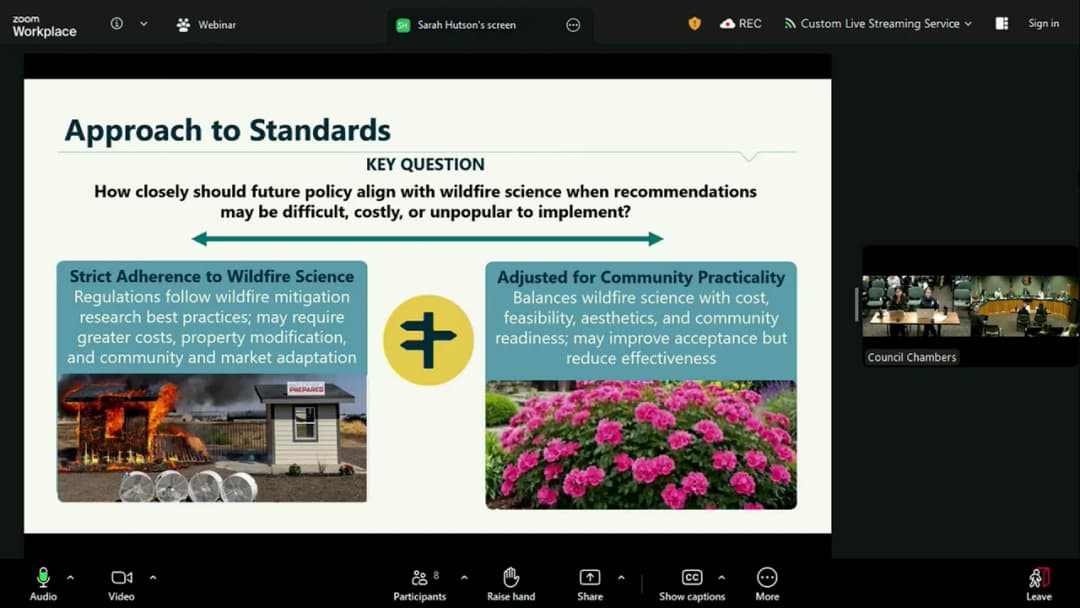
The Bend City Council held a work session on October 14, 2026, covering four major topics: a comprehensive update on the city's wildfire resiliency strategy including a proposed defensible space code; updates to the city's fiscal policies; a discussion on funding affordable housing projects via the Juniper Ridge Land Sale Reserve Fund; and the findings of a market analysis on neighborhood-serving commercial development. The session was focused on discussion and direction-setting, with no formal votes taken. Wildfire Resiliency: Defensible Space Code - Sarah Hudson and Deputy Fire Marshal Melissa Steele presented the status of wildfire preparedness efforts, noting that 2026 was the largest fire season on record in Oregon with over 2.5 million acres burned. - The state of Oregon has released a finalized model defensible space code, but no jurisdiction has adopted it yet. City staff proposed a suite of potential code updates for new construction and existing development, including rules for the first five-foot immediate zone, non-combustible fencing, firewood storage, and fuel breaks. - Council members largely expressed support for a long-term goal of adopting a community-wide defensible space framework. Councilor Riley advocated for a broad approach with community agreement within three to five years. - Councilor Platt proposed launching a pilot project targeting a high-risk neighborhood before the next fire season by reprioritizing existing city funds and leveraging volunteers. Mayor Pro Tem Perkins and Councilor Franzosa stressed the need for significant community engagement and equity considerations before implementing a citywide code. - Staff will develop two parallel work streams: scoping a citizen assembly or similar engagement process for long-term policy development, and identifying a targeted pilot area for immediate fuel mitigation efforts. Fiscal Policy Update - CFO Samantha Nelson reviewed proposed updates to the city's fiscal policies, which included formatting and language simplifications. - A key substantive change proposes directing 20% of street preservation funding toward bike, pedestrian, and traffic safety projects. Councilor Riley suggested simplifying the language to a direct target and requiring an explanation for any deviation in the biannual budget document, a suggestion staff supported. - Another change would shift the approval of Full-Time Equivalent (FTE) positions from the City Council to the City Manager, tying new FTEs to the adopted personnel budget. Councilor Méndez raised concerns about the permanence of FTEs versus Limited Term Employees (LTEs), and staff clarified the operational nuances. - The city will begin providing quarterly financial reports to council for improved oversight. Juniper Ridge Land Sale Reserve Fund (TAHA/BURRA Loan) - Staff presented a request from the Bend Urban Renewal Agency (BURRA) for a loan from the Juniper Ridge Land Sale Reserve Fund to cover Bend Park and Recreation District (BPRD) System Development Charges (SDCs) for four affordable housing projects. This request arose after a Boley prevailing wage ruling altered the financial landscape of the city's Tax Increment Financing for Housing Affordability (TAHA) program. - The total request for all four projects was estimated at $6.3 to $6.8 million, while the available balance in the land reserve fund is approximately $5 million. - Council members expressed a preference for supporting the two projects currently under construction (Breda Ridge and Emblem) with a loan of approximately $3.1 million, rather than committing to all four projects. - Mayor Kebler emphasized the partnership aspect, noting developers relied on the TAHA program in good faith. Councilor Méndez requested detailed pro forma data, including current rents, to evaluate the value of the affordable units being purchased. - Staff was directed to bring back a formal loan proposal for the two projects under construction, incorporating additional requested financial information, for a decision at a subsequent meeting. Neighborhood-Serving Commercial Market Analysis Update - A consultant from Place Dynamics presented findings from a market analysis. The report found that Bend is well-served by commercial retail but lacks traditional neighborhood commercial centers due to land use patterns developed along highway corridors. - A key finding was that grocery shopping is heavily influenced by brand and price rather than proximity, with residents frequently driving past nearby stores to reach a preferred store. The Core Area (specifically the Hawthorne Avenue corridor) was identified as a primary opportunity for new neighborhood commercial development. - Discussion centered on fostering smaller-scale commercial nodes by creating more permissive zoning and building residential density near existing commercial hubs like Juniper Ridge. Councilor Riley inquired about expediting code changes in specific areas, but staff cautioned that broader zoning changes could trigger comprehensive plan issues. - The analysis was received as informational. Staff will use the findings to inform the upcoming Ben-Made comprehensive plan update and will continue conversations with developers interested in neighborhood-scale projects. Key Outcomes - Wildfire Resiliency: Council provided direction to explore two parallel paths: a community engagement process for developing a long-term defensible space code, and a targeted pilot project for fuel mitigation before the next fire season. - Fiscal Policy: Council expressed support for the staff proposals with a direction to clarify the 20% street fund target language. Formal adoption will occur at a future business meeting. - Juniper Ridge Land Fund (BURRA Loan): Council directed staff to prepare a formal loan proposal for the two affordable housing projects currently under construction, including a request for updated financial data from the developers. A decision is expected in a subsequent meeting. - Commercial Market Analysis: The analysis was received as informational, to be used in the upcoming comprehensive plan update and ongoing developer outreach.
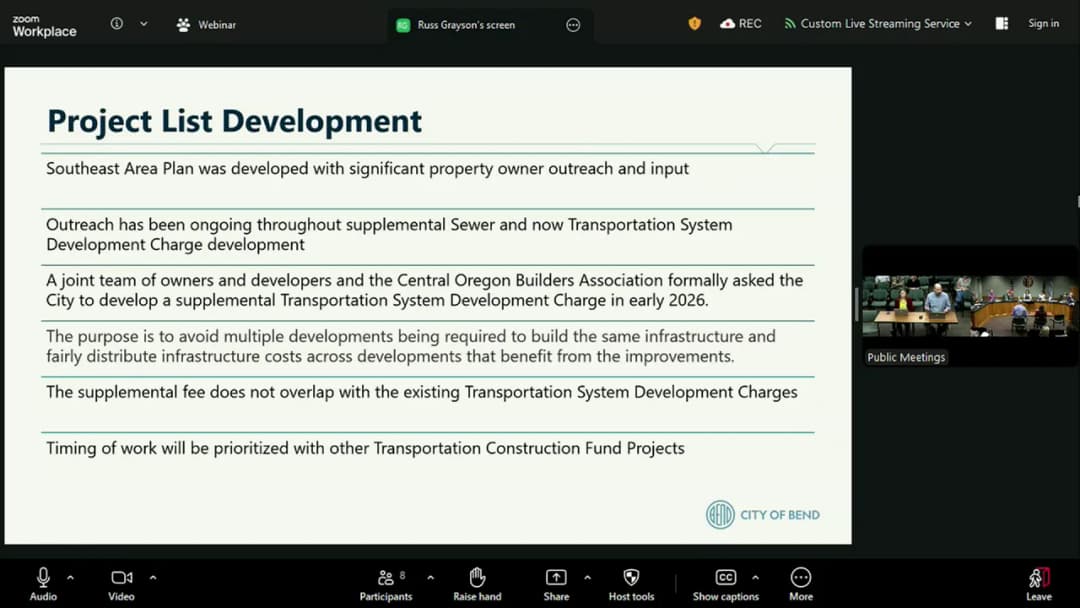
On October 7, 2026, the Bend City Council held a 5:00 p.m. executive session followed by a 6:00 p.m. business meeting in Council Chambers at Bend City Hall, 710 NW Wall St. The executive session was held under ORS 192.660(2)(h) to consult with legal counsel about litigation and ORS 192.660(2)(e) to discuss real property negotiations; no decisions were made in executive session. Mayor Melanie Kebler presided, with Mayor Pro Tem Megan Perkins and Councilors Ariel Mendez, Mike Riley, Megan Norris, and Steve Platt present; Councilor Gina Franzosa was excused. The Council issued the Lights Out for Bird Migration proclamation, heard public comment about Sunday transit, approved the consent agenda, adopted a Southeast Area supplemental transportation system development charge (SDC), reestablished the Century West Neighborhood District, adopted two ordinance amendments, and received the city manager's report. Proclamation and Council Action & Reports - Councilor Platt read a proclamation declaring Lights Out Bend, noting that Oregon has the sixth-highest bird species total in the United States, more than one billion birds die annually from building collisions, North America's bird population has declined by 30% since the 1970s, and the Lights Out program has been shown to reduce bird mortality by 70%. The Council accepted the proclamation unanimously. - Molly Honia of Think Wild, Bend's Wildlife Hospital and Conservation Center, expressed support and said Think Wild has admitted more than 400 birds due to window strikes since 2021, including 91 this year across 38 species. - Barb Rumer of the East Cascade Bird Alliance and Bend Night Sky Alliance expressed support and noted that 15 community organizations co-signed the Lights Out initiative. - The Mayor reported that the Council was joining a U.S. Conference of Mayors letter to protect Head Start programs and submitting a comment to HUD to protect proven methods of serving people experiencing homelessness. - The Council unanimously appointed Wayne Moter as an alternate to voting member on the Environment & Climate Committee. - Council reports highlighted Habitat for Humanity's affordable housing groundbreaking, police and airport updates, climate action partner grants, the Children's Museum (24,000 people served since 2024; planned 6,000 sq ft indoor and 3,000 sq ft outdoor space), the small business assistance grant program ($130,000 available, with 77 applications requesting $2.1 million), Welcoming Week, NAMI Central Oregon's suicide prevention event and the 988 crisis line, an accessibility walk-and-roll tour with about 40 participants, a Central Oregon Builders Association development tour, and plans for a joint city-county meeting. Public Comments & Testimony - Joyce Nichols, a Bend resident who is partially blind, asked the City to fund Sunday Dial-A-Ride service. She said Cascades East Transit canceled Sunday Dial-A-Ride on September 6 due to budget shortfalls, that the service costs about $2,000 per Sunday, and that disabled riders need it to reach churches, jobs, and community. She said she counted 10 churches served by the bus route and described losing the service as isolating and harmful to mental well-being. No other public commenters were present. Consent Calendar - The Council approved the consent agenda unanimously. It included: - Meeting minutes from the 08/31/2026 Developer Round Table and the 09/02/2026 Business Meeting - A brand name exemption determination for APG-Neuros Turbo Blowers for the Turbo Blower No. 6 Project - A Bend Enterprise Zone property tax exemption agreement with Lonza Bend Inc. for new capital investment for up to ten years - An Owner's Representative contract with DOWL, LLC for the Reed Market Bridge Project not to exceed $999,884.50 - An amendment to Clean Water State Revolving Fund Loan R14529 with Oregon DEQ, increasing the loan by $300,000 to a total not to exceed $2,000,000 - A construction contract with Deschutes Construction Corporation for the Central Oregon Villages Site Preparation Project not to exceed $299,184 - Amendment No. 2 to the Intermediate Construction Contract with Central Service, Inc. for the 1st Street Fueling Station Decommissioning Project, increasing the not-to-exceed amount by $16,860 Discussion Items - Southeast Area Supplemental Transportation SDC Public Hearing: - Councilor Mendez declared an actual conflict because the item would have a financial impact on his employer, Hayden Homes, and did not participate in the discussion or vote. - Staff said the supplemental SDC was requested by property owners and developers working with the Central Oregon Builders Association. The Southeast Area Plan includes approximately 122 acres of residential land, 103 acres of employment land, and 67 acres of commercial land. - The identified project costs total $13.33 million, up from the previously shared $11 million amount, and include a $4 million roundabout at 27th and Caldera, a $2.5 million internal roundabout, and a $6.83 million road improvement whose outside half is covered by the citywide transportation SDC. - The methodology results in a fee of $3,323 per PM peak-hour trip, plus compliance and administrative costs, for a total of $3,389 per PM peak-hour trip. The fee does not overlap with the existing citywide transportation SDC and would be adjusted annually for inflation. - Councilor Riley noted that the development community was asking for the supplemental SDC despite a roughly 30% increase in SDCs and said he was for it, describing it as the cost of development. Staff noted the fee helps developers avoid paying for major improvements as an initial capital outlay and instead pay as permits are pulled. - Councilor Mendez asked whether the methodology could be amended later; staff said amendments are possible but would require the same notice process, and outside funding sources must be accounted for and could require reducing the fee. Mendez also questioned the use of PM peak-hour trips as the basis for traffic modeling; staff said that approach follows current adopted plans and could be revisited in the Transportation System Plan and the Bend Made comprehensive plan process. - An email of questions from an adjoining neighborhood HOA arrived about 30 to 40 minutes before the meeting and had not been fully reviewed; staff said it appeared the project list and fee table were substantively correct. - No one signed up to speak at the hearing. The Council adopted the resolution on a motion by Councilor Riley, seconded by Councilor Platt. - Century West Neighborhood District: - Staff introduced the community effort led by Jenny Sutton to reestablish the Century West Neighborhood District. The district has created bylaws and identified new board members, including an operating chair and a land use chair, and planned to participate in the neighborhood round table on Monday, October 12. The Council adopted the resolution reestablishing the district unanimously. - Real Estate Contract Ratification: - The Council ratified the vacant land real estate sale contract dated July 15, 2026, with Brian and Mindy Howe for 530 Southeast 3rd Street in the amount of $1.2 million, authorized a 30-day extension of the due diligence period, and directed staff to take steps necessary to close the purchase without further Council approval. The motion was made by Councilor Riley, seconded by Councilor Platt, and approved unanimously. - Second Reading: BMC Chapter 12.10 SDC Ordinance: - The Council approved the second reading and adoption of the ordinance amending Bend Municipal Code Chapter 12.10, System Development Charges, on a 6-0 roll call vote. - Second Reading: BMC Chapter 9.50 Signs Ordinance: - The Council approved the second reading and adoption of the sign code amendment on a roll call vote; Mayor Pro Tem Perkins voted no. The Mayor said she voted yes because there were four votes in support. - City Manager's Report: - The city manager reported that the Franklin underpass site is active, several sewer and waterline projects are wrapping up for the winter, and striping is planned as weather allows. - On traffic diverters, he said the pilot program is about six months into a two-year project. The Lava Avenue and Delaware Avenue intersection has drawn the most comments, including concerns about safety, cut-through traffic using alleys, and vehicles driving over curbs or ADA ramps. Staff recommended evaluating conversion of the diverter to a small traffic circle, with keeping or removing it as other options. A change would likely occur in early 2027 after neighborhood engagement. One councilor suggested removing it now and returning later with a new solution, and staff was open to working with the neighborhood on that approach. - The neighborhood round table is scheduled for Monday, October 12, at OSU-Cascades Ray Hall at 5:30 p.m. Key Outcomes - Accepted the Lights Out for Bird Migration proclamation. - Appointed Wayne Moter to the Environment & Climate Committee. - Approved the consent agenda. - Adopted the Southeast Area supplemental transportation SDC resolution; Councilor Mendez recused. - Reestablished the Century West Neighborhood District. - Ratified the 530 SE 3rd Street sale contract and authorized a 30-day due diligence extension. - Adopted the BMC Chapter 12.10 SDC ordinance, 6-0. - Adopted the BMC Chapter 9.50 Signs ordinance; Mayor Pro Tem Perkins voted no. - Directed staff to evaluate the Lava/Delaware traffic diverter and engage the neighborhood before changing it.
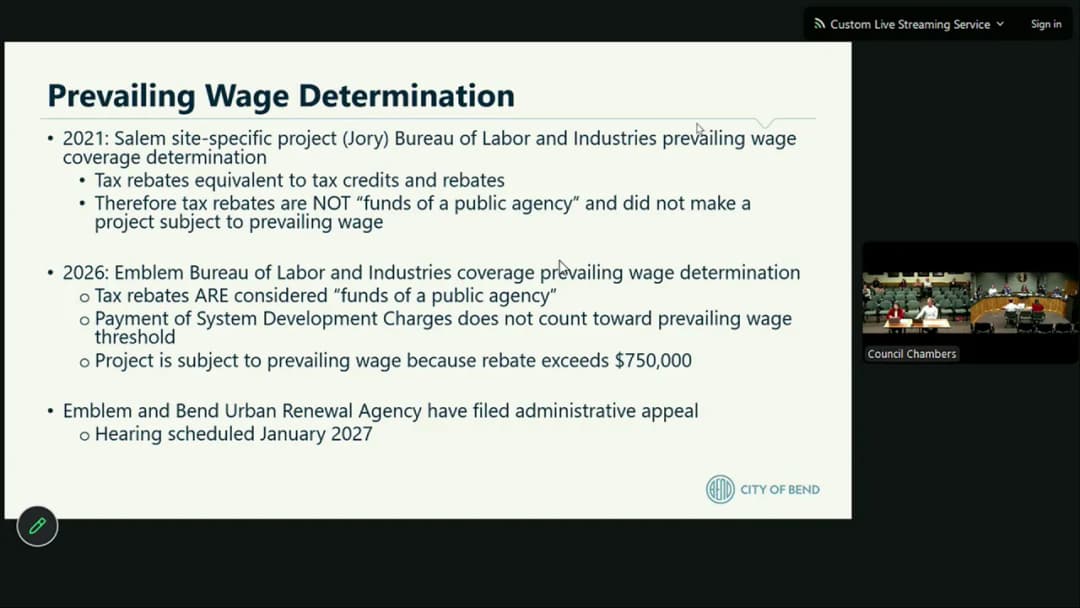
The Bend City Council and the Bend Urban Renewal Agency (BURA) met on September 16, 2026, starting at 6:00 p.m. The meeting included proclamations, council reports, public testimony, first readings on System Development Charges (SDC) exemptions and sign code amendments, authorization for a property purchase and bond issuance, discussion of 2027 state legislative priorities, and second readings on the Caldera Ranch development and repeal of an Economic Improvement District. The BURA portion covered approval of loan and grant programs, initiation of a conceptual plan for the Bend Central District, an update on Tax Increment Assistance for Housing Affordability (TIAP), and a project update on the Joule development. Consent Calendar - Approved the July 2026 Monthly Financial Report. - Adopted a resolution extending the Houseless Services Grant Program through June 30, 2027, adding funds. Public Comments & Testimony - Michelle Monroe (Bend resident) asked council to remove a sentence from the 2027 legislative priorities supporting "responsible technologies," citing concerns about surveillance expansion, data privacy, and misuse of Flock camera data. - Madison Bordeaux (Bend resident) echoed concerns about the same sentence, arguing it authorizes broad surveillance without specifics or public oversight, and requested a separate council vote before advocating for such technology in Salem. - Dr. Ali Boudreau (Woodside Ranch) opposed the Caldera Ranch development, stating the application is incomplete, the traffic study is obsolete, and the site sits on two former cinder mines. He requested a full geotechnical review before approval. - Jennifer Jones (Woodside Ranch) urged council to abandon the Caldera Ranch plan, citing incomplete application, outdated traffic analysis, fire evacuation risks, and a city error on housing minimums. - Ricardo Waits (Bend resident) criticized the city's equity infrastructure, citing the resignation of the equity director, lack of response to a March letter from BIPOC community organizations, and called for a real meeting on equity. - Jonathan Bim (apparent speaker, name from transcript) opposed expanding surveillance technologies, noted that Axon has not met state audit requirements, and argued that without technical safeguards, the city is building a surveillance network that could be misused. - Garth Finley (North Coast States Carpenters Union) opposed staff direction to avoid triggering prevailing wage on publicly subsidized affordable housing, claiming it perpetuates worker exploitation and wage theft. - Chris McGee (carpenter, North Coast States Carpenters) argued that avoiding prevailing wage undermines worker community and allows labor brokers, asking council to direct staff to prevent exploitation. - Joe Weinmiller (Bend resident, carpenter) supported prevailing wage, stating it allows workers to afford to live where they build, and also opposed expanding surveillance without clear limits. Discussion Items - First Reading of SDC Exemption Ordinance (Item 5) – Staff proposed a five-year, core-area-wide exemption of all city SDCs for non-residential projects. Councilor Méndez moved to amend the duration to three years, arguing it would be easier to pull back if needed. The amendment failed (2 opposed: Councilors Mendez and Riley). The main motion passed (5-2). Council also prioritized three follow-up items: revisiting the SDC credit look-back, reviewing percentage of sales on industrial sites, and creating a shot clock for transportation/water/sewer reviews. - First Reading of Sign Code Ordinance (Item 6) – Council debated whether to allow increased illuminated signs on the parkway. Councilor Méndez expressed concerns about expanding lighted signs, supporting a motion to adopt the package minus the illuminated sign changes (using Alternative Exhibit A). The motion passed (4-3). - Authorize Purchase and Sale Agreement for Conners Property (Item 7) – Staff presented a $17.95 million purchase of two properties on the east side (2965 NE Conners Ave and 1979 NE Tucson Way) to consolidate city administrative offices, reduce costs vs. new construction, and free up downtown land for redevelopment. Council expressed strong support, noting fiscal savings and opportunity for BCD investment. Motion passed unanimously. - Adopt $25M Full Faith and Credit Bond Resolution (Item 8) – To finance the purchase and related improvements. Motion passed unanimously. - Discuss 2027 State Legislative Priorities (Item 9) – Staff presented top three priorities: shelter funding, Deschutes Basin groundwater mitigation, and statewide transportation funding. Council debated the technology bullet ("support expanding allowed uses of responsible technologies that strengthen public safety and service delivery"). After public comment and discussion, council agreed to remove or narrow the language, instead crafting a more specific statement focused on preemption and photo enforcement, with regular updates to council on technology-related bills. Council also asked to strengthen language on no cuts to shelter funding and to consider homeownership opportunities. The LOC ballot priorities were noted. - Second Reading – Caldera Ranch Ordinance (Item 10) – Adopted by unanimous roll call vote, approving the binding conceptual plan and UGB expansion per SB 1537. - Second Reading – Repeal of EID Ordinance (Item 11) – Unanimously adopted. - BURA – Business Development Loan and Property Improvement Grant Programs – Two resolutions adopted unanimously. - BURA – Initiation of Bend Central District Conceptual Plan Process – Approved; Core Area Advisory Board (CAB) to provide guidance. Timeline estimated at 12-18 months. - BURA – TIAP Update – Staff reported on a 2026 BOLI determination that tax rebates trigger prevailing wage, reversing a 2021 determination. Staff recommended front-loading assistance, including parks SDCs, and maintaining the program pause. Council expressed general support for the staff approach, with discussion about appealing the determination and potential legislative action. - BURA – Joule Project Update – Staff reported that the project had been redesigned from 125 to 79 units (100% at or below 80% AMI), with a reduced funding gap. Council directed staff to bring back a resolution for a minor amendment to the Core Area TIF boundary. Key Outcomes - SDC Exemption Ordinance: First reading approved (5-2). Staff to explore follow-up items. - Sign Code Ordinance: First reading approved with Alternative Exhibit A (4-3). - Conners Property Purchase: Authorized city manager to enter into Purchase and Sale Agreement (unanimous). - $25M Bond Resolution: Adopted (unanimous). - Caldera Ranch Ordinance: Adopted (unanimous roll call). - EID Repeal Ordinance: Adopted (unanimous roll call). - BURA Loan and Grant Programs: Resolutions adopted (unanimous). - BURA BCD Conceptual Plan: Process initiated (unanimous). - BURA TIAP Update: Direction given to proceed with staff recommendation; program remains paused. - BURA Joule Project: Staff directed to bring back resolution for minor boundary amendment.
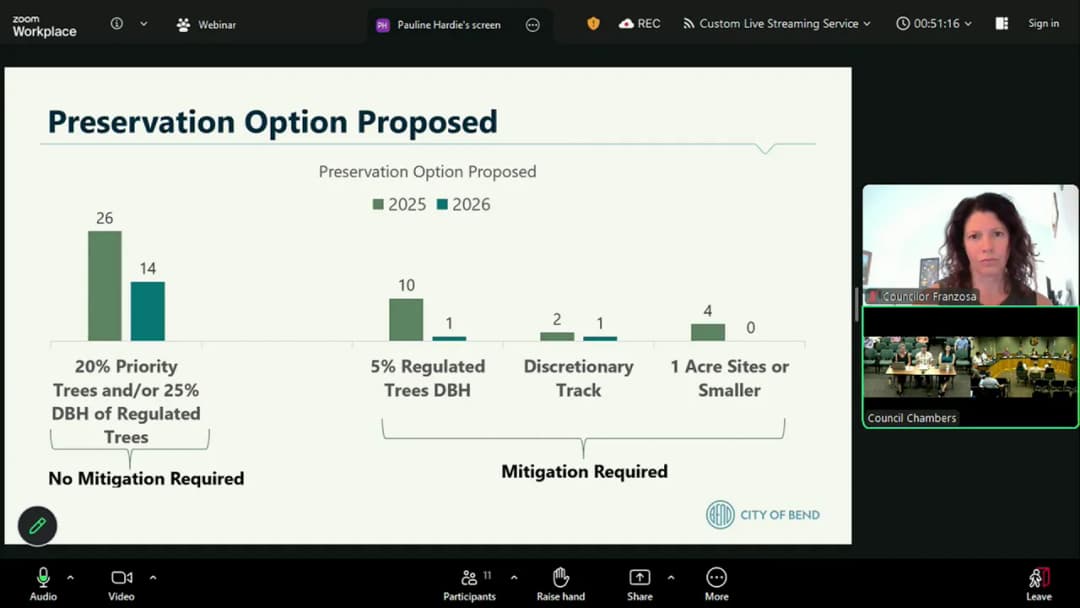
The Bend City Council held a work session on September 9, 2026, beginning at 4:00 p.m. Topics included the annual tree code review and follow-up from the March 11 work session, a recap of the August 31 Developer Roundtable covering employment site readiness and system development charge (SDC) relief, updates on the General Obligation Bond transportation capital improvement program (CIP) – including GO Bond prioritization, the Olney Ave/8th Street intersection, and Greenwood Avenue quick-build data – and the joint City–Bend Park and Recreation District shared framework. Council provided direction on several items and referred others to advisory committees. Discussion Items Tree Code Follow-Up Staff presented data from the first two annual review periods (2025 and 2026). In 2025, 819 housing applications on one acre or less were exempt (95% of total), while 40 land division/site plan applications were subject to preservation standards; in 2026 those numbers were 467 exempt and 15 subject. Most applicants met clear‑and‑objective standards, with only 10 in 2025 and 1 in 2026 choosing the mitigation path. In‑lieu fees collected totaled $63,000 in 2025 and $0 in 2026. Staff proposed two recommendations: (1) Allow fee‑in‑lieu reimbursements for trees voluntarily retained and verified healthy after three years. (2) Expand tree preservation incentives (e.g., reduced setbacks, increased lot coverage) for priority trees on lots one acre or smaller. Staff also sought direction on three items from the March 11 work session: allowing required street trees to count as mitigation, exempting trees in future public rights‑of‑way, and adopting special regulations for western junipers. Council discussion: Councilors broadly supported the two staff recommendations. Mayor Kebler, Councilor Perkins, and Councilor Platt favored counting street trees toward mitigation, while Councilors Méndez, Franzosa, and Riley opposed that change. Councilors agreed not to pursue juniper‑specific regulations. The direction given: advance only the fee‑in‑lieu reimbursement and small‑lot incentive proposals; street‑tree mitigation, right‑of‑way exemption, and juniper changes are not moving forward at this time. Developer Roundtable Recap Sarah Hudson and Cyrus Mooney presented outcomes from the August 31 Developer Roundtable, focusing on two main policy areas. Employment Site Readiness: Three options were discussed for industrial zoned lands: (1) full deregulation of tree preservation requirements, (2) a flat per‑acre fee, and (3) a tiered per‑acre fee based on tree density. Roundtable participants strongly preferred option 1, citing competitiveness and complexity. Council discussion revealed support for option 2 (flat per‑acre fee) as a compromise, with some councilors suggesting a discount if developers exceed minimum greening standards. Council also supported allowing on‑site rock crushing and grading to prepare industrial sites. Direction: staff to bring back a code amendment package incorporating a flat per‑acre fee for industrial lands, along with associated grading/rock crushing allowances. SDC Relief Programs: Two concepts were considered: (a) a time‑limited SDC exemption for non‑residential adaptive reuse projects in the core area (or city‑wide), and (b) an SDC exemption for grocery stores on the east side. Roundtable participants strongly supported the core‑area approach and did not think the grocery store exemption would be decisive. Council directed staff to prepare a five‑year SDC exemption for the core area (beyond the Bend Central District) for eligible projects meeting the minimum development standards review threshold (i.e., tenant improvements, change of use, adaptive reuse). Council asked that an evaluation and capacity analysis be included. The grocery store concept was set aside pending further data from an urban renewal study. Other ideas raised (extending SDC credit look‑back from 10 to 12 years, fast‑track permitting for tenant improvements, etc.) were deferred to the next meeting on September 16 for prioritization. GO Bond Prioritization Ryan Erster and Garrett Sabrin presented the current GO Bond program status. The bond resolution (No. 3218) originally allocated about $180 million to projects; with successful grants the total delivery is now about $244 million. Unallocated funds are estimated at $28.1 million, but staff recommended setting aside $9 million as contingency for four major projects (e.g., Hawthorne overcrossing, Empire–ODOT coordination), leaving approximately $19 million for new commitments. Council discussed priorities for these funds: - Empire Highway 20 / US 97 interchange: Council expressed strong interest in contributing $8–10 million to help build a full connection, contingent on ODOT matching and timely delivery. Staff will invite ODOT to present to TMAC. - Neighborhood Street Safety Program (NSSP): Several councilors supported allocating a portion of the funds to continue NSSP projects through the bond period. - Hawthorne overcrossing connections: Councilor Riley and others noted the importance of completing the bridge landings to catalyze the Bend Central District. - Colorado Avenue improvements: Council directed TMAC to analyze both river‑crossing and parkway‑interchange needs at Colorado, with an emphasis on congestion relief. - Boyd Acres key route: Council asked TMAC to evaluate cost‑effective alternatives to the $13 million preferred option, such as a $3 million option with protected bike lanes. - Council decided to keep the analysis within the six existing bond‑resolution categories to avoid scope creep. Direction: TMAC will develop scenarios based on these priorities and return to council with recommendations, including an “escape clause” if ODOT cannot move forward on Empire within the bond timeline. Olney Ave/8th Street Intersection Carrie Harris and Kayla (DKS Associates) presented a detailed evaluation of a signalized alternative versus a partial multi‑lane roundabout. The signal option would require significant right‑of‑way acquisition (two parcels, $400–500k each) and trigger relocation review, with a total cost of about $5 million. The roundabout option had lower right‑of‑way impacts, preserved existing driveway access, and better aligned with the city’s roundabout‑first policy. Both alternatives would meet future capacity needs for 20 years. The existing intersection is failing for six hours daily; traffic is projected to grow 15–20% over 20 years. Staff recommended the roundabout. Council discussion: Councilors Méndez and Franzosa opposed the roundabout – Méndez called for more holistic measures (transit, demand management), and Franzosa raised safety concerns about multi‑lane roundabouts and questioned the data. Other councilors supported the staff recommendation. Mayor Kebler and Councilor Riley noted the roundabout addresses east‑west congestion and meets bond goals. Direction: proceed with the roundabout design, including enhanced pedestrian/bicycle crossings and coordination with the Norton key‑route improvements. A resolution of need for right‑of‑way will be brought back for council action. Greenwood Avenue Quick‑Build Update Ryan Erster provided data from five evaluation periods (May 2024 through March 2026). A 215‑foot curb extension was removed to lengthen the left‑turn bay. Post‑construction data show: average pedestrian/bicycle volumes increased (e.g., east of Hill Street from 100–150 to 300–400 per day); 85th percentile speeds decreased; average travel time increased by 8–10 seconds; crash counts over comparable six‑month periods are similar (10 pre‑construction, 11 post‑construction). Vehicle volumes dropped. Staff recommended maintaining the current configuration until the Franklin Avenue and Hawthorne Overcrossing projects are complete and operational, allowing a system‑wide evaluation. Council concurred. Joint City–Bend Park and Recreation District Shared Framework Eric King presented the draft framework. Councilor Méndez suggested removing the specific mention of “Placer AI” (a technology vendor). Mayor Kebler noted that minor edits had been incorporated. Council directed staff to bring the framework to the October 7 meeting as a resolution for adoption. Key Outcomes - Tree Code: Staff to develop code amendments for fee‑in‑lieu reimbursements for voluntarily retained trees (verified after three years) and expanded incentives for priority tree preservation on lots under one acre. - Developer Roundtable: Staff to prepare a flat per‑acre fee for tree preservation on industrial lands, along with supporting rock crushing and grading allowances. Staff to draft a five‑year SDC exemption for adaptive reuse projects in the core area using the minimum development standards review threshold. - GO Bond Prioritization: TMAC will develop spending scenarios for approximately $19 million in unallocated funds, with guidance to prioritize Empire/Highway 20 interchange (up to $10 million, subject to ODOT partnership), neighborhood street safety, Hawthorne overcrossing connections, Colorado Avenue improvements, and cost‑effective solutions for Boyd Acres. A contingency of $9 million is reserved for major project cost overruns. - Olney Ave/8th Street Intersection: Council endorsed the multi‑lane roundabout alternative; staff will proceed with design, right‑of‑way acquisition, and engagement with ODOT on the Norton key route crossing. - Greenwood Avenue: Current quick‑build configuration will remain in place through completion of Franklin and Hawthorne projects. - BPRD Shared Framework: To be presented for adoption at the October 7 council meeting, with minor edits.
The Bend City Council met on September 2, 2026, at 6:00 p.m. (following a 5:00 p.m. executive session on real property negotiations) to address a wide-ranging agenda including a quasi-judicial hearing on the Caldera Ranch Urban Growth Boundary expansion, a legislative hearing on sign code amendments, a declaration of surplus property for affordable housing, and several infrastructure and design contracts. The meeting included extensive public testimony, particularly on the Caldera Ranch project, which centered on wildfire risk, evacuation, and traffic concerns. The council approved the Caldera Ranch UGB expansion and several other items, while the sign code amendments were continued to a future meeting. Consent Calendar The council unanimously approved the consent agenda, which included minutes from prior meetings (June 24, 2026 Work Session; June 30, 2026 Joint City/Confederated Tribes of Warm Springs Meeting; July 15, 2026 Business Meeting; July 22, 2026 Work Session; August 5, 2026 Business Meeting; August 12, 2026 Work Session) and two contracts: a $1,299,900 contract with HP Civil, Inc. for the Primary Clarifier Rehabilitation Phase 2 and a $765,337 contract with Consor North America, Inc. for design services on the River Well 1 Renewal Project. Public Comments & Testimony - General Comments (non-hearing): Brandon Matthews (Bend Night Sky Alliance) reported that night sky brightness is increasing at about 5% per year across Bend and urged updating the city's lighting ordinance. Natalie Peterson, a junior at Bend Senior High School, proposed supporting local organic farms to reduce food transportation and meet climate goals. John Lennon Corbella introduced himself and thanked the council. - Caldera Ranch Public Hearing: Over 30 speakers testified, with the vast majority opposing the development due to wildfire evacuation risks, traffic congestion on Knott Road, inadequate infrastructure, and environmental concerns. Speakers included Dr. Matt Eschelbach (ER physician), Dr. Todd Tournay (ER physician), Dr. Pamela Tournay, Dr. Alison Boudreau, Greg Holcomb, Carl Matalitzia (Woodside Ranch HOA Board), Mike Stambler, Susan Rikert, Ray Meow (Woodside Ranch Association President), Michael Sidin, Susan Scakel (retired forester), Peter Christoff, Lana Denrath, Paola, and others. They cited the Hidden Forest fire (August 7, 2026), the 2026 Oregon wildfire record (nearly 2.5 million acres burned), and evacuation modeling concerns. Supporters included Garrett Mosher (Central Oregon Buildings Association), Emily Boyd (Bend Chamber of Commerce), Deborah Flagan, and David Welton, who emphasized the need for 716 housing units with 30% deed-restricted affordable housing (254 units) and the project's compliance with Senate Bill 1537. - Sign Code Public Hearing: Brandon Matthews (Bend Night Sky Alliance) opposed expanding illuminated signage, arguing it conflicts with the city's dark sky commitment. Emily Boyd (Bend Chamber of Commerce) supported the amendments, citing benefits for businesses along Highway 97. - Juniper Ridge Surplus Property: No in-person testimony; written comments from Pauline Ward (concerns about costs and permanent supportive housing) and Alison Dean (opposition) were entered into the record. - North Mirror Pond Parking and Event Space: No public testimony. Discussion Items - Caldera Ranch UGB Expansion (Item 5): This quasi-judicial hearing involved a binding conceptual plan to add 93 acres to the UGB with 716 housing units (including 254 deed-restricted affordable units for 60 years), commercial space, and a low-stress trail network. Staff (Michelle Patrick, Brianne Gale) and the applicant (Joey Shearer, FKS Engineering) presented the proposal. Planning commission representative Aaron Leden noted concerns about cumulative traffic impacts but recommended approval. Council deliberated on wildfire mitigation language, ultimately adopting an amendment requiring the future master plan to demonstrate wildfire risk mitigation through creation of defensible space (as defined by council) and at least one additional method (e.g., landscaping, building materials beyond minimum, or a wildfire mitigation plan prepared by a professional). Council also extended the application deadline per Resolution 3411. - Sign Code Amendments (Item 6): A legislative hearing to amend BMC Chapter 9.50 Signs. Staff (Amy Barry, Kim Bruce) presented changes to streamline permits, add allowances for window signs, directory signs, illuminated signs in certain districts, and increase sign area for churches/schools. Dark sky advocates opposed illumination expansions. Council debated; a motion to adopt the amendments without illumination expansions failed 3-4 (Councilors Franzosa, Norris, Perkins in favor; Councilors Platt, Riley, Kebler, Mendez absent opposed). A motion to adopt the full package as proposed also failed. Council voted to continue deliberations to the next meeting when Councilor Méndez could attend. - Juniper Ridge Surplus Property (Item 7): Staff (Matt Stewart) proposed declaring 24 acres (Lot 1) surplus for affordable housing under Senate Bill 8, with a first phase of 6 acres. The resolution included a 30-year affordability covenant, $1/year lease, and evaluation criteria including bonus points for deeper affordability (below 60% AMI), longer deed restrictions (e.g., 60 years), permanent supportive housing, and accessible units. Council adopted the resolution unanimously. - North Mirror Pond Parking and Event Space (Items 8 & 9): This project uses $5 million in funds (transient room tax, parking reserves, debt financing) to create a multi-use event space in the North Mirror Pond parking lot, including public restrooms and trash solutions. Staff (Joe) requested exemption from competitive bidding to use Construction Manager/General Contractor (CMGC) delivery and an amendment to Walker Macy's design contract ($666,943 increase to $902,586). Council debated parking loss and debt financing; the CMGC exemption passed 6-1 (Councilor Franzosa opposed), and the design contract amendment passed 6-1 (same opposition). - Repeal of Economic Improvement District (Item 10): First reading of an ordinance repealing Ordinance NS-2554 for the Bend Central District EID after a remonstrance hearing showed 33% opposition. Unanimously approved. - Transportation SDC Project List and Design Contract (Items 11 & 12): Council adopted a resolution amending the transportation system development charge (SDC) project list to allocate $3.915 million for the Bond Street and Reed Market Roundabout Widening Project, modifying two existing projects. Then authorized a $1,599,831.03 design contract with HDR for this project, which will evaluate hybrid vs. full double-lane roundabout options. Both unanimous. - Stevens Ranch Master Planned Development (Item 13): Second reading and adoption of an ordinance amending BDC Article XXIV. Unanimous roll call. - HB 2138/4037 Code Amendments (Item 14): Second reading and adoption of an ordinance implementing state housing laws and updating various standards, with effective date of January 1, 2027, for middle housing bonus unit provisions. Unanimous roll call. - City Manager's Report (Item 15): Brief updates on Market Wells opening (end of Friday before school), Ferguson Ave opening September 18, and Cooley Road reopening for school traffic. Encouraged walking and biking to school. - Appointments: Council approved Transportation and Mobility Advisory Committee alternates Chase Reynolds and Austin Mazzolini. Key Outcomes - Caldera Ranch UGB Expansion: Council voted unanimously to extend the application deadline and accept the applications. On the second motion (first reading of ordinance adopting the binding conceptual plan and UGB expansion), council voted unanimously to approve, with the wildfire mitigation policy amended as described (defensible space defined by council). The ordinance must still be approved by Deschutes County and DLCD. - Sign Code Amendments: No action taken; continued to the next council meeting when all members are present. - Juniper Ridge Surplus Property: Resolution adopted unanimously to declare 24 acres surplus and initiate an RFP process for affordable housing development. - North Mirror Pond Parking and Event Space: Exemption for CMGC delivery approved 6-1; design contract amendment approved 6-1 (Councilor Franzosa opposed both). - Repeal of EID: Ordinance for first reading passed unanimously. - Transportation SDC List & HDR Contract: Resolution and contract both approved unanimously. - Stevens Ranch MPD: Ordinance adopted unanimously. - HB 2138/4037 Code Amendments: Ordinance adopted unanimously, with effective date January 1, 2027, for middle housing bonus provisions.
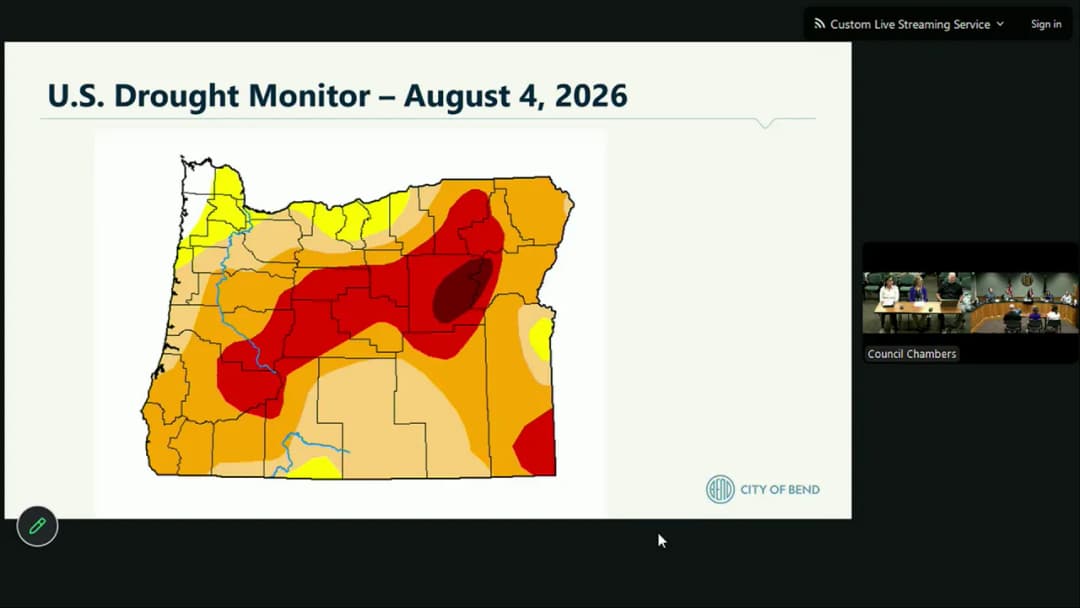
This work session, held at 4:00 p.m. in City Council Chambers, covered three major topics: the HOME Committee's housing recommendations, a water supply update, and the growth plan engagement strategy. Council discussed priorities, raised concerns, and provided direction for next steps. Discussion Items - HOME Committee Work Plan (55 minutes): Matt Stewart, Chris Ogren, and Rachel Baker presented the findings of the Housing Options Made for Everyone (HOME) Committee after a year of work. Committee chairs Sarah Odendahl and Carly Colgin detailed the recommendations. The committee recommended three revenue-generating mechanisms: an affordable housing bond in the range of $50–100 million, a moderate income revolving loan fund (MURAL) to leverage state capital, and a rental registration fee to improve data on the rental market. They also recommended five programmatic tools: SDC exemptions (tiered up to 100% AMI with a sunset review), support for community land trusts, an infrastructure revolving loan fund, a rate buy-down program, and property tax exemptions for affordable housing. Council members expressed general support but had mixed feelings on the bond, with some preferring alternative revenue sources like a vacancy tax or gross receipts tax. Strong consensus emerged to explore the rental registry, infrastructure revolving loan fund, and property tax exemptions, while deprioritizing expanded SDC exemptions and the rate buy-down program. Council agreed to include a question about the bond in the upcoming community survey and to consider continuing the HOME committee. - Water Supply Update (45 minutes): Mike Bittner, Jillian Achner, and Brittany Barker provided an update on statewide drought conditions, surface water and groundwater management, and the 18.2 cubic feet per second (CFS) limit on diversions from Bridge Creek. They noted that 90% of Oregon is in drought, with 24% in extreme or exceptional drought. The city's peak water use has declined from 28–30 million gallons per day a decade ago to under 25 million in 2025. The 18.2 CFS limit is enforced by water rights, Forest Service special use permit, and city ordinance. The city is planning for climate resilience, including the Outback facility expansion (48 acres of Forest Service land being acquired for $250,000). Councilor Méndez proposed restating and modernizing Resolution 2933 to reaffirm the city's commitment to the 18.2 limit and conservation. Council supported this idea and agreed to work on it. Councilor Norris requested future information on the other 25% of Bend served by private water providers. - Growth Plan Engagement (20 minutes): Renee Mitchell introduced the renewed branding and community engagement plan for the Growth Plan, now called "Bend Made." The engagement goals include reaching diverse communities, using innovative methods, and reporting back. Council praised the name and approach, emphasized the importance of including neighborhood districts, and suggested using a civic assembly format for key decisions. The public launch will follow council workshops on September 14 and 23, 2026. Key Outcomes - Council directed staff to proceed with developing a 3–5 year housing work plan based on the HOME Committee recommendations, with initial prioritization of the infrastructure revolving loan fund, land trusts, and property tax exemptions. The bond will be explored further, and a question will be included in the December community survey. - Council agreed to explore a vacancy tax as a potential future revenue tool, pending further analysis. - Council directed staff to work on restating and modernizing Resolution 2933 regarding the 18.2 CFS surface water diversion limit, with Councilors Méndez and Kebler volunteering to lead the effort. - Council endorsed the "Bend Made" brand and engagement plan, with feedback to incorporate neighborhood districts and consider a civic assembly for specific growth plan topics.
The Bend City Council met on August 5, 2026, at 6:00 p.m. following a 5:00 p.m. executive session. The meeting included a proclamation, public comments, approval of the consent agenda, two public hearings (quasi-judicial and legislative), decisions on affordable housing funding, an enterprise zone tax exemption, a design-build contract for the Reed Market Bridge, and the second reading of the Cavvy Master Planned Development. The Council also received a City Manager’s report and later convened as the Bend Urban Renewal Agency (BURA) to review proposed development assistance programs. Proclamation - Councilor Riley presented a proclamation recognizing August 24, 2026, as Ukraine Independence Day. Anna Artemenko, Yuliia, and Pete Zaydachny accepted the proclamation on behalf of Ukrainian families in Central Oregon. The proclamation was adopted unanimously. Consent Calendar - Approved unanimously: The Council approved the consent agenda, which included: - Minutes from the June 3, June 10, and June 17, 2026 meetings. - Authorization for the City Manager to amend the Intergovernmental Agreement with Bend Park and Recreation District for the Gilchrist Bridge Replacement Project, increasing the project cost authorization by $621,650 to a total not to exceed $2,100,000. Public Comments & Testimony - Emily Boyd (Bend Chamber): Expressed support for the BURA loan and grant programs, emphasizing that banks should remain primary lenders, and that BURA should complement rather than compete with private markets. She noted a lender roundtable held in June and stated that the Chamber will provide a detailed letter. - Rondo: Called on the Mayor to declare Benjamin Netanyahu a war criminal and state he would be arrested if he visited Bend. - Jay Smith: Claimed his rights as a handicapped senior citizen had been violated by city-funded entities and that the city attorney refused to accept his complaint. He warned of potential lawsuits. - Michael Baker (Boys & Girls Clubs CEO): Thanked Mayor Pro Tem Perkins and City Manager King for participating in the club’s Civics Week, noting that Perkins is a former club kid. - Unnamed speaker (parking sign issue): Requested clearer signage for 15-minute parking zones in downtown Bend, suggesting arrows instead of “this side” language, and asked for a waiver of a $45 fine because the signage was ambiguous. - Old Bend Residents (multiple speakers): Approximately 10 residents spoke in opposition to the Bend Bikeway project’s modal filters (diverters) installed in the Old Bend neighborhood. Key concerns included: - Increased traffic on narrow streets (Chamberlain, Delaware, Lava) and safety hazards. - Drivers ignoring stop signs, driving onto sidewalks and private property. - The diverters shifting traffic rather than calming it, and creating dangerous conditions for pedestrians and cyclists. - The pilot project’s design being obstructive and not meeting its stated goals. - Requests to remove the diverters, shorten the pilot, or implement alternative traffic calming measures such as speed bumps or roundabouts. Discussion Items - Quasi-Judicial Public Hearing – Stevens Ranch Master Planned Development (MPD) Text Amendment: - Staff presented a proposal to shift a 50-acre large-lot industrial overlay from the southwest corner of the Stevens Ranch MPD to the eastern boundary, maintaining compliance with Comprehensive Plan Policy 1187. The underlying zoning remains General Industrial. The amendment also updates the Transportation Mitigation Plan. The Planning Commission had recommended approval unanimously. The applicant (Tia Lewis) stated the shift would accelerate development of infrastructure and industrial lands. No public testimony was offered. Councilor Franzosa supported the amendment for creating jobs. The Council voted unanimously to approve the first reading of the ordinance. - Legislative Public Hearing – Amendments for HB 2138 and HB 4037: - Staff (Pauline) outlined changes to the Bend Municipal Code and Development Code to implement state housing bills. Key provisions: - Allow middle housing on lots with existing dwellings (e.g., a house with an ADU can add a quadplex). - Prohibit traffic impact analysis for townhouses and cottage clusters with 12 or fewer units. - Provide bonus units for accessible or affordable middle housing units (up to 2 additional units for quadplexes, etc.). - Allow single-room occupancy developments with more flexibility. - For middle housing land divisions, reduce public hearing and notice requirements, and allow concurrent divisions. - For developments of housing using clear and objective standards, limit notice to property owners only and restrict appeals to the applicant. - For planned mixed-use developments over 10 acres, if affordable housing occupies more than 20% of commercial land, replacement commercial land must be provided elsewhere. - Staff proposed two additional amendments (clarifying language for “approved plan” and requiring a will-serve letter for water from non-city providers). The effective date for bonus units and existing dwelling provisions is January 1, 2027. No public testimony was offered. The Council approved the first reading with the recommended amendments. - Affordable Housing Fund Recommendations: - Staff (Melissa Kamania) presented the 2026 Affordable Housing Fund allocations. The Affordable Housing Advisory Committee recommended two projects from five applications requesting $2.16 million (only $1 million available): 1. Bend-Redmond Habitat for Humanity – $350,000 for home buyer assistance for 8 units at Bear Creek Village (2 at 31-50% AMI, 6 at 51-80% AMI). Land trust model, 99-year affordability. 2. Thistle & Nest – $650,000 for construction costs for 38 units at Woodhaven Estates Phases 5&6 (10 at 31-50% AMI, 28 at 51-80% AMI). Land trust model, 20-year silent loan. - Councilor Franzosa noted the importance of addressing homeownership, as previous funds went to rental housing. The motion to approve the recommendations passed unanimously. - Lonza Enterprise Zone Agreement: - Staff (Sarah Smooney) presented a 10-year property tax exemption for Lonza Bend Inc. (formerly Bend Research) for a $251 million capital investment at 20465 and 20475 Murray Road. The project will create 81 new jobs with salaries above 150% of the county average annual wage. The extended exemption (years 4-10) requires a 15% school support fee. Multiple letters of support were received. Lonza representatives (Kathy Schweibert, Steph Geisler) noted the investment would create meaningful careers and the extension made Bend competitive with other locations. Councilors expressed strong support, citing the company’s long community presence and STEM education contributions. The motion passed unanimously. - Reed Market Bridge Project – Progressive Design-Build Contract: - Staff (Alex Doza) requested authorization for a progressive design-build contract with Stacy and Witbeck, Inc. for pre-construction services (including 100% design) in an amount not to exceed $5,231,770. The project will eliminate the at-grade railroad crossing on Reed Market Road, funded by a $32 million federal grant and local GO bond funds. Construction is slated for mid-2027 to mid-2029. The Council approved the motion unanimously. - Second Reading – The Cavvy Master Planned Development: - The Council held the second reading and adoption of an ordinance to create The Cavvy, an approximately 45-acre Major Community Master Plan. The motion included a condition that the applicant submit a final master plan incorporating all conditions of approval. The ordinance was adopted by roll call vote (7-0). Key Outcomes - Consent Agenda: Approved. - Stevens Ranch MPD Amendment: First reading approved (unanimous). - HB 2138/4037 Code Amendments: First reading approved with staff-recommended amendments (unanimous). - 2026 Affordable Housing Fund: $1,000,000 allocated to Habitat for Humanity ($350,000) and Thistle & Nest ($650,000). Staff authorized to execute loan agreements. - Lonza Enterprise Zone Agreement: Authorized (unanimous). - Reed Market Bridge Contract: Authorized for $5,231,770 (unanimous). - Cavvy MPD: Second reading adopted (roll call vote 7-0). - BURA Discussion: No action taken; staff will return September 2, 2026, for adoption of grant and loan policies. Grants expected to launch October 1, 2026; loans in January 2027.
The Bend City Council met on July 22, 2026, for a work session focused on the quarterly council goal update, a deep dive into housing and permitting performance, and a discussion on shelter planning and potential affordable housing development at Juniper Ridge. The meeting opened with a note that the mayor was absent due to a conference and that severe weather with lightning and fires was ongoing. Staff presented progress across six goal areas, reviewed housing market trends and permit timelines, and sought council direction on shelter funding cuts and a proposed surplus of 33 acres in Juniper Ridge for affordable and permanent supportive housing. Discussion Items Quarterly Council Goal Update - Staff presented a scorecard showing 77% of actions on schedule, 14% complete, and 9% off schedule. The off-schedule items were primarily in the housing goal area. - Highlights included: - Accessible & Effective Government: Launch of the "One City" initiative with revised mission, vision, and values emphasizing accountability, collaboration, stewardship, and inclusion. - Climate Resiliency: Adoption of a climate pollution fee and home hardening building code (R327); citywide tree inventory expanded to two years due to higher volume; Bloomberg Wildfire Resiliency Project completed with prototypes for direct resident assistance. - Economic Prosperity: Financial analysis of city-owned properties led to narrowing options for a new facility to First Street/Franklin and the former public works campus; extended enterprise zone adopted; $515 million in multifamily units under construction; concern about a Bureau of Labor and Industries ruling on prevailing wage for tax increment financing. - Housing & Homelessness: 2026 point-in-time count showed a 16% reduction in homelessness regionally (Bend down 16%); 260 shelter beds developed; 175 households transitioned to permanent housing (goal 300); 447 households prevented from homelessness in 2025. - Public Safety: Fire & Rescue earned American Heart Association Gold Award; D-shift transition completed; police staffing at 96.5 deployed out of 120.5 authorized, with seven in training; automated traffic enforcement in June recorded 1,097 citations (330 speed, 767 red light). - Transportation Infrastructure: Ben Bikeway improvements, Butler Wells project ahead of schedule, Wilson Railroad Crossing finished, NEF Corridor multi-use path starting. Housing and Permitting Deep Dive - Staff (Russ Grayson, Jesse Thomas, Melissa Camania) presented data on market trends, permit timelines, and continuous improvement efforts. - Single-family permit applications have stabilized at a lower level (12-month rolling total around 634), reflecting market slowdown. - Council goals for the biennium are based on Oregon Housing Needs Analysis (ONA): 3,942 total permits, 1,818 affordable units, 826 middle-income units. Staff stated that affordable and middle-income targets will not be met, though the overall permit goal may be achieved due to large multifamily projects permitted in prior years. - Permit review times: first review for residential averaged 25 days (on track for 35-day goal); however, permits are increasingly waiting for final fee payment, indicating market hesitation. - Review cycles: most residential permits require 2–4 review cycles; smaller builders tend to have more cycles due to complexity and code changes. - Staff highlighted continuous improvement efforts: publishing top 10 review comments, monthly calls with builders, and exploring a development navigator role for smaller permit holders. - Councilmember Platt suggested exploring field-issued permits for simple structures to speed up the process. Staff acknowledged the idea but noted risks of construction errors. Shelter Planning and Juniper Ridge Surplus Discussion - Amy Fraley, Matt Stewart, and Brooke Keefe presented on shelter funding cuts and the potential surplus of 33 acres in Juniper Ridge for affordable housing. - State funding for homeless services is shifting to regional allocations; the region received $10.3 million for 398 beds in fiscal year 2026, but a 50% cut is expected next year. Safe parking programs in Bend received no state funding. - The city currently supports 316 beds directly (out of 596 citywide); a funding cliff is expected July 1, 2027, when ARPA dollars are exhausted. - Staff recommended using the Franklin Avenue shelter closure (temporary use) as a catalyst for developing permanent supportive housing (PSH) at Juniper Ridge. Council expressed support for moving forward, with emphasis on maintaining overall shelter capacity and tying the closure to new development. - Matt Stewart outlined the Juniper Ridge proposal: up to 33 acres eligible under Senate Bill 8 for deed-restricted affordable housing at 80% AMI or less (average 60%), with a minimum 30-year affordability covenant. A first phase of 6 acres is proposed, utilizing existing infrastructure. - Council and staff discussed criteria for the surplus process: land lease vs. sale, bonus scoring for lower AMI (e.g., 50%), permanent supportive housing component, universal design, and longer affordability terms. - Concerns raised by neighboring businesses and residents about PSH included location, access to services, public safety, school proximity, and concentration of homeless services. Staff proposed requiring applicants for PSH to include an outreach plan, operations management plan, and a good neighbor agreement. Key Outcomes - Direction on Shelter Planning: Council expressed support for continuing to explore the closure of the Franklin Avenue shelter in tandem with developing affordable and permanent supportive housing at Juniper Ridge, with the goal of not reducing overall shelter capacity. Staff will bring back an RFP and surplus criteria to council in September. - Juniper Ridge Criteria: Council generally agreed with the proposed bonus scoring structure (lower AMI, PSH component, universal design) and suggested adding a bonus for longer affordability terms (e.g., greater than 30 years). - Next Steps: The Affordable Housing Advisory Committee (AHAC) will review proposals and make recommendations; council will make final award decisions. Staff will also continue state advocacy for sustainable shelter funding.