Bend City Council Work Session and Regular Meeting - November 15, 2023
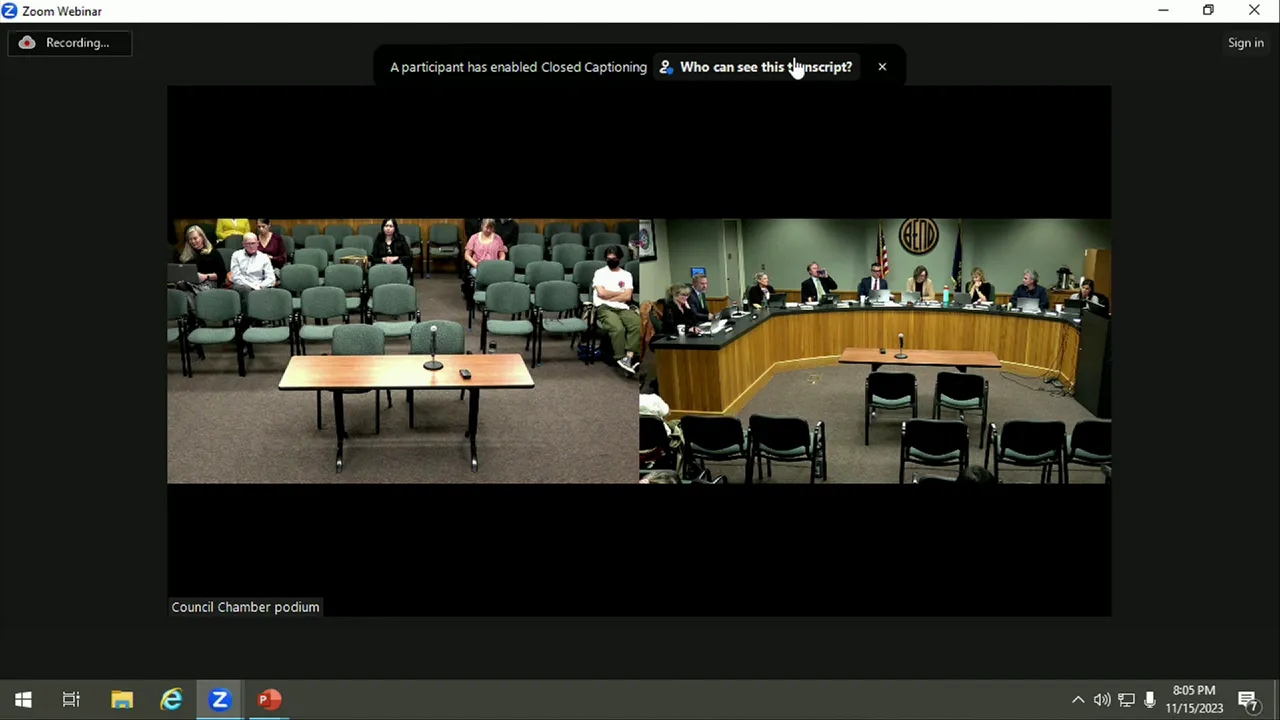
STREAMING COPY IN PREPARATION — RECORDING AVAILABLE FROM THE ORIGINAL SOURCE
Bend City Council Meeting - November 15, 2023
This meeting included a work session from 5:00 p.m. covering community development fee updates and an update on the camping code, followed by an executive session. The regular meeting began at 7:00 p.m. with a consent agenda, public comments, and several action items including approval of a housing code amendment, the second intergovernmental agreement for the Coordinated Houseless Response Office (CHRO), and a rapid rehousing contract.
Consent Calendar
- Approved minutes from November 1, 2023 work session.
- Authorized a Master Price Agreement with PacificWRO for furniture (up to $3,500,000 over five years).
- Approved sole source contracts with Pacific Power for Wilson Avenue Corridor project ($129,129).
- Accepted a $152,740 Energy Efficiency and Conservation Block Grant from the Department of Energy.
Public Comments & Testimony
- Electrification advocates (Brendan Brees, Amelia DuBose, Freddie Finney Jordan, Annie Nichols, Emmy Lerding, Rowan Lucas – members of Fridays for Future Bend and Deschutes Youth Climate Coalition) urged council to task the Environment and Climate Committee with drafting a comprehensive building electrification plan and to raise the right-of-way fee to 10% to fund equitable transitions. They noted September 15, 2023 was the 60-day mark from a letter sent to council; several youth speakers expressed urgency for bold climate action.
- Bob Peel, Camden Hendrix, Keith Higby, Nancy Bouchard, Corey Gillette, James Thiele (all Bend residents) spoke in opposition to the repeal of BDC Section 3.1.400.J (13-foot-6-inch vertical clearance standard) as part of the housing code amendments. They argued the building code does not cover the same scope and that removing this standard would create safety gaps for delivery trucks and emergency vehicles. Several noted the repeal was presented as “redundant” but appeared to be a substantive change.
- Katie Brooks (CEO of Bend Chamber) expressed appreciation for the fee update process and asked for continued focus on streamlining pre-application permitting.
- Dorian Tai, Gary Miller, Garrett Welch, Robert Watkins, Faye Phillips (airport users and stakeholders) criticized the proposed airport rules and regulations update, citing a short 30-day comment period over Thanksgiving, lack of stakeholder input, and concerns about hangar lease terms, flight instructor restrictions, and privacy (requiring member lists). They requested the draft be withdrawn and redrafted with genuine participation.
- Richard Regard (formerly unhoused) expressed frustration with resources and enforcement of camping rules, asking for assistance and a shopping cart.
Discussion Items
- Community Development Fee Update (Work Session): Sharon Witter and Colin presented a fee increase plan for the Community and Economic Development Department funds (Building, Engineering, Planning). The plan includes step increases (e.g., 20% on July 1, 2024, and 10% on January 1, 2025 for Building; similar for other funds) to restore reserves to policy targets. Council discussed the need to align with the 6-month reserve policy and possible options for the Planning fund. Next steps include revisiting at June budget and ongoing stakeholder meetings with BDAB.
- Update on Camping Code (Work Session): Ian Lightheiser, Sherry Meisel, and Chief presented data from eight months of implementation: 68 cases opened, 42 notices issued in March, seasonal peaks. Notices to clean vs. move for tents and vehicles. Parking complaints (abandoned vehicles) exceed 10 per day. City has issued no citations. Staff recommended clarifying the 750-foot move requirement for all vehicles citywide as a short-term code amendment, with a larger parking code overhaul in 2024. Council directed staff to return with that ordinance.
- Approve Employment Agreement for Judge Ruocco: Council unanimously approved amendments including a 4% salary adjustment and an additional court session to manage docket.
- Rapid Rehousing Sole Source with NeighborImpact: Council approved $215,000 for direct client assistance (rent, deposits, arrears) for up to 30 households, funded by a state grant that must be expended by January 10, 2024.
- Second IGA for CHRO (Item 8): Council authorized the City Manager to sign the agreement that moves CHRO oversight to Central Oregon Intergovernmental Council (COIC) and includes updated board bylaws.
- Housing Code Amendment (Second Reading – Item 9): After extensive public comment and procedural discussion, council voted 6-1 (Councilor Riley opposed) to adopt the ordinance amending the Comprehensive Plan and Development Code to facilitate housing. The vote passed despite concerns about removal of the 13-foot-6-inch vertical clearance standard. Mayor and Councilor Riley will meet with staff to clarify the issue and possibly bring a future revision.
- Council Reports: Councilors reported on committee meetings (BDAB, ECC, ATF, affordable housing, tree code, etc.), Veterans Day events, and a letter to the Deschutes Youth Climate Coalition outlining existing climate action planning and a commitment to report in March 2024.
- City Manager’s Report: STC methodology public notice begins November 17; e-bike information page launched; Bird bikes averaging 3,500 rides per month; 17 of 25 neighborhood street safety projects completed; 32 pump stations decommissioned reducing energy use.
Key Outcomes
- Approved consent agenda (unanimous).
- Approved employment agreement for Municipal Court Judge Angela Ruocco (unanimous).
- Approved sole source contract with NeighborImpact for $215,000 for rapid rehousing (unanimous).
- Authorized second IGA for CHRO (unanimous).
- Passed housing code amendment on second reading (6-1).
- Directed staff to bring ordinance clarifying 750-foot vehicle move requirement citywide.
- Appointed Mark Fronti and Petra Oros Lenova to BDAB; named alternates Gillian Taylor and David Dowdy.
- Approved homelessness collaborative agreement (unanimous).
- Council authorized participation in the 3M and DuPont PFAS settlement (unanimous).
- Letter to youth climate groups to be sent by November 17 outlining timeline and work plan.
Meeting Transcript
Okay. Um, good evening, everyone. We're going to start our Ben City Council work session. Our first item is an update on our community development fee, and Councillor Norris needs to put something on the record. Yes, I have to declare an actual conflict because of my employment with Hayden Homes and the community development fees that we're discussing right now on this work session item would most likely have an impact on Hayden Homes. So I'm going to recuse myself and leave the room for this item. Thank you, Councillor North. All right. Turn it over to Sharon Witter. Yeah, so as Colin is trying to get into the meeting to share the slides. So if you recall during budget deliberations back in May, um, we we had a lot of discussion on proposed fee increases for building planning and engineering. We adopted the increases, you adopted the increases July one that were lower than we had projected in the budget. And as part of that fee resolution adoption, Counselor Riley had asked that we come back with an update and kind of a forecast of what fee increases would be needed over the next couple of years in order for us to kind of meet our financial obligations and one of that work session in November. So we're here today to follow up on that. I can cover some of the background slides as they're getting logged in. So can you move the bank over to you too? First time anyone said that to me. So a little bit of background when we're able to share slides. The first background slide we have is for the most part an update from a slide we had during budget deliberations, kind of explaining how we got where we are and having this fee conversation. You'll see in some of Colin's slides where over the last couple of years, we haven't had we've had pretty limited fee increases over the last five years. There's only been a couple of years that even had any increases, and that was because we had enough cash on hand or reserves that we didn't we didn't have a solid, obviously, we didn't have a solid justification of doing significant fee increases at that time. Well, fiscal year 23, the year that just ended in June was kind of this perfect storm of the revenues kind of leveling off, but then we were able to fill a lot of the vacant positions that we had in the department, which is great because that allowed an increase in turnaround times and permit review times, but that happened at a time that revenues were kind of leveling off, and our reserve levels and cash on hand to sustain those operations started declining. And we are we're not covering our expenses with our annual revenues. So wanted to take a look. Um we've been working with a stakeholder group, um, and I'll just start talking through the first couple of slides. We had an internal um staff team that was myself, Colin, Ben Hempson, um, the economic development manager, finance staff, and met with um Carta from the Central Oregon Builders Association, Katie Brooks from the Chamber, Gary North, who is with RH Construction, he's also on the Bend Economic Development Advisory Board or BDAB, um, Wes Price with a local CPA firm, Jim Sandburn with Hayden Homes, he's also an ex-oficio member of BDAB. And then we had several meetings in which representatives from the state building code division participated. So really working closely, we met five times from July through mid-October, um, really pouring through to kind of get everybody on the on the same page in terms of an understanding of this is this is a need, not a want. Um, because we want to maintain those uh turnaround times and just have prudent financial management to ensure we're covering our costs with our revenues on an annual basis. Um it's also bringing us in line with our financial policy. So you all have fiscal policies that were most recently adopted or updated in June of this year for all of the community and economic development funds. So building planning I'm putting it up there. Oh I've got it. Um building planning and engineering have a minimum reserve target of six months of operating reserves. Um, so that means we want to have enough cash on hand to have to cover six months of our operating costs if if no other revenues were to come in. The state building code has a recommended best practice of 12 to 18 months on the building side. So that's just a little bit of framework and background to set it up as Colin will go into kind of more of the details and with some updated graphs that you've seen and some work sessions last spring and budget deliberations showing what those um kind of what that financial picture looks like with no infant fee increases and then what it would take going out until uh 2028 um to to make sure we're we're looking out over this five-year horizon to really have that strong financial planning, but also give the development community some idea so they can start planning and building this into our proformas. Obviously, you're not we're not proposing any any fee increases right now. We don't have any fee increases proposed until next July. And you can't bind future councils, but similar as the way we handle our utility rate models, doing those long-term forecasts just to give you some idea um kind of what that's gonna look like. So with that, I've kind of covered the first couple of slides. Um, so then I'll turn it over to Colin. Okay, thank you. Sorry, my apologies for the technical difficulties. But great lead-in, thank you, Sharon. Um, so I'm gonna start the the three main funds within CEDD are the building, engineering, and planning funds, and I'm gonna go through them in that order. Um, got quite a few slides and 30 minutes for this item, so I'm gonna go fairly quickly, but I am gonna spend a little bit more time on the building slides um just to explain how they work because the other two funds are are uh organized the same way. So this is the building safety fund, and I call this slide the problem statement. It goes back to the fiscal year 2019, where you could see things were looking pretty good. The top line, which is brownish or maroon, is uh our reserves.
openpublica.com