Bend City Council Meeting December 6, 2023: SDCs, Right-of-Way Code, and Property Surpluses
STREAMING COPY IN PREPARATION — RECORDING AVAILABLE FROM THE ORIGINAL SOURCE
Bend City Council Meeting – December 6, 2023
The Bend City Council met on December 6, 2023, starting with a work session at 5:00 PM on System Development Charge (SDC) methodology and code updates, followed by a Right of Way code update, and then an executive session. The regular meeting at 7:00 PM included proclamations, public comments, a consent agenda, three public hearings, a Multiple Unit Property Tax Exemption (MUPTE) resolution, council reports, and the city manager's report. Key actions included adoption of parking regulation amendments, approval of surplus property sales for housing and industrial development, and approval of a MUPTE for a 199-unit project.
Consent Calendar
- Approved minutes from November 1 and November 15, 2023 meetings.
- Accepted the Oregon Liquor and Cannabis Commission (OLCC) report.
- Accepted the Monthly Financial Report for October 2023.
- Authorized a two-year agreement with Kancler Consulting, LLC for government relations services not to exceed $156,000, with renewal options.
- Authorized an agreement with Cascade Pump & Irrigation Services, LLC for pump and motor repair not to exceed $500,000.
- Authorized purchase of six Stryker Power-PRO XT cots not to exceed $150,700.
- Authorized purchase of emergency medical supplies from Life-Assist, Inc. not to exceed $250,000 per fiscal year of the 2023-2025 biennium.
- Accepted petition to vacate a segment of right-of-way along Cooley Road.
Public Comments & Testimony
- Veterans Village Update (In-person): Eric Tobiason thanked the city for support, reported that the expansion will finish in two weeks, with seven units ready before winter. He credited the building department for efficient project completion.
- Airport Rules (Zoom): Gary Miller, Bend resident and airport user, expressed dissatisfaction with proposed airport rules, noting no city staff defended the proposal. He offered cooperation and tours for staff to understand airport operations.
- Verizon Wireless (Zoom): Kim Allen stated no objection to moving from franchise to license model but raised legal concerns about the access fee for wireless providers. Supported the proposal to set the fee to zero temporarily.
- Utilities (In-person):
- Casey Rhodes (Rosewater) supported the general concept of the right-of-way code but urged collaborative process to avoid ratepayer impacts.
- Rick Bailey (Avion Water) noted the city's shift from partnership to one-size-fits-all, citing a past conflict over the Brown and Caldwell report. He requested more stakeholder involvement compared to the SDC process.
- Brenton Pass (Central Electric Cooperative) appreciated staff responsiveness but highlighted concerns about emergency language, gross revenue definitions, and relocation costs.
- Marcus McCloskey (Cascade Natural Gas) urged a more thoughtful timeline, mirroring the SDC stakeholder process.
- Matthew Chancellor (Pacific Power) expressed concern that an ordinance ends the partnership approach, could shift costs to customers, and conflicts with state law on undergrounding.
Discussion Items
-
System Development Charge (SDC) Methodology and Code Update (Work Session):
- Staff presented a tiered residential SDC structure: smaller homes pay less (e.g., under 600 sq. ft. ~$11,000), larger homes pay more (over 3,000 sq. ft. ~$31,000), with the current uniform charge of $21,760 as a midpoint. Multi-unit housing gets a uniform charge per unit.
- Non-residential SDCs updated using current ITE trip generation data, causing increases in some categories (e.g., auto-dependent uses) due to historical arbitrary reductions from 2003 being corrected.
- Urban area rates for transportation SDCs in core areas (downtown, opportunity areas) based on lower trip generation due to walkability.
- Water and sewer SDCs aligned with building square footage instead of meter size or employee counts.
- Code changes include: deferred SDC payment phased in over three years (multi-unit residential starting now, all residential in 2025, all development in 2026) with fixed rate at building permit time; simplified credits for existing use (using current schedule); expanded credit for qualified public improvements with transferability for credits over $250,000 for improvements in same basin; exemptions for affordable housing (20-year deed restriction) and childcare/shelters (non-durational, no credit upon conversion). Staff will review exemptions without Affordable Housing Advisory Committee involvement.
- Council directed staff to explore reducing the transportation SDC for ADUs (currently ~$2,239) as a policy incentive.
-
Right of Way Code Update (Work Session):
- Staff proposed replacing individual franchise agreements with a uniform license program to streamline management and ensure equitable fees.
- Key elements: registration for providers (utility service), license for operators (facility owners), and two fees (use fee on operators, access fee on providers) based on gross revenue percentages unchanged from current.
- Public comments from telecom raised legal concerns about the access fee under federal law. Staff recommended enacting the code but setting the access fee to zero temporarily (via resolution) while the city determines who is operating in the right-of-way, to avoid litigation risk.
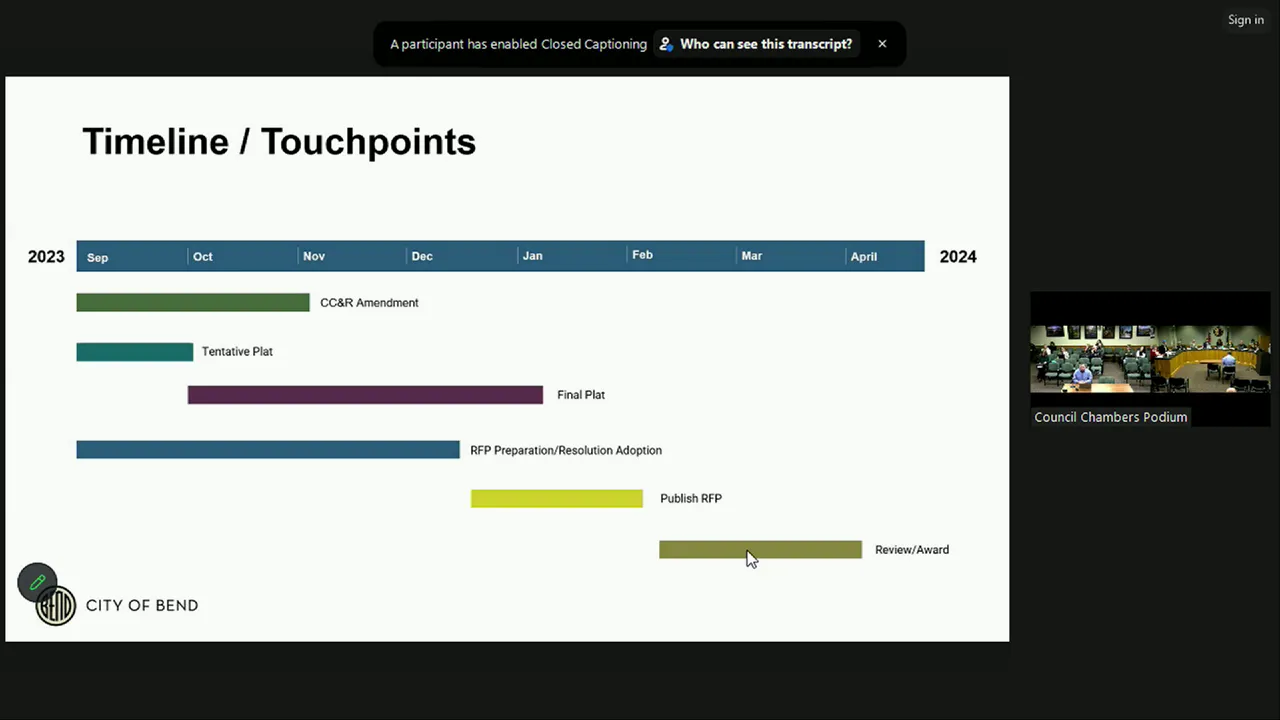
- Timeline: first reading delayed to January 2024; implementation delayed until May 1, 2024; stakeholder meeting on December 11, 2023.
-
Public Hearings (Regular Meeting):
- CFEC Parking Amendments (Item 6): Adopted first reading of ordinance implementing OAR 660-012-0405 and 660-012-0415. Includes 40% tree canopy or solar panels for parking lots over half acre; parking maximums for multi-unit and large commercial near transit. Planning commission recommended approval with amendment allowing building frontage to face pedestrian plazas or breezeways. No public comment. Unanimous vote.
- SE 9th Street Surplus Property (Item 7): Adopted resolution declaring two tax lots (3.4 acres) surplus for housing development (excluding shelters). RFP process will include covenant for rental or owner-occupied housing, with evaluation criteria including ability to proceed, compensation, expediency, and community benefit. Unanimous vote.
- Juniper Ridge Surplus Property (Item 8): Adopted resolution declaring five lots (approx. 200 acres) surplus for industrial/commercial development. Two-step RFP: first 100 acres (lots requiring major infrastructure), then remaining 100 acres. Proposals must include infrastructure development. Unanimous vote.
-
Multiple Unit Property Tax Exemption (MUPTE) – 105 NE Franklin Ave (Item 9): Approved 10-year tax exemption for two five-story buildings with 199 residential units (Platform Project). Priority public benefit: Earth Advantage Platinum energy certification; additional benefits: enhanced landscaping and EV charging. Financial analysis by independent consultant found project not viable without exemption. Estimated $4.4 million exemption over 10 years; project in core TIF district, so impact deferred to Bend Urban Renewal Agency. All taxing districts approved. Unanimous vote.
-
Council Reports:
- Stewardship Subcommittee (Councilor Riley): Youth Advisory Council progress with Campfire partnership; Community Crisis Response Team update—shift to first-response model, ~one-third reduction in mental health calls, need for stable funding and detox center.
- Community Building Subcommittee (Councilor Perkins): Meeting next week.
- Mayor pro tem Perkins: BDAB continued discussion on non-residential Transportation Utility Fee; business survey results (289 responses) showed top concerns: congestion (36%), enhanced street quality (23%), snow plowing/sweeping (12%); 67% support phase-in over 3 years.
- Councilor Campbell: Attended rural fire protection board; shared personal story of husband rescued by city/county cooperation; emphasized value of the agreement.
- Councilor Méndez: Bend MPO awarded Safe Streets for All grant; updates to Transportation Safety Action Plan and Transportation System Plan starting.
- Appointments: Carly Colgan and Christopher Fultz appointed to Human Rights & Equity Commission.
Key Outcomes
- SDC Update: Council provided direction to proceed with the proposed methodology and code changes, including exploring reduced ADU transportation SDC, and staff to bring back a refined proposal for January 17, 2024 public hearing.
- Right-of-Way Code: Council directed staff to proceed with the code, delay implementation until May 1, 2024, and set access fee to zero temporarily via resolution. Stakeholder meeting on December 11.
- CFEC Parking Amendments: Ordinance adopted on first reading (unanimous).
- SE 9th Street Surplus: Resolution adopted to declare property surplus and initiate RFP for housing development (unanimous).
- Juniper Ridge Surplus: Resolution adopted to declare lots surplus and initiate RFP for industrial/commercial use (unanimous).
- MUPTE Approval: Resolution adopted for 10-year tax exemption at 105 NE Franklin Ave (unanimous).
- Appointments: Two members appointed to Human Rights & Equity Commission (unanimous).
- Consent Agenda: Approved (unanimous).
- Public Comments: Noted for action by staff; right-of-way stakeholders invited to December 11 meeting.
Meeting Transcript
Okay, everybody ready? Yep. All right, let's begin our work session. Um we are starting with an item covering SDCs and Councillor Norris is gonna make a declaration. Yes, due to my um employment and Hayden homes, this item could um or cannot financially impact Hayden Home. So I will be refusing myself on this item this evening. And I'll come back when it's done. Thank you. Thank you. Well, good evening. Uh Sarah Hudson, senior policy analysts in the city manager's office. I'm here with Russ Grayson and Elizabeth Oshel, and we're gonna talk about the system development charge methodology update. Um, in terms of our goals for the 45 minutes that we have today, I'm gonna give a very brief background and process to date just to kind of orient us, but we have a lot to cover, so we'll just move to that pretty quickly. Then we're gonna review the methodology and code updates, particularly highlighting what's different under the proposed structure from from the current. Um then we have a number of questions to kind of work through with council and some time at the end for questions and answers. So just as a reminder, when we're talking about SDCs, these are the fees that developers pay associated with new development, um, one-time charges at the time of building permits. So this is uh the way of having development pay for um for growth with SDCs going to growth related infrastructure, and as a reminder, per Oregon statute, SDCs are for capital expenses only, they cannot provide revenue for operations and maintenance. And then in terms of why we are um doing the methodology update, the reasons behind this work. First and foremost, it's really important that we're aligning project list with current infrastructure master plans. So the water and transportation system master plans were uh recently updated in the past few years, and so we need to make sure that the SDEC project lists are in alignment with those master plans so that we can collect the appropriate revenue and um complete uh the projects needed for our system. Uh this is a recurrent activity, it is standard practice to update methodologies every five to ten years, so we're a bit overdue. Um we haven't updated the water SEC since 2008, transportation in 2011, and sewers since 2015. Parks updated their SDCs in 2021, so part of this work as well was to um have alignment um with parks just because the city does collect park SDCs, so trying to have consistency there to make it uh easier for those who pay SDCs. Um a number of objectives through this work. So first and foremost, we're covering growth costs, but also as we really undertook this work, let's have uh holistic conversation with relevant stakeholders rather than having piecemeal conversations, so having a total look at uh the the impact both financially and to policies, um wanting to increase administrative efficiency and transparency uh by having more consistency with how we assess SDCs between the various systems, uh so the city um collecting water, sewer and transportation, and to align with council priorities. So under Oregon statutes, there is some flexibility in the methodology methodological approaches that cities choose. Um in terms of council priority priorities around housing production and affordability and complete neighborhoods, those are objectives that we were able to look at under this methodology update. In terms of process and timeline, we brought a consultant team on board last year. As you may recall, last last year we also had extended the affordable housing and child care exemptions that were due to expire at the end of 2022 just to get kind of bridge the gap through this methodology update. Um a big piece of this work was convening a stakeholder group that represented over 30 local organizations. We met six times between February and August. That was really to dig into the details of various options under the methodology update and uh stakeholders stakeholders provided feedback to to staff, and then we were here at the beginning of September to kind of synthesize that feedback and to get uh policy guidance to move forward. So middle of October, we began our 90-day notice period, so that's leading up to uh the January 17th public hearing date. Um a couple weeks ago, November 17th, we released the methodology reports that uh outline the technical basis for the the methodology update. And we've been uh kind of going around with the different advisory bodies to kind of update them on the progress as well. And we're looking at a new fee schedule beginning um July 1st of next year. So with that, I will switch it over to Russ to go over some of those proposed methodology changes. All right, good evening, council. You ready? Here we go. Um so as you can imagine, as we've talked to you before, this is a very technical document, a lot of different moving parts and pieces. So, really, what I'm gonna give you is the highlight reel of kind of some of the major changes that are going on. But there's as Sarah talked about, there is a pretty holistic change to how we're approaching the SDC methodology across all these different categories. I can't go into all the changes and everything that went up and what went down. The main message we want to get out to both council and the community is if this is of interest to you. I'm gonna say, especially on the non-residential side of things as I go through it. We would highly advise you to go to the city's website, look at the documents and see how how that may or may not impact your projects because I cannot tell you holistically everything's going up, five, ten, fifteen percent of everything is going down, five, ten, fifteen percent. Some categories are going up, some are going down. So we just want to get that word out to everybody because now is the time for the public involvement period for people who have interest in this to really review those documents and provide feedback to us. So with that, just gonna we've talked, we've had several conversations around this.
openpublica.com