Bend City Council Meeting - January 3, 2024
STREAMING COPY IN PREPARATION — RECORDING AVAILABLE FROM THE ORIGINAL SOURCE
Bend City Council Meeting - January 3, 2024
The Bend City Council held a work session at 5:00 p.m. and a regular meeting at 7:00 p.m. on January 3, 2024. The work session focused on a proposed transportation fee, including structure, phasing, and non-residential rate design. The regular meeting included approval of a consent agenda, adoption of a Multiple Unit Property Tax Exemption (MUPTE) for the Jackstraw project, authorization of planning approval extensions, eminent domain resolutions for neighborhood street safety and Yeoman Road extension, acceptance of a $19.56 million RAISE grant for a pedestrian/bicyclist overcrossing, an amendment to a shelter operations grant, and second reading of the Magnolia Meadows annexation. All items were approved except the MUPTE, which passed 6-1.
Consent Calendar
- Approval of Minutes: Minutes from the December 20, 2023 work session and regular meeting were approved.
- OLCC Report: Accepted.
- Monthly Financial Report for November 2023: Accepted.
- Vehicle Purchase Authorization: Authorized the purchase of four F600 dump trucks, one F600 chassis/cab, and one Ford Ranger from Kendall Dealership Holdings for up to $424,677.73.
- Utility Rate Consulting Agreement: Authorized an agreement with Financial Consulting Services Group Inc. for utility rate and financial analysis consulting for up to $576,770.
- Fiber Connectivity Agreement: Authorized a 5-year agreement with LightSpeed Networks for fiber communication to the new Public Works Campus for $119,750.
Public Comments & Testimony
- Sarah Odendahl (Bend Chamber of Commerce) supported the transportation fee phasing and BDAB recommendations, emphasizing the need for a robust appeals process and equitable assessment of parks and schools.
- Roberta Silverman (Southern Crossing Neighborhood) supported the Jackstraw MUPTE application, stating it meets requirements, but urged review of MUPTE criteria. She also requested improved public outreach on transportation fee recommendations.
- Kate Hines (Immersion Brewing) opposed the Jackstraw MUPTE, citing insufficient affordable housing (only 2 units out of 313), poor communication from developer Killian Pacific, and unresolved issues like broken pedestrian lighting.
- Paul Evers (co-founder of Crux and RIF) supported the Jackstraw MUPTE, praising Killian Pacific as a responsible developer based on positive experiences during COVID.
- David Welton (Bend YIMBY) supported the Jackstraw MUPTE, arguing more housing is needed and economic research shows new supply helps affordability.
- Will Green (Bend YIMBY member) endorsed the Jackstraw MUPTE, supporting increased housing in the area.
- Bryce McMorris (Historic District resident) opposed the Jackstraw MUPTE, expressing frustration that he struggled to build an ADU while large developers receive tax breaks.
Discussion Items
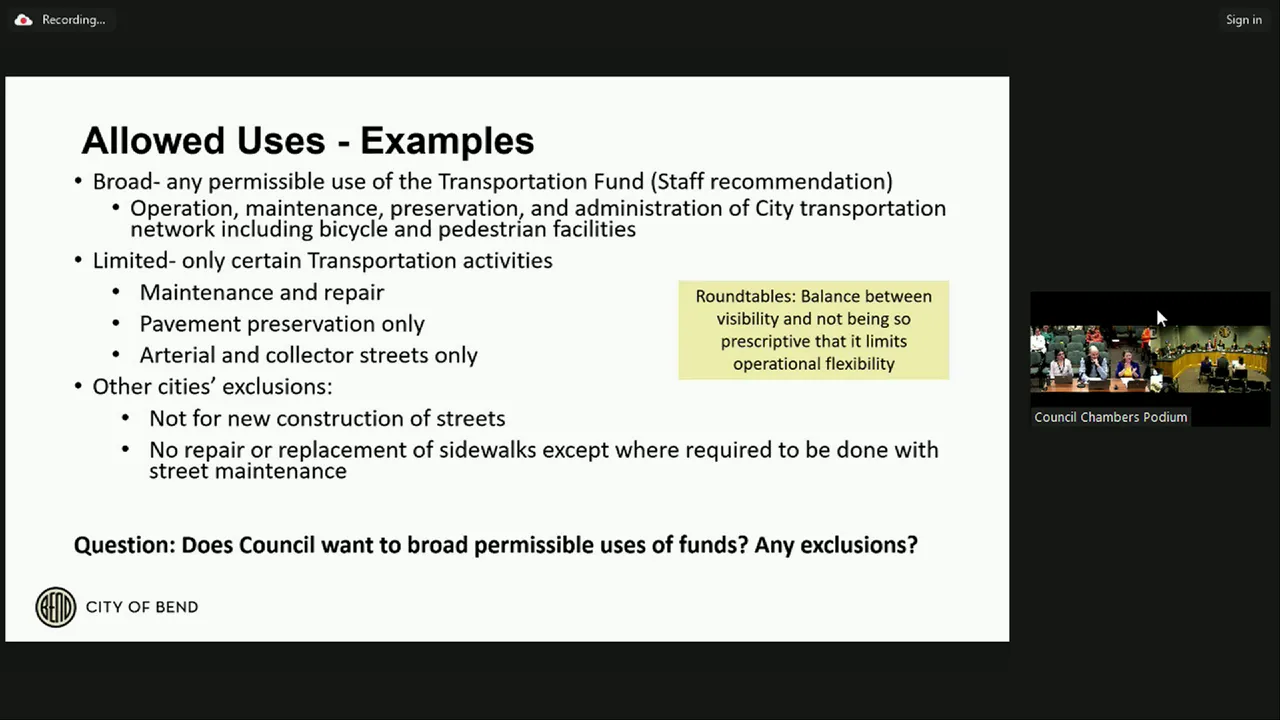
- Direction on Transportation Fee (Work Session): Staff presented options for a phased implementation ($5M in year one, $10M in year two, $15M in year three) and a 53% residential/47% non-residential revenue allocation. Council supported phasing and the split. Residential rates: single-unit accounts at a higher rate than multi-unit; a 50% discount for households on utility billing assistance was supported (consistent with HREC recommendation). Non-residential rates: Council supported a square footage-based approach with a step-down for larger buildings (e.g., $6/1,000 sq ft for first 50,000 sq ft, $4 for 50,000–100,000, $2 over 100,000), a minimum floor of $650 for accounts under 1,000 sq ft, and no cap. Hotels/motels to be charged per room (room count data available). Short-term rentals: staff to explore applying hotel/motel rate via license. Schools: Council directed staff to consider a per-student charge for phase one and bring back options for discounts/reallocation. Parks: Council supported assessing buildings by square footage and charging parks with off-street parking. Childcare facilities: Council expressed interest in exemptions. Revenue use: Council favored broad allowed uses (operation, maintenance, preservation, administration of transportation network) without restrictive allocations in code, emphasizing flexibility and alignment with TSP programs.
- Legislative Update and Prep for Short Session: Lobbyist Eric Kancler outlined three priorities: (1) Shelter operations funding – requesting $3.5M for gap to avoid mid-biennium shortfall; (2) Criminal justice reform and addiction crisis response – supporting the LOC’s 11-point plan but emphasizing need for funding for local programs; (3) Housing production package – including infrastructure funding (sewer interceptors in SE and Central districts), a revolving loan fund for middle-income housing, and a one-time UGB expansion (up to 150 acres). Council directed staff to work on a letter to the Housing Production Advisory Council (HPAC) and to continue advocating for funding.
- Resolution Approving MUPTE for 310 & 350 SW Industrial Way (Jackstraw): Staff presented that the project meets all MUPTE criteria: 313 residential units, LEED Platinum certification (priority benefit), mobility amenities, wrapped parking. Financial analysis by third-party consultant determined the project is not financially feasible without the exemption. Estimated 10-year property tax exemption is $10.6 million; the project will still pay $1.1M in taxes on land/commercial and over $5M in SDCs. Taxing districts: County approved, Park District supported, Library neutral, COCC supportive, Bend-La Pine Schools scheduled to vote. Council discussion: Councilor Riley opposed due to construction starting before approval, arguing it shows financial viability. Others expressed support, citing housing need, alignment with program goals, and desire to avoid stalled projects. Councilor Broadman recused after returning campaign contributions. Motion passed 6-1 (Riley opposed).
- Resolution Authorizing Planning Approval Extensions: Staff proposed a one-year extension for planning approvals, building permits, and engineering permits to address economic challenges (high interest rates, material availability). Council amended the resolution to limit the window to June 30, 2024, with intent to revisit if needed. Motion passed unanimously.
- Resolution Authorizing Eminent Domain, Neighborhood Street Safety Program 2024 (Archie Briggs Road): Staff requested authorization for eminent domain if necessary to acquire a portion of one parcel for sidewalk construction. Motion passed unanimously.
- Resolution Authorizing Condemnation for Yeoman Road Extension: Staff requested authority for eminent domain to acquire underlying property rights under the North Unit Irrigation Canal for road and bridge construction. The developer (Polish Homes) will cover costs. Motion passed unanimously.
- Authorize City Manager to Sign RAISE Grant Agreement (Hawthorne Overcrossing): Staff requested authorization to sign a grant agreement accepting $19.56 million from USDOT (via ODOT) for the pedestrian/bicyclist overcrossing at Hawthorne Avenue. Non-federal match of nearly $5M will be met by state lottery bond funds and an Oregon Community Pass grant. Motion passed unanimously.
- Authorize Amendment to COIC Grant Agreement for Shelter Operations: Staff requested an increase of $127,868 (total $1,060,450) and extension to June 30, 2024, for the Franklin Avenue Shelter (60 beds, serving families and medically vulnerable). Motion passed unanimously.
- Second Reading – Ordinance Annexing Approximately 19 Acres (Magnolia Meadows): Ordinance to annex land in the Southeast Area (PLANX20230396). Councilor Norris recused due to employment at Hayden Homes. Council passed the ordinance on second reading by roll call (6-0-1, Mayor Kebler abstained).
Key Outcomes
- Consent Agenda: Approved unanimously.
- Transportation Fee Direction: Council approved phased implementation (5/10/15M), 53/47 split, residential two-tier rates with 50% discount for utility billing assistance, non-residential square footage with step-down and minimum floor, hotel/motel per-room charge, staff to develop code for February work session.
- MUPTE (Jackstraw) Adopted: 6-1 (Riley opposed).
- Planning Approval Extension Adopted: As amended (window through June 30, 2024). Unanimous.
- Eminent Domain Resolutions (Archie Briggs and Yeoman Road): Both adopted unanimously.
- RAISE Grant Agreement: Authorized unanimously.
- COIC Shelter Grant Amendment: Adopted unanimously.
- Magnolia Meadows Annexation: Second reading and adoption (6-0-1, Kebler abstained).
- Council Reports: Community Building Subcommittee will seek council input on target speeds and quick-build projects. Youth Advisory Committee lost Campfire participation.
Meeting Transcript
Okay, we are gonna get started with our work session. And our main item tonight is talking about our transportation fee and also receiving some feedback from DAF. So I'll kick out Russ, you're gonna start us off. Okay. Well, good evening, Mayor and Council and Respiration Chief Operations Officer with me is Elizabeth Oschel from our city attorney's office and Sarah Hudson, who is also from the city manager's office who's really been leading this up for quick thanks for her for keeping the ball moving as we go through this. So this as our as council is aware we've been working on this for about a year now. Um and if you think of the discussion of a funnel, we're getting to the point where we're getting towards the bottom of the funnel and we're we're ready to actually set the policy and get a code out there for review with the public. So in my eyes, we are starting to enter into the kind of the more official public engagement process. Um, and the purpose of this meeting is you're gonna see a lot of technical information, a lot of questions that we have for council. The purpose of this work session is to provide staff with direction, especially Elizabeth, because she needs to draft the code over the next several weeks to get that out for formal review with the public, and we'll go through the process of everything. So, again, a lot of technical questions, a lot of work's been done around this as we go through this. Sarah's gonna um give you kind of what the topic is, what feedback we receive from the community, give you some context, and I would say this is a conversation. So, as we go through this, please ask questions. Um, we will try to address them as we can, but we're gonna try to keep this moving, and this really is intended to be a very detailed conversation with council to give us kind of clear policy direction so that we can we can start drafting the code moments forward. So, with that, I will turn it over to Sarah. Thank you. So, really, we want to review process to date, specifically have a chance to synthesize the feedback we heard from the round tables that were held this fall, and um the Bend Economic Development Advisory Board discussions around the non-residential side of this fee. And as Russ was saying, we have a number of policy questions, we'll kind of go through them one at a time. Um, and we divided it into kind of two different buckets. So we'll be talking about fee structure and collection first, and then we'll talk about use and oversight of funds and have a number of questions under each of those categories, and then we'll talk about next steps and timeline a little bit more at the end, but just to kind of preview what the proposed next steps are. So, this isn't our last conversation. Um, we'll really take how the discussion goes today and and decisions that council makes, and then use the rest of the month to develop the code, initiate some of the implementation work, um, then the idea is that we'll come back next month at the first work session in February to kind of have that draft code, um, discuss any open questions, um, something that we'd like to get direction on from council, but um whether we want to have listening sessions in February on that draft code to kind of collect more input. The idea being then we'd come back at the beginning of March work session to get um any direction to kind of incorporate any of that feedback we received, um, and looking at later in March for a first reading and targeting July for this to start appearing on bills. So, just a quick review of process today. As Russ said, we're gonna move through this part pretty quickly just because um there's a lot of technical um items to go through, but just to kind of remind ourselves of what what we've kind of gone through together in the past year. Um, but we had four council work sessions last year, and I'm gonna detail on the next slide kind of the decisions, the discussions that took place at those work sessions. Um, we had three round tables this fall. We also had a couple neighborhood district forums, um, five different BDAB conversations, and then we did a number of advisory board presentations um as well, and all the while met kind of internally, did a lot of technical work in the background, um responding to community member questions as well, interviews, things like that. So there's been a lot of work that's occurred in the past year. In terms of council direction received to date, just to kind of remind ourselves of the discussions that we had last February is when we confirmed the need for establishing the fee, where we talked about the scope of the fee to really be a sustainable source of funding for operations and maintenance and to address some programmatic elements and other priorities out of the transportation system plan. Um, in March, we um discussed kind of what our community engagement approach would be where there was support for having city kind of a city city advisory group and round table-led approach to gather input on various elements of the transportation fee in July, is when we kind of confirmed what we'd be talking about at those upcoming um round tables and um council indicated preference to identify revenue targets that the community would then be reacting to. And at the August meeting, that was our last work session together, and that's where we discussed uh $15 million annual revenue target to serve as the basis for roundtable discussions moving forward, and that was also used for ongoing rate estimate analyses. And then today, as discussed, we're gonna be um discussing the feedback received and getting some policy guidance. So, as a reminder for the community roundtables, we had three meetings August, September, and October, and the purpose of the round tables was to have representative and focused guidance on elements of the transportation fee. And this is really building off of work that was done a few years prior by the citywide transportation advisory committee that explored a number of funding options and identified the transportation fee as a preferred funding mechanism. We covered a lot of topics over the course of those three meetings from fee estimates to transportation values, got some high-level feedback on the non-residential approach. We reviewed revenue priorities, benchmarking data. I guess it would just be for any community members who are watching this and haven't been following us closely. Everything is online and recorded, and as Russ said, we're going through these items and kind of deep diving in. But if people kind of want more of that primer, that would be a good places to kind of get that background. And then on the slide is a list of the organizations represented as well. And then in terms of the BDAB, the Bend Economic Development Advisory Board, non-residential discussions. The purpose of that was getting feedback on elements of the non-residential fee from a group of business representatives because there's just some uh more technical consideration there. So we cut cover fee estimates, different assessment options, um, policy considerations. I think an important thing to point out was that we did a business community survey. Uh we got over 300 responses representing a wide variety of business types and sizes and locations that help to inform the recommendations that um BDAB gave, and they will be um sharing some of those recommendations today. So to overview the questions that are kind of in this fee structure and collection part of the presentation, we're gonna be talking about revenue targets and phase-in. So should the fee be phased in and how also want to talk about revenue allocation. So does council want to move forward with a um a proposed residential, non-residential allocation that we'll be chatting about in more detail in just a few moments. And then we'll talk about um specifics for the residential side of the fee and then the non-residential side of the fee.
openpublica.com