Bend City Council Meeting February 21, 2024: Work Session & Regular Meeting
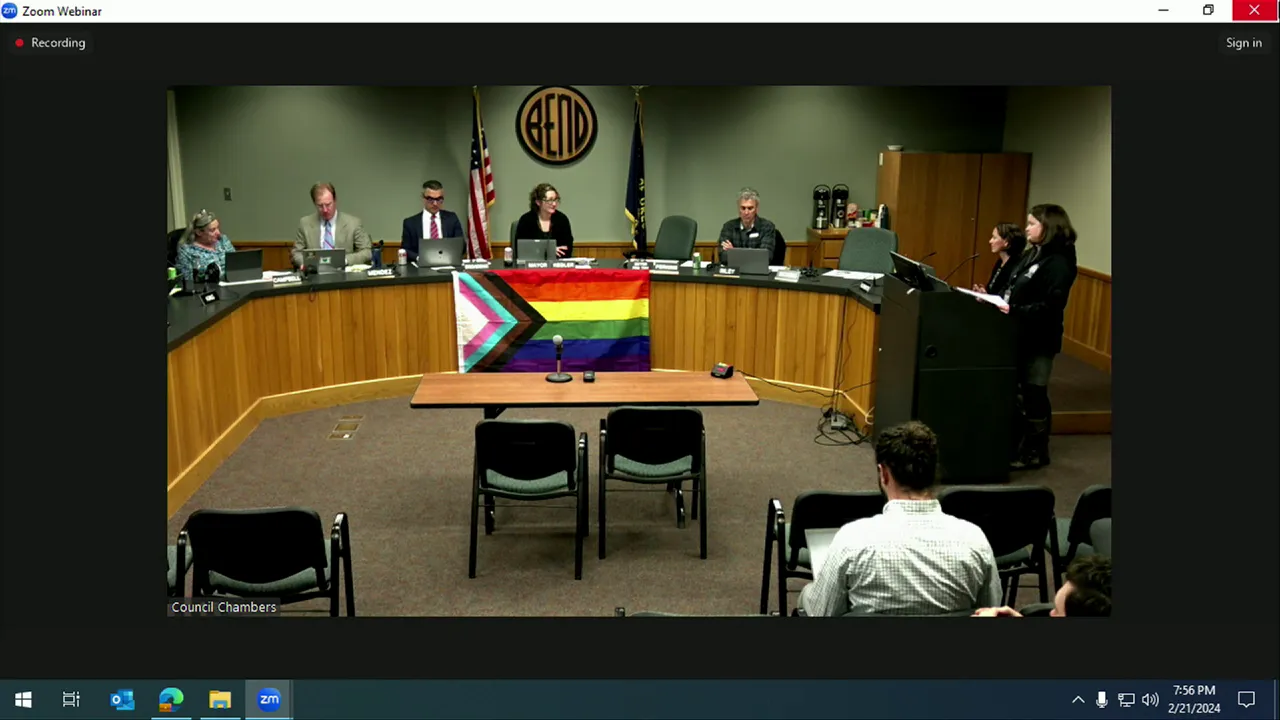
STREAMING COPY IN PREPARATION — RECORDING AVAILABLE FROM THE ORIGINAL SOURCE
Bend City Council Meeting Summary – February 21, 2024
The Bend City Council held a work session beginning at 5:00 p.m. followed by a regular meeting at 7:00 p.m. on February 21, 2024. The work session covered a water system overview and in-conduit hydro feasibility study, direction on bridge types for the Hawthorne Crossing, and a discussion on transportation system development charges (SDCs). The regular meeting included a consent agenda, a public hearing on a street name change, approval of debt issuances, affordable housing fund allocations, and construction amendments for the Purcell Boulevard and Neff & Purcell intersection projects.
Consent Calendar
- Approved minutes from the February 7, 2024 work session and regular meeting.
- Authorized a contract with Jaron McKernan Enterprises for the Pinehaven and Woodhaven Sewer Project in an amount not to exceed $933,139.35.
- Authorized advanced SDC credit agreements with Costco Wholesale Corporation for transportation and sewer.
- Authorized a professional services contract with Consor North America, Inc. for Owner’s Representation for the Midtown Multimodal Connections & Streetscaping Project in an amount not to exceed $249,591.
- Approved the OLCC report.
Public Comments & Testimony
- Ricardo Wiggs (Bend resident) expressed concern about the Bend Police Department’s lack of transparency regarding release of body camera footage, citing a specific incident. He requested the council review policies for releasing body camera footage and hold a public hearing.
- Garth Finley (Western States Carpenters Union representative) advocated for responsible bid language and enforcement to prevent wage and tax fraud on affordable housing projects, stating that some developers and contractors do not prioritize fair pay and safe conditions.
- John Calkins (Bend resident since 1985, engineering student at OSU-Cascades) recommended adding signage at roundabouts to remind drivers to signal exits, citing a 15–20% flow rate loss when signals are not used, which increases congestion and emissions.
- Public Hearing – Street Name Change (Item 6): No public testimony was offered.
Discussion Items
- Water System Overview & In-Conduit Hydro Feasibility (Work Session):
- Staff presented findings from a study evaluating in-conduit hydropower within the city’s water system. The water system uses 60% surface water (from Bridge Creek/Outback facility) and 40% groundwater (20 wells). The surface water diversion is capped at 18.2 cubic feet per second. The study identified two priority sites: the Outback Water Filtration Facility (potential generation of 8 million kWh annually, offsetting emissions equivalent to 730 homes) and the Aubrey Butte reservoir site (potential 55 homes). The system’s existing head loss (1,000 feet of vertical drop) provides the energy potential. Council gave concurrence to proceed with planning for integration of hydro at the Outback facility and to prepare the Aubrey Butte facility for future hydro installation. No construction was approved.
- Hawthorne Bridge Structure Type (Work Session):
- Staff presented six bridge types for the Hawthorne Crossing over US-97 and BNSF rail: cable-stayed, extradosed, thrust arch, strutted arch, through girder, and steel truss. The total project funding is approximately $26 million, with $20 million for construction. Cable-stayed is the least expensive among signature types but may require additional local funds. Council directed staff to take three options to the public for feedback: cable-stayed (with two sub-options for number of towers), extradosed, and steel truss (with potential for aesthetic enhancements). Maintenance costs for cable-stayed bridges are higher than for utilitarian types.
- Transportation System Development Charge (SDC) Update (Work Session):
- Staff reviewed public comments and proposed adjustments to the SDC methodology. Key changes included: creating a medical overlay district rate (supporting a lower rate for medical offices within the existing hospital overlay zone) and a hospital campus rate; disaggregating some land use categories; and adjusting the integrated rate to two tiers. Council supported a three-year phase-in (Option C) for non-residential categories with increases, where increases over 50% are phased in over three years (20% year 1, 50% year 2, full rate year 3), increases 20–50% over two years, and increases under 20% take effect July 1, 2024. Staff will release revised methodology reports in March, with a public hearing scheduled for April 17, 2024, and an effective date of July 1, 2024.
- Debt Issuance (Item 7):
- Finance Director Samantha Nelson presented three resolutions: (1) Full Faith & Credit Obligations up to $11.3 million for real and personal property acquisition; (2) Full Faith & Credit Bonds up to $45.9 million for vehicles, equipment, Public Works Campus, and transportation projects; (3) General Obligation Transportation Bonds up to $65.8 million for traffic and safety improvements from the 2020 GO Bond. All three were approved unanimously.
- Affordable Housing Fund Recommendations (Item 8):
- Rachel Eden Baker, Affordable Housing Manager, presented the 2024 recommendations from the Affordable Housing Advisory Committee. The committee recommended allocating $1,383,725 to three projects: (1) College View Apartments (59 units, 60% AMI or below); (2) Thistle & Nest Land Trust (30 homeownership opportunities, 80% AMI); (3) Redmond Habitat for Humanity (9 homeownership opportunities, 80% AMI). Council approved the recommendations unanimously.
- Purcell Boulevard Extension and Neff & Purcell Intersection Improvements (Items 9 & 10):
- Staff reported on the completion of the Neff-Purcell intersection and Purcell Boulevard extension projects. Due to unforeseen utility conflicts, the projects required change orders: $414,377.91 for the extension and $1,381,783.89 for the intersection. Total contract value with Taylor Northwest LLC is now approximately $12.5 million. The cost overruns are partially offset by savings on the Newport Avenue project. Council approved both amendments unanimously.
- Stevens Road Tract Ordinance (Item 11):
- Second reading of an ordinance amending the Comprehensive Plan, Development Code, and Transportation System Plan for the Stevens Road Tract. Approved on roll call (6-0, Councilor Norris excused).
- Cooley Road Right-of-Way Vacation (Item 12):
- Second reading of an ordinance vacating a segment of right-of-way along the north side of Cooley Road between Scenic Drive and Berg Lane. Approved on roll call (6-0).
Key Outcomes
- Water System: Council directed staff to continue planning for in-conduit hydro at the Outback facility and to prepare the Aubrey Butte reservoir site for future hydro installation.
- Hawthorne Bridge: Council chose three bridge types (cable-stayed, extradosed, and steel truss) to present to the public for feedback, with cable-stayed options including two variations on tower count.
- Transportation SDC: Council supported a three-year phase-in for non-residential SDC increases (Option C), a medical overlay district rate, and other technical adjustments. The revised methodology will be released in March, with adoption planned for April 17.
- Debt Issuances: All three bond resolutions were approved, authorizing up to $122.7 million in total borrowing.
- Affordable Housing: $1,383,725 allocated to three projects, with staff authorized to execute loan agreements.
- Construction Amendments: Two change orders totaling $1,796,161.80 were approved for the Purcell/Neff projects.
- Street Name Change: Resolution adopted renaming SW Division Street and a portion of SW Scalehouse Loop to SW Industrial Way, effective 90 days after approval.
- Ordinances: Second readings for Stevens Road Tract and Cooley Road vacation were passed.
- Council Reports: Mayor Kebler reported on a Salem trip regarding shelter funding, and staff provided updates on permit process improvements and a tree code listening session schedule.
Meeting Transcript
Where did Mary get that sticker? I think am I not sharing? One more time. Coming. There it is. All right. Okay. There we go. Ready to start. Okay, so let's get started with our work session. We are called to order. Council Norris is excused tonight. So we're starting with water system overview and inconduit hydro feasibility. Hi. Hi, thanks, Council. Really excited to share some of the results of our study year with you all. So just like Miss Keebler said, we will be going over the results of the inconduit hydrofeasibility study. So what we plan to present tonight, what we plan to cover is a review of the findings from the study, discussion about what the report's recommendations are, and then a look at the next steps and just a general concurrence from council that we're heading in the direction you'd like us to proceed with. And then finally answering any questions that we have moving forward. So with that, I'll hand it off to Lori to give us an overview of the water system. Yes, thanks, Austin. Good evening, Mayor and Council. I'm Lori Feya, Environmental Resources Manager for the Utilities Department. And I'm just going to kick this off for Austin a little bit with some just some background about our water sources, and it might be a refresher about where our water comes from, and then this will support why we did the feasibility study and the results of that. So the graphic on the screen is kind of a cartoon graphic of Ben's drinking water sources, just to remind everybody that we have two sources of drinking water. So on the graph you can see at the far left, it says source springs. That's our surface water supply source at Prowl Springs. That water we uh pull water from the source springs. Uh it gets transported into Bridge Creek and then into our intake facility where there's uh 10 miles of pipeline to go down to the outback facility where there's the water filtration plant. So that's our surface water source, and I'll talk a little bit more about that as well in just a minute. Um the other thing you can note on the graphic is we have our second water source, which is groundwater, and um it shows some of the locations of our 20 drinking water wells that pull water about a thousand feet up from underground from the regional uh water aquifers, and um supplies water also to the city of Bend. So if you could click to the next one, Austin. Thank you. So let me first talk just really briefly about the surface water source. Um the municipal watershed was established uh about a hundred years ago, and it is considered our primary source of water, so that's where we get about 60 percent of our water. We uh use that as the primary source year-round. Uh one of the primary reasons we do that is not only it's a great quality, but it's gravity-fed. So we have a lot of elevation difference, and that can carry the water down into the plant and down into the city with a very low carbon footprint. This is a protected watershed that we partner with the U.S. Forest Service on. Um we've highlighted here on the slide what's important uh relevant to our water use and also the inconduit hydro topic, is we take more than no more than 18.2 cubic feet per second. That is dictated in our city code. It's also dictated in our Forest Service special use permit. And that that would not change. That's the maximum we can take. Um I'll note that the photo there is of our intake facility that was built about 10 years ago, and it replaced an older facility. One of the great things about this this newer facility is it allows us to just take the amount of water that's being demanded in the water system. So we don't take any more than we need. There's no other place for extra water to go. So we have daily demand information.
openpublica.com