Bend City Council and BURA Meeting Summary for March 19, 2025
STREAMING COPY IN PREPARATION — RECORDING AVAILABLE FROM THE ORIGINAL SOURCE
Bend City Council and Urban Renewal Agency Meeting Summary
Date: March 19, 2025
Location: Bend City Hall, 710 NW Wall St, Bend, Oregon
This meeting combined a work session (5:00 PM), a regular city council meeting (7:00 PM), and a Bend Urban Renewal Agency (BURA) meeting. Key topics included solid waste franchise updates, traffic calming tools, the Greenwood Pilot Project check-in, approval of the 2025-27 Council Goal Framework, several proclamations, and the first steps toward creating three new Tax Increment Finance (TIF) districts to support affordable housing.
Consent Calendar
- Approved the OLCC report.
- Approved minutes from the February 3-4, February 19, and March 5, 2025 meetings.
- Authorized an agreement with ODOT for traffic signal maintenance and related work (not to exceed $706,000 over three years).
- Pulled item C (Aune Street Extension design services) for separate discussion; it was later approved individually.
Public Comments & Testimony
- Justin Gottlieb (Bend resident) shared his personal journey from shelter to potential employer, and mentioned he filed a complaint about the Bend Park Board.
- Jordan Elliott (Bend resident, Orchard District) requested council support for House Bill 3140 to allow recreation providers to use liability waivers, citing the federal EXPLORE Act.
- Bill Kowallock and Chris Hill (both DarkSky Oregon board members) urged the city to adopt modern outdoor lighting standards to reduce light pollution, noting Bend is the largest source of light pollution in Central Oregon.
- No public comment was made during the Romaine Village Way vacation hearing.
- For the BURA TIF public hearing, one attendee (representing D. Chase Development) offered support for the projects but made no formal comment.
Discussion Items
Solid Waste Updates
- Staff presented an update on solid waste franchise agreements and a proposed regional coordination framework with Deschutes County. Key elements include facility designation, rate-setting, and a 7-year evergreen term.
- Council expressed support for regional consistency tempering the plan's alignment with the Climate Action Plan, and raised concerns about staffing and fiscal risks.
- Discussion included the need for improved customer service and incremental enforcement mechanisms.
Traffic Calming Tools
- Staff presented an overview of traffic calming tools, focusing on raised pedestrian crossings. They discussed current standards that limit raised crossings on arterials and collectors, but noted exceptions (e.g., Butler Market Road, Hawthorne Bridge landing).
- Council generally supported expanding the use of raised crossings, emphasizing context-based application and the need to address speeding as the root problem. Councilor Méndez suggested using them more liberally, while Councilor Riley noted the need for data but cautioned against relying solely on existing demand.
- Next steps include a broader transportation standards work session on April 2, 2025.
Greenwood Pilot Project Check-in
- Public feedback (1,586 responses) showed 63% negative overall rating, but noted a segment supporting safety improvements. Travel times increased (e.g., eastbound from ~93 to ~112 seconds), but speeds decreased by 5-7 mph. Bike volumes increased significantly in September and January compared to baseline.
- Crash data showed a decrease from ~30-32 crashes to 25 in a comparable window.
- Council acknowledged construction-related disruptions (e.g., Wall/Only closure) and requested continued data collection, particularly after the Wall/Only intersection reopens.
2025-27 Council Goal Framework
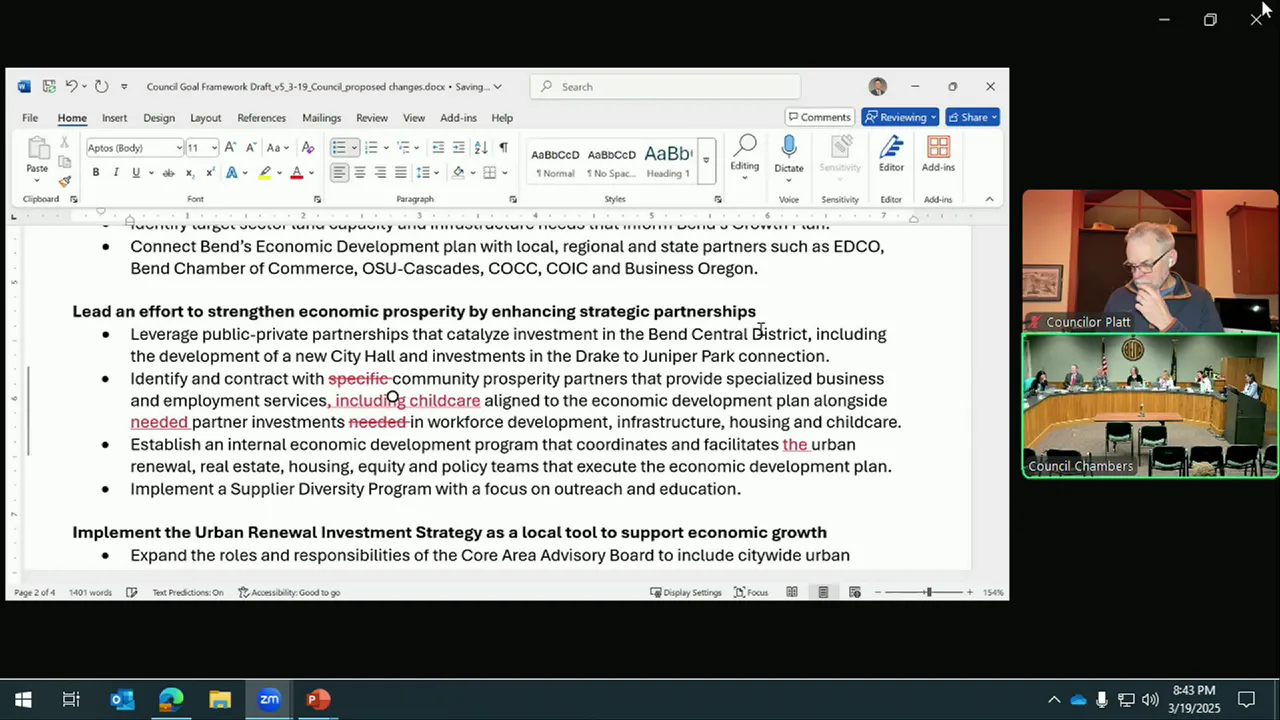
- The framework was approved with several amendments made during the meeting, including language adjustments to the transportation and economic prosperity sections.
- Key edits included adding 'increase transit service' and clarifying economic prosperity goals to focus on living-wage jobs and workforce development, with housing addressed elsewhere.
- Approved unanimously (7-0).
Key Outcomes
- Consent Agenda Approved: With the exception of item C, which was later approved separately.
- Aune Street Extension (item C): Authorized an agreement with DOWL, LLC for design services not to exceed $545,517, for the first phase (0% to 30% design).
- Romaine Village Way Vacation: Approved the first reading of an ordinance to vacate a portion of Romaine Village Way (unanimous).
- Council Goal Framework: Approved unanimously (7-0).
- Proclamations: Approved for Absolutely Incredible Kid Day and Women’s History Month.
- Appointments: Approved five appointments to the Human Rights and Equity Commission, including three commissioners and two alternates. Council also directed staff to prepare a code change to allow ex-officio members on advisory bodies.
- Letters: Approved letters of support for BPRD plan amendment, on tax bill priorities, and on tourism revenue reform.
- Solid Waste Updates: Staff will continue working toward new franchise agreements and an IGA with the county; next update at the joint city-county meeting on April 28, 2025.
- Traffic Calming: Council expressed support for expanding raised crossings; staff will incorporate feedback into the transportation standards update.
- Greenwood Pilot: Staff will continue data collection, with a comprehensive report expected in September or October 2025.
Bend Urban Renewal Agency (BURA)
- Minutes Approved: February 19, 2025 BURA meeting minutes were approved.
- TIF Districts Forwarded: Resolutions to forward the Britta Ridge, Century, and Veridian Tax Increment Finance Area Plans and Reports to the Planning Commission, affected taxing districts, and Bend City Council were passed with votes of 6-1, 6-1, and 7-0 respectively. Councilor Franzosa opposed the first two.
- The TIF districts aim to fund affordable housing projects, with a total of 696 units across the three areas (178 at Britta Ridge, 152+297 at Century, and 69 at Veridian), including rent-restricted units at 80-90% AMI.
- Next steps include a 30-day public comment period, Planning Commission review on April 14, and a City Council hearing on May 7, 2025.
Meeting Transcript
Okay. So we are gonna get started with the work session here tonight. Um we have Council Platt online. Council Norris is excused, she'll be here for the business meeting. So we are gonna start with solid waste updates. Great. Good evening, Mayor and Council. I'm Stephanie Betteridge, Assistant City Manager, and I'm joined by Michael Selkirk, senior assistant city attorney to provide you with an update on solid waste franchises. We are joined tonight by two city staff, Samantha Nelson and Cassie Lacey, who will be here momentarily, along with our county partners, Tim Brownell and Susan Baker. And we also have a few um representatives from our solid waste haulers in the audience who you heard clapping just a few minutes ago. So the focus of tonight's presentation is to provide an update on solid waste franchises and the work that's been accomplished since the joint city county meeting that took place in September. We'll also be looking to you for feedback on the priorities that have been informing our approach to solid waste management, including agreements and the solid waste hauler agreements with the solid waste haulers and an IGA with the county. In the interest of time, we're gonna keep things fairly high level, but um please don't hesitate to pause us and ask for additional details. So to start us off, I will be turning it over to Michael to talk about the current franchise agreement. Uh good evening, council. So I'm gonna start uh just with some background on our franchise arrangements. Uh I think at least four of you were here when we did our franchise code recently. Uh and this may be new for two of you. So a franchise in this context is not like a fast food franchise. Um this is an exclusive or non-exclusive right to use the city rights of way to conduct business. So that right to do business using our streets comes with certain conditions to ensure public health and safety, to ensure that city property is properly managed and maintained, and that the city is fairly compensated for use of the streets. So you'll remember that that when we updated the franchise code last year, we did not include in that update the solid waste franchisees. It was just uh the other utilities that do business in our city, and that is primarily because solid waste regulation is different than the other utilities that we have in our city. So with solid waste, the city acts like the PUC public utility commission does for the other utilities. The city sets exclusive service areas, sets rates, and sets service levels. So first, an exclusive service area, and this is pretty self-explanatory, but it means that no one else can provide the solid waste business service at a particular address other than the franchisee. And that's because it would be inefficient, noisy, and harmful to streets to have multiple large vehicles serving the same neighborhood. Similarly, the city sets rates and regulates quality of service because that exclusivity essentially creates a monopoly. So the PUC is regulating with the other utilities. The city is acting like the PUC with respect to solid waste. So because of this exclusivity and rate regulation, the city's solid waste franchises are similar to the other utility franchises. For example, there are liability provision provisions. A lot of that looks the same, but there are some key differences. And those key differences are up on the screen. I'll go through them quickly. So the first one is that the city plays a larger role with respect to what types of business the service providers can do exclusively and what they can't. So for example, uh in Bend, the franchise is very broad, the right to provide that exclusive service. But one of the exceptions would be the right that we all have to bring our trash to a disposal site on our own. You're not required, for example, to have service in town. Second, because this is a city creative monopoly, the city evaluates and sets rates to ensure that those rates and costs are reasonable. There's currently no requirement in the code for a particular level of profit, but in the recent past, in the recent past, profits have hovered around 10%. Third, the city sets and enforces service standards to ensure that the companies are providing services that are safe, that are fair, and that are dependable, and also that they're operating consistent with environmental loss. And then finally, because the providers are making very significant capital investments in town and their service here, the city guarantees a rolling seven-year term, meaning that the city would have to give six years' notice before a franchise terminates. So I mentioned quickly about compliance with environmental law. I'm going to go over these laws very high level. There are two relevant laws for recycling in Oregon. One is the OTR or the Opportunity to Recycle Act. That was enacted in 1998. That essentially set the statewide recycling policy that we're all used to. Requires recycling, for example, certain education and outreach.
openpublica.com