Bend City Council Meeting – May 21, 2025: Housing, TIF Plans, and Policy Actions
STREAMING COPY IN PREPARATION — RECORDING AVAILABLE FROM THE ORIGINAL SOURCE
Bend City Council Meeting – May 21, 2025
On May 21, 2025, the Bend City Council held a work session at 5:00 p.m. followed by a regular session at 7:00 p.m. The meeting addressed housing funding strategies, council goal prioritization, proclamations, a resolution supporting the 2SLGBTQIA+ community, creation of three new tax increment finance (TIF) districts, short-term rental licensing changes, and other administrative items.
Work Session – Housing Funding Work Group Scoping (5:00 p.m.)
- Staff from Real Estate, Housing, and bond counsel (Chris Reynolds, Mike Schrader of Oregon Public Finance) presented housing funding needs: Bend requires 33,000 units by 2045 (1,400/year), with a median home value gap around $450,000–$500,000. Since 2004, the city has leveraged over $20 million in local/state/federal funds for homeless services.
- Discussion focused on possible tools: general obligation bonds (Measure 102), credit enhancement, deed-restricted purchase programs, vacancy taxes, employer partnerships, and a proposed Housing Funding Strategies Committee (named "HOME"). The committee would meet 5–6 times over fall–winter 2025 and report back by spring 2026. Council directed staff to include short-term actions by end of 2025, large employers, and non-expert community members.
Work Session – Council Goal Work Plan (5:00 p.m.)
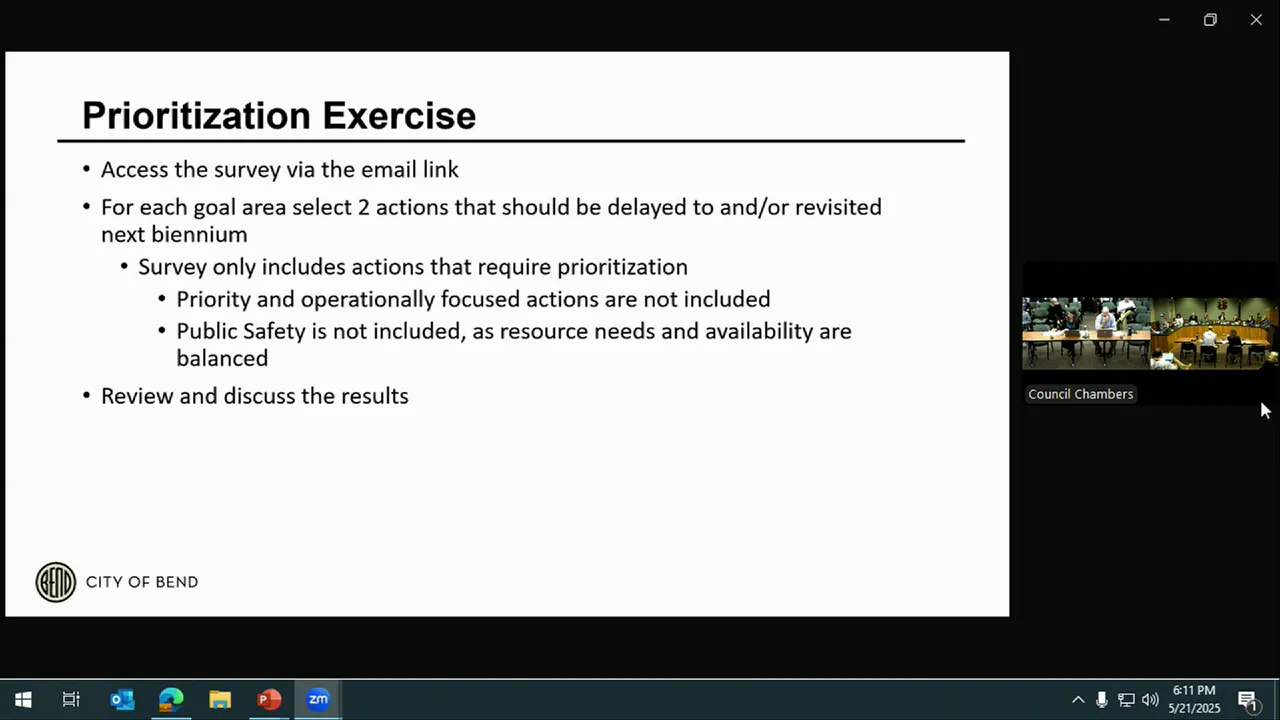
- Staff presented 6 goals, 18 strategies, and over 50 actions; 50% result in new/expanded programs. Council prioritized using a survey to delay or revisit certain actions. Key decisions: the growth plan, transportation funding, and public safety were deemed foundational. Items like data collection on rental markets and outreach programs were folded into the housing work group. On transportation, property acquisition for water reclamation was prioritized over grants. On climate, dark sky and leaf blower restrictions were moved to later. Council agreed to a holistic funding discussion in early 2026.
Regular Session – Roll Call (7:00 p.m.)
All seven council members present: Mayor Melanie Kebler, Mayor Pro Tem Megan Perkins, Councilors Gina Franzosa, Ariel Méndez, Mike Riley, Megan Norris, and Steve Platt.
Good of the Order & Proclamations
- Mental Health Awareness Month – Councilor Riley presented the proclamation; Kenny Haddon (NAMI Central Oregon) spoke about mental health challenges.
- Stroke Awareness Month – Councilor Norris presented; Carol Stiles (Stroke Awareness Oregon) highlighted that 1 in 5 people will have a stroke.
- Committee Updates: Stewardship Subcommittee meets next week; Community Building Subcommittee in June.
- Letters: Council approved sending a letter to the Deschutes Civic Assembly regarding their recommendations.
- Appointments: Bet Hannon appointed to the Human Rights and Equity Commission (unanimous).
- Council Reports: Councilor Franzosa attended Bend Central District meeting; Councilor Riley attended Made in Bend Tour; Councilor Perkins reported 2025 Point-in-Time Count showed Bend’s homeless population stable, with 50% sheltered and 50% unsheltered; 800 children in Deschutes County schools are homeless. Councilor Norris attended Environmental and Climate Committee; Councilor Platt highlighted budget transparency. Mayor Kebler testified on transient lodging tax reform, attended mayors’ call, and announced the city joined a lawsuit against federal grant conditions.
Visitor’s Section
Public comments included: Josh Burgess (Central Oregon Civic Action Project) encouraging continued civic assembly funding; Nancy Bould urging rental data collection; Tiara Lee discussing homelessness and mental health; Peter Growe supporting innovative housing finance; Clayton Crowhurst urging sharpened housing tools; and Michael Caligure (later moved to TIF hearing) opposing tax increases.
Consent Agenda
Items A–C, E–H approved unanimously. Item D (Safe Routes to School Bear Creek grant of $765,710.96) was pulled by Councilor Perkins for discussion; Council approved it separately after staff presentation.
Discussion Items
Resolution Reaffirming Support for 2SLGBTQIA+ Community (Item 5)
- Council heard from four community members (Ryan Roberts, Linda Heimer, former Councilor Linda Johnson, and Kina Chadwick) who emphasized the importance of visible support. Council adopted the resolution unanimously (7-0).
Tax Increment Finance (TIF) Plans for Britta Ridge, Century, and Veridian (Item 6)
- Quasi-judicial public hearing. Staff (Elizabeth Oshl, Jonathan Taylor) presented three new TIF areas: Britta Ridge (6.16 acres, 178 units, $14.6M max indebtedness), Century (9.2 acres, 297 + 152 units, $49.6M), and Veridian (2.81 acres, 69 units, $8.7M). All are infill on blighted land; 123 of 698 total units will be rent-restricted at 90% AMI for at least 12 years. Two taxing districts requested shorter durations; staff recommended maintaining 30–32 year terms.
- Public testimony support from Tyler Nees (Cascades East Realtors), Morgan Greenwood (COVA), David Welton, Sarah Odendahl (Bend Chamber), and Planning Commissioner John Mamma.
- Council debate: Councilor Méndez supported as innovative; Councilor Perkins voted no on Britta Ridge and Century, citing insufficient affordability and long duration; she voted yes on Veridian. Councilor Riley noted the projects exceed the 15% affordability minimum (17.6%). All three plans passed on first reading: Britta Ridge (6-1, Perkins opposed), Century (6-1, Perkins opposed), Veridian (7-0). Second reading scheduled for June 4.
First Reading – Short-Term Rental Operating License Amendments (Item 7)
- Amendments require every short-term rental (including those in Mount Bachelor Village) to obtain an individual operating license. Current umbrella license expires Nov. 15, 2025. Estimated $40,000 annual revenue increase. Approved unanimously (7-0).
First Reading – Ex-Officio and Alternate Members for Boards/Commissions (Item 8)
- Amendment allows the mayor to designate ex-officio (non-voting) and alternate members. Approved unanimously (7-0).
Resolution Authorizing Eminent Domain for Olney Pedestrian and Bicycle Project (Item 9)
- Additional temporary construction easement (115 sq ft) and an access easement for sewer line maintenance. Property owner (Riverside Vet Clinic) may relocate access easement if property redevelops. Adopted unanimously (7-0).
Second Readings – Graffiti Ordinance (Item 10) and System Development Charges (Item 11)
- Graffiti ordinance: Amends BMC Chapter 13.40; approved unanimously (7-0).
- SDC ordinance: Councilor Méndez recused (conflict of interest). Approved 6-0.
City Manager’s Report
- Olney and Wall project and Aubrey waterline project (Portland Avenue) expected to reopen by Friday, May 23. City Manager thanked community for patience.
Key Outcomes
- Housing Work Group: Council directed staff to form the HOME committee, with a resolution in June, appointments in July/August, first meeting in September 2025, and check-in by end of year.
- Council Goal Work Plan: Survey results to inform prioritization; staff to return with updated proposal at early June meeting.
- 2SLGBTQIA+ Resolution: Adopted unanimously.
- TIF Plans: First reading passed for all three districts; second reading June 4.
- Short-Term Rental Ordinance: First reading passed; second reading June 4.
- Ex-Officio/Alternate Ordinance: First reading passed; second reading June 4.
- Eminent Domain Resolution: Adopted unanimously.
- Graffiti Ordinance: Adopted unanimously.
- SDC Ordinance: Adopted 6-0.
- Legislative Update: Lobbyist Eric Gansle reported on transportation package (no draft yet), shelter funding ($217M in governor’s budget), wildfire funding, and two Bend-sponsored bills (SB 967 on LIDs, SB 1129 on urban reserves) that passed unanimously.
- City Lawsuit: Bend joined 30 local governments in a lawsuit challenging federal grant conditions.
Meeting Transcript
We will magically get the program. The control. All right. So we are going to go ahead and get started with our Benn City Council work session. We are all present, and we are starting with our housing work group scoping items. So we have a lot of people in front of us ready to kick this off. All right. Good evening, Marion Council. My name is Matt Stewart, the real estate facilities director, and I'm joined Steven by Rachel Baker, our housing division manager, and Chris Reynolds and Mike Schrader with Oregon Public Finance in our uh our bond council capacity. So tonight we wanted to discuss sort of some housing funding options. We'll first kind of talk about the housing funding need, so around our council goals, and then we'll dive into the existing tools that we've been using to date to produce some affordable housing as well as uh other housing and housing spectrum. We'll talk about potential tools that are out there that we could look at, and then finally we'll dive into a proposal from staff to uh establish a housing funding committee, and that would just kind of spend the next 12 months evaluating some of these potential tools and coming back to council with a recommendation to then further develop work plan and move those forward. So that will be part of the council guidance at the end, asking how we kind of put that committee together. So for over 20 years, the city of Bend has adopted incentives or created funding programs to produce housing at every level of the housing spectrum. Housing mobility requires an adequate amount of housing or shelter at each level of this spectrum. When interest rates are high and moving would increase a household's property taxes, those community members cannot afford to consider moving into a new home for downsizing or a bigger home for family growth. Unless and until there are changes outside of this city's control, more incentives and subsidies will be necessary to create much needed housing elasticity in central Oregon. And so if we look at our housing need here, uh we've talked a lot about in the past the Oregon housing needs analysis, and that came out saying over the next 20 years, Bend in its here in our region needs about 33,000 units by 2045. That is about 1900 units a year. That 1900 includes how we addressed our house list situation, but also units that we have underproduced. So currently they estimate that Ben is underproduced about 5,000 units today. Well, if we break that down into how many units a year we need to produce to meet that number from today until 2045, that is about 1,400 units per year. And then the last item that we always look at is the affordability. So anything below 120% AMI. So that's one of the big items that we're looking at tonight is how do we address some of those items? And you can see from our housing production over the last 10 years. If we want them to not be house burdened or house cost burden, that would be 30% of that needs to go to their housing costs and no more. That roughly translates to a home value of somewhere between 450 to 500,000. So we see that gap between where the median home price is and what we're seeing from our area median income here in the county, in the city and the county. Sorry. So awards in affordable housing development since 2004 include over 10 million in community development block grant funding, over 18 million in affordable housing funds, 500,000 for middle income housing funding, and over 360,000 in funds from the commercial and industrial construction tax. Since 2021, the city has leveraged over 20,000 or sorry, 20 million in local, state, and federal funds for houseless services, including acquisition, renovation, and operation of shelters, expansion of the safe parking program, housing focused case management at the temporary safe stereo and other outreach and prevention. So since uh 2007, we've produced 1,260 affordable housing units per year. While subsidies facilitate housing production for market costs, incentives encourage housing development despite market demand fluctuations. The city adopted incentives over 20 years ago to encourage affordable housing production, but recently adopted incentives, whether city-led or mandated by state legislature, ensure steady housing development and stabilize the housing market. Today we share these ideas. Oh, just so you're aware. Sorry. We do have a middle housing production dashboard that you can check out to see how much middle housing product has come on board since some of those state initiatives in 2022 and until this year. Today we share ideas that could spur more housing production. I can provide you an explanation of these listed ideas, but this presentation is not for you to get a comprehensive understanding of these possibilities. We just want to share with you some of the potential ideas that could be explored over the next year. With uncertainty of state and federal funding availability to sustain current affordable housing production in Bend, exploring local revenue generating options may be critical to housing for our very low, low and moderate income households. Any new reverend any new revenue generating program would require allocated staff taken from either current work or newly hired. And at this time, I'd like to introduce Christina Reynolds and Michael Schrader to share with all of you some of the legal requirements of complex financing mechanisms you may want to consider. Thanks very much, Rachel and Matt. Hi, I'm Chris Reynolds. I've had the pleasure of working with the City of Bend my entire public finance career, a little more than 22 years as your bond counsel, and we're here today to talk about housing finance tools and excited to talk through some of those with you. On the first page here, you see the topic of general obligation bonds. As you may be aware, the Oregon State Constitution and many, if not most constant state constitutions, have a provision that prevents governments, including the city, from lending their credit to private parties.
openpublica.com