OPENPUBLICA · PUBLIC MEETING RECORD
Record of Proceedings
Biddeford City Council Workshop: TIF, Development Overview, and Staffing Discussion – January 13, 2026
City Council & Committees — Tuesday, January 13, 2026
BodyBiddeford, Maine
SessionCity Council & Committees
DateTuesday, January 13, 2026
StatusFILED
Video Record
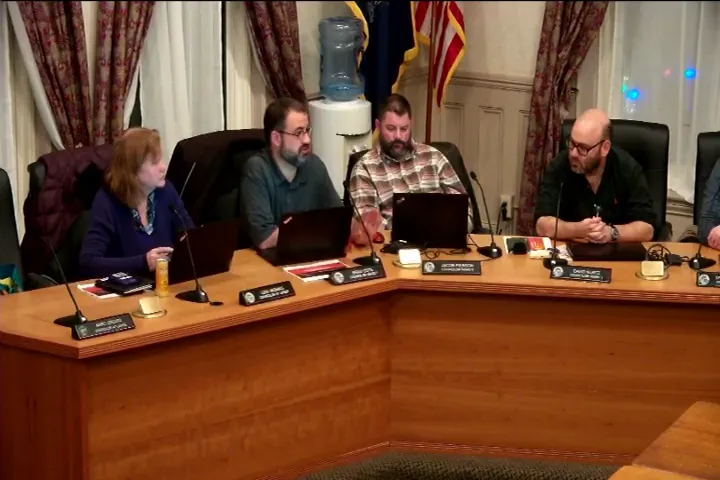
STREAMING COPY IN PREPARATION — RECORDING AVAILABLE FROM THE ORIGINAL SOURCE
Transcript — Verbatim
Speaker numbers apply only to this recording.
Discussion Breakdown — Share of Meeting
Personnel Matters30%
Investment Policy13%
Tax Increment Financing12%
Affordable Housing9%
Community Development Block Grants8%
Economic Development7%
Procedural6%
Engineering And Infrastructure3%
Community Engagement3%
Summary of Proceedings
Biddeford City Council Workshop: TIF, Development Overview, and Staffing Discussion – January 13, 2026
The Biddeford City Council held a workshop on January 13, 2026, at 5:30 PM in City Hall Council Chambers and via Zoom. All council members were present except Councillor Lassard, who was excused. The workshop included a TIF 101 presentation by Philip Saucier of Bernstein Shur, a city development overview by City Planner David Galbraith, and a discussion of staffing vacancies and potential organizational changes.
TIF 101 Presentation
- Philip Saucier, a shareholder and leader of Bernstein Shur's Municipal & Governmental Services Practice Group, explained that Tax Increment Financing (TIF) is an economic development tool that captures the increased assessed value of property within a designated district and shelters it from the municipality's state valuation.
- TIF districts may be economic development, affordable housing, downtown, transit-oriented, or omnibus districts. Economic development TIFs are approved by the Department of Economic and Community Development (DECD); affordable housing TIFs are approved by MaineHousing.
- The maximum TIF term is generally 30 years, but the legislature recently allowed a 20-year extension to 50 years when at least 75% of costs in the extension period are attributable to affordable housing or transit-oriented development. The city recently extended its Route 111 TIF to 50 years.
- State caps limit TIF acreage: a single district may not exceed 2% of municipal acreage, and all qualifying districts combined may not exceed 5%. Biddeford currently has 227 acres in TIF districts, but 200 acres are excluded as transit-oriented; qualifying TIF acreage is only 0.19% of city acreage versus the 5% cap. Qualifying original assessed value is 0.05% against a 5% valuation cap.
- TIF revenues must be used for approved project costs in the TIF development program. Costs fall into three tiers: inside the district, outside but directly related, or anywhere in the municipality for specific statutory uses. Credit enhancement agreements (CEAs) are an optional tool to reimburse developers from increased tax dollars; about 60% of Maine's roughly 400 TIF districts include at least one CEA.
- Saucier described the tax shift benefit as the real municipal benefit of TIF: shielding valuation protects state education subsidy, county tax apportionment, and state revenue sharing. For Biddeford, the tax shift benefit was recently estimated at about 55–60%, meaning the city would lose roughly 55 cents per dollar without a TIF.
- Saucier reviewed Biddeford's TIF inventory, including CEAs with Adams Point, Marble Block, Riverdam, Route 111, Sacco Lowell, Saxon Lowell, and multiple affordable housing TIFs. He noted the city has room under statutory caps and could adopt local policy guidelines for TIF requests.
- In response to council questions, Saucier said TIFs are not available for owner-occupied single-family homes; rental housing can qualify. Developers do not need to consent to having a parcel placed in a TIF. There is no state audit specifically for TIF, but recordkeeping is important because DECD requires actuals during amendments. TIF revenues can pay for economic development salaries and consultants.
City Development Overview
- David Galbraith, City Planner and Acting Director of Planning, presented an overview of active and pending developments across downtown and western Biddeford.
- Downtown highlights: Lincoln Mill redevelopment opened in 2022 with 147 residential units and 35 hotel units; Laconia House in Pepperell Mill Building 11 has 76 market-rate units under construction; Westbrook Development Corporation's two Pearl Street buildings would each have 45 low-income senior housing units, with first-building funding secured; a planning-board-approved lot near the Pearl Street garage includes about 52 units, 5 condominiums, 85 units, and a 154-seat restaurant; the One Diamond project has changed from roughly 480 housing units to about 130 townhouses and will require renegotiation of its development agreement; Adams Point is about 80% complete; Buildings 19 and 20 at the Pepperell Mill were approved in 2025 for 64 rental units; Building 30 at 2 York Street has 11 units under construction; Marble Block added 8 residential units plus commercial uses; and 12 Pearl Street is proposed for about 20 apartments.
- Western Biddeford highlights: The Eddy includes 250 workforce housing units, with 116 studio apartments and 134 one-bedroom apartments, off Bear Road; Westbrook Development Corporation's 37 Bear Road project has funding for a 40-unit family building and is expected to start construction in spring; Avesta Housing's 46-unit senior development did not receive funding this year and will reapply for 2026–27; Forest Green Apartments, a proposed 60-unit senior development, did not receive funding but the developer has agreed to pay about $225,000–$250,000 in sewer impact fees plus $750,000 toward pump station upgrades, with the city contributing about $350,000; Divine Capital is building a 216-unit apartment complex at Andrews and Alfred; Chick-fil-A at 222 Bariner Way has preliminary approval for a dual drive-thru; a 195-unit mobile home park at Waterworks Drive is under construction in eight phases, with about $25,000 per phase in impact fees for a future sidewalk; and a 30-lot single-family subdivision is under review near the Biddeford-Kennebunkport-Vernon Pool Complex.
- Galbraith warned that sewer capacity in western Biddeford is nearing capacity and will need upgrades as development continues. He also mentioned several smaller projects, including FMI, Popeyes, Mystery Springs, Burger King, a potential parking garage at 41 Main Street, UNE student housing at the St. Joseph Convent, and Biddeford Housing Authority's proposal to convert 25 Adams Street into 10 low-income units.
- Councillors asked for a consolidated list of all housing units by type and status, information on which projects have CEAs, and analysis of impacts on city services. Councillor Badney expressed concern that too much housing relative to industrial and commercial development could strain infrastructure. Councillor Woods questioned whether The Eddy actually meets the city's workforce housing definition of 80% of area median income and asked about enforcement. Councillor Kurtz asked about traffic improvements, including a planned Elm Street and Upper Falls Road traffic signal and MDOT presentations; Galbraith said both Westbrook projects received first-phase funding. Councillor Cody asked for usage data on the existing footbridge before considering a second bridge. Councillor Delby expressed frustration with developers changing project scopes after approval, especially One Diamond, and called for accountability and more starter homes. Councillor Pearson asked what staff needs from the council; Galbraith said clear direction, staff involvement in development agreements, and fees for plan changes would help.
Staffing Vacancies and Organizational Discussion
- The city manager discussed current vacancies: an APAR clerk, a possible in-house city attorney, deputy city manager, deputy director of human resources, economic development director, facilities manager, wastewater treatment plant superintendent, life safety code inspector, and staff engineer. The deputy city manager vacancy was created by Brian Finney's retirement, and the deputy HR recruitment was near conclusion.
- Proposed reorganizations included converting the COO title to deputy city manager, using a new facilities manager to absorb day-to-day facility duties, shifting economic development and TIF and joint development agreement coordination into the deputy city manager role, potentially eliminating the economic development director position to fund an assistant planner, and splitting the vacant staff engineer salary to fund a transportation planner or engineer and on-call engineering services.
- Council President read written comments from absent Councillor Lassard, who favored more support staff over quasi-management positions, supported succession planning, opposed a deputy HR director, favored a business-development-focused position, and opposed an in-house staff attorney because outside solicitor services already cost more than $100,000 per year and a staff attorney would likely cost more.
- Council President said he has full confidence in the city manager and did not want the council micromanaging personnel decisions. Councillor Boston agreed but asked for current and revised org charts and said an economic development director may still be needed. Councillor Pearson argued the city should support existing staff before adding new titles. Councillor Cody supported moving forward on the deputy HR director and favored a city manager proposal.
- The city manager noted a compensation and classification study is under consideration; bids are being vetted, with an estimated cost of about $30,000, and it would need finance committee and council approval.
- In discussing the in-house city attorney idea, the city manager reported legal services costs of approximately $104,000 in FY23, $105,000 in FY24, and $136,763 in FY25. The proposed salary range tops out at $130,000, not including benefits, and outside counsel would likely still be needed for specialized areas. Councillor Kurtz supported the idea, Councillor Doughty wanted a fuller cost picture including support staff, and Councillor Woods wanted cost details before a decision.
Key Outcomes
- The council gave direction to advertise for the deputy city manager position, with the job description including some economic development director responsibilities.
- Recruitment for the economic development director position was paused pending further discussion by the personnel committee; the council did not support eliminating the position outright.
- The in-house city attorney posting was paused until the city manager provides more detailed cost and benefit information, including total compensation and likely ongoing outside counsel needs.
- The deputy director of human resources recruitment will move forward, and the facilities manager position is expected to be posted.
- The city manager will return with additional organizational and budget information, including org charts and cost data, through the normal personnel, finance, and budget processes.
No formal votes were taken; the workshop adjourned after the council discussion.
Meeting Transcript
Good evening. I will call the workshop for January thirteenth, twenty twenty-six to order. Uh roll call, all members except Councillor Lassard are present. He is excused. And with that, please stand for the Pledge of Allegiance. A presentation from Philip Sassier from Bernstein Sure. Thank you. Take us away. Uh Philip, would you like us to ask questions at the end of your presentation or throughout? Okay, thank you. Could everyone hear what I said before? Okay. Um I apologize. You did tell me to do that, and I forgot. So I'll just dive right into it. So this is the general agenda. I'm going to go over what is a TIFF district, the types of districts, how can TIF revenues be spent, what a tax shift benefit is, and just a listing of what the city currently has as TIFF inventory. So a TIFF is what we usually like to talk about it as is it's an economic development tool. And it's actually one of the few economic development tools that the legislature has have given municipalities. As you know, we keep uh municipalities don't have a lot of authority in terms of taxing or anything like that, but they do have the authority to implement TIFF districts. What a TIFF district is a geographic boundary around some parcel or parcels within your community. There's an original assessed value. I'm gonna get into each of these terms a little bit more detail as I go along. In other words, at the time you adopt that district, what's that value of the parcel, what's that worth from an assessment perspective? You need to adopt something called the development program. That's what I think of when I think of the TIFF. So there's a narrative form, and um and you and you have one for each of those, and includes a map as well. And then the application after the council adopts the TIFF district is reviewed and approved by one of two state agencies depending on the type of TIFF. So the main Department of Economic and Community Development, DECD reviews what we call economic development TIFF. So those are the TIFS that most people are familiar with. But there's also an affordable housing uh TIFF district, um, which is very similar in concept, but it's targeted specifically to affordable housing developments, and those are those applications are reviewed by the main housing authority, main housing. Some potential benefits of TIFFs. They can help municipalities achieve your economic development goal or vision within your comprehensive plan and other planning documents. So in other words, you can use them to try to encourage development in certain areas or target development in certain areas. You can use them to attract new investment, tax dollars, redevelopment of property, jobs, things of that nature. You can use them to accomplish significant infrastructure projects through the use of TIF dollars. And there is a tax shift benefit associated with it. And that's really the benefit to the municipality. So this is just a slide I like to use to give you an example of what it means to put a parcel in a TIFF district. So at the base, you have a you have a uh base value. So let's just say that's the parcel as it exists today, and it's worth a million dollars. You know that there's some development coming. A developer is going to redevelop a property, build a new facility with approximate value of five million dollars. So the city puts a TIFF district around that. That base value continues as an assessment of 1 million dollars. But everything above that, that's called the increased assessed value, is captured and sheltered from the state, seeing it as part of your municipal valuation. Right? So that's the way it works, and I'll get into what that means, but there benefits the city to do that to doing that.
SUMMARIZED BY OPENPUBLICA AI
TRANSCRIPT VIA PUBLIC VIDEO
openpublica.com
openpublica.com