OPENPUBLICA · PUBLIC MEETING RECORD
Record of Proceedings
Biddeford City Council Meeting Summary - January 20, 2026
City Council & Committees — Tuesday, January 20, 2026
BodyBiddeford, Maine
SessionCity Council & Committees
DateTuesday, January 20, 2026
StatusFILED
Video Record
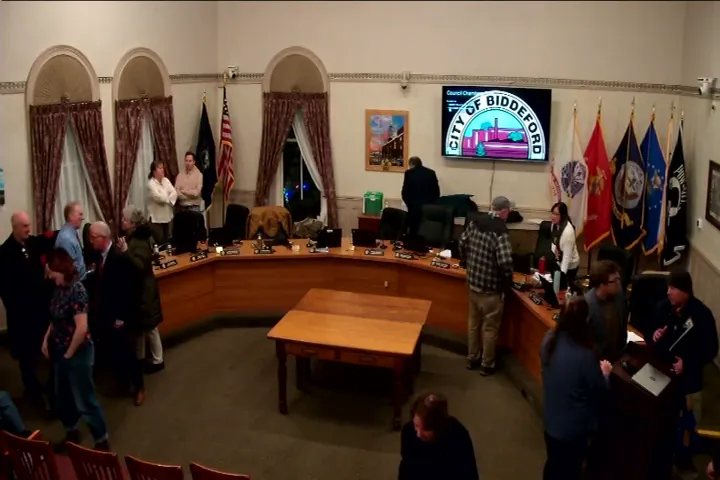
STREAMING COPY IN PREPARATION — RECORDING AVAILABLE FROM THE ORIGINAL SOURCE
Transcript — Verbatim
Speaker numbers apply only to this recording. Names come from transcript evidence. “Possibly” marks uncertain attribution.
Discussion Breakdown — Share of Meeting
Affordable Housing44%
Procedural15%
Community Development Block Grants8%
Education6%
Economic Development4%
Public Engagement3%
Fiscal Sustainability3%
Personnel Matters3%
Engineering And Infrastructure2%
Summary of Proceedings
Biddeford City Council Meeting Summary - January 20, 2026
The Biddeford City Council met on Tuesday, January 20, 2026, at 6:00 PM in City Hall Council Chambers and via Zoom. All nine councilors were present, and there were no agenda adjustments. The meeting included a CDBG plan presentation and public hearing, mayoral appointments, public comment, approval of minutes, a parking change, Winterfest approvals, two abatement requests, an institutional zone/university use moratorium, a failed mobile home lot fee moratorium, a council rules change, reports, and an executive session on personnel.
Presentations and Public Hearing
- Jessica Wilson, Community Development & Grants Manager, presented the five-year CDBG Consolidated Plan and the FY24/FY25 action plans. She stated CDBG funding must primarily benefit low- to moderate-income households at 80% or less of area median income, and described the FY25 allocation of $424,428, proposed uses including $65,000 for housing rehabilitation and $155,000 for MacArthur Library renovations. The public comment period runs through February 17, 2026, with a second public hearing scheduled for that date.
- The CDBG public hearing opened and closed at 6:26 PM with no public comments.
Appointments
- 2026.07 (citizen committee appointments) was approved 8-0-1; Councilor Kurtz abstained because his mother was among the appointees.
- 2026.08 (councilor committee appointments) was approved unanimously.
- 2026.14 (Institutional Zone ad hoc committee) was approved unanimously.
Public Comments & Testimony
- In the first public comment period, two residents discussed possible ICE activity in Biddeford; one requested a family reporting avenue and a formal petition to the Governor. Another resident spoke in support of MacArthur Public Library's services to people experiencing homelessness. One resident raised public beach access. One resident asked that agenda items 10.e and 10.f be moved earlier; a motion to do so passed 6-3.
- On the institutional zone/university use moratorium, three residents spoke in favor and three against. A UNE representative opposed the moratorium, saying UNE's last new building was in 2018, traffic has decreased since the osteopathic medicine college moved to Portland, and UNE does not burden city infrastructure. Representatives of the Sisters of the Good Shepherd also opposed it, saying the moratorium would delay the sale of St. Joseph's Convent and hurt their ability to care for elderly sisters. Other residents supported the moratorium as a needed review of a 20-year-old regulatory framework.
- On the mobile home lot fee moratorium, 23 Granite Estates residents were present and five spoke. Residents reported lot fees rising from roughly $350 in 2020, with repeated annual increases of $35-$75, and said new buyers would face about $900 per month in lot rent. Councilor Cote noted fees at Granite Estates rose from $300 to $385 between 2016 and 2022 under the original owner. Two commenters warned of financing costs, investor signals, and unintended consequences of a freeze. The Council voted unanimously to restrict further comments on this item to in-person speakers.
- In the second public comment period, one resident reflected on the Council's 'elasticity,' citing a prior decision to waive a developer penalty, and urged equal consideration for all parties.
Orders of the Day and Key Votes
- Minutes of January 6, 2026 were approved unanimously.
- 2026.02, changing two-hour parking to no parking in front of 93 Alfred Street, odd side, for the bus stop, was approved unanimously.
- 2026.10, the Winterfest Special Events Application, was approved unanimously.
- 2026.09, the Winterfest fee waiver, was approved unanimously; Councilor Beaupre encouraged the organizers to request future funding through the budget process rather than as a waiver.
- 2026.12, the abatement for Tax Map 2 Block 5 Lot 5 (Thebarge, 7 Andrews Rd.), was approved unanimously.
- 2026.13, the abatement for Tax Map 43 Lot 11 (Dube, 9 Decary Rd.), failed 4-5 after City Assessor Deanne Vail explained the 2021 fire had not been accounted for and the taxpayer requested relief in August 2025.
- 2026.11, the Institutional Zone and University Use Moratorium, was approved unanimously after public testimony and council discussion.
- 2026.16, the moratorium on mobile home lot fee increases, failed 6-3. Councilors Woods, Kurtz, and Cote voted yes; Councilors Beaupre, Lessard, Vadnais, Boston, Doughty, and Pierson voted no. During discussion, several councilors said 90 days was too short, voiced concern about affecting other mobile home parks, and questioned enforcement; the Mayor was asked to consider an ad hoc committee or policy committee review.
- 2026.15, amending Council Rules to broaden employee recognition, was approved unanimously; the second reading was waived so it takes effect in 30 days.
Reports and Updates
- City Manager Truc Dever announced the city will move from Zoom to Teams for public meetings, starting with the next Policy Committee meeting. She also reported that recruitment for an Economic Development Director will proceed and that the city attorney position discussion was tabled to March.
- Dever updated the Council on the IRS penalty for non-filing of Forms 1094-C/1095-C for tax year 2021. The penalty grew to about $700,000; the IRS applied a $200,000 refund, leaving about $500,000. The city is working with Senator Collins' office and hopes for a decision before March.
- Councilor Kurtz said he is the new liaison to Heart of Biddeford. Councilor Woods reported on Public Art Commission outreach and an upcoming ordinance.
- Councilor Boston noted two new businesses at 2 Main Street will hold ribbon cuttings on Thursday.
- Council President Beaupre said the council retreat should have been public and televised, and raised complaints about cannabis odors from businesses.
- Mayor LaFountain thanked Public Works for handling 20 storm events this winter and reminded the public about school bus safety.
Executive Session
- The Council entered executive session at 8:55 PM and exited at 8:59 PM, then extended the meeting past 9:00 PM and entered executive session again from 9:00 PM to 9:33 PM under 1 MRS 405(6)(a) for personnel matters. No votes were taken after returning. The meeting adjourned at 9:33 PM.
Meeting Transcript
Testing testing one two. Good evening. I will call the City Council meeting for January twentieth, twenty twenty-six to order. First order of business is the roll call from Clerk Patterson. Council President Both Ray? Here. Council Lassard. Councillor Badneys. Councillor Boston. Councillor Woods. Present. Councillor Jody. Here. Councillor Kurtz. Here. Councillor Pearson. Present. Councillor Cody. Present. Thank you. Please stand for the Pledge of Allegiance. And so we'll move on to 4A, a presentation on our community development block grant or CDBG plans. We have Jessica Wilson. Okay. And we are pretty regulated. And we don't have a lot of options for what those goals are. We have some some sort of big um ideas, and then we drill down into activities specific to those overarching goals. Usually we take our most recent allocation and we multiply that by five, and we just think that's what we probably are going to have over the course of five years. And then we, if we don't have as much funding or we have more, we just in our plan put some language that if for some reason it's more or less, we will adjust our public facilities and infrastructure bucket, or you know, whatever we we decide to adjust. So there's there's a little bit of room there. And during this five-year plan, if we make substantial changes where we're changing what our goals are, and I'll go into just what those goals are in a second, or where we are allocating funds within those goals, we need to come back and do a substantial amendment, have another 30-day public comment period and public hearing for the council to then take action on that. So with the con plan, um, we've gone into this, and this we had an extension before I came to the city, we were under an extension for our consolidated plan. And with all of the we've had a couple of shutdowns with government, we've had our HUD rep, we're on our third for CDBG since I've been here in almost three years. Um a couple different things. We've had staff turnover, but here we are, we've got this plan together. Our citizens advisory committee is a group of citizens and a council rep who sits on the committee, they solicit public feedback from the community, whether it's just individually, whether at events, gatherings, um, we put out surveys, a number of different things. We'll be starting that process again this spring for next program year. But we took the information that we had gotten from that and put together an outline of where the funds seem to need to go based on the priority needs that were identified by the community. So all of the funding needs to be used to benefit the majority of low to moderate income households. That's anyone in Bitterford that is making 80% or less of the annual meet area median income. There is a chart, it goes by family size, and we figure it out from there. Um as long as we're hitting 51% of the people that are benefiting from these funds, we've met our goal. Um we have three things goals that we're always trying to accomplish with these funds to provide safe, decent and affordable housing, a suitable living environment, or expanded economic opportunities. We have to meet a national objective, the one that we use the most just based on our area and the demographics that we have here in our community. Um the funding is to benefit low to moderate income people. The other two, we could aid in prevention or elimination of slums or blight. The rules for that are a little harder than to benefit individuals. So we we tend to stick with with those other activities, and then we can also meet an urgent need that is serious threatening and that cannot be met with other sources of funds. That's another one that there's a lot of rules around that, and to find something that fits perfectly is usually not as easy.
SUMMARIZED BY OPENPUBLICA AI
TRANSCRIPT VIA PUBLIC VIDEO
openpublica.com
openpublica.com