OPENPUBLICA · PUBLIC MEETING RECORD
Record of Proceedings
Biddeford City Council Meeting Summary – April 21, 2026
City Council & Committees — Tuesday, April 21, 2026
BodyBiddeford, Maine
SessionCity Council & Committees
DateTuesday, April 21, 2026
StatusFILED
Video Record
STREAMING COPY IN PREPARATION — RECORDING AVAILABLE FROM THE ORIGINAL SOURCE
Transcript — Verbatim
Speaker numbers apply only to this recording.
Discussion Breakdown — Share of Meeting
Homelessness36%
Procedural10%
Engineering And Infrastructure8%
Education8%
Waste Management7%
Public Safety6%
Environmental Protection5%
Budget Equity Analysis4%
Parks and Recreation3%
Summary of Proceedings
Biddeford City Council Meeting – April 21, 2026
The meeting was called to order at 6:00 PM with a moment for the Pledge of Allegiance. The City Council adopted an Earth Day Proclamation and then heard two substantial staff presentations. A public hearing on a liquor license for a new pop-up restaurant was held. The consent agenda included approval of prior minutes, several second-reading ordinances, and a policy update. Two public comment periods allowed residents to speak. The council spent significant time on the first reading of the FY27 School Budget but did not pass it. Other orders of the day passed largely without opposition. The meeting concluded after 9 PM with a unanimous vote to enter executive session.
Consent Calendar
- Approval of minutes from April 7, 2026 (unanimous).
- Liquor license granted to Shokutsu Restaurant, allowing beer, wine, and liquor for a pop-up concept (unanimous).
- Second Reading – Household Waste Ordinance: Amended and approved after multiple changes to definitions and exclusions (unanimous).
- Second Reading – Adams Street disability parking elimination: All three stalls removed (unanimous).
- Remote Meeting Participation Policy updated to allow flexible platforms like Teams instead of requiring a specific vendor (unanimous).
- Limited parking ordinances: Three amendments on Elm, Thornton, and Cut streets to remove or shorten parking zones (all unanimous).
Public Comments & Testimony
First session (3-minute limit):
- Kathy Griffin (Ward 7) spoke on behalf of the Biddeford Community Gardens, urging adoption of the Monarch Pledge, reduced pesticide use, and participation in No-Mow May.
- John Collins (Ward 6) praised the student Community Service Day and encouraged budget support for community gardens.
- Ryan Fecto (Ward 4) endorsed the staff recommendation for a regional shelter, stating the county must contribute.
- Melissa Camanetti (Ward 5) requested sharps containers and public restrooms at her local park, and expressed support for continued Seeds of Hope funding.
- Sam P. Gore (Ward 7) advocated for public restrooms and seating downtown, and urged a regional solution to homelessness. Second session (5-minute limit):
- Amy Kearns (Ward 2) spoke on the school budget, arguing that other departments are making cuts and the school board should also reduce spending.
Discussion Items
- Vacancy Registration Ordinance Update: Codes Director Robbie Fecto presented data: 17 properties initially; 6 registered; 4 removed; 6 paid fees. He recommended shifting to a two-step calendar year and defining multifamily vacancy as over 50%. Council discussed enforcement and fee levels. No vote; policy to be drafted.
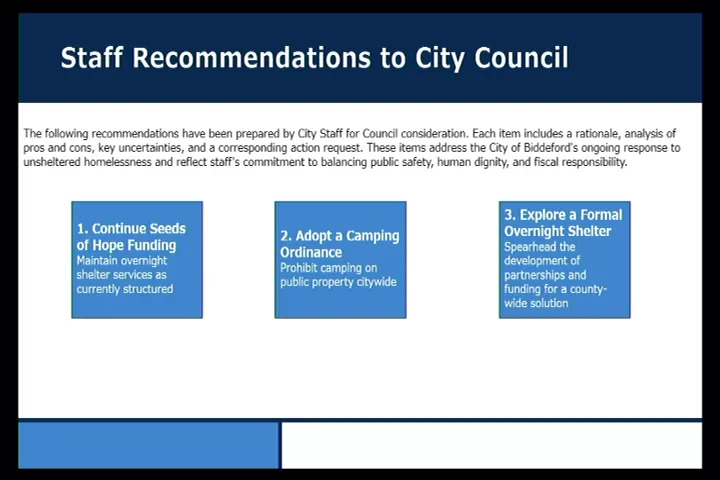
- Homelessness Impacts and Recommendations: GA Supervisor Jake Cammer provided cross-departmental costs: Code Enforcement $25,000; Police $33,000 (383 calls, 45 min avg., 2.5 officers per incident); Encampment cleanup $42,000; GA Seeds of Hope $461,000 (reimbursed $130,000). EMS calls at Seeds of Hope rose from 24 (2023) to 109 (2025). He recommended (1) continue Seeds of Hope funding, (2) adopt a no-camping ordinance, (3) explore a regional shelter. Council discussed legal aspects, fiscal realities, and humanitarian impacts. City solicitor confirmed camping ordinances are legal if not criminalizing status. The mayor noted a budget meeting on April 23 for homelessness. Direction was given to proceed with a camping ordinance draft and regional exploration.
- School Budget – First Reading (Order 2026.54): School Finance Director Colin revealed an error in the original 2.98% local increase figure, which was higher. Council expressed frustration over the lack of a final School Committee-approved budget and last-minute changes. Motions: a $250,000 cut failed (split 4-4); an amendment to revert to the 2.98% increase passed with the mayor's tie-breaking vote. The main order then failed unanimously. The council did not consider subsequent school budget items (Orders 2026.59–2026.63). A special first reading will be scheduled after the School Committee meets.
- Mayor's Monarch Pledge (Order 2026.52): The city joined the National Wildlife Federation pledge to support monarch butterflies. Approved 7-1.
- Remote Meeting Policy (2026.46) and Limited Parking Ordinances (2026.56-2026.58): All approved unanimously.
Key Outcomes
- Liquor license, minutes, waste ordinance, parking elimination, remote meeting policy, and three parking amendments passed without opposition (most unanimous).
- Mayor's Monarch Pledge passed 7-1.
- FY27 School Budget first reading failed; council to schedule special first reading.
- Council directed staff to draft a no-camping ordinance and explore a regional shelter solution.
- Unanimous vote to enter executive session for personnel matters.
The meeting adjourned after the closed session.
Meeting Transcript
Good evening. I will call the Tuesday April twenty first City Council meeting to order. Councillor Lassard is excused. All other members are present. Please stand for the Pledge of Allegiance. Item three on the agenda is adjustments to the agenda of which there are none, which will take us to a proclamation for Earth Day, April 22, 2026. Whereas Earth Day, first celebrated in 1970, has grown into a global movement, uniting more than a hundred and ninety three countries and a shared mission to safeguard the planet for current and future generations. And whereas Earth Day exists to raise awareness, strengthen environmental education, and mobilize community action to address urgent environmental challenges. Thank you and congratulations. Thanks for sharing your artistic gifts with us. And also would note that on Saturday we do have another sustainability commission is organizing an Earth Day cleanup as well, and you can visit them at Cannon Park across from City Hall at 10 a.m. to 2 p.m. for a cleanup as well. With that, we will move on to two presentations, beginning with a vacancy registration ordinance presentation from Codes Director Robbie Fecto. Okay, good evening. The title is Vacant Building. So a little bit of a background for the folks in the audience and the people listening at home as well as the council. The purpose of the ordinance or the the city adopted the vacant building registration and fee ordinance of April uh April 1 of last year, so just about a year today. The purpose of the adoption of the ordinance was the City of Biddeford recognizes that vacant buildings negatively impact property values, neighborhood safety, and overall development. To address these concerns, this provision establishes a vacant building registration requirement and an escalating fee structure to encourage property owners to return vacant buildings to productive use. So the ordinance was at the second reading was April uh first of twenty twenty-five, and we waited until the code was actually codified before we did anything with it. So it's it's hard when you're looking at the code online. Um if the ordinance is not codified, it shows up in the left-hand section under new laws. And what that it sits there for a few months before it actually gets into the body of the code. So once it was in the body of the code, that's when we rolled out the program. So our initial um shot of notices went out in June to 17 property properties that met the definition under the ordinance. Uh a little bit about the ordinance and the fee structure. So the first, the way the ordinance was built is the first six months, there was no fee. After six months, there was a three hundred dollar fee. After twelve months, it was a six hundred dollar fee. And after eighteen months, it was twelve hundred. So when we sent out the first registration uh notices, the first six months were free. Uh six responded with the registration forms, two owners of record abandoned the property and never received our notice. Two received permits to repair, so they came off the list. One was being sold, six no responses uh from current owners. So we did uh the way we rolled the program out is we sent a copy of the ordinance in with uh with an attached letter from me to describing the ordinance and asking for uh registrations from them. And highlighting that the next six months after that that notice was going to be a fee established. So here comes the money. January, there was a the invoicing period that went out. 17 notices went out for registration and fees, nine registered, six paid fees, four were removed from the program, and four no responses. So the way the ordinance was created, it's more of a revolving ordinance where as you don't have set time strengths in the ordinance. You have to wait for the time period to go by to deem it an abandoned building and then send notifications to the property owners. That's the way the current ordinance is written. From a time management perspective, it takes a lot of time to do that.
SUMMARIZED BY OPENPUBLICA AI
TRANSCRIPT VIA PUBLIC VIDEO
openpublica.com
openpublica.com