Fiscal Special District Committee Meeting - March 16, 2026
STREAMING COPY IN PREPARATION — RECORDING AVAILABLE FROM THE ORIGINAL SOURCE
Fiscal Special District Committee Meeting - March 16, 2026
The Fiscal Special District Committee of Bloomington, Indiana met to review the city's long-term financial outlook, the impact of recent state legislation on local income tax, debt capacity, and property tax options. Participants included City Controller Jeff McCamin, Sophia McDowell, and financial advisors Justin Chang and Tim Sugar from Reedy Financial Group. One public commenter raised concerns about delayed financial reporting. Note: The transcript states the meeting was called to order on March 13, while the provided meeting date is March 16, 2026.
Consent Calendar
- Agenda approval: The committee unanimously approved the agenda as modified, combining agenda items 2 and 3 (Indiana General Assembly updates) into a single presentation, Q&A, and public comment period. No calendaring updates were offered.
Public Comments & Testimony
- Kevin Keo, a member of the public, expressed concern that the city has not published its 2024 Annual Comprehensive Financial Report (ACFR) as of March 13, 2026, nearly 15 months after the fiscal year ended. He noted that the 2023 federal single audit had a qualified opinion and a material internal control weakness. He cited the 2016 general obligation bond's continuing disclosure agreement, which sets a 180-day benchmark (June 30) for annual reporting, and stated that State Board of Accounts requires a 90-day audit window, meaning the city should have books ready by April 1. He argued that delays could lead to higher interest rates, SEC 15C2-12 notices of failure to file, enforcement actions, and reputational damage. He asked when the 2024 financial statements were delivered to auditors and what the delays might cost taxpayers.
Discussion Items
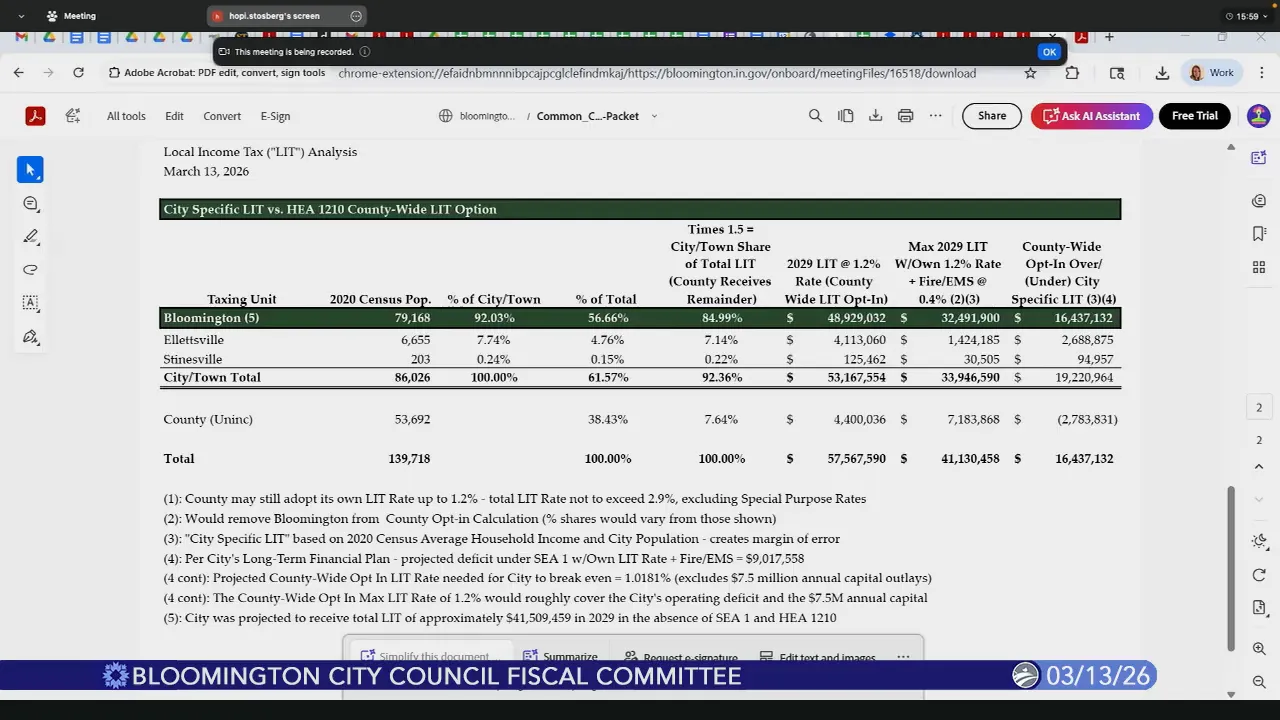
- Financial Outlook and Deficit: Tim Sugar reported that the city's five-year plan projects a roughly $3 million general fund deficit in the near term due to Senate Enrolled Act 1 (SEA 1) and budget choices. Once SEA 1 and House Enrolled Act 1210 (HEA 1210) are fully implemented (around 2032), the operating deficit could reach about $9 million, plus about $7.5 million in annual capital outlays, totaling a potential $16.5 million deficit.
- Local Income Tax (LIT) and HEA 1210: Justin Chang and Tim Sugar explained that HEA 1210 now allows any city or town to opt into a countywide municipal services local income tax rate, with a formula based on population multiplied by 1.5. If Bloomington opts in at the maximum 1.2% rate, the projected 2029 LIT revenue would be approximately $48.9 million, compared to $41.5 million without the opt-in—a $7 million increase that would nearly cover the general fund deficit. If the city instead imposed its own LIT rate, the projected revenue would be around $32 million (including the 0.4% fire/EMS share). The county and cities can form a task force to set the rate unanimously by October 1, 2026; otherwise, the city may opt in by October 1, 2028, but would be locked into the rate for three years.
- Debt Capacity: The city has roughly $97 million in remaining constitutional debt limit across general obligation, park, and redevelopment districts. The city currently has three general obligation bonds and three park district bonds, with no redevelopment district bonds. The current debt rates are 0.053 and 0.0338 (likely per $100 assessed value). Issuing bonds could fund capital outlays, but petition-remonstrance thresholds and project-size referendums apply.
- Property Tax Rate Considerations: The city's current total debt rate is 84 cents per $100 assessed value, lower than comparable communities like Lafayette and Noblesville (around $1.00). Increasing the rate to $1.00 would generate about $8.2 million in additional levy, potentially covering deficits. This could be phased in over several years.
Key Outcomes
- The committee unanimously approved the amended agenda.
- No binding decisions were made on LIT, debt issuance, or property taxes.
- Next steps include further committee discussions, preparation of a draft letter, and exploring cooperative conversations with county partners about the LIT task force.
- Jeff McCamin responded to the public commenter: he stated that property tax-backed bonds are secure and short-term bonds are unlikely to be affected by reporting delays, though longer-term bonds could be. He noted the city is in regular communication with auditors and provided a timeline report at a previous meeting.
Meeting Transcript
Yeah. All right. So seeing that we are all here. Um I'll go ahead and call this meeting the fiscal special district committee to order on March 13th. Jeff McCamin City Controller. Sophia McDowell X office. Yeah, large tax number. I'm just in Chang with the REDE financial group. Non-Tim Sugar with Venetian group. Sorry, what is that? Tim Sugar. Okay. Okay. Wonderful. Thank you guys for being here tonight. Um, I'm just so used to evening meetings, that's well. Um so uh first thing on the agenda is the agenda review and approval um controller McCam just mentioned uh changing the agenda from what was published because the Indiana General Assembly updates are gonna come up during the reading discussion, so we can just combine numbers two and three into one big kind of presentation and question and answer and public comment period and and then adjourn. Um I did realize that uh I didn't put anything on about the calendar, any updated calendaring stuff. Um, and I didn't put anything in the packet about that, but does anybody have any updated calendaring stuff about this committee that you should put on the agenda? Great. Seeing none um if somebody wants to move to approve to approve the uh agenda for 13 March 2026. Okay, great. We're all here. Can we just everybody in favor of that? Say hi. Right closed. Great. So at this point, I'm gonna turn it over to Jeff and uh Justin and Tom, right? Tim I'm gonna write that down right now, so I remember and uh take it away. Terrific. Well, I'd love to just set set the stage. Um we have uh Justin and Tim from Reedy Financial Group who are our uh financial advisors at uh at the city, and they're um they're going to go over a couple of of things that I think are gonna be really interesting to everybody and very important to us going forward, including uh our debt position uh and local income tax, uh particularly with respect to the new uh lit system that's right now selected to go into effect in 2029 and um and property tax as well. So uh very much I think everybody's gonna be very interested in uh what they have to say. So uh are you are you going first, Justin? Or well really few will be, but just to set the stage for what we're going to be talking about, we're Tim's gonna start out with kind of the citywide financials, whether what that'll look like going forward 2026 and 27 volumes expenditures, whether we're surplusing or deficiting, and then we're going to go into what are the ways we could improve the city's financial provisions. Uh local local income tax, like Jeff mentioned earlier, is going to be a big part of that. And we're going to build the House Enroll that 1210 into that discussion. And then we're also going to look at other tools, including the debt and potentially part of some RDC um financing capacities that the city could use to improve the city's overall um financial situation. All right, so I guess a little precursor or set the stage to use best one's time. Um so we have for about a year now uh been developing the city's long-term operating capital three plan. It's a five-year plan. Uh it captures all of the funds that you budget in gateway. Uh and we do revenue projections, expenditure projections, we have the restorable budgets, doable revenues, projections based on that, and we also incorporate any changes in legislation into your long-term plan. Um having said that, Justin had mentioned the you know, I guess revenues and court burden use funding surplus deficit. Uh right now on your long-term plan, you have basically for the next two years due to SEA one. Um, and because of some innate choices in the budget, there's roughly a three million dollar deficit projected in your general fund. Now, as Central F one ramps up, and depending on the choices that the council is for lack of better term, forced to make due to housing electrolyn and sea one. Now, one of the other things that we've done in your long-term plan is that we've identified about seven and a half million dollars of capital outlays that the city historically has done on using rough estimates. Um we actually have removed those capital outlays from your operating funds. So on top of the nine million dollar potential operating deficit, we also have to figure out a way to fund if it's the city's choice to continue the seven and a half million dollar capital outways on average annually, a way to fund that essentially deficit as well.
openpublica.com