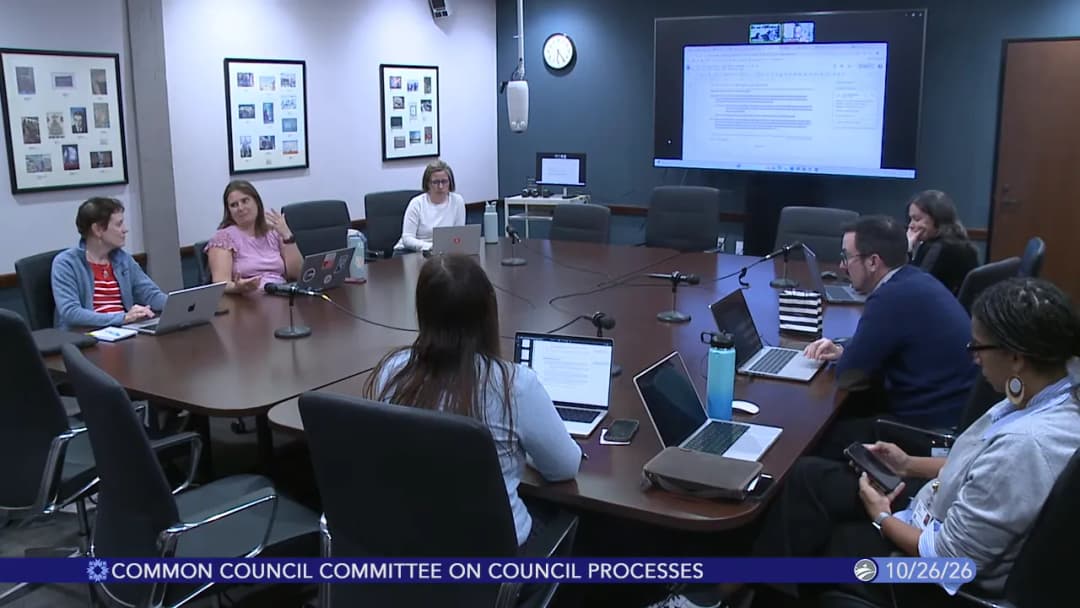
The Committee on Council Processes met for about one hour on October 27, 2026, with a 6:30 p.m. special council session limiting the agenda. No agenda or minutes were provided; this summary relies on the raw transcript. Participants included committee members, City Clerk Nicole Bolden, Council Attorney Jake Rossman, Chief Deputy Clerk Sophia McDowell, and Deputy Clerk Crossley online. The raw transcript opens with “Monday, October 26, 2026” and says “Wilmington,” but the system-provided meeting date is October 27, 2026, and the agenda items reference Bloomington. Discussion covered the proposed removal process for council-appointed board and commission members, an update on Bloomington Public Transportation Board expansion, and continued Title II code review. No formal votes were taken; decisions were by consensus. Discussion Items - Bloomington Public Transportation Board expansion update: Councilmember Stoutburgh said there was no new update. Research was still in progress, and a pros-and-cons discussion could not be placed on the October board agenda. The item was deferred. - Proposed removal process: Council Attorney Rossman presented a draft nine- or ten-step process, noting that current ordinance 2025 allows removal “for cause” but does not prescribe a procedure. The draft covered informal and formal complaints, review and verification of claims by council staff and legal, optional staff screenings, formal notice with specific code/rule violations and a logical nexus to diminished ability to perform duties or disrupted proceedings, recusal considerations, and a floor motion for due-process notice. - Clerk Bolden said the proposal duplicated a process already administered by the board/commission staff position under her office and shifted work onto council staff; she said the committee had previously agreed to develop this with the clerk’s office. Deputy Clerk Crossley recommended removing step 3 or clearly assigning responsibility for screenings, and said the existing process could be outlined and streamlined while continuing to involve the council attorney. - Councilmembers generally agreed that Clerk Bolden, Deputy Clerk Crossley, and Council Attorney Rossman should jointly prepare a second draft. One councilmember emphasized that the council attorney should remain closely involved in removals. The committee also discussed whether a commission itself could censure a member under Robert’s Rules; Rossman agreed to research that option for the next meeting. - Title II review – committee of the whole: The committee examined committee-of-the-whole provisions and questioned what “freedom of committee procedures” adds, noted the section has not been used as written, and observed that committee of the whole is now used mainly for budget discussions where no vote is taken. Members decided to check Robert’s Rules and the prior code context before proposing changes. One councilmember also recalled former council member Steve Bolin’s caution that these provisions were written that way for a reason. - Title II review – scheduling committee meetings: The committee agreed to remove the scheduling-committee-meetings section from city code and move it into council rules of procedure instead of leaving it in code. Public Comments & Testimony - A speaker involved in the HPC removal matter said they generally supported the memo and the standard the council adopted in 2023 in the Alexander matter, but argued that no council member should serve as both prosecutor and judge. They called for a real hearing with access to the full file, the right to question accusers, and the right to counsel; for the vote threshold and quorum to be stated; and for the vote to be by the full council. They also said the current removal should be dismissed and restarted under any newly adopted process, and that this was their first opportunity to speak after others had been heard. - Eric Oz said the removal-for-cause process should be formal, precise, rigorous, cautious, and not easy, and that it should be aligned with legal and constitutional authority. He argued that removal authority belongs to the appointing branch, in this case the council, and that the clerk’s office role is supportive and non-authoritative. He recommended a uniform removal process developed in collaboration with the executive branch. - Jeff Richardson, a former council member, urged more welcoming and deeper public dialogue, including panel discussions and longer formats rather than the three- or five-minute comment limits. He said the current process can feel like one-upmanship and diminishes everyone involved. - Terry, a public commenter, praised the council’s recent deliberative sessions as beneficial to democratic governance and public trust, asked how the council will evaluate and learn from them, and noted that the city no longer has a public engagement director, though the position still exists and the mayor’s office reportedly intends to hire someone. Key Outcomes - No action was taken on Bloomington Public Transportation Board expansion; the update was deferred. - The proposed removal process was not adopted. The committee directed the clerk’s office and council attorney to prepare a second draft, clarify who conducts screenings, and return it at the next meeting. - The removal currently before the council is expected to continue moving forward without restarting while the formal process is drafted. - Council Attorney Rossman will provide more information on formal censure options at the next meeting. - Title II review will continue; committee-scheduling language will be moved from code to council rules of procedure. - The next meeting was set for Monday, November 16, 2026, at 5:30 p.m.
Public Meetings - Bloomington, Indiana
Public Meetings - Bloomington, IndianaThis special session was convened to consider Resolution 2026-23, which would increase the Public Safety Answering Point (PSAP) rate and the overall Public Safety Local Income Tax rate to fully fund dispatch operations, as recommended by the Monroe County Local Income Tax Council's PS Lit Committee. The resolution failed after extensive discussion and public testimony. Public Comments & Testimony - Kevin Keel opposed the resolution, arguing that the projected funding gap does not by itself justify a tax increase without a formal plan for reserves, equipment, and staffing. He noted that actual spending has differed from budget due to recruitment challenges and that the county holds significant dispatch reserves. He urged the council to take more time to develop a combined financial forecast and reserve targets. - Eric Oz raised multiple material questions about the lack of required annual meetings, the late creation of a dedicated PSAP fund (April 2025), gaps in revenue tracking, and compliance of the interlocal agreement. He recommended not increasing the PSAP rate until these issues are transparently addressed, and called for an immediate meeting of the PS Lit committee. Discussion Items - Financial Presentation: Controller Jeff McKim presented updated financials for the city's PSAP fund, showing a projected year-end balance of about $1 million for 2026, and a deficit budget of $4.8 million against $4 million in projected revenue (from the county) for 2027, leaving reserves nearly exhausted. He noted that the county's PSAP reserves ($3.26 million) and 911 reserves ($2.7 million) could be used, but that major technology replacements (e.g., $2.3 million for radios) are imminent. - Interlocal Agreement Concerns: Council members discovered that the 2018 interlocal agreement requires an annual joint work session between city and county councils before September 1, which apparently has not been held in recent years. The agreement also requires the city and county to cover budget shortfalls equally after reserves are exhausted. - Rate Impact: An increase would cost approximately $37 per year for a household with $100,000 adjusted gross income (71 cents per week). - Alternative Funding: Some council members suggested using General Fund dollars or a General Obligation bond for capital equipment, rather than a tax increase. - Timing: The county must also adopt the increase by November 1 for collection to start January 1, 2027; a later adoption would delay collection. Amendment - Councilmember Stasberg introduced an amendment to correct a rounding error (changing 0.287 to 0.2869) and fix a formatting issue in Section 1, Item 5. The amendment passed unanimously on a voice vote (no roll call recorded). Key Outcomes - Resolution 2026-23 Failed: After discussion and public comment, the resolution was put to a roll call vote. Councilmembers Piedmont Smith, Daily, and Stasberg voted no; no yes votes were recorded. The motion did not pass. - Next Steps: Council acknowledged the need to revise the interlocal agreement, schedule a joint meeting with the county, and develop a comprehensive funding plan for dispatch operations. A special Plan Commission session was announced for Wednesday, and a Fiscal Committee meeting for Friday.
The Board of Zoning Appeals (BZA) met on October 23, 2026, to consider a phasing plan request for a conditional use approved in 2023 for a supportive housing project at 1201 West Third Street. The applicant, Beacon Inc., sought approval to construct the project in two phases due to funding challenges, with phase one covering approximately half of the originally planned building. The board unanimously approved the request with a condition requiring initiation of phase two by January 1, 2029, or a new conditional use approval would be needed. Discussion Items - The project was originally approved in 2023 for a 45,000-square-foot building containing supportive housing (50-bed overnight shelter, 20 dwelling units, five work-to-live units), community services, and parking, with variances for work in the floodplain and riparian buffer. - Staff reported that the applicant encountered funding challenges, leading to a request for a phasing plan: phase one (approximately 20,000 square feet, two stories) would include the west side of the building, half the parking, all stormwater improvements, and the entrance from Third Street. Phase two (remainder of building and parking) would be built when funding becomes available. - Staff recommended approval with a condition that if phase two is not initiated by January 1, 2029, a new conditional use approval would be required. - Don Gray (Spring Point Architects, for petitioner) stated phase one construction drawings are underway and construction is expected to begin early 2027, weather dependent. He expressed gratitude for the board's consideration. - Board members discussed the history of the original case, noting that the prior approvals (conditional use and variance) were unanimous. They questioned the appropriateness of the 2029 deadline and the risk that phase two might never be built, leaving the project without full services (emergency shelter, day center) that were part of the original concept. - Forrest Gilmore (Executive Director, Beacon Inc.) testified that phase one is funded by a $7 million grant requiring lease-up by March 31, 2028. He stated that phase one is self-contained with permanent supportive housing, case management offices, and community space, and would function independently even if phase two is not completed. He noted a $4 million funding gap for phase two, but said Beacon is committed to completing the full project. He confirmed that the 2029 deadline is reasonable but could not guarantee due to unpredictable funding. - A board member raised a concern from the original public comment about distance to services and bus lines, and another noted that the project originally received letters of support, including one expressing concern about services proximity. - Staff clarified that the city cannot compel construction of phase two even if approved; it can only approve what is brought forward. Public Comments & Testimony - No members of the public spoke in person or online during the public comment period. Key Outcomes - The board approved the phasing plan (ZR 2026-09-0043) for 1201 West Third Street by a vote of 4-0 (Roch Morton: yes, Burrell: yes, Fernandez: yes, Casinka: yes). - Condition of approval: If phase two has not been initiated by January 1, 2029, a new conditional use approval is required for phase two. - No other new business was discussed; the meeting adjourned.
This was the second community deliberation session on public safety hosted by the Bloomington City Council. Approximately half of attendees had also participated in the first session in September. The meeting began with an overview of four focus areas derived from prior feedback: safe and welcoming public spaces, community care and crisis response, public safety response and accountability, and communication and trust. After establishing community agreements, participants divided into small groups for 75 minutes of facilitated discussion. Each group was led by a council member and supported by facilitators from CGM. Following the discussions, each group reported key themes to the full assembly. The meeting concluded with an exit survey and a preview of next steps. Discussion Items - Group A – Safe, Accessible, and Welcoming Public Spaces: Participants discussed how information flows (e.g., about downtown businesses, homelessness) affect perceived safety. They highlighted the need for user-centered design (e.g., fenced playgrounds), consistent lighting, and prioritization of sidewalk investments. Solutions revolved around increased spending, but trade-offs in prioritizing among competing needs were noted. - Group B – Community Care, Crisis Response, and Supportive Services: The group quickly identified shelter as the top public safety need, especially for underserved groups (people with pets, couples, women, sex offenders, those with behavioral issues). Discussion included better coordination among service providers (e.g., a universal release-of-information form), hiring Spanish-speaking staff, coupling housing with wraparound services, and increased visibility of existing services. Specific recommendations for the council included holding grant recipients accountable, reviewing outcome data, following up on the mayor's homeless coordinator position, and avoiding stigmatizing language. - Group C – Public Safety Response, Prevention, and Accountability: Key themes were the need for careful crisis communication on social media, balancing enforcement with compassion, and addressing the trauma inherent in public-safety encounters for all involved. Participants emphasized asset mapping of existing resources, expanding public education (e.g., a residents academy model), and marketing alternative numbers like 211 and 988. They called for integrated services involving IU, Monroe County, and the city. - Group D – Communication, Transparency, and Community Trust: Two separate reports were given - one from the in-person group and one from a virtual group. The in-person group focused on improving information access for both council members and the public. Suggestions included better council awareness of community organizations and public-safety resources, expanding partnerships, and council members meeting regularly with district leaders. Gun safety education was also raised. The virtual group discussed budgetary concerns (PSAP funds commingled, tax increases for dispatch), cybersecurity vulnerabilities, inadequate public comment time (proposal for an ombudsman), and the need for comprehensive collaboration on substance-use treatment, including jail programs and peer support. Key Outcomes - No formal votes or decisions were taken; the session was designed for idea generation and community input. - The council plans to consider legislative proposals related to public safety within the next six months, informed by the discussions and exit survey results. - Participants completed an exit survey to provide additional feedback on both the topics and the process. - CGM will compile a report of the evening's findings for the city council.
The Bloomington City Council held its regular session on October 16, 2026, at City Hall. The meeting covered approval of minutes, reports from council and the mayor, a transportation commission report, first readings of three ordinances, second readings and adoption of several key items, and public comment on multiple topics. The most significant action was the unanimous passage of Ordinance 2026-22, permanently banning automated license plate readers (ALPRs) and restricting certain surveillance camera technologies within the city. The council also adopted the 2027 civil city and water/wastewater budgets, updated membership on the transportation and environmental commissions, and approved the ADA Transition Plan. Several first-reading items were advanced to November 4 for second reading. Consent Calendar - Minutes: Approved as amended from April 15, April 22, May 6, May 13, May 20, and June 3, 2026. - Appointment: Justice Belton appointed to seat C2 on the Commission on the Status of Black Males (voice vote, unanimous). Reports - Councilmember Stasberg: Recognized Domestic Violence Awareness Month (wearing purple). Reported on Plan Commission actions: UDO amendments (higher density housing, ADUs, duplexes) forwarded with positive recommendation; two voluntary annexation cases coming to council in 1-2 months. Also noted fall high school cross-country season limits weekend availability for constituent meetings. - Councilmember Piedmont Smith: Also recognized Domestic Violence Awareness Month and promoted the Alzheimer's Walk at Switchyard Park on Sunday. - Mayor Thompson: Updated on SNAP cuts (effective October 1) impacting local service agencies. Provided updates on 714 South Rogers (future police station, still in due diligence, RFP for architects, no anticipated police force growth), Showers West (lease negotiations concluded, only Bloomington Board of Realtors remaining until June 2027; $621,000 in high-priority repairs needed; city to assume utilities and maintenance in 2028 budget). Thanked Councilmember Piedmont Smith for outreach on last-minute amendments. - Transportation Commission Chair Steve Woland: Presented commission findings on Walker parking study. Commission endorsed 8 of 12 recommendations. Disagreements included: not transferring citation appeals to parking services (0-5), not reducing on-street hours to 8 PM (4-1, failed endorsement), not using license plate recognition for enforcement (0-5), and not creating separate brand identity for parking (0-5). Endorsed data-driven approach, rate changes (zone system and off-street), multi-space meters, gated equipment updates, and marketing/signage improvements. Public Comments & Testimony - Non-Agenda Items: Noah Thompson (IU student, Young Americans for Liberty) advocated for lower parking ticket fines. - Ordinance 2026-29 (Superintelligence): Thomas Westgard urged caution based on historical technology risks. Barry dismissed the ordinance as a distraction, arguing artificial superintelligence is not real and resources should focus on actual AI harms. Jesse Edwards questioned enforceability. Elijah asked for definitions of AGI and ASI. Jamie Scholl supported the ordinance, recounting personal AI manipulation and citing infrastructure vulnerabilities. Paul Rousseau supported, emphasizing the concept of "beyond human control." - Ordinance 2026-30 (General Obligation Bonds): Oliver Hinshaw expressed concern about funding priorities, asking whether bonds could support social services rather than capital projects. - Ordinance 2026-23 (UDO Amendments): Doug Hazen (Hazen Insurance) described unexpected $36,000 in compliance costs after purchasing a building. Jason Bell (Bell's Vacuum) recounted a five-month permitting delay costing over $350,000. Chris Hernie (Greater Bloomington Chamber of Commerce) supported the changes, citing reputation for being hard to do business and specific examples. Sarah Wolford (Habitat for Humanity) supported as a good start. - Ordinance 2026-22 (ALPR Ban): Over 20 speakers, including students, community members, and representatives from Exodus Refugee Immigration, expressed strong support for the ordinance, citing privacy concerns, documented abuse by law enforcement (e.g., stalking, immigration enforcement), and distrust of corporate vendors. Scott Tibbs opposed, arguing the technology helps solve crimes and rescues children. Many speakers urged the council to pass the ordinance without weakening amendments, particularly opposing Amendment 5. Others called for independent audits of data use. - ADA Transition Plan: Paul Rousseau argued the city is "wildly out of compliance" with ADA. Eric Oost called for restoration of unified PDF meeting packets and more resources for the ADA coordinator. First Reading Items - Ordinance 2026-29 (Prohibiting Superintelligence): Councilmember Rallo presented the ordinance as a companion to Resolution 2026-10, banning deployment of autonomous artificial superintelligence (ASI) in Bloomington. He argued it is an interim public safety measure due to lack of state/federal regulation. A video compilation of expert warnings was shown. Council discussion raised concerns about enforceability and language (e.g., dissolution requires 95% voter approval). Public comment was mixed. Moved to second reading on November 4 (voice vote, unanimous). - Ordinance 2026-30 (General Obligation Bonds, $6.868M): Controller Jeff McKim, Deputy Fire Chief Max Litwin, City Engineer Andrew Sebor, and financial advisor Justin Chang presented. Projects include: replacement of an aerial platform fire truck (current truck down 4+ months, repair over $100k), 10th Street corridor improvements (design funded, construction targeted 2028), 3rd Street signal modernization (part of Rogers-Kinser-Madison study), crosswalk safety projects (Phase 3 & 4), and sidewalk/bikeway/lighting improvements. Bonds are first in a planned three-year cycle. Councilmember Stasberg explained the rationale for debt financing. Oliver Hinshaw questioned funding for social services vs. capital projects. Moved to second reading on November 4 (voice vote, unanimous). - Ordinance 2026-23 (UDO Amendments): Development Services Manager Eric Gruulick presented amendments to streamline the "change in use" process. Changes include: removing full compliance requirement for subdivisions (as long as no new noncompliance), increasing thresholds for building/parking/ dwelling unit additions to 25%, removing triggers for changes between use subcategories, and extending vacancy abandonment from one to two years. Plan Commission voted 7-0 to recommend. Public speakers supported. Moved to second reading on November 4 (voice vote, unanimous). Historic Preservation Commission Removal - Councilmember Zulick reported that the interview committee had met but could not give a verbal report under council rules. A motion to suspend rules for a verbal report failed (4-3, needing 2/3). The item was continued to November 4. Councilmember Piedmont Smith requested more specific notice be given to the commissioner regarding the conduct, code of conduct violations, and fitness to serve. Second Reading Items - Ordinance 2026-22 (Prohibiting ALPRs and Surveillance Cameras): Councilmember Piedmont Smith presented the ordinance, co-sponsored by Zulick and Asari. Extensive debate on amendments: Amendment 1 (strike "Flock" from title) passed 7-0. Amendment 2 (narrow definition of surveillance camera to include automatic detection, recognition, classification, or tracking) passed 7-0. Amendment 3 (align prohibitions with amended definition, allow repair access, ban facial recognition/biometric tracking without council authorization) passed 7-0. Amendment 5 (allowed body-worn cameras, dash cams, and evidence sharing with a case number; also defined city agency to include central dispatch) passed 5-2 (Zulick and Asari opposed). After public comment, the ordinance as amended was adopted 7-0. - Appropriation Ordinance 2026-02 (2027 Civil City Budget): Controller McKim addressed questions about self-insurance changes (reduction due to eliminated telemetry devices) and police TDM manager position. Adopted 7-0. - Appropriation Ordinance 2026-04 (Water/Wastewater Budget): Utilities Director Catherine Zegler explained the depreciation fund. Adopted 7-0. - Ordinance 2026-21 (Transportation and Environmental Commissions): Councilmember Stasberg moved Amendment 1 to change the Environmental Commission reduction from 9 to 11 members, following feedback from commission members. The amendment passed 7-0. The ordinance as amended was adopted 7-0, creating a dedicated seat for Monroe County Community School Corporation on the Transportation Commission and reducing the Environmental Commission from 12 to 11. - Resolution 2026-22 (ADA Transition Plan): Presented by ADA Coordinator Michael Shermis. The plan documents the city's progress on accessibility. Council discussion raised concerns about underinvestment and incomplete coverage. Councilmember Asari voted no, arguing the plan lacks ambitious implementation. The resolution was adopted 6-1. Key Outcomes - Ordinance 2026-22 passed, permanently banning ALPRs and restricting surveillance camera technologies with third-party data access. (7-0) - 2027 budgets adopted (civil city and water/wastewater). - Transportation Commission membership updated to include MCCSC; Environmental Commission reduced from 12 seats to 11. - ADA Transition Plan approved as an advisory document, with further work expected. - First-reading items (Superintelligence ban, GO bonds, UDO amendments) advanced to November 4 for second reading. - HPC removal item continued to November 4 with specific notice requirements. - Public safety deliberation series continues with next session on October 21.
At the Oct. 1, 2026, work session, Bloomington city councilmembers met beginning at 6:30 p.m. to discuss draft budget amendments ahead of the upcoming budget adoption. No votes were taken and no public comment was offered. Participants included councilmembers Isaka, Courtney, Isabel, Hope East Osberg, Sydney Zoe, and later Dave Rallo; City Controller Jeff McKim answered technical questions. The agenda and minutes were not included in the source materials. Discussion Items - Sanitation subsidy: An amendment would reduce the sanitation subsidy by $600,000, from $1.6 million to $1 million. Supporters cited the sanitation department's rate-increase plan, presented to the fiscal committee, which assumes only $1 million in subsidy; if the rate increase is not approved, funds could be reallocated later. Councilmember Isabel agreed to co-sponsor, and final language will be worked out with Larry Allen. - Election operations/public works line: A councilmember proposed trimming the election operations line, which grew from $575,000 last year to $1.2 million. Controller McKim said the line includes $650,000 for the city's general election portion, $350,000 for Brighton B Town, $218,000 carried from the 2026 adopted budget, and smaller items. He also noted the 2023 election cost $471,804. A councilmember said she would reduce the line to the $218,000 base if the remaining components were not clarified. - Branding implementation: Amendments proposed cutting $10,000 budgeted for branding implementation; a broader version also cut other items such as leadership development. Councilmembers did not settle on a version. - Transportation demand manager: Councilmembers discussed eliminating the vacant TDM position in the Economic and Sustainable Development Department and the matching salary-ordinance line. Supporters said the position did not meet its carpool/transit goals, BT ridership is down, and planning staff already do effective outreach. Some hoped to redirect the funding to food security or climate-action work. - Parking study implementation: An amendment would remove the $2.5 million placeholder for parking-study implementation until the administration explains what will be purchased and how the funds will be used. There was broad support for requiring more detail before appropriation. - Housing trust fund: Amendments would reduce or possibly eliminate the housing trust fund appropriation. One proposal left $1 million available and required reporting before more was spent. A councilmember said they had not received a response from housing staff after a week and was inclined to take it down to zero. Councilmembers stressed support for affordable housing funding, but wanted transparency, clearer priorities, and possibly an ad hoc committee to oversee major allocations. The controller said he had compiled the requested list of capital expenditures over $100,000 and would share it. - Controller software/ERP: A $600,000 appropriation for new financial/ERP software was questioned because the budget narrative tied it to outcome-based budgeting, but the administration reportedly said there would be no near-term outcome-based budgeting. Controller McKim and others countered that the New World system is outdated and core financials must be upgraded before HRIS; the administration is preparing a detailed response memo. - Planning studies: An amendment would cut $265,000 for a corridor/sub-area study and $225,000 for additional studies/projects. Supporters said the city has spent too much on studies and should start implementing; opponents noted some studies are prerequisites for future MPO funding, can stay relevant longer than plans, and may help implement projects like the Kirkwood corridor. No consensus was reached. - Historically overfunded accounts and telemetry: One amendment reduced several accounts that have been regularly underspent and removed $274,250 from the risk-management fund for fleet telemetry. The controller said telemetry is intended to improve vehicle safety and reduce accidents. Some councilmembers warned against cutting contingency cushions and second-guessing staff. - Travel reduction: A 25% across-the-board cut was discussed. One participant noted clerk's office staff are required to obtain certifications, with individual costs up to about $2,000 including registration, hotel, and travel; the clerk's own recent travel costs were offset by the Clerk's League. Others questioned travel funded from the parking meter fund and opposed blanket cuts. - Licensing/procurement: A councilmember proposed cutting $90,000 from a licensing line but could not recall the exact basis at the meeting and said they would provide more information. No decision was made. - Special legal services: An amendment proposed cutting special legal services by $350,000. The sponsor said there was no need for the increase if annexation and litigation are not continuing. Councilmembers requested updates on the annexation lawsuit, the Beacon lawsuit, and a recently lost condemnation/eminent domain case involving the Showers business. - Legal/risk administrative assistant: A councilmember proposed eliminating the grade 4 legal/risk administrative assistant position (about $79,000 fully loaded). Though it had been vacant, it has since been filled. Supporters saw it as overinvestment in risk management; others argued the city manages substantial public-space and workforce risk. No decision was made. - Communications and community-relations positions: Councilmembers floated cuts to the public engagement director (vacant), a second communications position in the mayor's office (filled), a legislative affairs specialist, parks community relations manager, and health/wellness coordinator. A councilmember argued centralized communications overemphasize mayoral promotion, citing the branding report and a delayed citywide boil-water notice, and proposed funding the communications director for only half the year to force a restructuring discussion. Others cautioned about losing staff and urged a more deliberate review. - ESD restructuring: One councilmember argued the Economic and Sustainable Development Department has become unwieldy, with high arts-administration overhead, and proposed moving economic development back to the mayor's office, relocating sustainability to parks or planning, and increasing direct community funding. To force that conversation, they suggested funding ESD positions for only part of the year. Other councilmembers asked for a workshop and raised concerns about the budget calendar and staff retention. Key Outcomes - No formal votes were taken; the session was discussion-only. - The administration will provide a written response memo addressing each amendment before the budget's first reading next week. - Councilmembers will continue drafting amendments; co-sponsorship and text changes were arranged for the sanitation amendment, with final language coordinated through Larry Allen. - Controller McKim will share the capital expenditure list and follow up on the election-line breakdown and the licensing question. - Budget timing: first reading is scheduled for next Wednesday, with a meeting on Oct. 14 and a deliberation session on Oct. 21. If the council makes complex cuts, the adoption meeting would be continued to a later date; the budget must be passed by Oct. 31, and a special session could be scheduled if needed.
Note: The transcript identifies the meeting as Monday, September 28, 2026, but the provided timestamp is September 29, 2026. This summary uses the provided date. The Committee on Council Processes met on September 29, 2026, chaired by Council Member Isabel Piedmont Smith (District 1). Also present were Council Members Hopi East (District 3), Courtney Daly (District 5), and So heis Overing (District 6), along with Deputy Clerk Jennifer Crossley and City Attorney Larry Allen. The agenda included discussion of the possible expansion of the Bloomington Public Transportation Board, developing a removal process for board and commission members, improved training on Robert's Rules of Order, and ongoing review of Title II of the city code. Public Comments & Testimony - Terry Amsler, a Bloomington resident, spoke in person. He mentioned an upcoming Indiana Municipalities summit on consensus-building, Robert's Rules resources (including alternatives), a potential IU capstone project on boards and commissions, and the Monroe County Health Equity Coalition's name change. He expressed general support for the committee's work. - Eric Ghost, participating online, argued that categorizing removal of appointed board members as "for cause" creates a constitutionally protected property interest. He stressed that removal must include procedural due process, detailed written notice, full disclosure of evidence, and a meaningful hearing before the full council. He also called for codifying how points of order are raised and addressed, and noted that resignations from the Historic Preservation Commission (HPC) resulted from process failures at the June 25, 2026 meeting. Discussion Items - Expansion of the Bloomington Public Transportation Board: Council Member East reported that the item is still in the research phase; he is scheduled to attend a board meeting in October to gather more information. No conclusions or proposals were presented. - Developing a Process for Removal of Board and Commission Members: City Attorney Larry Allen summarized the case of Mr. Cross, an HPC advisory member, whose behavior at two meetings (July 9 and July 23, 2026) led to recommendations for removal. Issues included delaying meetings, rudeness to the chair, and potential open door law violations. The committee discussed whether to route complaints through council leadership or the relevant interview committee, and whether to require the interview committee to meet first. After extensive debate, the committee directed staff (Larry Allen and Jennifer Crossley) to draft a formal removal process proposal for review at the next meeting. Key points included ensuring due process (notice, opportunity to respond), cutting unnecessary steps, and balancing transparency with efficiency. - Improved Training on Robert's Rules of Order for Boards and Commissions: Deputy Clerk Crossley shared materials from a June training session. The committee agreed that detailed Robert's Rules training is not within its purview, but suggested providing cheat sheets or optional resources. The clerk's office indicated it would work with legal to develop or adapt training materials for chairs and members. - Title II Review: The committee reviewed several sections of Title II: - Intentional Display of Firearms (2.04.225): Members questioned the legality and placement of the provision under "Committees" rather than "Meetings and Rules of Procedure." It was agreed to move it to the meetings section for broader applicability. - Reports from Standing Committees: The current code requires written reports signed by a majority. The committee proposed at least one written report per year, with oral reports as needed, and to remove outdated references to document return. - Special Committees: The committee adopted edits to language drafted by Chair Piedmont Smith, adding that a special committee shall give a final report to council and may disband after completing its duties. The provision for continuation by the new council president was retained. Key Outcomes - Staff (City Attorney Larry Allen and Deputy Clerk Jennifer Crossley) were directed to draft a formal process for the removal of board and commission members, addressing complaint intake, investigation, notice, hearing, and council decision. The draft will be presented at the next meeting. - The Title II review continued with specific edits: the intentional display of firearms provision to be relocated; standing committee reports to require at least one written annual report; and special committee language updated to include a final report and potential early disbandment. - The next committee meeting was scheduled for October 26, 2026. Note on date discrepancy: The agenda and minutes were unavailable; the transcript indicates the meeting was held on Monday, September 28, 2026, while the provided timestamp is September 29, 2026. This summary reflects the latter date as instructed.
The Bloomington City Council met on September 29, 2026, with Councilmember Hopi Stasberg (District 3), Clerk Crossley, and the presiding officer present. No formal agenda or minutes were available, so this summary is based on the raw transcript. The meeting opened at 9:00 a.m. (metadata timestamp 2026-09-29 14:12:20 UTC) and focused on one appointment and an update on the public transportation board. Appointment: Commission on the Status of Black Males - The council considered the sole application for a vacancy on the Commission on the Status of Black Males, submitted by Justice Belton after a resignation in July. - Crystal, the commission liaison, wrote the previous day that she highly recommended Belton and noted that he won the Outstanding Leaders of Today award in 2021. - Councilmember Stasberg remembered Belton favorably and said his application looked great. - Stasberg moved to appoint Belton; the motion was seconded and approved unanimously. Discussion: Public Transportation Board Expansion - The council discussed the public transportation board's proposal to expand from five to seven members. - Although the transportation board appeared to think it could make the change on its own, council members said the council must amend Title Two of the city code instead. - James and Nancy were identified as the working group/subcommittee on the issue; the presiding officer had contacted them and hoped to speak with them before the next CCP meeting. - A staff member prepared a pros-and-cons summary. The presiding officer's main concern was recruitment, including the need to find another Republican to serve. - The presiding officer said an anticipated future collaboration between IU and BT made a larger board seem appropriate. - Because service has expanded outside city limits and rural transit is doing less, the council discussed possible collaboration with Monroe County and Ellettsville. One idea was to use "urbanized area" language, matching MPO terminology, and the presiding officer said they would be happy to update the relevant provisions. - The presiding officer had also raised the topic at the CCP meeting and planned to share the research summary there. Key Outcomes - Justice Belton was appointed to the Commission on the Status of Black Males by unanimous vote. - No formal action was taken on the transit board expansion; the presiding officer will continue research and engagement before the next CCP meeting. - The meeting was then adjourned.
The Bloomington Board of Zoning Appeals (BZA) met on September 25, 2026 (date provided per instructions; transcript notes the meeting began on Thursday, September 24) to consider one expedited sign variance, one conditional use petition for a duplex with associated parking variances, and one administrative appeal of a notice of violation. The meeting included staff presentations, public testimony, board deliberation, and votes on each item. Consent Calendar - Minutes from previous meeting: The board attempted to approve the minutes but two members abstained (Throckmorton and Fernandez, who had not seen a link to the minutes). The motion passed 3-0-2 (Burrell yes, Smith yes, Throckmorton abstain, Fernandez abstain). However, due to the abstentions, the minutes were continued to the next meeting. Public Comments & Testimony - ZR 2026-05-0022 (412 East Wiley Street duplex): Numerous public speakers opposed the petition. Key points: - Jane St. John: The structure is disproportionately large for the block, lacking curbs/sidewalks, and would exacerbate safety issues at Wiley and Henderson. Urged denial. - Jan Sorby: Displayed a scale graphic showing the proposed duplex is tall and vertical, while existing homes are low and horizontal; argued it does not meet design similarity standards. - Von der Schmidt: Cited Comprehensive Plan policies discouraging high-density student housing in single-family neighborhoods; noted demolition of an affordable home; street width cannot support additional parking; asked for denial. - Julie Von der Schmidt: Distinguished this proposal from other duplexes in different locations; noted street lacks sidewalks and curbs and is designated a bike route; raised concerns about using public rights-of-way to solve private parking problems; cited a city engineer email stating roadway width is insufficient for parking on both sides; requested denial. - John Lawrence: Argued Wiley Street lacks adequate infrastructure capacity; the proposed duplex is not similar in shape, size, and design to the majority of block-face homes; urged two specific findings for denial. - Eric Ost: Stated the proposal runs counter to R3 zoning purpose; demolishes naturally occurring affordable housing; infrastructure inadequate; asked for denial. - Corey Gearhart: Argued the design fails three of four use-specific design elements (porch, setback, vehicle parking access); provided square footage and height comparisons; said the building is 80% taller than block-face median. - Marcus Moyer: Read a statement from Jody Atkins about alley access concerns and adverse impacts on safety and quality of life. - Kim Vint: Emphasized the need to protect neighborhood character; suggested a smaller design would be appropriate; noted the street cannot sustain more density. - Tatiana Moyer: Argued for preserving walkable neighborhoods for permanent residents; cited safety issues with narrow streets and no sidewalks; noted similar problems at a nearby duplex approved earlier. - Pat Medland: Anecdotal evidence from a nearby duplex where rear parking is underused and street parking is common; no longer walks on Wiley due to narrowness. - Isabel Piedmont Smith (City Council, District 1): Stated the proposal does not meet use-specific standard for vehicle parking access (none of the block-face homes use alley access) and there are insufficient public facilities; requested denial. - Dave Rollo (City Council): Cited the intent of the 2021 UDO amendments to ensure duplex scale matches single-family homes; a 2019 consultant memo confirmed the goal of compatibility; urged denial. - Betty Rosenagel: Praised neighbors' detailed presentations; argued the duplex does not belong based on UDO and Comprehensive Plan; questioned why the petition is heard a third time. - ZR 2026-07-0033 (530 South Washington Street appeal): No public comments. Discussion Items - Expedited Agenda – ZR 2026-08-0038 (1327 North Lincoln Street sign variance): Staff presented a request for four wall signs (total 44 sq. ft.) on a large student housing building, whereas the UDO allows only 24 sq. ft. for multifamily. Staff found no adverse impacts and recommended approval with one condition. Petitioner Kevin Miners explained the need for signs at multiple entrances for safety and vehicle guidance. No public comments. The board voted unanimously (5-0) to approve the variance. - ZR 2026-05-0022 – Conditional Use and Variances (412 East Wiley Street): Staff recommended approval of the conditional use for the duplex but denial of the two parking variances (to allow five spaces instead of four, and to enlarge the alley parking pad from 20'x20' to 20'x42.5'). Staff argued no peculiar conditions justified the variances and that a compliant driveway off Wiley Street was possible. Petitioner Kevin Spicer said he changed his site plan to alley access to reduce street parking impacts; he requested the variances to provide five spaces. During board discussion, members noted that height is not a use-specific criterion, the street width and existing parking problems, and the tension between the UDO's ambiguity and the board's role. A motion to approve the conditional use and deny the variances, with an added condition allowing either a code-compliant alley parking pad or a front driveway, passed 3-2 (Burrell yes, Fernandez yes, Smith yes, Kosinko no, Throckmorton no). - ZR 2026-07-0033 – Administrative Appeal of Notice of Violation (530 South Washington Street): Petitioner Joe Davis appealed a warning letter for a sign on a utility cart he parked in the public right-of-way. He argued the cart is a transportation mode, not a permanent sign, and that prohibiting it violates his First Amendment rights. Staff presented UDO language prohibiting signs in the public right-of-way and stated that vehicle signs are a prohibited sign type. The board questioned the location (a legal parking area) and the definition of vehicle signs. No public comments. After deliberation, the board voted unanimously (5-0) to deny the appeal, thereby upholding the notice of violation. Key Outcomes - ZR 2026-08-0038: Approved (5-0) – sign variance for 1327 N Lincoln Street. - ZR 2026-05-0022: Conditional use approved, variances denied (3-2). The approved plan allows a duplex at 412 E Wiley Street with either a code-compliant alley parking pad or a front driveway cut per code. A six-foot privacy fence on the east side is part of the plan. - ZR 2026-07-0033: Appeal denied (5-0) – the sign on the utility cart in the public right-of-way is a violation. - New Business: Staff will investigate potential occupancy at 230 Morton Street (old Ferris Market) after a prior variance denial. - Minutes: Continued to next meeting due to insufficient review.
The Bloomington City Council met on September 24, 2026, in a special session to introduce five 2027 budget-related ordinances and then immediately convened as a Committee of the Whole to review them. No agenda or minutes were supplied; this summary is based on the raw transcript. The committee segment of the transcript says 'Today is Wednesday, September 23rd,' which conflicts with the supplied meeting date of September 24; the date used here follows the supplied timestamp. Committee of the Whole votes are non-binding do-pass recommendations to a future council meeting. Special Session Proceedings - The special session opened at 6:30 p.m. with roll call. - Councilmember Rosenbarger announced she will be absent for medical reasons until November and may attend remotely on October 5. - Councilmember Stasberg announced a Park Board special meeting on Monday, September 28, at 5:30 p.m. at Switchyard Park to review long-range capital investment priorities, including pool repairs and the ice rink. - By voice vote, with no audible opposition, the council introduced and referred to the Committee of the Whole: - Appropriation Ordinance 2026-02, establishing the 2027 civil city budget and tax rates. - Appropriation Ordinance 2026-03, setting the Bloomington Transit Corporation 2027 budget and tax rates. - Ordinance 2026-25, fixing 2027 police and fire sworn personnel salaries. - Ordinance 2026-26, fixing 2027 salaries for appointed officers, non-union employees, and AFSCME employees. - Ordinance 2026-28, fixing 2027 salaries for Bloomington City Clerk employees. Public Comments & Testimony - Kevin Keel spoke during the civil city budget hearing. He said he tried to trace the public safety local income tax fund and the PSAP/911 dispatch fund, citing a $2.481 million historical net cash calculation, a $1 million transfer to the new PSAP fund in 2025, a $1.481 million transfer in April 2026, an estimated $3.2 million in city PSAP funds held by the Monroe County auditor, and the unavailability of audited 2025 financials. He urged the city to present a clearer financial story for taxpayers: what the city has, what it owes, what it is trying to accomplish, what it will cost, and how success will be measured. - Eric Oost echoed Keel's request. He said the city's financial transparency portal publishes expenditures in split-warrant form without fractional accounting by fund, making it nearly impossible to track fund balances. He asked for more information in the portal and encouraged council members to independently verify budget information. - No public comment was offered on the transit, public safety salary, general salary, or clerk salary ordinances. Public comments were heard during the civil city budget hearing. Discussion Items Bloomington Transit 2027 Budget (Appropriation Ordinance 2026-03) - Krista Browning, BT controller, presented the proposed budget with a total of $37,589,658: $9.6 million personnel, $1.5 million materials and supplies, $3.9 million professional services, and $22.5 million capital. - Revenue projections included $1.8 million property tax revenue, $627,000 local income tax, $3.8 million ED LIT partnership funds, $2.5 million passenger fares, about $100,000 advertising, $17.8 million federal funds, and $2.6 million from the state Public Mass Transportation Fund. - BT reported a 2% union CBA wage increase, up to 3% for staff and administration, a 27.5% health insurance increase, a $177,000 decrease in diesel fuel costs, a $325,000 increase in electricity costs, and a $477,000 net increase in professional services. The fleet is about 45% electric with 18 full-time electric buses. - Councilmembers asked about the final year of the ED LIT agreement, long-term stability, health insurance pooling, fare increases, and administrative salary changes. Several answers were deferred to written follow-up. - Councilmember Rallo expressed concern that BT is exposed to fuel price variability because Indiana University no longer locks in diesel prices; BT budgeted diesel at $4.50 per gallon and unleaded at $3.50, while current diesel was about $6.50. Rallo said the city should return to locked-in pricing for fiscal stability. BT said it would likely cover fuel spikes from reserves, which were about $16 million at the end of August. - The committee's do-pass recommendation passed 7-0. Civil City Budget (Appropriation Ordinance 2026-02) - Controller McKim presented the state-required budget forms and said the last line of Form 4B is the best proxy for fund reserves. - The city budgeted a 9% health and life insurance increase to absorb the employees' share; the actual increase was 5.8%. HR Director Paycheck said the AIM trust has helped keep premium increases low and that the administration did not want to offset recent pay increases with higher employee health care costs. - Public Works Director Adam Wyson said the $2.5 million parking meter fund capital item is a placeholder for replacing aging garages, meters, and technology, with decisions still to go through the Transportation Commission. There was also discussion of a $600,000 ERP/budgeting software estimate. - Councilmember Stasberg raised concerns about spending two-thirds of the housing development fund in one year, saying large projects funded from it deserve more transparency; she also questioned the $2.5 million parking technology placeholder and the large drawdown of the parking meter fund from an estimated $4.5 million balance to under $800,000. She supported reducing the sanitation fund subsidy. - Councilmember Asari said he would propose roughly $7 million in cuts, including $3-4 million from the general fund, targeting the parking placeholder, the $600,000 ERP software, the $3 million housing development fund allocation, unfocused studies, one of three park guides, non-required travel, some vacant positions, and possibly reducing the non-union COLA from 2.7% to 2%. - Councilmember Piedmont Smith said she would cut the vacant transportation demand manager position and the vacant director of community engagement position, possibly repurposing the TDM position to a food systems/climate action staff role, and cut $10,000 for brand implementation. - Councilmember Zulik said she would have preferred a more equitable pay increase policy that did not widen the gap between higher- and lower-paid employees. - The committee's do-pass recommendation failed: 0 yes, 5 no, and 2 abstentions. Police and Fire Salary Ordinance (Ordinance 2026-25) - HR Director Paycheck said the ordinance reflects previously approved union contracts and 2027 budget decisions, with title and language updates. Councilmembers asked about non-contract pay tracking with CBAs, a training footnote, a clothing allotment, and position counts; Paycheck agreed to follow up in writing. - No public comment was offered. - The do-pass recommendation passed 7-0. Appointed Officers, Non-Union, and AFSCME Salary Ordinance (Ordinance 2026-26) - Paycheck presented the ordinance, including a 3% COLA for AFSCME, 2.7% for non-union employees, and an updated living wage. - Councilmember Piedmont Smith voted no because she wants to cut at least one position in the ordinance. - The do-pass recommendation passed 6-1. Clerk Salary Ordinance (Ordinance 2026-28) - Clerk Nicole Bolden presented the ordinance, noting only longevity increases for two staff members and no position or title changes. - Councilmembers discussed the structure of the clerk's office and thanked clerk staff for assisting the council office after the council lost its legal team. Clerk Bolden thanked her staff by name. - The do-pass recommendation passed 7-0. Key Outcomes - All five ordinances were introduced and referred to the Committee of the Whole by voice vote. - The committee recommended do-pass for the Bloomington Transit budget (7-0), the police/fire salary ordinance (7-0), the general salary ordinance (6-1), and the clerk salary ordinance (7-0). - The committee did not recommend do-pass for the 2027 civil city budget (0 yes, 5 no, 2 abstentions), with councilmembers signaling that substantial amendments are coming. - A council work session was scheduled for Wednesday, September 30, at 6:30 p.m. at McCloskey to discuss amendments and budget questions. - Budget adoption is expected to be considered at a council meeting on or after October 7, 2026.