Special Fiscal Committee Meeting – July 27, 2026
STREAMING COPY IN PREPARATION — RECORDING AVAILABLE FROM THE ORIGINAL SOURCE
Special Fiscal Committee Meeting – July 27, 2026
The special fiscal committee met on July 27, 2026, to review the city’s second-quarter financial reports and a long-term financial plan. The meeting included presentations from the city controller and financial staff, public comment, and discussions on state tax law changes, capital funding, and bond timing.
Public Comments & Testimony
- Kevin Keogh, a member of the public, urged the committee and city council to take two concrete actions: establish an annual calendar item dedicated to reviewing and reauthorizing the city’s debt, investment, and reserve policies; and institute formal oversight of multi-year operational and capital plans, including timely completion of the Annual Comprehensive Financial Report (ACFR). He noted that a 16‑month delay in submitting audited figures undermines market trust and that the city has not historically aligned with Government Finance Officers Association (GFOA) best practices. He emphasized that policy adoption without regular legislative review is incomplete governance.
Discussion Items
-
Controller’s Second Quarter Financial Report – City Controller Jeff McKinn presented revenue and expenditure reports for the second quarter. Key points included:
- General fund expenditures were at 48.81% of appropriations; the Economic Development LIT fund was at 48.5%. However, front‑loaded expenses (e.g., nearly $4 million for Bloomington Transit, transfers to alternative transportation, sanitation, and fleet management) indicate that actual spending is ahead of the straight‑line projection and likely will result in year‑end reversions.
- Encumbrances from prior years explain some negative balances; the city will present a list of encumbrances at a public meeting later this year, as recommended by the Department of Local Government Finance (DLGF).
- Revenue reports showed that total Local Income Tax (LIT) collections exceeded 50% of the budgeted amount due to a supplemental payment not anticipated in the budget.
- New state law (House Enrolled Act 1001) will require planning and building permit fees to be deposited into separate funds starting in 2027, increasing accounting work but not changing overall revenues or expenses.
- A $500,000 transfer from the surety bond proceeds fund to the fiber connectivity fund was previewed. The surety bond proceeds fund was created last year to receive a $1 million bond from a developer related to fiber‑installation issues; none of those funds have been spent yet.
- Council members asked about the public safety LIT fund, which had only $1.4 million received against a $4.8 million budget. The controller said the budgeted figure may be incorrect because it may have included public safety answering point (PSAP) revenue; he will investigate.
-
Long‑Term Financial Plan and Capital Needs – Presenters from the finance office (likely the deputy mayor and other staff) discussed:
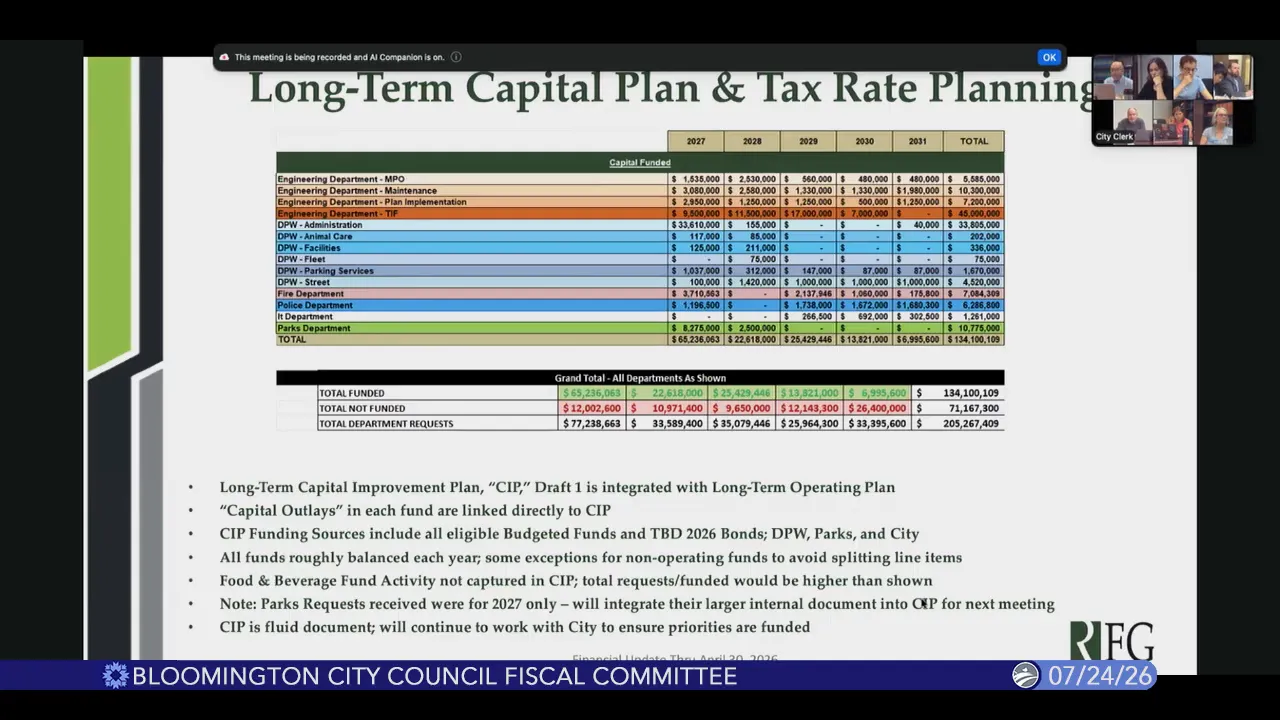
- A five‑year capital improvement plan showing $77 million in total capital requests for 2027, with $65 million currently funded and $12 million unfunded even with planned bond issuances.
- The city’s debt rate is currently about 20 cents lower than the next closest comparable city (Lafayette/Noblesville). Increasing the rate to $1.00 could generate $8–$8.5 million annually for capital projects.
- The potential bond issuances discussed include a 2026 Park GO bond and a 2026 City GO bond, plus a DPW building bond. If issued, total debt tax rates could increase by about 7 cents (combining park and city GO bonds).
- State tax law changes under SCA1/HB1210 were reviewed in detail. Under the “break‑even” scenario (where local units recover lost property tax revenue through a municipal services LIT rate), the city would receive approximately $42 million from the municipal services rate in 2029 (using 2026 certified numbers and 1% annual growth). The county would receive about $3.7 million. The city’s portion is higher because cities and towns get a 1.5× population multiplier.
- Homeowner impacts were projected: the average homeowner in Monroe County would save about $657 in property taxes under SCA1 compared to the old system, but would pay more in LIT. The net effect for the average household is a $353 per year savings, though the relief is regressive—homeowners with lower‑value properties (e.g., in Stinesville) may pay more overall.
- The general fund is projected to have an operating deficit of $7.8 million in 2026, with further deficits in 2027–2028. The large surplus projected for 2029 ($16 million) is due to the redirection of LIT and PSAP funding from separate funds into the general fund when state LIT allocations cease under the new structure. Interest revenue is expected to decline as cash balances are spent down.
- Council members raised concerns about the regressive nature of the property tax relief, the need for careful policy choices (e.g., ending Bloomington Transit subsidy), and the importance of keeping the overall tax rate low for residents.
Key Outcomes
- No formal votes were taken at this meeting. The committee received the controller’s report and the long‑term financial plan for discussion.
- The next fiscal committee meeting is scheduled for August 7, 2026, and will continue follow‑up on electric official salary matters.
- Council members were asked to send any follow‑up questions regarding the controller’s reports to Jeff McKinn. The committee will also consider establishing formal annual reviews of financial policies, as urged by public comment.
Meeting Transcript
All right. On that note, I'll uh call this meeting of the uh special fiscal committee in the order on Friday, July 24th at 834 a.m. Um be stock for uh district free fair. Uh we do introduction certain shaker, we thought you should read Justin Chang reading from Angelo. Isabella Montsmith, City Council District What? Sophia McDowell Clerk's Office. Jeff McKinn, City Controller. Regiment, Deputy Maiden. Thank you. Um, so today our um meeting, if we recall, was gonna be a little bit longer because of the buckera information and the never have time problem that we all have whenever we get um into these serious financial reports or reading. Um so we're gonna start with uh controller with second quarter reports, um, and then uh have questions and comments about that from the committee public comments on the reports, and then we will take it away with our more long-term umcial information and challenges. Any questions or concerns about great. Uh thank you very much. Um, so what you have in your packet and also on screen here is the um second quarter uh reports. And just to kind of remind everybody how it's structured, we have uh two revenue reports, which are the same. We're just at two different levels of detail, it's same numbers. Um, and then we have two expense reports, which are at this at the same, they're the same data but at different levels of level detail. And then we have a fund balance report. And I'm happy to take questions about any of them. I'm just gonna point out a few things. This is to kind of tell you about things I looked at when I get reports like that. So um, you know, first let's talk about the expenditures. When we look at the uh expenditure report, you know, one of the things I always look at is just that what percentage of the uh the fund departments lines have been spent uh by this time of year. So what we would expect is about 50% if the budget is being spent down completely in a straight line. So I tend to look at the big operating funds, um, which uh primarily the general fund and the economic development lit fund. Um so if I look at the general fund, and by the way, I the I added these percentages just as I was looking at these, they're not in the version I gave to you. Obviously, percentages would be useful. So we'll just add that to this edition of the report. But you could see that for the general fund, for example, uh we're spending we've got 48.81% of the of the appropriate expenditures spent so far. Um and then for the economic development lit, we have 48.5%. So, you know, in general, that would tell us that you know we're on track to spend uh uh 100 near 100% of the budget with some small uh reversions at the end of the year. However, there are a couple of large expenditures that aren't paid out even within these funds, but instead are paid out at the beginning of the year. So for example, the um almost $4 million in ED lit that's paid out in the ESD budget for Bloomington Transit. Um, that was paid out at the beginning of the year. We also have um project, we also have all the train, which we talked about at the last uh or one of these previous meetings, uh transfers to other funds like alternative transportation, Jack Hopkins, uh sanitation, et cetera, those were also paid out at the beginning of the year. So actually what that tells me is that although we're seeing nearly 50% of the budget be the appropriations being spent down at the midpoint, then in reality, because some big expenses were front loaded that actually were like we would expect to have some uh reversions at the end of the year. So we're actually not, and you know, I don't know a good way to uh to to try to end the indicate that without literally going through every line and doing the projection. But what was the other one? You said Wellington Transit, Jack Hopkins, what was another example? Uh there were a couple of couple of transfers that are done at the beginning of the year. Sanitation. Sanitation, uh also fleets, because you know, the way we manage our our fleet is that each of the uh operating budgets transfer money into the um in the fleets and management of the cars associated vehicles associated with that fund. So yeah, there are a whole bunch of kind of large front loaded expenses, which indicates that we're we're in good shape to have uh some decent reversions by the end of the year in our in our major uh operating funds. Um couple things when uh there is a decent reversions, just giving some number on that might look like well. I mean, we've got so the economic development lit is or the economic development lit payment to bullentin transit is nearly four million dollars. So I would say, you know, because that's all front loaded, I would say two million dollars of that we would have expected in the second half if it had been evenly paid out. So you know, there's two million dollars there, and the the transfers I think were about two million dollars. So you expect another million dollars uh to just you know back of the mapping calculations. Um when you see a negative note, so in other words, more is has been spent than was in the appropriation. Usually what that would mean, well, that could mean a couple of things.
openpublica.com