Brighton City Council Study Session - February 11, 2025
STREAMING COPY IN PREPARATION — RECORDING AVAILABLE FROM THE ORIGINAL SOURCE
Brighton City Council Study Session - February 11, 2025
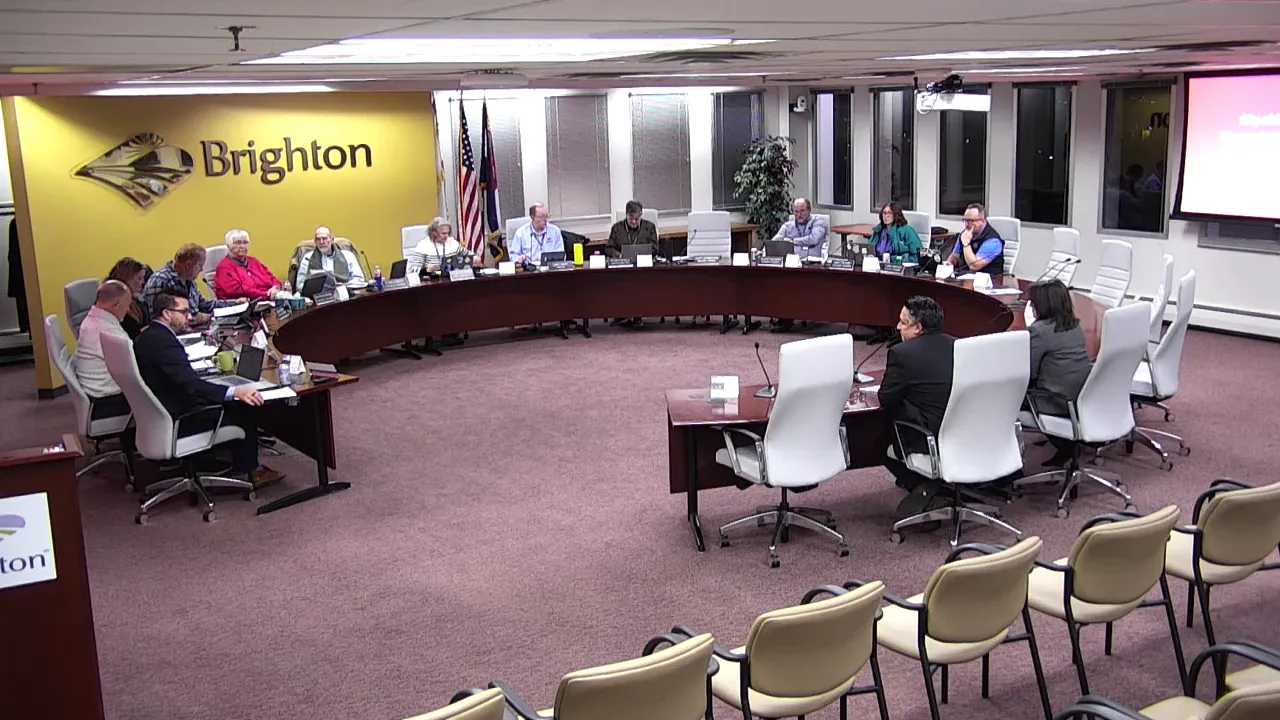
The Brighton City Council held a study session on Tuesday, February 11, 2025, beginning at 6:00 PM. The meeting covered four major discussion items: the Downtown Public Realm Study, the 120th Avenue Corridor Multimodal Study and Assessment, the Economic Development Business Incentive Policy, and a proposed Holiday Lights Display Policy. Council members provided feedback on each topic, with no formal votes taken during the study session.
Downtown Public Realm Study
- Presentation: Emma Lane (Historic Preservationist/Senior Planner), Ryan Soterakis (Dig Studio), and Jennifer Carpenter (Michael Baker International) presented three conceptual options for improving the downtown public realm, focusing on Main Street between Bridge Street and Bush Street.
- Option 1: Maintain two-way traffic, remove on-street parking (16 spaces) to gain 20 feet of pedestrian space on each side, creating a curbless shared street. Estimated low-cost interim option (e.g., planters and seating) at $15,000–$20,000.
- Option 2: Make Main Street one-way toward Bridge Street north of Bridge, and one-way toward Bridge Street south of Bridge, retaining parking on one side and adding a two-way cycle track. This would require no left turns from Bridge Street onto Main, potentially narrowing Bridge Street for wider sidewalks.
- Option 3: Create a one-way couplet with Main Street southbound and Cabbage Street northbound through downtown, requiring realignment of Cabbage and Bridge intersection and a new traffic signal, with about 15 feet of additional pedestrian space on each side.
- Council Feedback: Councilmember Pawlowski emphasized the importance of accessible/disabled parking and pedestrian safety, referencing a prior suggestion for a pedestrian bridge over the railroad. Mayor Pro Tem Padilla favored incremental, low-cost experimentation (citing Arvada's Old Wadsworth approach) rather than large upfront investments. Councilmember Green expressed reluctance to change traffic patterns without input from downtown businesses, noting the need for truck route alternatives. Councilmember Snyder raised concerns about cost magnitude (millions) and suggested focusing on affordable, temporary improvements. Councilmember Taddeo asked about likelihood of cooperation from the railroad and truck route changes. Councilmember Johnston supported the one-way options for traffic simplicity. Mayor Mills noted the importance of connecting parking areas to Main Street and supported option 2.
- Next Steps: Staff will hold a community meeting with downtown businesses and property owners to gather input before finalizing any preferred alternative.
120th Avenue Corridor Multimodal Study and Assessment
- Presentation: Jennifer Carpenter (Michael Baker International) and Greg LeBrie (Adams County) presented the study for 120th Avenue from US 85 to Tower Road, a collaborative effort with Adams County and Commerce City. The study evaluated three alternatives based on 10 criteria including safety, multimodal accommodation, and public support.
- Alternative 3 (Preferred): Includes a bus-only lane (shared with school buses), 10-foot bidirectional cycle paths, 8-foot shared-use paths, protected intersections, raised intersections near schools (Southgate and Salem), and elimination of channelized right-turn lanes where possible. Positive left-turn offsets are incorporated to improve safety.
- Crash Data (2017–2021): Over 100 crashes at US 85 and Sable Boulevard, 30–50 at Chambers and Buckley, 15–25 at Tower, E470, and Peoria. Three fatal crashes occurred (US 85, Sable, and east of Chambers).
- Public Engagement: Two open houses (80–100 attendees each), online survey with 300+ participants and 9,000 data points. Top biking barriers: no bike paths, heavy trucks, speeding cars. 20% of respondents reported walking on the corridor despite lack of sidewalks.
- Funding: Adams County submitted a RAISE grant application on January 30, 2025, and an HSIP grant for the Salem signal. The US 85/120th interchange is at 30% design, led by Commerce City, with a recent FRA grant to advance to final design. Long timeline noted (since ~1999). Councilmember Mills asked about pedestrian access across the I-76 bridge; staff noted a potential temporary sidewalk.
- Council Feedback: Support for safety improvements, raised intersections near schools, and separating bike lanes from traffic. Councilmember Green emphasized the need to coordinate with a developer required to make improvements west of Sable. Councilmember Pawlowski suggested roundabouts were considered but rejected due to right-of-way and bus lane constraints. Councilmember Taddeo asked about fire access; raised intersections were deemed acceptable in school zones with reduced speed (35 mph).
- Next Steps: Third public open house on March 11, 2025; final report expected May 2025. Staff encouraged council to advocate for inclusion of these projects in DRCOG and CDOT plans.
Economic Development Business Incentive Policy
- Presentation: Robin Martinez (Economic Development) and Mike Masciola (Economic Development) presented a draft policy to replace outdated 2014 and 2004 policies. Policy creates a structured, transparent framework for incentives, aligning with council’s principles and taxpayer responsibility.
- Eligibility Criteria: Primary employers must create 50 net new jobs, pay average wage 20% above Adams County average ($69,000 → ~$83,000), and invest at least $1 million. Sales-tax generators need 50 new jobs and $15 million minimum annual sales. Incentives include rebates of up to 50% of unrestricted tax revenue for 5 years (sales, use, and personal property tax). Expedited development review is available.
- Administrative Approval: City manager can approve incentives under $200,000–$250,000 (staff recommended $250,000). Council will be notified of all such approvals.
- Council Feedback: Councilmember Green requested that notification to council be included in the policy; City Attorney Calderon confirmed it can be added to the resolution. Councilmember Green also supported special-case scenarios being brought to council. Mayor Pro Tem Padilla asked that the policy require a “but for” clause—i.e., the incentive must be necessary to attract the business, not just generally beneficial. City Manager Martinez noted the policy is mainly a guiding tool, not a carte blanche. The number of expected deals is 1–3 per year.
- Next Steps: The policy will be brought back to council at the next business meeting (February 18) for a vote, likely on the consent agenda if no further changes are needed.
Holiday Lights Display Policy
- Presentation: City Attorney Calderon explained that the previous prohibition on holiday lights display duration was in the municipal code but was inadvertently removed when the sign code was updated. Staff had been operating under the old rule (lights down by January 15). Councilmember Pawlowski requested a policy to keep lights up through the National Western Stock Show (mid-January).
- Council Feedback: Councilmember Snyder supported keeping lights up longer, noting the low cost (city owns most lights, no extra electricity cost since street lights are flat fee). Councilmember Green questioned the need for a council policy, suggesting it should be an administrative decision. Mayor Pro Tem Padilla agreed it should not be a council policy; council should be generally supportive but not micromanage. Councilmember Taddeo supported the tradition. The discussion was mixed.
- Next Steps: City Attorney Calderon will bring a resolution to the next meeting for council to vote on the policy.
Key Outcomes
- Downtown Public Realm Study: No decision made. Staff will hold a community meeting with downtown businesses before selecting a preferred alternative. Council members expressed interest in low-cost, incremental pilot projects.
- 120th Avenue Corridor Study: No formal action. The preferred alternative (Option 3) continues to be refined. Adams County will submit grant applications. Council members voiced strong support for safety improvements.
- Economic Development Incentive Policy: Staff will incorporate feedback (notification to council for administrative approvals and a “but for” clause) and present a resolution for adoption at the February 18 business meeting.
- Holiday Lights Display Policy: A resolution will be brought for a vote at the next meeting; council opinions were divided on whether a formal policy is necessary.
Meeting Transcript
Study session for Tuesday, February eleventh, twenty twenty-five. I'll have uh Mayor Protem Padilla lead us in the Pledge of Allegiance. Thanks for leading us in that. Um agenda, we'll kick things off with the uh downtown public realm study. City Manager Martinez. Thank you, Mayor. Good evening, Mayor, Mayor Pro Tem, members of council. Uh, before we get into this item and the next item, I do want to just kind of set the table a little bit. Both this item and the next item are going to be very high-level discussions. So tonight we'll be talking to you about some things that we have been working on both in downtown and on a hundred and twentieth. Um, but again, I want you to keep in mind that we're still very far away from some of these things that we're still in the conceptual level, but we are asking for your feedback tonight. So keep that in mind as we're having the conversation tonight, and I'm going to turn it over to Emma. Thank you, City Manager. Good evening, Mayor, Mayor Pro Tem, members of Council, Emma Lane, Historic Preservationist for the City and Senior Planner. Um We are here to talk about the downtown public realm study. Um, you may recognize a couple of members of this team. We've worked with Diggs Studio and Michael Baker International before, um, most recently on the community identity design plan that came before you. And they are now working with us on the public realm study. So you may recall that city council and city staff have had numerous discussions about the functionality of downtown as related to the public realm. So we commissioned this study to analyze those concerns and see how best to improve downtown from a public standpoint. So we'd love to get your feedback, have uh deep discussions on that. Um as Michael said, it's very high level, but we really want that feedback so we can take this plan in the right direction. Um so with that, I will let them introduce themselves and take it from here. Thanks, Emma. Uh good evening, Mayor, Mayor Pro Tem, and members of council. Uh I'm Ryan Soterakis, um, urban designer and planner with Dig Studio, and um nice to be back in front of you this evening. And maybe Jen too. Sorry. Good evening, Jennifer Carpenter with Michael Baker. I'm a senior transportation planner. And I'm we are supporting Dig on this effort. Thanks. So we're gonna um go through um a lot of stuff kind of quickly, and then we'll focus on kind of the meat of where we are with this project, but some of the background stuff we'll go through pretty quick. But please feel free to stop me if you have any questions or we can save questions till the end as well. Um, so um as Emma said, Um, the the main overview of this project is really to look for ways to expand and enhance the public realm um within downtown Brighton and make sure it's a place for people. Um this includes um utilizing the existing plans that are in place, um, bringing in a lot of new ideas, ways to refresh downtown spaces, the sidewalks, and expand and enhance them. Um, also looking at ways to reroute the truck traffic that currently is going through um downtown. Um it's gonna be hard to make a a bit a nicer place for people to be and linger with all the trucks that are currently going through, uh, as well as the larger picture of evaluating transportation needs for a bit more inclusive multimodal network into and out of downtown Brighton. Um we've looked at the existing conditions, both from a public realm perspective as well as uh mobility and transportation. Um, some of the key takeaways in terms of the public realm um are that the historic architecture and the downtown branding and identity are really contributing to that sense of place. So that's a really great quality in downtown Brighton. Um however, the sidewalks in most places are very narrow. Um, and in a lot of places, there's no buffer between the sidewalks, between people on the sidewalks and moving traffic. Bridge Street is a great example of that. Um as well, there's really overall throughout downtown, there's a lack of seating, um, outdoor dining and other amenities that will help make downtown a lively place. From a transportation perspective, um, there's a few different areas of concern, areas of concern in downtown. There's some awkward intersections, there's some um inaccessible um or areas with lack of accessibility and a lot of congestion because of the traffic volumes and that and that truck traffic and the train crossing on Bridge Street. Um, and you all you all know this. It's it's a little, it's congested, right? It's everything's sort of tightly packed in there, and um, it can be a little bit complicated to navigate.
openpublica.com