Broward County Commission Workshop on Resilience Study – February 4, 2025
STREAMING COPY IN PREPARATION — RECORDING AVAILABLE FROM THE ORIGINAL SOURCE
Broward County Commission Workshop on Resilience Study – February 4, 2025
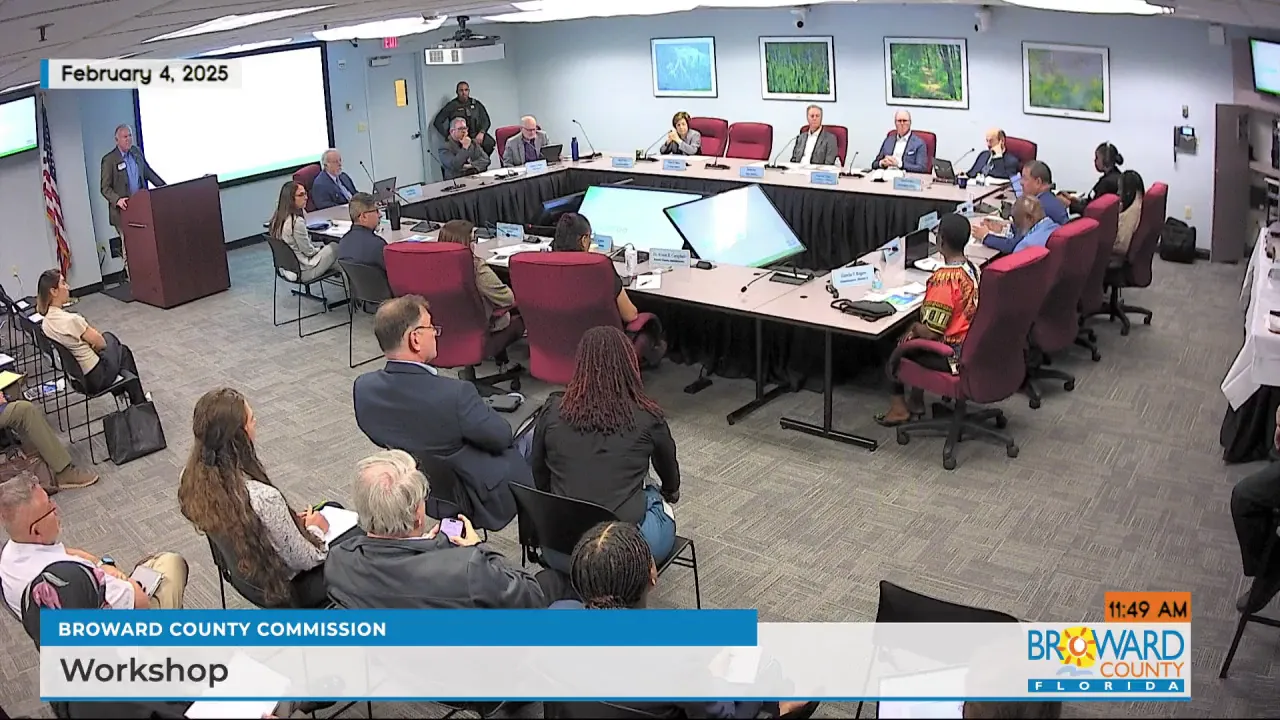
The Broward County Commission convened a workshop on February 4, 2025, from 10:00 AM to 12:00 PM, to review the final results of the multi-year Broward Resilience Study. Led by Chief Resilience Officer Dr. Jennifer Jurado, the presentation detailed climate trends, risk assessments, adaptation strategies, and economic analyses for a comprehensive blueprint to address flood and heat risks countywide. Commissioners discussed the massive projected costs ($20.1B for Tier 1, $28B for Tier 2), funding mechanisms, and prioritization. The workshop concluded with a consensus to focus initial investments on hard infrastructure (~$100M per year for 10 years) and a directive for staff to return with specific funding options and a prioritization plan.
Public Comments & Testimony
- Bob Swindell, President and CEO of the Greater Fort Lauderdale Alliance, spoke on behalf of the business community. He emphasized that businesses want to know the county is actively planning for resilience and highlighted opportunities for innovation and technology to reduce costs (e.g., new seawall designs, advanced air conditioning). He noted the February 26, 2025 workshop with the business community and a CBS Saturday Morning story on South Florida resilience.
Discussion Items
- Climate Trends and Projections: Dr. Jurado presented data showing accelerating sea level rise (5–7 inches since 2010 on the Atlantic coast), intensifying rainfall (58 inches average annually, with five of the ten most extreme events in the last five years), and increasing heat (projected 180 days over 90°F by 2100). Broward uses a unified sea level curve planning for 40 inches (3.3 feet) by 2070, with NOAA intermediate-high tracking.
- Risk Assessment and Economic Impacts: The study modeled 81 compound flood scenarios (sea level rise, king tides, storm surge, rainfall intensification). Key findings: 90,000 new parcels added to FEMA flood zones (50% of properties now in flood zones); average annual damages could increase from $600M (baseline) to $1.8B with 2 feet sea level rise; property values could drop 13% ($24B) without adaptation; tier two investments could reduce damages by 83% countywide.
- Adaptation Strategies: Five categories were modeled: storage (swales, bioswales, underground storage), green infrastructure, conveyance improvements (culverts, pumps), seawall upgrades (5-ft NAVD standard with caps for 7-ft), and land-use regulations. A priority zone (Zone 1) was identified for combined high flood/heat risk and social vulnerability. Potential conversion of 1,760 miles of residential roads to one-way/single-lane to create wider swales was presented.
- Cost Estimates: Tier 1 (2-ft sea level rise, 2050) est. $20.1B; Tier 2 (3-ft, 2070) est. $28B (includes Tier 1). Breakdown: ~$19B private (67%), ~$9.1B public (county, municipal, water control districts). Seawalls are the costliest component.
- Commissioner Questions and Concerns:
- Commissioner Geller asked for a breakdown of public costs between county and municipalities, and for prioritized funding scenarios. He expressed concern about traffic impacts of road conversions and asked about the effect on housing costs (Dr. Jurado estimated ~1.5% increase for new construction).
- Commissioner Fisher highlighted opportunities for public-private partnerships and educational workshops for municipalities.
- Senator Rich noted the existing seawall ordinance requiring higher standards by 2035/2050 and asked how the Army Corps’ Central and South Florida Flood Protection Study funding affects the numbers (if not funded, costs would be higher).
- Commissioner Udine stated the full plan is unaffordable and not realistic; he urged focusing on drainage improvements (especially at water control districts) and opposed massive county spending. He said he would not vote for the plan as presented.
- Commissioner McKenzie questioned the efficacy of existing retention systems and pointed out that older communities cannot afford redevelopment; he stressed maintenance and realistic expectations. He opposed new taxes.
- Commissioner Rogers requested assurance that new development does not worsen flooding in zone 1 and asked about enforcement of swale and retention requirements.
- Vice Mayor Bogan (participating by phone) supported prioritizing low-cost, low-tech solutions like restoring swales and noted the Keys’ example of road raising and retreat decisions.
- County Administrator’s Input: Monica Cepero noted that the county’s discretionary budget is limited due to new constitutional officer costs and growing obligations. She said the $9.1B public figure is not all county – it includes municipal and water district shares – and that a phased, leveraged approach is needed. She committed to providing funding options.
Key Outcomes
- The commission did not vote on adopting the plan but directed staff to return with:
- A refined prioritization of hard infrastructure projects (pumps, culverts, structures) estimated at ~$100M per year for 10 years.
- A breakdown of public investment needed by entity (county, municipalities, water control districts) under scenarios with and without Army Corps canal fixes.
- Specific funding models (e.g., bonds, assessments, PACE expansion) and a realistic assessment of what the county budget can accommodate.
- Commissioners expressed broad support for starting with the low-hanging fruit of drainage improvements while continuing to pursue federal and state grants.
- The county will host the 2026 Southeast Florida Climate Compact Summit and plans to showcase innovation and private-sector partnerships at a dedicated day.
- Staff will continue engagement with municipalities through the Resilience Roundtable and the February 26 business workshop.
Meeting Transcript
We have a couple I think uh Commissioner Bogan is going to be calling in. Commissioner Bogan, can you hear us? I'm in. You're in. I'm here, I'm in. Welcome back from DC. You have fun? Or in the morning. Four in the morning. All right. And you can't be here just because of that. Just because of that. I'll let Monica weigh in on some of that. Right. She made it. Yeah, Monica made it, Mark. Um, ten years. Monica's got ten years on me. So uh I think when you meant to say you've got ten years on me, right? Sorry. Okay, we're we are here to um have a chance for the uh resilient department to unveil the vulnerability assessment review, uh which they have been working on for a number of years now. Uh we commissioned this ourselves. Uh it is probably it is a groundbreaking project. One that I don't know if anybody else has done has done it like this before. Um, this commission back in two thousand nine started the climate change compact, um, which was groundbreaking in and of itself. And did a few things that uh no that were unique. One, uh the adoption of the unified sea level curve. And that has been kind of the what we've been going by. How did they do that? They they pulled together all the educational institutions and scientists locally and did the research, and uh, we're able to establish a unified sea level curve, of which we've watched it its accuracy. If anything, it has been we've seen things accelerate more than you know, more than that curve. That you know, those projections we we have to take them into consideration. We're years down. We won't be here. Uh we'll well, we'll be here, but we won't be in office here. Um those things start to take place, we we have to be looking, we have to be acting now. Because so many of these things will take a long time to either to put into place, to invest in. And so we we're gonna be looking at those. While we're giving uh while Dr. Harado is giving this presentation, I think it's important. Well, let me go back. Let me back up for one second. What I think all of us, when we when we see this, we ask, well, what are we gonna do? What's it where's our blueprint? This is essentially our blueprint. And the the thing about this part is that was that I think everybody wanted to see was I think the Broward workshop had in many ways challenged um the resilient department and us. Um what does it mean? What does it mean? And how do you what are the metrics for this? Um, so we know what the return and uh return on investments are.
openpublica.com