Browse by city
Date range
Search help

Search titles, summaries, topics and stored transcripts together. Keywords may match separately; put the whole query in double quotes for a phrase. Matching follows word analysis, so punctuation is not exact. Both dates are included. Documents are not searched.

SHOWING 1–10 ENTRIES
01
NEWNOV 3, 2026 · BROWARD COUNTY, FLORIDA · UPCOMING AND ARCHIVED MEETINGS
State of Housing Affordability in Broward County - November 3, 2026

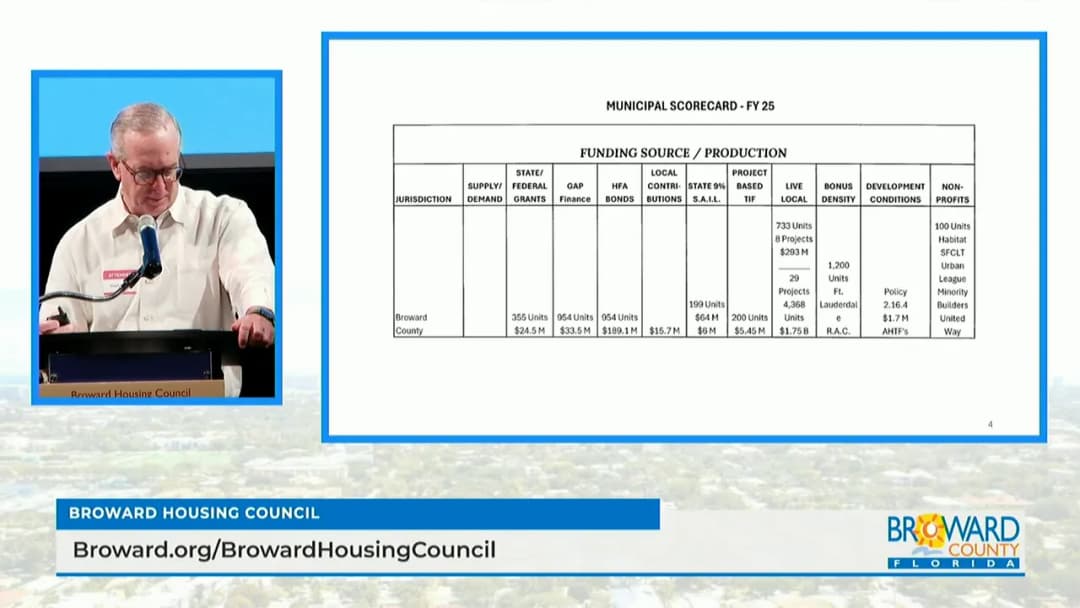
On November 3, 2026, the Broward Housing Council, in partnership with Broward County and Wells Fargo, hosted a workshop at the Broward Performing Arts Center to address the housing affordability crisis. The event featured presentations, panel discussions, and a call to action. Key statistics revealed that over 340,000 households are cost-burdened, the county ranks last in Florida for affordable rentals, and the region has lost 96,000 residents since 2020. Presentations - Broward County Affordable Housing Needs Assessment (Dr. Ned Murray, FIU Metropolitan Center): Dr. Murray presented updated data showing that 340,000+ households spend more than 30% of income on housing, with 175,000 severely cost-burdened (over 50%). The median home price is $620,000, unaffordable for over 95% of households. Average rent for a two-bedroom is $2,675/month. Since 2020, the county lost 96,000 residents to out-migration, and 15,000 jobs have been lost. Broward ranks 67th of 67 Florida counties in availability of affordable rentals at 60% AMI (fewer than 25 units per 100 households). 70% of housing was built before 1990 (median age 1981); only 7% since 2010. Current AMI is $102,450. - Municipal Scorecard (Ralph Stone, Broward County Housing Finance Authority): Stone introduced an analog scorecard to track affordable housing production. Since 2018, the GAAP program has awarded $180 million, constructing 5,000 units, with local governments contributing $67 million and the HFA providing $845 million in bond allocation. Average subsidy per unit is about $36,000 (lowest in state). Affordability periods now incentivize 99-year terms. Pipeline: 23 projects, 4,600+ homes. Panel 1: Public-Private Partnerships Moderated by Sandra Vassi Einhorn, panelists Mitch Rosenstein (Green Mills Group), Al Milo Jr. (Related Urban Development), Ralph Stone, Barbara Blake Boy (Planning Council), and Walter Duke III (former mayor) discussed the transformation since 2018. Key points: dedicated GAAP funding changed the landscape; municipal contributions have grown; predictability and speed are critical. Live Local Act was seen as a powerful but imperfect tool. Examples included redevelopment of a former motel into 400 units and partnerships with the Pantry of Broward. Panel 2: Looking Ahead Panelists Chris Cooper (Fort Lauderdale), Suzanne Cabrera (Palm Beach County Housing Leadership Council), Mayor Michelle Gomez (Tamarac), Tim Wheat (Pinnacle), and Chakira (Enterprise) focused on regional collaboration, Live Local adjustments, faith-based development (YIGBY), mixed-income communities, and workforce housing. Mayor Gomez expressed concerns about loss of local control; Cooper noted some projects causing friction. All agreed on the need for integrated housing and infrastructure coordination. Community Scholars Program Chelsea LaFrance (University of Miami) described the six-month program that trains emerging leaders in affordable housing. 117 alumni have completed capstones leading to policy changes, such as increased set-asides for very low-income households and extended eviction notice periods. Closing Remarks – Senator Nan Rich Senator Rich celebrated progress but warned that Amendment 3 could reduce county revenue by $195 million (first year) and $334 million (second year), threatening dedicated housing funds. She urged protecting the GAAP program, faster approvals, and changes to Live Local. She emphasized that every home built makes a difference for families and the economy. Key Outcomes No formal votes were taken. Strong consensus emerged on: - Protecting dedicated housing funding from Amendment 3. - Increasing municipal participation and streamlining approvals. - Adjusting Live Local Act to balance state and local needs. - Expanding public-private partnerships and faith-based development. - Strengthening regional collaboration across South Florida. - Continuing data-driven planning via needs assessment and scorecard.

AFFORDABLE HOUSING 56% · HOUSING AND URBAN PLANNING 11% · PROCEDURAL 9% · PUBLIC-PRIVATE PARTNERSHIPS 6%
02
NEWOCT 30, 2026 · BROWARD COUNTY, FLORIDA · UPCOMING AND ARCHIVED MEETINGS
Broward County Transportation Surtax Oversight Board Performance Dashboard Workshop - October 30, 2026

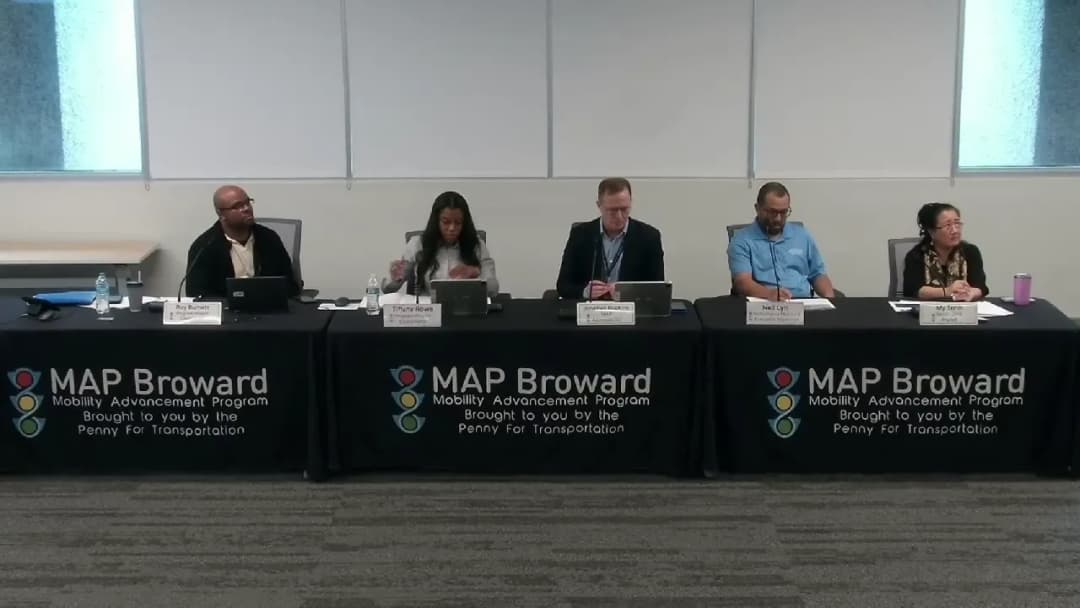
Discrepancy Note: The agenda listed the meeting start time as 1:30 PM local time, while the accompanying metadata specifies a UTC timestamp of 2026-10-30 18:45:00+00:00. No minutes from the meeting were available. The Independent Transportation Surtax Oversight Board held a virtual workshop to review best practices in performance metrics dashboards used by peer transportation surtax programs. MAP Administrator Jonathan Hopkins facilitated the session. The Performance Metrics and Evaluation Team, led by Tiffany Rowe, presented research findings to inform the development of MAP's next-generation public dashboard. Discussion Items - Performance Dashboard Peer Review: Tiffany Rowe presented research on 18 voter-approved transportation measures across nine states. Six key insights were identified: organizing dashboards around the voter promise, leading with an interactive map, providing budget versus spending transparency, listing targets alongside progress, separating outputs (what was built) from impacts (system-level changes), and building layers of detail from overviews to individual projects. - Peer Program Spotlights: Detailed analyses of three peer programs were shared: - Seattle (Move Seattle Levy): A $930 million, 9-year program noted for separating project delivery outputs in its main dashboard from system impacts in a separate dashboard called "Moving the Needle." - Phoenix (Transportation 2050): A $16.5 billion, 35-year sales-tax program, identified as the most comparable to MAP in scale and tax structure. It uses a narrative, story-based website rather than a traditional dashboard, supported by detailed formal reports. - Columbus (Link Us): An $8 billion program by the Central Ohio Transit Authority, highlighted for its one-screen program snapshot and consistent tri-annual progress reports tied to service changes. - MAP Dashboard Concept Design: A conceptual mock-up was presented incorporating the six insights into a single-screen interface with categories, map, budget tracker, progress bars, outputs vs. impacts, and navigational links. Board Feedback & Positions - Chair Pennant Wallace expressed strong support for the presentation and the direction of the work. He specifically advocated for the inclusion of impact metrics beyond the strict voter promise, such as safety improvements, job creation, economic impact, and minority business (CBE) participation. He also requested that the dashboard highlight matching funds and the growth of the initial investment, calling these "added value" metrics that tell a fuller story. - Vice Chair Ray praised the presentation as a "Rosetta Stone" that provides a clear macro-level understanding of the program's impact. He inquired whether the dashboard would replace the existing project-level tool or be a new platform. Staff clarified the existing dashboard would remain, with new segments added through a minimum viable product (MVP) approach over several years. - Board Member Ardal commended the peer benchmarking effort and suggested exploring how future board meetings could be aligned with the voter promise categories, proposing meetings be structured around the ballot measure's investment themes. - Board Member Ken Ortner stated the presentation was "excellent" and helped him better understand the program's purposes and public reporting goals. - Board Member Kuhlman raised significant concerns regarding the Third Amendment. He reported cities had been told they could no longer request new major capital projects, calling this "disturbing" and "not right." He requested a detailed spreadsheet of all committed funds. - Staff Response: Nathaniel and Jonathan Hopkins clarified the situation arises from a backlog of previously programmed major capital projects. The proportion of funding allocated to cities remains consistent, and the maintenance-focused items were specifically requested by the cities through the BCCMA. New capital project solicitations are expected after the current five-year plan ends in 2032. Key Outcomes - General Concurrence: Board members expressed general support for the proposed dashboard design, particularly its organization around the voter promise and its separation of outputs and impacts. - Dashboard Timeline: A fully-featured dashboard is not expected in 2027. An MVP will be released, refined with public and board feedback, and enhanced with features over several years. - Performance Audit Integration: The board and staff agreed to integrate findings from the upcoming performance audit into the dashboard recommendations. Audit results are anticipated for the December 10, 2026 meeting. - Meeting Structure Proposal: Staff proposed organizing the 2027 meeting calendar around the seven ballot measure categories, to be discussed and shaped further at the December meeting. - Follow-Up on City Funding: Staff will prepare a detailed financial spreadsheet and hold one-on-one briefings with board members, particularly Chair Kuhlman, to explain the city funding backlog, the Third Amendment, and the timeline for future capital project cycles.

TRANSPORTATION SAFETY 47% · TECHNOLOGY AND INNOVATION 26% · ENGINEERING AND INFRASTRUCTURE 16% · ECONOMIC DEVELOPMENT 5%
03
NEWOCT 30, 2026 · BROWARD COUNTY, FLORIDA · UPCOMING AND ARCHIVED MEETINGS
Broward County Planning Council Meeting - October 30, 2026

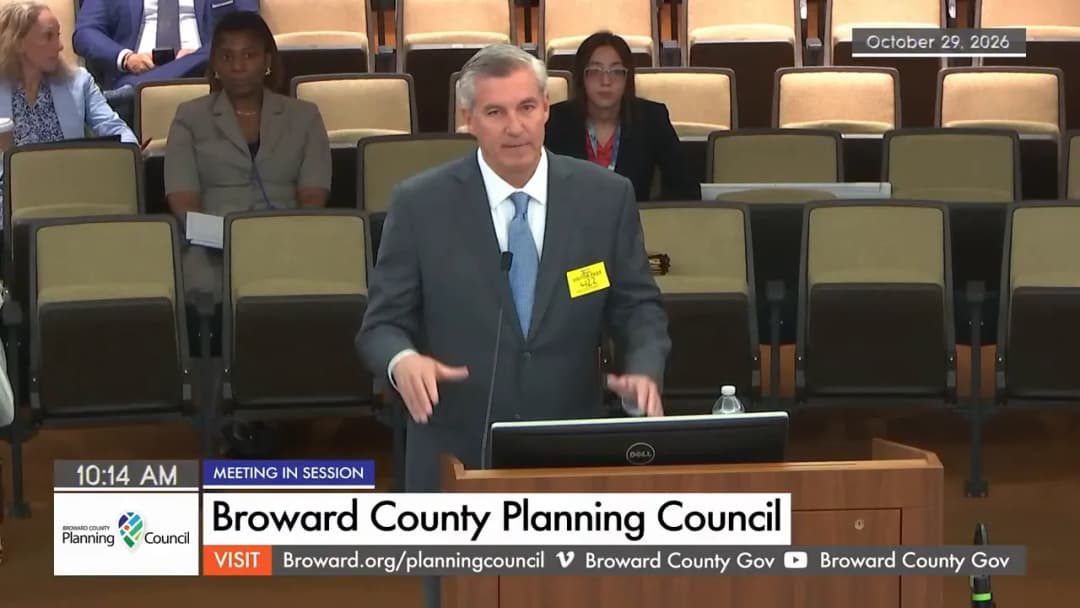
The Broward County Planning Council convened on October 30, 2026, to consider a proposed land-use amendment in Fort Lauderdale. The main item (PH1) was a change from residential to commerce on a 41.2-acre site adjacent to the former Wingate landfill superfund site. After extensive public testimony and deliberation, the council unanimously approved the amendment, subject to a restrictive covenant limiting industrial uses and requiring environmental mitigation. The council also handled routine consent items and discussed scheduling for the next meeting. Consent Calendar - Approval of the final agenda, including additional agenda materials: a conditional support letter from the city of Lauderhill and an email from a resident supporting residential use on the site. An excused absence request from Commissioner Fisher was removed. Motion by Mayor Levy, second by Mayor Castillo, passed unanimously. Public Comments & Testimony - Linda Patrick: Opposed any development on the contaminated site, citing numerous community illnesses and deaths. - Eddie Pierce: Asked for transparency and honesty, deferring to experts. - April Young (Vice President for Lake Air, educator, clergy): Described personal health impacts, including loss of a son and daughter, and criticized lack of transparency. Requested safeguards and independent testing. - Susie Fletcher: Described long-term health issues and contamination from the landfill, questioning the source of fill material. - Walter Haney: Supported the project, noting community benefits like flood control, a park, and a computer lab; encouraged the community to get involved to secure benefits. - Dr. Nadine Hankerson: Called for transparency and understandable scientific explanations; emphasized shared responsibility. - Farid Khan (school administrator): Described dust, noise, and health concerns; requested meetings at the site. - Ashley Davis: Supported the project as necessary to cap contamination, comparing it to healing a broken bone. - Al Callaway: Suggested reviewing hospital census tracts for disease incidence over 50 years before proceeding. Several speakers expressed concerns or support, highlighting environmental justice and the need for ongoing oversight. Discussion Items - PH1 – Land Use Amendment, Fort Lauderdale: The proposed change from low-5 residential and medium-16 residential to commerce on 41.2 acres, located east of 31st Avenue and south of 19th Street. Staff recommended approval with conditions, including a declaration of restrictive covenants limiting development to 550,000 square feet of industrial warehouse/distribution and up to 10,000 square feet of commercial uses. The applicant (Robert Lockery, representing Pro Logis and Langley Engineering) presented plans to cap contaminated lake sediment with clean fill, create a 26-acre voluntary wetland for water storage, and address flooding. Eighteen monitoring wells report every 90 days to the Florida Department of Environmental Protection and Broward County. The site is adjacent to the former Wingate landfill superfund site (not owned by the applicant). The city of Fort Lauderdale, Lauderhill, and Broward Municipal Services District provided comments noting compatibility would be addressed at site plan stage. - Council members expressed support as a first step toward remediation and economic development (600 permanent jobs), but emphasized the need for transparency, community engagement, and going beyond minimum environmental requirements. Key Outcomes - PH1 Motion: Mayor Levy moved to approve the staff recommendation for conditional recertification of the Fort Lauderdale municipal plan, seconded by Mayor Hardin. The motion passed unanimously. - PH2 Motion (small-scale amendment for Lighthouse Point): Moved forward with unanimous consent. - December 3rd Meeting: Executive director noted it may be canceled; a committee meeting (online) may be held instead for rule of procedure initiation and administrative rule updates. - Planning Council Comments: Celebration of life for Roy Rogers announced for November 22nd at the Emily Wilson Center in Pompano Beach.

ENVIRONMENTAL PROTECTION 28% · PUBLIC ENGAGEMENT 21% · LAND USE PLANNING 17% · PUBLIC HEALTH 17%
04
OCT 26, 2026 · BROWARD COUNTY, FLORIDA · UPCOMING AND ARCHIVED MEETINGS
State of Housing Affordability in Broward County - October 26, 2026

The Broward Housing Council, along with partners including the Coordinating Council of Broward, Broward County Housing Finance Authority, and Wells Fargo, hosted a workshop on housing affordability. The event featured a data presentation by Dr. Ned Murray, panel discussions on public-private partnerships and future strategies, and closing remarks by Senator Nan Rich. Discussion Items - Housing Needs Assessment Findings: Dr. Ned Murray presented the updated assessment, showing that over 340,000 households are cost-burdened (30%+ of income), with 175,000 severely cost-burdened (50%+). Median single-family home price is $620,000, average two-bedroom rent is $2,675/month. Only 7% of housing was built after 2010; 70% before 1990. Broward has lost 96,000 residents since 2020, mainly young adults. - Municipal Scorecard & GAP Program: Ralph Stone introduced a scorecard to track housing production across 31 cities. The GAP program, launched in 2018, has allocated $180 million in gap financing, produced 5,000 units with an average subsidy of $35,000 per unit (lowest in Florida). Funding comes from expired CRA/TIF revenues; projects now require 50–99 year affordability. - Public-Private Partnerships: Panelists (Mitch Rosenstein, Al Milo, Ralph Stone, Barbara Blake Boy, Walter Duke) stressed predictable processes, municipal contributions (totaling $67 million), and faster approvals. Examples included redeveloping motels and using city-owned land. Developers noted the importance of co-investment. - Live Local Act Impact: A second panel (Mayor Michelle Gomez, Chris Cooper, Tim Wheat, Suzanne Cabrera, Dr. Christine Kade) debated the Act. Supporters said it expands developable sites and provides tax exemptions; critics cited loss of local control, lack of public input, and infrastructure strain. Calls for tweaks to allow community engagement and mixed-income requirements. - Yes in God's Backyard (YIGBY) & Faith-Based Development: Discussion on using church land for housing. Need for pre-development resources and developer matches. Enterprise Community Partners highlighted ongoing projects in the region. - Regional Collaboration: Panelists urged a tri-county approach (Miami-Dade, Broward, Palm Beach) to align transportation, economic development, and housing. The housing crisis is an economic competitiveness issue. - Workforce Housing & Mixed-Income Communities: Mixed-income models are ideal but financially challenging. Incentives needed; stigma should be avoided through integration. - University of Miami Community Scholars Program: Chelsea LaFrance presented a 6-month professional development program on affordable housing, with capstone projects leading to real policy changes (e.g., extending eviction notice from 15 to 30 days, increasing set-asides for very low-income). Key Outcomes - Data Confirms Worsening Crisis: Assessment shows Broward ranks last in Florida for affordable rentals at 60% AMI (fewer than 25 units per 100 households). The county needs approximately 1,000 new affordable homes per year for 30 years. - GAP Program Sustained: Board recently allocated $27 million; HFA has 21 projects (4,000+ units) in pipeline. Program remains the primary driver of affordable housing development. - Municipal Engagement Growing: More cities are contributing gap financing; scorecard will increase accountability. Senator Rich urged local governments to protect dedicated housing funds and speed up approvals. - Live Local Act Adjustments Sought: Panelists and Senator Rich called for legislative changes to allow more local control, public input, and mixed-income requirements. The Act's density and height provisions remain contentious. - Amendment 3 Threat: Senator Rich warned that Amendment 3 (property tax cap) could divert up to $334 million in county revenue, endangering the GAP program's expired CRA funding source. - Call to Action: Senator Rich closed by emphasizing that housing impacts real lives; the county has tools and proof but needs continued political will and collaboration across sectors.

AFFORDABLE HOUSING 60% · HOUSING AND URBAN PLANNING 9% · PROCEDURAL 9% · ECONOMIC DEVELOPMENT 6%
05
OCT 20, 2026 · BROWARD COUNTY, FLORIDA · UPCOMING AND ARCHIVED MEETINGS
Broward County Commission Regular Meeting – October 20, 2026

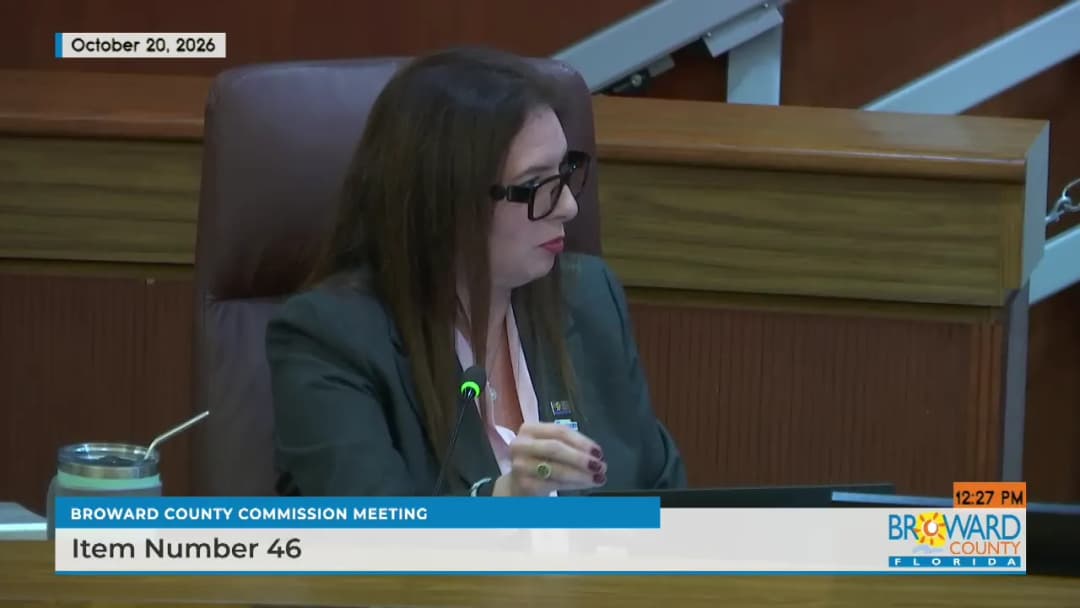
The Broward County Commission convened its regular meeting on October 20, 2026, at 10:00 AM. The meeting included the adoption of a large consent agenda, public testimony on proposed advisory board repeals and a data center moratorium, and a complex debate over a major airport janitorial services contract. Key decisions included deferring the advisory board repeals to explore legal exemptions, authorizing the drafting of a data center moratorium, and awarding the airport janitorial contract to finalize the procurement process for court review. Consent Calendar - The Commission approved the Consent Agenda (Items 1–40, 49, 53) with the exception of pulled items (5, 7, 10, 24, 40) and withdrawn items (19, 48, 50). - Approved items included board reappointments, aviation leases, Port Everglades agreements, Human Services contracts, and travel authorizations. - Commissioner Nan Rich abstained from voting on Items 7 and 10 to avoid the appearance of conflict, noting her board service with the affected organizations. Public Comments & Testimony - Items 43/44 (Advisory Boards): Nine public speakers strongly opposed the proposed repeal of the Racial Equity Task Force and the Commission on the Status of Women, as well as the removal of the LGBTQ+ seat from the Homeless Continuum of Care Board. Speakers included Bacardi Jackson (ACLU of Florida), who argued that state law SB 1134 explicitly exempts volunteer advisory boards, rendering the repeal unnecessary and potentially creating legal liability. Michael Rayner (Human Rights Board), Sidney Callaway (Urban League), and Toby Foyer (Commission on the Status of Women) urged the Commission to oppose the repeals. - Item 40 (Data Centers): Public speaker Chris Nelson supported the motion for a moratorium, advocating for a permanent ban on large-scale data centers in the county. - Item 46 (Airport Janitorial): Representatives from Sunshine Cleaning Systems supported the award, while representatives from Triangle Services requested the Commission defer the award or send it back to staff for review of local preference points. Discussion Items WSP Transit Contract (Item 5): Commissioner Rogers commended the firm for exceeding CBE goals. The $3 million contract amendment was approved unanimously. CBE QVL Ordinance (Item 24): Commissioner Geller pulled the item to raise concerns that the proposed change could allow CBE vendors on reserve lists to charge significantly more than non-CBE bidders without competition. Commissioner Davis and OESBD staff countered that the provision applies to a very narrow set of contracts (only one active CBE reserve list exists for CPA services), and that standard price reasonableness checks apply. The item was advanced to a public hearing on an 8-1 vote. Data Center Moratorium (Item 40): Commissioner Fisher introduced a motion to draft a one-year moratorium on large-scale data centers in the BMSD. Commissioner McKenzie cautioned against a broad prohibition that could negatively impact the struggling district and requested a workshop to examine precise definitions. The motion passed unanimously. Advisory Board Repeals (Items 43 & 44): Commissioners Nan Rich and others moved to defer the action to the December 8, 2026 meeting, citing the legal arguments presented by the public regarding the exemptions in state law. Commissioner Geller stated he would ultimately rely on the County Attorney's official guidance. The deferral motions passed unanimously. Janitorial Services Contract (Item 46): The Commission awarded a five-year janitorial contract to Sunshine Cleaning Systems. The top-ranked firm, Triangle Services, formally protested the removal of 25 local preference points. County Administrator Monica Sapiro clarified that approving the item as presented was the necessary final agency action to allow Triangle's pending circuit court lawsuit to proceed. The debate centered on whether the County should follow the Administrative Law Judge's ruling or overturn it. The Commission unanimously approved the item to let the court resolve the dispute. Key Outcomes - Advisory Boards: Repeals of the Racial Equity Task Force and Commission on the Status of Women, and modifications to the Homeless Continuum of Care Board, were deferred to December 8, 2026, to allow for a comprehensive legal review of statutory exemptions. - Data Centers: The County Attorney was directed to draft a one-year moratorium on large-scale data centers in unincorporated Broward County. - Airport Contract: The janitorial contract was awarded to Sunshine Cleaning Systems, transferring the dispute over local preference points to the circuit court for final adjudication. - Property Management: The sale process for the 22-acre Alpha 250 property in Pompano Beach was authorized, with an amendment allowing the Solid Waste Authority an opportunity to secure an extension from 25 cities. - Budget/Bond Rating: County Administrator highlighted the adopted FY27 budget, which lowered the overall millage rate and included the county's largest-ever investment in public safety, while maintaining a AAA bond rating.

PROCUREMENT AND CONTRACTING 24% · PROCEDURAL 22% · PUBLIC ENGAGEMENT 14% · RACIAL EQUITY 11%
06
OCT 13, 2026 · BROWARD COUNTY, FLORIDA · UPCOMING AND ARCHIVED MEETINGS
Broward County Commission Votes to Authorize Legal Action Against BSO Over Facility Access – October 13, 2026

The Broward County Commission convened at 9:20 a.m. on October 13, 2026, in Room 422 of the Broward County Governmental Center, and adjourned at 9:50 a.m. The only regular agenda item was a motion introduced by Mayor Mark D. Bogen authorizing the County Attorney’s Office to take legal action to secure access to County-owned and County-leased facilities used by the Broward Sheriff’s Office (BSO), including the Research, Development and Training Center (RDTC). After discussion, the motion was approved at 9:26 a.m. by a vote of 7-0. Consent Calendar - None; no consent agenda items were presented. Public Comments & Testimony - No members of the public addressed the Commission during this meeting. Discussion Items - Mayor Bogen said the action was not directed at BSO deputies or first responders, whom he praised as heroes, but at Sheriff Gregory Tony. He described the Sheriff as refusing to disclose information, locking doors, hiding in his office making videos, and failing to appear at Commission meetings. He said County books are open, taxpayers deserve to know how every dollar is spent, and asked what is being hidden. - Mayor Bogen stated that Sheriff Tony has said each Commissioner is under criminal investigation; the County Attorney said she was not aware of any criminal investigation involving commissioners or staff. - Mayor Bogen criticized the Sheriff’s use of a “cone of silence,” saying that term normally relates to procurement and appeared to come from a 1960s/70s TV show; he asked to see an order supporting it. - The County Attorney explained the motion authorizes the County Attorney’s Office to continue working with BSO and the County Administrator to gain access, and to file suit if necessary. She noted the property is owned by the Board of County Commissioners of Broward County. - One commissioner compared the County to a landlord and suggested requesting a scheduled, courteous inspection before taking more forceful action. Mayor Bogen responded that BSO had been informed days in advance and that a formal appointment request differs from notice of intent to visit. - Another commissioner noted the Sheriff had called the RDTC a protected facility, but the gym is not protected; the motion only gives the County Attorney authority to act where appropriate. - A commissioner spoke about budget transparency, saying BSO’s total funding from cities, state, federal grants, task forces, and forfeitures is not known, making it hard to assess requests for more money. - The same commissioner, a lawyer of 44 years, said the underlying event was a subpoena duces tecum for records, not a crime, and that such subpoenas are routine for law enforcement. - A commissioner read comparative budget figures: county agencies increased 2.7% in 2025 while BSO received an 8.7% increase; in 2026 county agencies saw a net reduction of 0.07% while the Sheriff received a 3.1% increase; in the current year county general fund agencies received a 3.4% increase while BSO received a 6.4% increase. They called the trend unsustainable and asked Sheriff Tony to stop “unwarranted and untrue shots” and social media attacks. - Several commissioners sought to clarify the motion’s scope: it authorizes, but does not require, immediate litigation. County Administrator Monica Cepero said multiple emails requesting fire-rescue coordination since the September 22, 2026 vote and a tour of the RDTC had received no response from BSO. - Commissioner Hazelle P. Rogers asked what recourse exists beyond court; County Administrator Cepero suggested adding a legislative-program request or sending a letter to legislative leaders. The County Attorney said the Sheriff does not report to the Legislature. Commissioner Steve Geller said sheriffs are powerful in Tallahassee and that a recent law allowing sheriffs to move budget money was passed over county objections after the Alachua County case; he saw little chance of legislative change. - Another commissioner distinguished the Sheriff’s core budget from contractual services such as fire rescue, airport, CPO, and 911, saying contract disputes can be addressed in court and that professional staff likely would be let into the building before suit; if not, lawsuits would be appropriate. Key Outcomes - The Commission approved the motion to authorize and direct the County Attorney’s Office to take all appropriate legal action to enable Broward County to access and inspect all County-owned and County-leased facilities used by BSO, including the RDTC, and to take any other legal action necessary against BSO to enforce the County’s rights. - Vote: 7-0. Commissioner Alexandra P. Davis and Commissioner Nan H. Rich were not present. Note: The published agenda initially listed all nine commissioners as present, but the minutes and vote notation indicate Davis and Rich were absent. - The next step is continued negotiation and attempts to schedule access; the County Attorney has authority to litigate if access is not granted.

PUBLIC SAFETY 35% · PENDING LITIGATION 23% · MISCELLANEOUS 21% · PROCEDURAL 17%
07
OCT 6, 2026 · BROWARD COUNTY, FLORIDA · UPCOMING AND ARCHIVED MEETINGS
Broward County Commission Meeting - October 6, 2026

The Broward County Commission met on Tuesday, October 6, 2026, from 10:08 a.m. to 12:32 p.m. in Room 422 of the Broward County Governmental Center, with Mayor Mark Bogen participating telephonically for part of the Regular Agenda. The board approved most consent items, approved two advisory-board hearing resolutions over two no votes, failed a resolution to begin the Alpha 250 land sale process, directed development of a plan to transition E-911 operator services from the Broward Sheriff's Office (BSO) to the county, enacted a towing ordinance, and deferred a towing rate resolution and a $5.85 million sheriff funding transfer. Proclamations and Opening - Presented proclamations: Chen Moore and Associates 40th Anniversary, National Women's Small Business Month, and Breast Cancer Awareness Month. The breast cancer proclamation referenced an estimated 321,000 U.S. women expected to be newly diagnosed in 2026. - Held moments of silence for victims/survivors of the October 7 attacks in Israel, civic leader Roy Rogers, Imogene Jefferson, civil engineer Anthony Alexander Collins, and armed forces members. - Several commissioners said proclamations should be presented when on the record; Commissioner Rich said she would place a related item on the agenda. Consent Calendar - Approved the consent agenda for the surviving items from Items 1-26 (Items 11, 12, 14, and 21 were pulled for separate discussion; Item 13 was withdrawn), plus Supplemental Item 35, by a 9-0 vote. Item 38 was withdrawn; Items 31 and 37 were deferred. - Approved board appointments and conflict waivers, including John C. Abbott, Kelvin G. Haynes, Glen Tupler, Jon J. Burkert, Pamela B. Africk, Sandra Lozano Barry, Alondra Machado, and Suzette B. Fleischmann. - Approved the BMSD Economic Development Program directive; FY2027 health insurance funding; 457 Deferred Compensation match with a $2,000 annual cap; and Unrepresented Compensation Policy/Pay Plan amendments. - Approved contracts and agreements, including: Arc Electric fiber optic intersection improvements ($3,110,399); Lead Engineering Consultants Pine Island Road capacity expansion ($34,953,406); aftermarket auto parts Sourcewell addendums up to $7,000,000; and Riskonnect Risk Management/Claims system amendment to $3,375,896. - Approved the Sunrise Mills signage easement/FDOT conveyance, the 951 South Andrews Avenue plat, County Auditor reports, Marc Fornes convention center artwork not to exceed $980,000, State Aid to Libraries grant of $999,381, and the October meeting schedule change. Public Comments & Testimony - Chris Nelson: expressed strong support for transitioning E-911 from BSO to county; criticized Sheriff Tony for not attending negotiations and for spending on self-promotional videos. - Stephen Corsa: a 911 operator since 2001 and FOP member, cautioned that transition involves human and union considerations and would be permanent beyond Sheriff Tony's tenure. - Keith Polykoff (Sunshine State Towing Association): requested towing rate modifications, stating diesel averaged $2.92/gallon from 2007-2026 but is now $6.29; asked for CPI timing shift and fuel surcharge ($15 Class A/B, $25 Class C/D); supported Level 1 background checks. - James Jennings (towing industry): supported the request, citing diesel fuel rising from $2.50 in 2020 to $6.43 two weeks earlier, storage land rent increasing from about $8,000-$10,000 to $16,000-$18,000 per acre, and EV storage safety costs. Discussion Items Advisory Board Resolutions (Items 11 and 12) - Items 11 and 12 set public hearings for October 20, 2026, on ordinances/resolutions changing county advisory boards, including repeal of certain articles and changes to Tourist Development Council, Climate Change Task Force, and Homeless Continuum of Care Board. Commissioners Furr and Rich voted no, saying state law forced the county to dismantle local advisory structures such as the Commission on the Status of Women and to backpedal on human and civil rights. Commissioners Geller and Rogers said they were complying with state law despite concerns. Item 11 approved 6-2 (Resolution 2026-398); Item 12 approved 6-2 (Resolution 2026-399). Commissioner Davis was not present. Alpha 250 Property (Item 14) - Commissioner Furr and Mayor Bogen pulled this item. The resolution would have declared approximately 22 acres in Pompano Beach no longer needed and directed staff to begin the sale process. City of Coconut Creek asked for a delay, including to explore affordable housing; Pompano Beach expressed interest in buying. County Attorney advised the county is obligated under the settlement agreement to start the process by mid-October and that delay could put the county in breach. Motion to move forward failed; only Commissioner Davis and Vice-Mayor McKinzie voted yes (2-0). Sheriff Audit, Funding, and E-911 (Items 21, 37, 36) - Item 21: Commissioner Geller pulled this follow-up review of the airport law enforcement services audit. County Auditor reported 34 total recommendations: 16 implemented, 1 no longer applicable, 3 partially implemented, and 14 not implemented, many due to lack of BSO cooperation. He noted BSO did not provide actual expenses, billed for deputies outside the airport (over $500,000 in the original audit), and refused to report response times at the 95th percentile. Approved 9-0. Before the vote, Mayor Bogen criticized the sheriff's news release claiming suspension of budget negotiations, noting the county had already passed the budget and inviting the sheriff to appear and answer questions. - Item 37: Proposed $5,850,000 General Fund transfer for Consolidated Dispatch with BSO. Mayor Bogen initially offered an amendment to require a signed agreement on use of funds. Staff noted the county and BSO have been operating under a term sheet rather than a contract. After discussion, the board voted to defer indefinitely 9-0. - Item 36: Commissioner Fisher motion (approved 9-0) directed County Administration to prepare a plan to transition E-911 operator services from BSO to county, with target date October 1, 2027, including municipal/union/agency coordination and continuity planning. Fisher and staff noted the county owns the PSAPs and equipment, the 2013 transition made BSO a vendor, the prior agreement expired in 2022 leaving a term-sheet arrangement, 449 employees would move over, leases would remain, and no one would be fired. Towing and Immobilization (Items 30 and 31) - Items 30 and 31 were heard concurrently and voted on separately. Item 30 ordinance enacted 9-0 as Ordinance No. 2026-42, adding Level 1 background screening for tow operators and a severely damaged electric vehicle category. - Item 31 towing rate resolution was deferred indefinitely by 9-0 vote after debate. Commissioner Davis questioned the cost basis for increasing the CPI adjustment from 3% to 5%, a $15/$25 fuel surcharge, and an EV surcharge she said was a 300% increase; staff said the per-tow fuel increase was about $6 based on the 10-mile limit and that Miami-Dade and Palm Beach do not have EV surcharges. Commissioner Geller offered amendments for a flat $15 diesel surcharge tied to a $1.50 year-over-year increase, a June-to-October rate review shift, and a higher CPI ceiling (from 3% to 5%); Commissioner Fisher withdrew his competing amendment; Commissioner Rich proposed setting EV surcharges to zero. The board instead deferred the item indefinitely; Mayor Bogen voted telephonically on the deferral. Visit Lauderdale Contract (Item 32) - Approved 9-0 as amended: First Amendment to website design/hosting agreement with Simpleview/Granicus, extending term to November 18, 2029, with five optional one-year renewals, and increasing not-to-exceed amount from $5,126,690 to $17,819,067. Public Hearings - Item 27: Renewed Port Everglades vessel oily waste removal franchise to Crystal Clean, LLC for five years (Resolution 2026-401) 9-0. - Item 28: Enacted BrowardNext Land Use Plan text amendments PCT 26-4 through PCT 26-8 (Ordinance 2026-40) 9-0, with amendments. - Item 29: Enacted claims/settlement authority ordinance (Ordinance 2026-41) 9-0. Key Outcomes - Consent agenda approved by 9-0, with pulled items resolved as noted above. - Items 11 and 12 approved 6-2 (Commissioners Furr and Rich no; Commissioner Davis absent). - Item 14 failed 2-0. - Item 21 approved 9-0. - Item 37 deferred indefinitely 9-0. - Item 36 approved 9-0, directing E-911 transition plan with target date October 1, 2027. - Item 30 enacted 9-0 (Ordinance 2026-42); Item 31 deferred indefinitely 9-0. - Items 27, 28, and 29 approved 9-0. - Item 32 approved 9-0; Item 38 withdrawn; Item 35 approved. - Meeting adjourned at 12:32 p.m.

PUBLIC SAFETY 26% · CONSUMER PROTECTION 16% · PROCEDURAL 14% · TRANSPORTATION SAFETY 10%
08
SEP 29, 2026 · BROWARD COUNTY, FLORIDA · UPCOMING AND ARCHIVED MEETINGS
Broward County Workshop on BSO Budget, E-911, Airport/Seaport, Jails, and Fire Rescue – September 29, 2026

The Broward County Board of County Commissioners held a workshop on Tuesday, September 29, 2026, starting at 10:00 AM, to discuss multiple public safety topics related to the Broward Sheriff’s Office (BSO). The meeting was marked by frustration over the absence of any BSO representatives, despite prior assurances. Commissioners and staff reviewed the FY26 budget appeal and FY27 adopted budget, E-911 costs, feasibility studies for law enforcement at the airport and seaport, jail facilities maintenance, and the transition of fire rescue services. The board directed staff to proceed with further studies, explore auditing options, and coordinate with municipal partners and state legislators. Discussion Items Budget: FY26 Appeal and FY27 Adopted - Assistant County Administrator Michael Ruiz reported that the core dispute in the FY26 budget appeal was approximately $73 million in salary increases sought by BSO, plus an estimated $100 million impact including benefits and overtime. No hearing has occurred, and the appeal is unlikely to be heard this fiscal year. - BSO approved a 4% cost-of-living adjustment (COLA) retroactive to October 1, 2025, implemented in September 2026 pay periods. This is estimated to cost about $13 million, affecting contract cities, regional services, and county functions (airport, seaport, 911). The sheriff’s office has not credited this increase against the $73 million salary study request. - The FY27 adopted budget includes a $52.6 million (6.4%) increase for BSO general fund operations, totaling $878.1 million. This increase comes despite the county assuming utility costs for jails. - Ruiz explained that under state law (2022 legislation), sheriffs have broad authority to move funds between categories and can appeal the entire budget to the Governor and Cabinet, politicizing the process and limiting county oversight. - Commissioners expressed frustration that BSO provided salary increases without additional funds, raising questions about transparency and the sheriff’s use of budgeted dollars. Commissioner Fisher noted that the county had funded salary increases, but BSO redirected those funds to other priorities, such as a training center and helicopters. - Auditor Bob Melton suggested the county could require an audit of BSO’s year-end rollover fund requests before approving them, and noted that changing the county charter could allow auditing of constitutional officers. E-911 Budget - Ruiz reported that the county has invested significantly in 911: $4 million initially, then $11.5 million in FY23 to raise salaries and fill vacancies. Staffing is now near zero vacancies (5 out of 449 positions), and call-taking performance has improved. - Despite full staffing, overtime costs remain high ($5–7 million annually). BSO requested an additional $5.85 million to close FY26, partly due to the retroactive 4% COLA (estimated $2.5 million of that). - BSO also requested 27 new full-time positions for FY27 without clear justification, which the board did not approve. - The existing 911 contract is expired, and BSO has been attempting to shift 911 to a regional general fund function, aligning with pending state legislation. Commissioner Fisher announced he would bring forward a supplemental agenda item to discuss the county taking over 911 operations entirely. - Commissioner Rogers emphasized the need to engage contract cities and state legislators, as the legislature granted sheriffs expanded powers. The board agreed that any lobbyist representing both the county and BSO creates a conflict of interest. Airport and Seaport: Feasibility Studies - Following a county auditor’s report on the airport BSO contract, a feasibility study concluded that creating independent law enforcement agencies for the airport and seaport is feasible but requires further analysis. - The next step is to issue an RFP for a competitive procurement to conduct a workload analysis and staffing study. Ruiz estimated this process would take 12–24 months, but commissioners pressed for a faster timeline, with some favoring under a year. - Commissioner Davis voiced concerns about creating a small standalone police department, noting potential gaps in specialized resources (marine policing, bomb threats, mass casualty events), recruitment and retention challenges, and the need to rely on other agencies. He advocated for measurable performance standards instead of structural change. - Other commissioners, including Mayor and Commissioner Fisher, supported moving forward expeditiously with the study to inform a decision. - It was clarified that these studies would be funded by enterprise funds (airport and seaport revenues), not tax dollars. Jails: Facilities Maintenance - The county is transitioning utility and maintenance responsibilities from BSO to the county, effective October 1, 2026. A counterproposal for onboarding 34 maintenance staff is under negotiation. - Letters are being sent to hospitals regarding inmate medical billing to ensure timely payment. The county discovered a backlog of medical bills dating back to 2023, totaling $11–12 million, due to delays in BSO’s billing process. Fire Rescue: Update - On September 22, the board voted not to renew the BSO fire rescue contract after September 30, 2028. BSO has been notified. A transition team will begin public records requests to inventory contracts and equipment. - The county aims to complete the transition by October 1, 2028, with an option to accelerate using a six-month termination clause if progress allows. - Commissioner Fisher urged the administration and legal team to expedite the process. Key Outcomes - Airport/Seaport Study: The board reached consensus to proceed with issuing an RFP for a competitive staffing and workload analysis, with an expedited timeline (target under one year). County administration will bring a formal item to the board. - E-911: Commissioner Fisher will introduce a supplemental agenda item to explore the county taking over 911 operations. The board agreed to coordinate with contract cities and state legislators on potential legislation affecting 911 and sheriff oversight. - Lobbyist Conflict: The board expressed consensus that any lobbyist representing both the county and BSO creates a conflict of interest; county administration was directed to review existing arrangements. - Auditing BSO: The county auditor suggested that the board could require audits of BSO’s year-end rollover fund requests before approval. A charter review process to allow auditing of constitutional officers may be explored, subject to legal analysis by the county attorney. - Fire Rescue Transition: Staff will initiate public records requests and begin transition planning, with a goal of October 1, 2028, and potential acceleration. The board requested a quick timeline, with support from legal and administrative teams. - Jail Utilities/Medical Billing: The transition of utilities and inmate medical billing is on track for October 1, 2026. The county will assume direct oversight of medical vendor payments to prevent future backlogs.

PUBLIC SAFETY 58% · BUDGET EQUITY ANALYSIS 20% · PUBLIC WORKS 4% · PUBLIC ENGAGEMENT 4%
09
SEP 24, 2026 · BROWARD COUNTY, FLORIDA · UPCOMING AND ARCHIVED MEETINGS
Broward County MMMP Technical Working Group Final Meeting - September 24, 2026

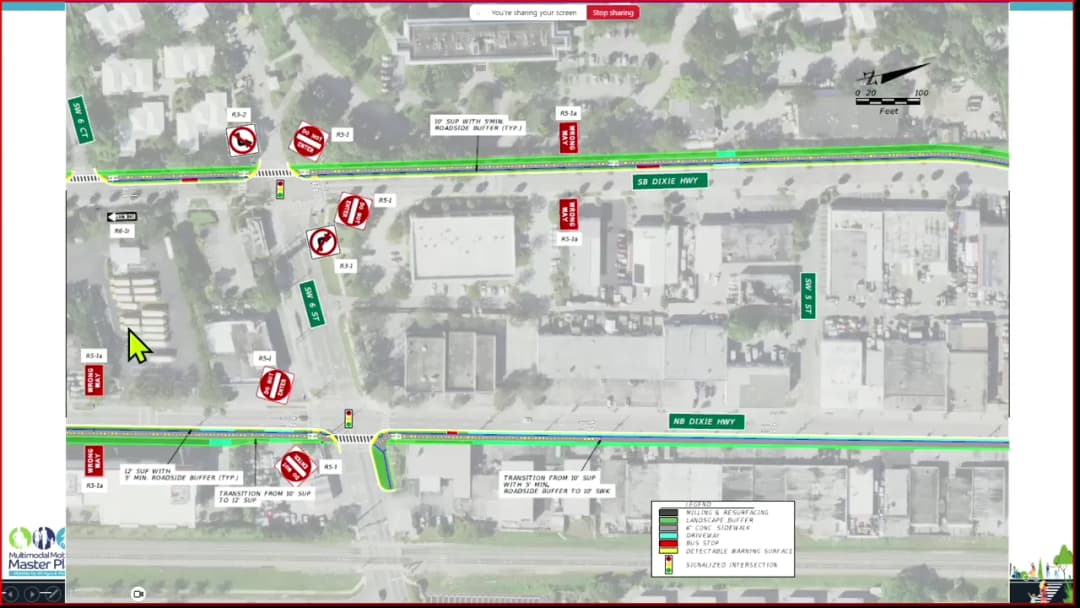
This final technical working group (TWG) meeting for the Broward County Multimodal Mobility Master Plan (MMMP) brought together county and city staff, consultants, and stakeholders to review the completed conceptual designs for four corridors, the updated Low Stress Multimodal Designation Standards and Criteria (formerly the Design Manual), the finalized Placemaking Toolkit, and the draft plan recommendations and target implementation plan. Attendees participated in interactive polling via Slido and engaged in detailed discussion about specific project details, design criteria, and implementation challenges. The meeting marked the conclusion of the TWG's input phase, with final comments on the master plan document due September 30, 2026, and a public meeting scheduled for September 29, 2026. Public Comments & Testimony - No public comments were made; the meeting was a technical working group session with invited participants. Discussion Items Project Overview & Recap - Consultant Christina Fermin (IMEG Corp.) presented the MMMP vision: creating an inclusive low-stress multimodal transportation network for all ages and abilities. The proposed network covers 591.4 total miles across 296 projects, with 36% of projects on city jurisdictional roadways, 24% on state roads, 18% on county roads, and 22% on multi-agency corridors (including canal opportunities and greenway extensions). The average score across all projects is 53.34. - Slido poll: Attendees described the desired future mobility network as "connected," "comfortable," "accessible," and "safe." Conceptual Design Final Draft – Four Corridors - W. McNab Road (Project 6B): 2.24 miles, 45 mph, 6-lane arterial with canal, missing southside sidewalk. Proposed improvements: 10–12 ft shared-use path, lane width reduction to 11 ft, midblock crossing with pedestrian hybrid beacon (PHB), high-emphasis crosswalks, protected intersection, sidewalk on south side. Discussion: Jurisdiction is shared city/county; funding identified in target implementation plan and surtax. Concerns raised about canal cantilever coordination with water management district and potential cost escalation. A TWG member suggested a jogged crossing at the PHB for safety; another noted slopes in graphics should be consistent. - NE 3rd Avenue (Project 155): 1 mile, 30 mph, 2-lane neighborhood street, residential with school and nature preserve. Proposed: speed limit reduction to 25 mph, 10–12 ft shared-use paths, raised midblock crossings, high-emphasis crosswalks, transit shelters. Discussion: City of Pompano Beach requested raised intersections instead of raised crosswalks. Questions about missing crosswalks on three legs and gaps in midblock crossings—project scope was desktop feasibility; detailed analysis will follow in later phases. Concern expressed about using RRFBs near a school crossing; traffic studies recommended. - Miramar Parkway (Project 174): 4 miles, 30–40 mph, 4-lane arterial with bike lanes and sidewalks. Proposed: widen sidewalk to shared-use path (varies 8–12 ft), restrict left turns at Canal Rd and Newport Dr due to crash history, raised midblock crossing, high-emphasis crosswalks, speed tables at 6700 block (county plan). Discussion: County is evaluating a capacity project and has designed speed tables for the 6700 block crash curve. Questions about city support—city is broadly supportive but residents may need persuasion. Left-turn restrictions would push drivers to U-turns; traffic analysis needed. Existing streetscape east of 64th Ave has curb extensions and pedestrian lighting but needs wider sidewalks. - Dixie Highway (Project 194 A/B): 1.13 miles each direction, 35 mph, 2-lane one-way arterials with on-street parking and buffered bike lanes. Proposed: convert to 10–12 ft shared-use path (removing bike lanes), raised midblock crossings, high-emphasis crosswalks, protected intersection at McNab Rd, improved signage to address wrong-way driving. Discussion: City has completed some improvements north of 2nd St.; a gap remains from 3rd St. to 2nd St. that the city is working to fill. Low-cost pavement markings suggested for speed enforcement. - General: A TWG member requested that concept drawings show before/after Level of Traffic Stress (LTS) scores. Consultant agreed to add that. Low Stress Designation Standards & Criteria (formerly Design Manual) - Consultant Kirsten Campitello (subconsultant) presented updates. Renamed to "Low Stress Multimodal Designation Standards and Criteria." Key changes: refinements to the Multimodal Quality of Service (MQOS) scoring tool (used for prioritization, not final design); clarifications in text/graphics; expanded comparisons with Safe Streets for All (SS4A) countermeasures; added neighborhood context classification; softened approach to bollards and raised crosswalks per Florida regulations; improved cross-references between chapters. A detailed example of MQOS scoring was shown: starting base score tied to speed and AADT, then interventions (e.g., on-street parking, sidewalks, lane reductions) adjust the score, with a goal of final score ≤2 (LTS 1 or 2). Discussion: A TWG member cautioned that the public should not be shown the detailed MQOS scoring—it's a technical tool for prioritization. Another member noted that the prerequisite assumption (streets need sidewalk and separation or it's high stress) should be qualified for low-volume local streets. The updated document is due mid-October. Placemaking Toolkit - Ralph (consultant) presented the Placemaking Toolkit as a companion to the design standards. It provides resources for creating low-stress networks that respond to local character. Includes step-by-step guide and case studies. A map of potential placemaking nodes was shown, including locations near interchanges (e.g., Turnpike, I-595). Discussion: Concerns raised about placemaking at interchanges—could attract pedestrians/cars but may be problematic for safety or maintenance. Consultant clarified these are potential sites for aesthetic improvements (e.g., painting, lighting, landscaping) not necessarily pedestrian destinations. A rendering for McNab Road showed extensive landscaping, seating, art, and distinctive paving. Several members expressed caution about setting unrealistic expectations (cost and maintenance) with aspirational renderings. Consultant stated renderings are meant to show potential and build public support. A member suggested adding disclaimers like "aspirational" and noting that maintenance funding is a question. Recommendations & Target Implementation Plan - The plan includes 296 projects with facility types: 64% sidepaths/shared-use paths, 23% greenways, 9% neighborhood greenways, 4% separated/protected bike lanes, 1% pedestrian bridges/underpasses. Recommendations cover design, policy, education, performance measures, and funding. - Target Implementation Plan: $46.2 million (FY 2019) increased to $76.3 million between FY 2028–2040. Assumptions: Planning 3%, Design/PE 10%, CEI 15%, Contingency 10% (lowered for projects over $10M), Operations & Maintenance from Highway Construction Engineering Division (HCED)—later clarified to be Maintenance Division. Annual inflation 2.5%. Four projects fully funded: NW 27th Ave/Blount Rd (FY 2028–2040), NE 48th St/Wiles Rd (FY 2029–2040), McNab Rd (FY 2031–2040), Pine Island Rd (FY 2035–2040). Two additional planning studies: Miramar Pkwy and SW 15th St post-2040. Discussion: Some TWG members noted that the four conceptual design corridors (two county, two city) are not all in the implementation plan—county projects included, city projects (NE 3rd Ave, Dixie Hwy) are not funded in this plan. Consultant explained that city projects are expected to be funded by the respective cities. A member questioned the overall value for money and requested clearer linkage between investment and level of service improvement. Next Steps - Final comments on master plan due by September 30, 2026. - Public meeting on Tuesday, September 29, 2026 (virtual 5:30–6:30 PM, then in-person at Government Center East). - Consultant contract ends October 30, 2026; final document delivery by that date. - County next steps: draft LDC ordinance amendments, formally adopt MMMP, conduct inter-agency technical training, launch pilot LTS 1 retrofit corridors, and revise/update plan every 5–10 years. Key Outcomes - No formal votes were taken. A Slido poll asked "Are you in general support of the MMMP?" (results not announced but comments indicated mixed support pending clarifications). - TWG members provided verbal feedback and will submit written comments by September 30. - The updated Low Stress Designation Standards & Criteria will be delivered to the county by mid-October. - The final public meeting is scheduled for September 29, 2026, to present the plan to the broader community. - Key concerns raised: need for clear language on level of service improvements per dollar spent, realistic expectations for placemaking renderings, inclusion/exclusion of certain corridors (e.g., Federal Highway, Commercial Boulevard) in the low-stress network, and coordination with water management and other agencies on canal projects.

TRANSPORTATION SAFETY 32% · ACTIVE TRANSPORTATION 21% · PUBLIC TRANSPORTATION 15% · PUBLIC WORKS 14%
10
SEP 23, 2026 · BROWARD COUNTY, FLORIDA · UPCOMING AND ARCHIVED MEETINGS
Broward County Transportation Surtax Oversight Board Appointing Authority Meeting – September 23, 2026

The Broward County Transportation Surtax Oversight Board Appointing Authority met on September 23, 2026 at 2:36 PM. The meeting included approval of minutes, the unanimous appointment of Kenneth Ortner, a detailed discussion of proposed ordinance amendments triggered by Florida Senate Bill 1134, and scheduling of future standing meetings. No public comments were received. Consent Calendar - Minutes Approval: The board approved the minutes from the previous meeting by unanimous consent (motion made, seconded, no objections). Public Comments & Testimony - No members of the public signed up for comment on regular agenda items or non-action items. Discussion Items - Proposed Amendments to County Ordinance (Chapter 31½): Staff attorney Nate presented amendments necessitated by Senate Bill 1134, which requires changes to two appointing authority categories. Additional amendments expand eligibility for oversight board seats by allowing individuals who currently hold or previously held professional licenses (CPA, attorney, etc.) provided the license was never revoked. The quorum for action items will be reduced from all members to five, as requested at the April 1, 2026 meeting. Member Sydney Calloway expressed concern about potential successful legal challenges to SB 1134 and asked whether a reverter clause could be included to automatically restore the previous ordinance. General Counsel advised against an automatic reverter due to litigation risks, but committed that if the law is overturned, the board could request the County Commission to revisit the ordinance. Calloway solicited support from colleagues for a recommendation to the Commission to consider reverting if SB 1134 is invalidated. Other members (Felipe, Randall, Monica, Steven) expressed general support for Calloway’s comments and confidence in the County Attorney’s Office. The consensus was to communicate this concern to the Commission via the agenda report. - Standing Meeting Schedule: Staff proposed regular meetings on the third Wednesday of May and November, beginning May 19 and November 17, 2027. Meetings would be cancelled if no business arises. The default location will be Fort Lauderdale unless the board decides otherwise. The change to a quorum of five was confirmed as providing flexibility for shorter-notice meetings. Key Outcomes - Appointment: Kenneth Ortner was unanimously appointed to the Transportation Surtax Oversight Board in the accounting category (motion, seconded, all in favor). - Ordinance Direction: The board reached consensus to recommend that the County Commission include consideration of a mechanism to revert to the previous ordinance if SB 1134 is overturned. Staff will include this in the agenda report to the Commission. - Meeting Schedule Adopted: Standing meetings set for the third Wednesday of May and November, effective 2027. Calendar invites will be distributed. - Quorum Change: The proposed ordinance amendment reduces the quorum for action items from all members to five, as discussed. Meeting adjourned at 2:59 PM.

PROCEDURAL 49% · PUBLIC COMMENT 29% · PENDING LITIGATION 15% · PERSONNEL MATTERS 7%
0102
NEXT →
OPENPUBLICA · PUBLIC MEETING INDEXUPDATED DAILY · openpublica.com