Broward County FY26 Budget Workshop – June 17, 2025
STREAMING COPY IN PREPARATION — RECORDING AVAILABLE FROM THE ORIGINAL SOURCE
Broward County FY26 Budget Workshop – June 17, 2025
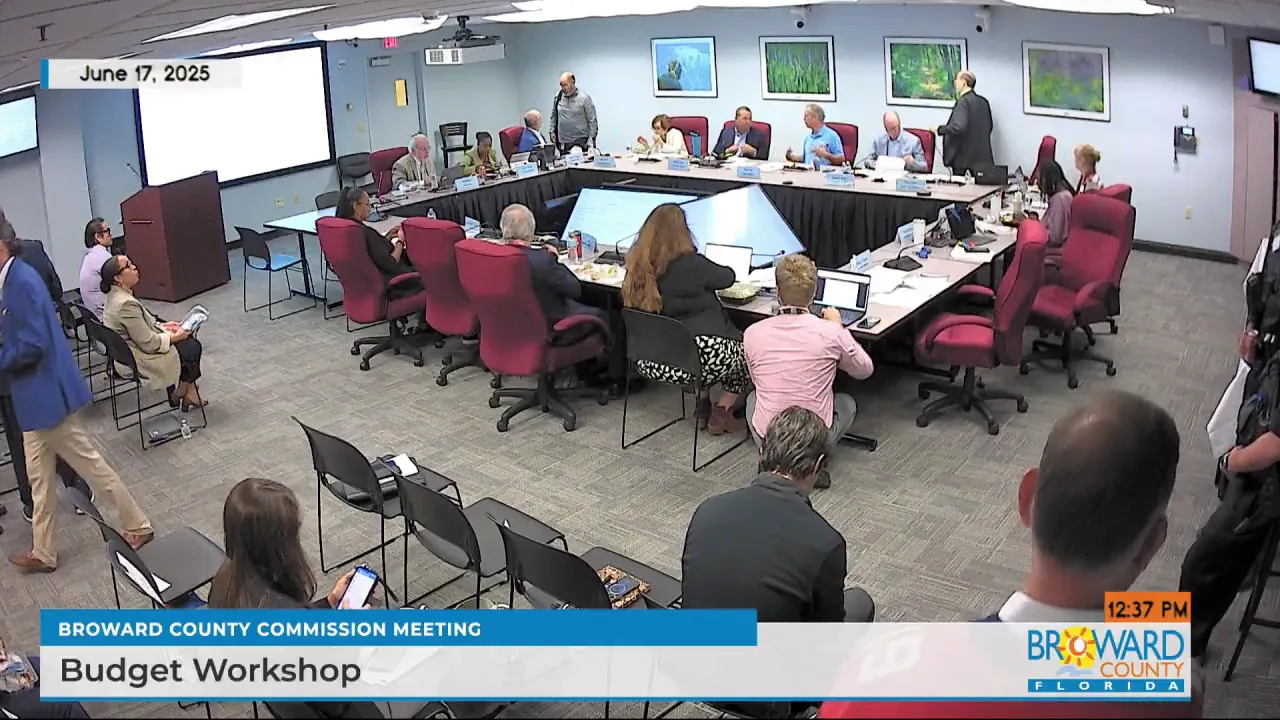
The Broward County Commission held a budget workshop on June 17, 2025, to review the County Administrator's General Fund Outlook for fiscal year 2026. The meeting covered revenue projections, the impact of state legislative changes, millage rate options, and the county's five strategic goal themes. Commissioners discussed spending priorities, affordable housing funding, constitutional officer budgets, and the proposed use of freed-up Community Redevelopment Agency (CRA) funds.
Discussion Items
General Fund Overview & Revenue Outlook
- County Administrator Monica Cepero and Budget Director Norman presented the FY26 budget schedule and preliminary revenue estimates. The preliminary tax roll (June 1) showed 7.12% growth in property values, but the county can only budget 95% of revenues.
- The state legislature eliminated the 2% business rent tax, which will significantly reduce the county's discretionary surtax (SERTAX) revenue. The impact is estimated to be conservative, with potential higher losses. Implementation is delayed to October 1, 2025, to avoid an immediate July 1 impact.
- General fund revenues are projected at ~$1.7 billion, with general fund capital cash at ~$100 million. Sales tax and state revenue sharing are down $17 million from the current year, totaling ~$113 million.
Millage Rate Discussion
- The countywide millage has been constant since 2017-2018. The administrator proposed a scenario: using $9.5 million from the debt service millage shift – $8 million for the second year of BSO detention salary increases, $1 million to reserves, and ~$500,000 for a small millage reduction.
- Commissioners expressed mixed views: Commissioner Dean supported a reduction to honor past promises to voters; Commissioner Rich and others opposed, citing service needs and future uncertainty; Commissioner Geller suggested a reduction only if it would deflect state pressure; Commissioner McKenzie supported reduction in principle but wanted more information on sheriff and tax collector impacts. The consensus was not clear, but the administrator will certify the existing millage and the board will decide on the final allocation in August.
CRA Fund Allocations
- The county anticipates $27.3 million in freed-up CRA funds for FY26, up from $9 million in FY25. Commissioners discussed the 90/10 split (90% affordable housing, 10% economic development) from the previous year. Some wanted to keep the allocation at $20 million for affordable housing (as in FY25), while others argued for increasing to 90% of the full $27.3 million (~$24.6 million). The board did not reach a definitive decision; the administrator will seek direction later.
- Commissioner Geller noted that the county's gap financing program has provided $154 million, funding 4,300 units with an average subsidy of $35,875 per unit, generating $1.3 billion in economic impact.
Constitutional Officer Budgets
- BSO requested a 9.8% increase ($79.4 million) for FY26. Commissioners generally favored a 2–3% increase, with some supporting the $8 million for detention salaries. The administrator noted that the sheriff's office has not amended its request, but negotiations continue on 27 requested 911 positions.
- Other constitutional officers (property appraiser, supervisor of elections, tax collector) had smaller percentage increases (e.g., elections office 6% increase equals only $1 million). The new tax collector's office is expected to cost $80 million; the tax collector indicated unspent funds would be returned, but no amount is known.
Affordable Housing & Economic Opportunity
- Commissioner Rich highlighted the success of the gap financing program, noting that 4,300 units have been funded with 50-year affordability periods. Commissioners Rogers and McKenzie stressed the need for homeownership and neighborhood improvements in addition to rental units.
- The board discussed the importance of cultural, park, and transit investments. Commissioner Geller advocated for improving bus service over east-west rail, citing cost efficiency and worker needs.
Resilient Community & Transportation
- Commissioners supported the resilience plan for canals and flood mitigation but acknowledged limited funding. The county's study on salinity control and flood zones was noted as a priority.
- Transportation comments focused on improving bus service frequency, cleanliness, and connectivity, with support for the east-west rail concept deferred.
Key Outcomes
- Millage Rate: The administrator will certify the existing countywide millage rate by August 1. The board will decide in August whether to apply ~$500,000 to reserves or a millage reduction.
- BSO Funding: The $8 million for the second year of detention salary increases was generally supported. The sheriff's overall request of 9.8% increase will be negotiated down, with a target of 2–3%.
- Affordable Housing: The FY26 allocation for affordable housing will be at least $20 million, with the split between gap financing, homeownership, and neighborhood improvements to be finalized. The board did not commit to a specific percentage.
- CRA Funds: The freed-up CRA funds ($27.3 million) will be allocated as directed by the board, with a likely 90/10 split for affordable housing and economic development, subject to future board action.
- Cultural and District Funding: The administrator will develop a centralized process for cultural event sponsorships, with a $50,000 per district option under consideration, to be brought back for public discussion.
- Next Steps: The county administrator will submit a recommended balanced budget by July 15, 2025. The board will hold public hearings in August and September to adopt the final budget.
Meeting Transcript
Morning. Good morning. Everybody doing good? Everybody doing good? Let's see if we can get started here. Wait for County Administrator. Good morning. Okay, today we are going to be looking at the general fund outlook. And we have to know. Yes, please. I I am going to be uh yeah, I we have it we have our um things divided into five categories. I'm gonna do one category at a time and see if we build consensus on each one. Okay. We'll do that. But first we will hear from our county administrators. We're getting feedback. You get feedback, correct? Thank you. Thank you. Um and the reality is we don't have as much to work with this time. Um we'll be hearing that. And we'll try to put some guardrails on ourselves as best we can. With that, I'm gonna pass it over to Monica. Thank you. Um good morning again. Um this is uh the one of the most uh important um um feedback sessions that we get to hear from you for us. As you know, uh, we sit here today at June 17th, um, statutorily. I am required to submit a recommended budget to you all by July fifteenth. Um we will be doing that, uh, a balanced budget. Um, you know, the challenges that we we shared with you all during the uh retreat, um, where we talked through um uh the the um the the financial outlook that we had at that time, and certainly there's been some moving um targets, if you will, through um between that time and today. Um, there has been a little bit of um a slight uh a little bit of uptick in some revenues um and some other um you know components that we have done to try to accommodate the beginning shortfall position that we were starting the budget uh discussions with our with our agencies. Uh, to make sure that you had at least some ideas of of where we were, uh, at least initially, and there's gonna be um something in here that we'll talk through about millage as well that I want to make sure you understand. Um I I proposed something for discussion for you all um that I'd heard um as well over time, but there's there's alternatives and there's different uh approaches that we will absolutely be able to take, and that's the feedback that will be very helpful to me as we put uh this recommended budget together uh for you all. Um the three areas that uh we are gonna basically be covering today, and you'll look at the the schedule ahead of us as as what the remaining uh budget process will look like. But um we're gonna be looking at the general fund predominantly today. I am going to share with you some things that happened in the legislative process in the last couple of days that have kind of kept me up at night. Um it will be impacting uh SERTAX. We'll get into that a little bit as well, but really we're gonna just sit on um the commission priorities today. Um, and I'm gonna give you a little bit of um um you know outlook of where we are at the end of the revenues that they've shaken out thus far. Um I will need some feedback also, and just in advance, I'll let you know on how what to do with the constitutionals um and how to approach the that discussion. Um and then that's it. We'll go through the uh the five goal themes. Okay. I'm gonna let Norman walk us through some of these slides and I will be jumping in as well. Uh good morning. As the county administrator said, the the first slide is just the the remaining key points of the schedule. We didn't put everything down. There are things that are obvious and so usual that we didn't put down, so we didn't put down June 17th, Panthers win the Stanley Cup. There's a big superstition, so we will just cheer for them. Um as you know, since we last met with you on this uh level, um the preliminary tax roll was released on June 1st.
openpublica.com