Charlotte City Council Business Meeting - June 24, 2024
STREAMING COPY IN PREPARATION — RECORDING AVAILABLE FROM THE ORIGINAL SOURCE
Charlotte City Council Business Meeting - June 24, 2024
The Charlotte City Council met on Monday, June 24, 2024, at 5:00 PM for the Action Review and Consent Agenda, followed by the Business Meeting at 6:30 PM. Key actions included approval of the $650 million Bank of America Stadium improvements project, funding for the Katie Blessing Center pediatric behavioral health facility, and adoption of several consent agenda items. The meeting also featured a public forum with speakers on animal services, re-entry programs, and healthcare access.
Consent Calendar
- Approved consent agenda items 17 through 50 in a single motion, except for items pulled by council members: 19 (Cooperative Purchasing Contracts for Vehicles and Equipment), 30 (South Boulevard Light Rail Facility Roof Recovery and Replacement), 31 (South End Station Pre-Construction Services), 34 (Airport Fourth Parallel Runway Roadway Relocation Construction), and 38 (Airport Ramp Cleaning and Pressure Washing Services).
- Item 19 (Cooperative Purchasing) was approved after a separate vote.
- Item 30 (Roof Recovery) was approved with one opposing vote.
- Item 31 (South End Station) was approved with one opposing vote.
- Item 34 (Airport Runway Relocation) was approved after discussion on DBE participation.
- Item 38 (Ramp Cleaning) was approved with one opposing vote.
Public Comments & Testimony
- Nicholas Thomas (Program Director, Reimagine Reentry) advocated for juvenile reentry services, emphasizing the need for funding to reduce recidivism.
- Marissa Garst urged the council to make Animal Services an independent department and build a new adoption center, citing overburdened shelter conditions.
- Tina Baer (volunteer at Animal Care and Control) echoed the need for a new adoption center and independent department, describing the emotional toll of euthanasia.
- Kelsey Joseph (Friends of CMass board member) thanked the council for 10 new positions but noted only 8 were funded, reiterating the need for an independent animal services department.
- Danine Carroll addressed healthcare access issues, urging the city to partner with Atrium Health to improve patient services and physician availability.
- Christine Edwards (Civility Localized) advocated for increased transparency in local government and announced the Civic Impact Academy launching fall 2024.
- Joshua Beasley offered re-entry and youth services through his programs, seeking partnership with the city.
- Douglas Saul did not speak (not present).
- Speakers on Bank of America Stadium (see Discussion Items):
- Miller Yoho (Charlotte Sports Foundation) supported renovations, citing $17 million economic impact per college football game.
- Joe Boss (Charlotte Regional Business Alliance) supported the public-private partnership.
- Will Pitts (Charlotte Sports Foundation) emphasized the stadium as a community asset.
- David Longo (CBI Workplace Solutions) supported the investment.
- Reverend John Cleghorn urged council to consider moral priorities.
- Jonathan Stewart (former Carolina Panther) supported renovations, highlighting community unity.
- Douglas Wilson and Larry Shaheen spoke in favor.
- Lamberto Avila (Daily View Pools) supported, noting opportunities for MBE firms.
- Scott Bryan opposed, citing lack of transparency and a rushed process.
- Ian Albuquerque opposed, citing economic research showing poor return on investment.
- Corey Correll supported, highlighting economic benefits.
- Dante McCory briefly opposed, calling it a bad deal.
- Grace Fendrick opposed, citing a petition of 537 signatures and criticizing the non-relocation clause.
- Garland Green asked for details on hospitality tax revenue and tailgating facilities.
Discussion Items
Strategic Energy Action Plan Update
- Sarah Hazel (Office of Sustainability) presented an annual update. Key points:
- 8.2% reduction in energy use intensity across benchmarked buildings in 2023.
- 33 solar projects in operation or construction; 19 systems online powering 175 homes annually.
- Projected to offset all municipal electricity use with zero-carbon sources by 2030.
- 10% of fleet is alternative fuel (3% electric); 43% more carbon avoided than previous year.
- Electric vehicle take-home policy adopted.
- Community programs: electric bike pilot, Power Down the Crown building benchmarking, Solarize program with DOE grant.
- Climate risk assessment will be part of updated CAP (due March 2025).
Katie Blessing Center
- Council approved a $2.5 million allocation from FY2025 Pay-As-You-Go funds for the Katie Blessing Center, a pediatric behavioral health facility in east Charlotte. The project is a $63 million capital campaign; the city’s funding is contingent on receiving a construction permit.
Bank of America Stadium Improvements Project
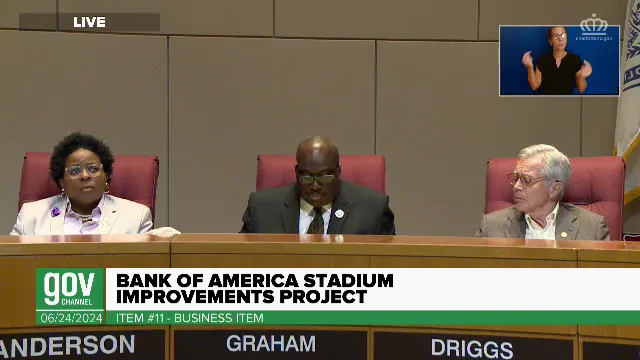
- After extensive debate, council approved the project (action A and B) by a vote of 7-2. The city will contribute $650 million from the Convention Center Capital Fund (hospitality taxes) for stadium renovations and a new field house. Tepper Sports & Entertainment (TSE) will contribute at least $150 million in initial capital and $421 million in future capital and maintenance. A 20-year non-relocation agreement was included. The substitute motion to require the full contract to return to council before execution failed 3-7. Councilmembers Bokhari, Driggs, Graham, Anderson, Molina, Mitchell, and Mayfield voted in favor; Councilmembers Ajmera, Brown, and Johnson opposed.
Other Business Items
- Storm Water Refunding Revenue Bonds (Item 12): Approved unanimously to issue up to $205 million in bonds to refund short-term debt.
- Biogas to Renewable Natural Gas (Item 13): Approved resolution to sell biogas by sealed bid.
- DOE Energy Efficiency & Conservation Block Grant (Item 14): Approved $777,930 grant for Solarize program.
- Evoke Living at Ballantyne (Item 15): Approved actions to facilitate affordable housing development (60 units).
- Appointments to CRVA (Item 16): Keith Haywood appointed to three-year term.
- Zoning: Compact Residential Development Text Amendment (Item 51): Approved petition to allow smaller lot sizes and more open space in N-1 districts.
Key Outcomes
- Bank of America Stadium Improvements approved 7-2. City will contribute $650 million; TSE will contribute at least $571 million. Next steps: contract development, council vote on financing in fall 2024, LGC approval early 2025.
- Katie Blessing Center approved $2.5 million allocation.
- Consent agenda items approved except those pulled; pulled items individually approved.
- Stormwater refunding bonds approved.
- Biogas sale authorized.
- Solarize grant accepted.
- Evoke Living at Ballantyne ground lease and COP release approved.
- Compact Residential Development zoning amendment adopted.
- Public forum comments will be referred to staff for follow-up.
Meeting Transcript
But our before we go to that motion, let me ask if there are any items that the count a council member would like to um have for a separate vote or would like to take it off of our list of votes. So um and I know that I saw a report from um Marie to say that there are some things that needed to be followed up. So is there for comment or for a separate vote? Any council member would like to have comment? Miss Mayfield. Yes, madam mayor. For number 19, I want to see if we could defer that vote for this cooperative purchasing contracts between the seven vendors that are listed on here. There is one vendor that is a minority-owned vendor, but the our DBE processes we go out for collective bargaining. Marie was able to get some additional language for me earlier on that. Marie, can you share that? Yes, ma'am. And I would have to, you said something about deferring the vote altogether. I would like to so that we can get because I know that yeah, get your thing. Um the only there's one, it's several different businesses that are listed. We have this cooperative purchasing agreement. I am not sure, and since this was just presented to us on Friday for us to vote on it tonight, there was no time for me to ask questions prior to this evening, what our actual process looks like to ensure that we have diversity within the pool that we reach out to for RFPs. Like there is a company that is actually they have a contract with the city of Louisiana, the Calvin Braxton Ford that is out there that was not aware and did not know that we had an opportunity in order to contract with the city. So I'm trying to get better information on how what that looks like when who's at the table in these cooperative agreements. So in the cooperative agreement, the one that you recognize or have information about is not in there. It is Louisiana. Is it a state contract or a city contract? It is both they just signed, they just threw their they just signed a purchasing agreement with the city of Louisiana that was done through their cooperative. I'm just saying this is a minority-owned business that was not aware. So since this was brought was in our packet on Friday for us to vote on tonight, I am trying to get a better understanding of who is actually at the table when these cooperative agreement requests go out. I just I was just saying that is it a city cooperative or a statewide cooperative would be Louisiana. So I was just wondering which city it is. Um I could tell you which city and I think the contract was with the city of Lockport in Louisiana, but it was done through the same process that we'd done this, except for this vendor is not in the system. So I'm trying to get a better understanding of how do we miss Harry and yes, Miss Mayfield, just given the schedule and the next opportunity for this to come before you wouldn't be till late August, and we may miss some of the some of them we have like six months windows, and once we miss a production schedule on a particular piece of equipment or vehicle, we miss it. This is 10 weeks. I don't I would hope that we don't have anything out there considering this particular agreement is for the purchase of light duty trucks and some other things that we don't have anything that's getting ready to break down in 10 weeks. I'm just sorry, I meant not just the 10 weeks, then there's also a production schedule by the vendor, and if you don't get in on that window, you gotta wait till that production cycle rolls again. So I I'm not sure about this. I'd really prefer, I mean, it's definitely it's up to you. I mean, it's gonna take six votes to do it, but I would like for us to take into consideration to not put us in a position where, and this isn't for you, Marie, but for staff, to present us with a decision that information on Friday for a decision that has to be made on Monday, and then if there's questions about it, to say, well, we need to go ahead and vote on it, then we'll figure it out later. I understand. So um I would like to suggest that because we do have these requirements for a number of things and a lot of the items on our agenda this day is all about getting our infrastructure started out with these kinds of vehicles and equipment. So I I guess the question I would say is that we could guarantee that this vendor would be included next after we find the information. But I see Phil Reger here, so help us understand the impact of not doing this, and if there is a pathway for another vendor to join at some point in this process. Right. So there's a question about the cooperatives in general. The cooperatives are two cooperatives. Specifically, who is at the table so that they know so that we have diversity in our selection process because on the actual application for the DBE, it does give you the opportunity to say that if you have any specific certification, whether it's minority, female, veteran, then please share it. Share that. Yes. So two cooperatives here. One's a national cooperative, that's the source well cooperative, and one is a state cooperative, which is the sheriff's the state sheriff's cooperative. And so as a matter of practice, so what happens is these entities will uh go out and put out bids for specific pieces of equipment, and then vendors will come and bid and they will get selected based on low bid. Um and these cooperatives are available to entities across the country, and so that's how they get buying power, right? Um traditionally, when the city of Charlotte has tried to put out uh RFPs or uh in this case invitation to bid for equipment, uh our buying power actually isn't big enough to get uh a lot of response, and so it's uh why we traditionally use cooperatives because the cooperatives uh represent more buying power, and with more buying power, we get better pricing. Um the second thing is is that in general, before we um use a cooperative, we look at our MWSB certified firms to see if there are any certified.
openpublica.com