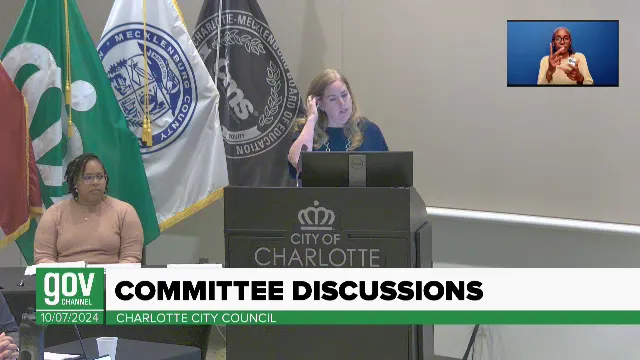
Charlotte City Council Committee Discussions Meeting - October 7, 2024
STREAMING COPY IN PREPARATION — RECORDING AVAILABLE FROM THE ORIGINAL SOURCE
Charlotte City Council Committee Discussions Meeting - October 7, 2024
The Charlotte City Council held committee discussions on Monday, October 7, 2024, at 6:00 PM in Room 267 of the Charlotte-Mecklenburg Government Center. The meeting featured updates from committee chairs, a detailed presentation from NCDOT on the I-77 South Express Lanes project, and a review of the proposed Financial Partners Policy. Council also received updates on workforce development, the Chetty study on economic mobility, and a fire response review.
Updates from Council Committee Chairs
- Transportation & Development (Councilmember Ed Driggs): Reported on CATS operating data, tree canopy plans, CAP energy plan updates, and provided an extensive overview of the I-77 South project. The committee heard from NCDOT about the comparative analysis between traditional toll delivery and a public-private partnership (P3).
- Budget & Governance (Councilmember Dimple Ajmera): Recapped committee discussions on the federal/state legislative agenda (including child care, gaming, and DA office funding) and optimizing MWSBE participation in capital projects. A pilot program is under review.
- Jobs & Economic Development (Councilmember Malcolm Graham): Received an update from the Office of Workforce Development on the development plan. Consultants will deliver a final report in late October, with a detailed presentation expected in late November/early December.
- Housing & Safety (Councilmember LaWana Mayfield): Provided a report on the May 18 South Park fire (707 41 Liberty Road Drive), highlighting response challenges (11-minute delay in calling 911, no fire suppression systems, inoperable hydrant). The city is now coordinating with Mecklenburg County for early notification of construction projects. Also reported on the updated Chetty study on economic mobility: Charlotte now ranks 3rd out of 50 cities in upward mobility, and Mecklenburg County is the only county where low-income white children experience no decline in mobility.
Public Comments & Testimony
- No public comments were taken during this committee discussions meeting.
Discussion Items
- I-77 South Express Lanes Project:
- NCDOT Division 10 Engineer Brett Knipe, Carly Swanson (Director of Innovative Delivery), and David Roy (N.C. Turnpike Authority) presented the project overview. The proposed 11-mile managed lanes project from Brookshire Freeway to the South Carolina state line is estimated at $3.7 billion. The project has been in the State Transportation Improvement Program since 2014, with $600 million in state funds allocated. The comparative analysis showed that a traditional toll delivery has a $1.3 billion funding gap, while a P3 delivery is likely financially feasible.
- Several council members expressed concerns and asked detailed questions about lessons learned from I-77 North (controversy, toll pricing, utilization rates, MWSBE contracts, equity programs, and community impacts). Councilmembers Johnson, Molina, Ajmera, Graham, Brown, and others voiced support for moving forward cautiously with the P3 process, emphasizing transparency, transit benefits, emergency responder access, and community engagement.
- Councilmember Driggs stated his recommendation to support continuing work on the RFQ. The CRTPO board is scheduled to vote on next steps on October 16, and the full council will consider a resolution on October 14. Councilmember Driggs requested that any strenuous objections be communicated before the vote.
- Financial Partners Policy:
- Marie Harris and Cherry Smith presented the proposed policy, which includes a 30% budget cap per organization, five-year funding limit (with annual renewal), enhanced performance monitoring, and a ranked review process. Key points of contention: allowing applicants who are actively seeking 501(c)(3) status (not yet granted) and the five-year limit.
- Councilmembers Johnson and Molina objected to allowing pending 501(c)(3) status, arguing it could displace qualified organizations and create uncertainty. Councilmember Brown championed the provision as a way to support grassroots organizations. Councilmember Mayfield noted the committee had extensive discussion and the provision was included as a compromise.
- Councilmember Molina suggested the policy needs more structure regarding the five-year limit and the pending status requirement. The policy is scheduled for a vote on October 14, with an opportunity for amendments.
- City Manager Marcus Jones noted that an update on unspent ARPA funds will be presented at the next meeting, which could affect the financial partners conversation.
Key Outcomes
- I-77 South: The council will consider a resolution at the October 14 meeting to authorize the city's CRTPO representative (Councilmember Driggs) to vote in favor of continuing the P3 development process. If approved, NCDOT will work with CRTPO to form a working group and develop indicative terms over an estimated 6-9 months. The council retains the ability to withdraw support at any point before public advertisement of the RFQ.
- Financial Partners Policy: The proposed policy will be placed on the October 14 agenda for a vote. Amendments are possible. Concerns about the pending 501(c)(3) provision and five-year limit may be addressed during the meeting.
- Workforce Development Plan: Final consultant report expected by end of October, with a detailed presentation to the Jobs & Economic Development Committee in late November/early December.
- Chetty Study: The housing committee recommended a deep dive on the updated Chetty study during the council's strategic planning session. Staff will present to additional committees as needed.
- Fire Response: The city is implementing new protocols for construction project notification and fire hydrant operability checks.
Meeting Transcript
All right. Okay. Thank you. Thank you, Amanda. Thank you, everyone, for the time and attention that you've given to today to talk through the council policies of and how we operate under our committees. I want to first say I really appreciate all that we're being have done. It was a long day. It was good to watch a lot of the meetings. So why don't we go ahead and begin with introductions and we'll start with our city clerk. Ariel Smith, lead city clerk. Councilmember Brown. District 3. Good evening, Renee Johnson, and I'm honored to represent District 4. Dante Anderson, District 1, Mayor Pro Tem. By Lowles, Mayor. Marcus Jones, City Manager. Malcolm Graham, District 2. Ed Driggs, District 7. Councilmember at Lodge. Patrick Baker, City Attorney. All right. This is the um for those that are watching today. This is the time that the council has developed committee discussions that help us frame our policy and a lot of the work that we do in the future. But before we go to the committee of the whole, we have council committees that are about, I think five to six people. And so today was a really good day, I believe, from the materials that I have in front of us. But this is also a time that we don't just read back what people have done. We try to address what's going to be important and what the initiative is. And any questions that the at colleagues would have with each other, we address. So I believe that our first um our first committee meeting was with Mr. Driggs, who chairs our transportation and development committee. So Ed, do you have a report to give us a couple of things? I do, yeah. Yeah. Thank you, Mayor. Um I will just say briefly, at our meeting today, we heard an update from Katz about operating data about their progress on refurbishing the cars. Uh we are seeing a recovery in uh ridership, although not back to pre-COVID levels, but uh good progress there. We we also heard an information report on the tree canopy and the progress of plans uh for to basically implement a new plan for trees sometime next year. And we heard from uh about CAP and uh the work that's being done there, very good work that's being done there to create an update to our existing CAP energy plan. So you could see more detail about those things looking at the uh at what's online, uh the slides and things. The main thing I did want to talk about though is the I-77 South uh decision process that's going on right now. And uh you all received the last week information about this. Um I'm gonna try and paraphrase briefly what's going on for the benefit of anybody who might be watching. But uh for the last year, the Charlotte Regional Area Regional Transportation Planning Organization, uh, which is a federally mandated body, it includes 21 municipalities as members, has a service area of about 1.7 million people, and uh is the place where a lot of the policy around uh transportation that is state funded and federally funded is made, and that body has been engaged with uh NCDOT in discussions about possible solutions for I-77 South. And I think you know I-77 South is an overcrowded road already. Conditions there get pretty dreadful even during the day. And over the last year we've had a lot of information from NCDOT, data on congestion, on travel times on the road, accident data, safety issues, and it's apparent that there's uh an urgent need to do something. Um but what it came down to in our conversations between Cartport and NCDOT was there were two possibilities. One was a state-funded managed lane project, um, and the other was a public-private partnership, working with a private organization to do the funding, the construction, collect the uh tolls on a managed lane. And uh what we heard back from them, and we're going to hear from NCDOT tonight, is that essentially uh there isn't enough money in the state uh uh funding process for a state-funded project. And they just said it really is just not going to happen.
openpublica.com