OPENPUBLICA · PUBLIC MEETING RECORD
Record of Proceedings
Charlottesville City Council Meeting - September 8, 2026: Affordable Housing Report, Azalea Springs Dispute, and Homelessness Interventions
City Council — Tuesday, September 8, 2026
BodyCharlottesville, Virginia
SessionCity Council
DateTuesday, September 8, 2026
StatusFILED
Video Record
STREAMING COPY IN PREPARATION — RECORDING AVAILABLE FROM THE ORIGINAL SOURCE
Transcript — Verbatim
Speaker numbers apply only to this recording. Names come from transcript evidence. “Possibly” marks uncertain attribution.
Discussion Breakdown — Share of Meeting
Affordable Housing19%
Homelessness17%
Engineering And Infrastructure14%
Procedural6%
Public Safety6%
Personnel Matters5%
Environmental Protection5%
Workforce Development5%
Arts And Culture4%
Summary of Proceedings
Charlottesville City Council Meeting - September 8, 2026
The Charlottesville City Council met on September 8, 2026, in a session divided into a work session, closed meeting, and business meeting. Key topics included the annual Affordable Housing Report, public concerns over the Azalea Springs development, updates on the Holiday Drive homeless shelter, and several resolutions and ordinances. The meeting lasted from 4:00 PM to approximately 9:30 PM.
Consent Calendar
- Minutes: Approved from May 18 and June 1 regular meetings, and August 12 joint Council-School Board work session.
- Resolution 3: Appropriated $78,150 for the Virginia Behavioral Health Docket Grant (2nd reading).
- Resolution 4: Appropriated $10,000 for Virginia State Police FY27 HEAT Equipment Reimbursement (2nd reading).
- Resolution 5: Appropriated $750,000 from Jefferson Scholars Foundation for the vacation of Clarke Court (2nd reading).
- Resolution 6: Allocated $2,000,000 in School Operations Contingency Funds and amended FY 2027 budgets for Charlottesville City Schools and pupil transportation (2nd reading).
- Resolution 7: Adopted the 2026 Regional Solid Waste Management Plan for the Thomas Jefferson Solid Waste Management Unit.
- Resolution 8: Appropriated $450,707 in Dockless Mobility Revenue for bicycle programming (1st reading). Council discussion clarified that bicycle programming includes items like helmets and event swag, not infrastructure. Vice Mayor Oschrin raised concerns about sidewalk blocking by scooters; staff noted geofencing is being expanded.
- Resolution 9: FY 2027 Budget Amendments and Appropriation of $300,252 in additional General Fund Revenue (1st reading).
- Resolution 10: Appropriated $452,704 for the Virginia Juvenile Community Crime Control Act Grant (VJCCCA) (1st reading).
All consent items passed 5-0.
Public Comments & Testimony
First Community Matters (pre-registered and walk-in speakers):
- Jesse Hopper (Azalea Springs resident): Urged Council to suspend or revoke Stanley Martin's permit for the Azalea Springs development, citing intentional disregard of critical slope waiver conditions, sediment discharge (equivalent to 10+ dump truck loads), and a stop work order lifted prematurely. Stated the fine was a "price" not a deterrent.
- Alby LeFayez (Fry Spring resident): Raised concerns about mature trees along the perimeter being damaged by excavation and grading. Requested an independent certified arborist assessment of trees on neighboring properties and clarification of homeowner liability for tree damage caused by construction.
- Casey Gioelli (Fry Spring resident): Described 75-foot-tall trees on a paper street (unaccepted city alley) with damaged root systems. Asked the city to adopt the paper street, conduct risk assessments, and plant native trees after construction.
- David Mays (former Charlottesville resident): Proposed transforming the vacant Dewberry building (201 East Water Street) into a centralized transitional housing and workforce development center. Requested a feasibility study.
- John (Johnny Hall): Presented a poster solution for sewage issues at Azalea Springs, proposing grinder pumps and T-channel cross channels. Also advocated for uniform street widths.
- Donna Tajin (Albemarle County): Criticized the city's approach to homelessness, calling encampment sweeps "displacement" and stating the Holiday Drive shelter is a "soft option prison camp." Noted only 90 permanent supportive housing units vs. 264 unhoused persons by name list.
- Laura Seganey: Described police surveillance, arrests, and forced institutionalization before the encampment closure. Claimed shelter operations cost $50,000 per person per year, and that the shelter was not easily accessible with onerous paperwork.
- Isis Newman: Addressed Jen Fleisher directly, expressing anger over the encampment closure. Alleged multiple arrests, belongings thrown away, and mental health crises. Stated shelter was set up with only 60 beds instead of 120, and that people were turned away.
- Additional speakers:
- Dennis Chambers (shelter resident): Reported that shelter was promised for encampment residents but others were admitted first; women feel unsafe with men threatening them; no fire sprinklers; outdoor bathrooms; no local staff.
- Damon Ransom (Monte Vista Avenue resident): Raised noise pollution (construction 6 AM-10 PM, 7 days/week), ecological impact (80% forest cleared), trespassing by subcontractors, and muddy runoff. Presented a letter from Stanley Martin denying liability.
- Fred Heen (Monte Vista Avenue): Concerned about leaning trees falling on existing homes; urged Council to change rules to hold developers accountable.
- Eric Pugh (Monte Vista Avenue): Shocked by the scale of clearing; worried about future problems if initial rules were violated.
- Jessica Prim (Monte Vista Avenue, landscape architect): Noted grading not reflected in site plan is affecting trees.
- Additional speaker (name not given): Emphasized need to protect mature trees as a "Tree City."
Second Community Matters (at end of meeting): No speakers.
Discussion Items
Annual Affordable Housing Report (Work Session)
- Presented by Madeline Metzler, Senior Housing Planner. Key points:
- Investment progress: $65.8 million invested in first 5 years (66% of 10-year $100M goal). Ahead on direct housing investments and tax relief, behind on administrative capacity.
- Production: Over 1,000 new subsidized units in pipeline (97% of 10-year goal); 530 preserved units (88% of goal).
- Household stabilization: Averaging ~1,100 households annually, below target of 1,600-2,200 (65% of low range, 53% of high range).
- AMI targeting: Only 25% of funds served households at or below 30% AMI, far below the 50% target. 71% served ≤60% AMI, 5% served ≤80% AMI.
- Correction: Added $6 million for 2000 Holiday Drive purchase, bringing total direct investment to $58.5 million.
- Future outlook: Projected total investments of $107 million by FY31, fulfilling the 10-year commitment. Planned $41 million in CIP contributions for remaining years, plus $11 million from CAF.
- Council questions and comments:
- Councilor Payne: Asked for cost per unit to bring a unit from 60% to 30% AMI. City Manager Sam Sanders noted a 2024 Piedmont Housing Alliance project showed $125,000 subsidy per unit.
- Councilor Snook: Questioned the effectiveness of tax abatement; staff agreed a plan is needed before implementation.
- Councilor Fleisher: Supported filling recommended staff positions; noted permitting and inspection delays as a concern. City Manager confirmed inspector positions filled, but plan reviewer position remains vacant.
- Vice Mayor Oschrin: Raised concern about using only AMI as a metric due to Charlottesville's economic inequality; suggested other impact measures. Staff noted a regional housing study due March 2026.
- Councilor Payne: Advocated for exploring revolving loan funds and acquisition of existing units to serve lower AMIs.
- City Manager: Highlighted that Charlottesville's per capita affordable housing investment is highest among cities of its size in the country. Announced transformation of an existing position into a housing position, bringing housing division to 3 full-time staff.
- Staff priorities: Focus on 30% AMI households, build administrative capacity, implement tax abatement program, expand transparency tools.
Azalea Springs Development Update
- City Engineer Brennan Duncan reported: Stop work order issued in early August for sediment discharge; lifted after about a week when contractor built detention basin and control structures. Inspections now every 3-4 days. Fine under development, expected in tens of thousands of dollars. No city ordinance protects trees outside property lines or restricts clearing during nesting season. Council asked about revocation of critical slope waiver; City Attorney said it is "thorny" and would require council action but no revocation language exists.
- Councilor Snook: Noted fines are not a deterrent on multi-million dollar projects.
- City Manager: Acknowledged the project was approved under old zoning code; many things would not be done today.
Homelessness Interventions Update
- Assistant City Manager Roman gave update: Holiday Drive shelter opened September 1 as planned. As of September 7, 57 guests. Priority given to encampment residents. No arrests for trespassing; only two non-uniformed police officers present. One ambulance called for acute medical issue. Shelter has capacity to add more beds; operator CASS is working with guests. Fire watch in place; no fire code violations. Permanent improvements (sprinklers, plumbing) to come.
- Councilor Fleisher: Volunteered at shelter; reported positive interactions, working residents accommodated, and case management underway.
- Councilor Snook: Clarified that the shelter is a low-barrier, temporary emergency shelter that meets building code and will become permanent.
- Councilor Payne: Asked about the arson investigation; police and fire marshal are investigating, video released, public asked to call non-emergency line.
- Vice Mayor Oschrin: Expressed pride in the collaborative effort; noted that the encampment had multiple deaths, sexual violence, and fire risks.
Police Civilian Oversight Board (PCOB) Ordinance (1st reading)
- Presented by Walker (staff) and PCOB Chair Fraser. The revision transitions from independent investigations to a monitor, audit, and review model, expanding oversight. Legal review conducted by city attorney and independent counsel. Changes since May are minor wording adjustments. Council agreed to two readings for public input. Motion to approve on first reading passed.
Carver Recreation Center Lease
- Director of Parks and Rec Rihanna Anthony: Two-year lease agreement with Jefferson School Foundation at $23.40 per square foot (up from ~$17). City will no longer pay for landscaping, garage cleaning, custodial, or maintenance costs, saving an estimated $130,000 annually. This gives time to negotiate a long-term lease and resolve a loan issue with Jefferson School Foundation. Resolution approved 5-0.
MCI Metro Franchise Agreement (Ordinance)
- Staff: Re-up of franchise for MCI Metro with updated public right-of-way language. All lines are buried. Approved on first reading with waiver of second reading (5-0).
Public Hearings
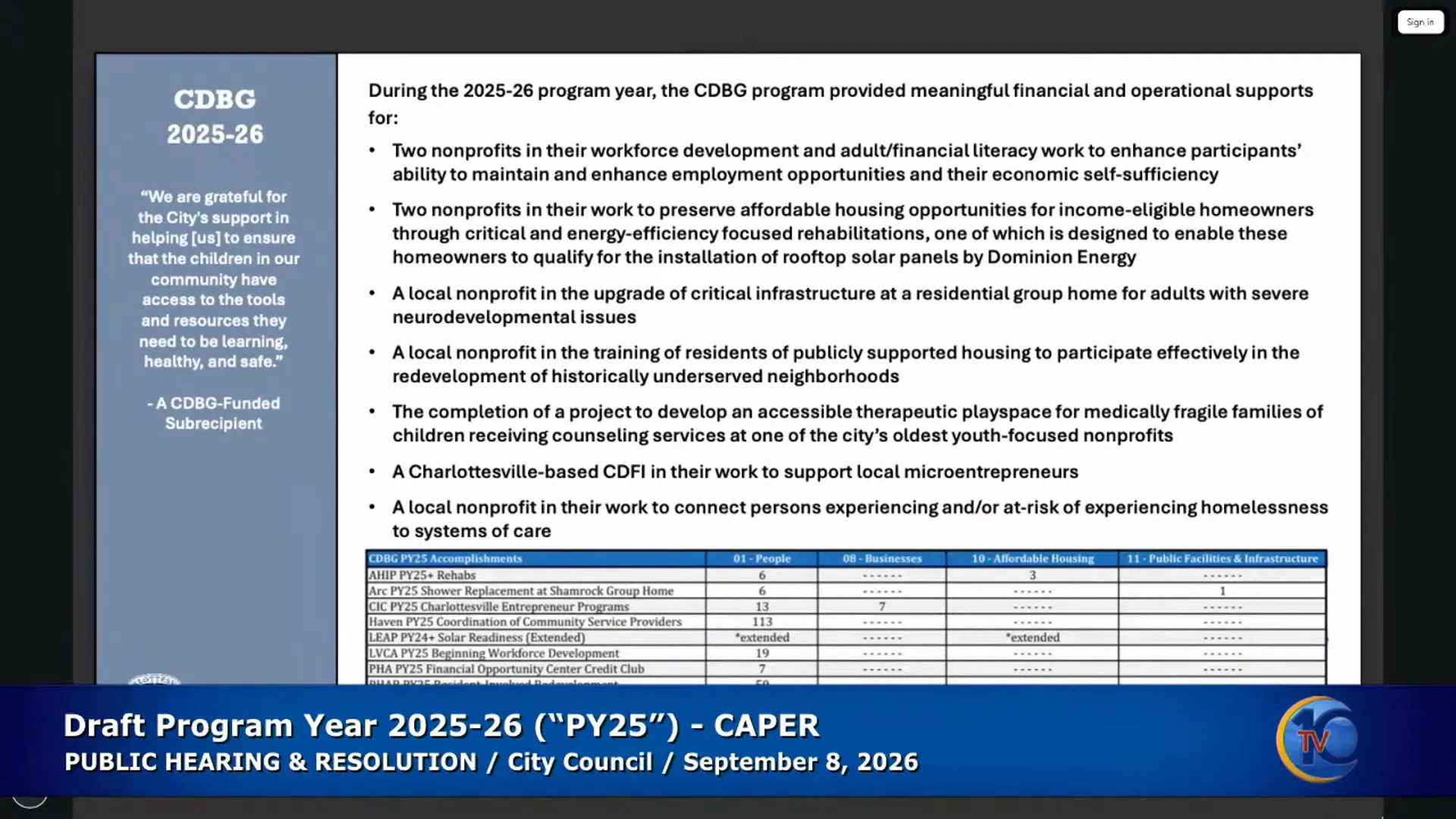
- CAPER (Program Year 2025-26): Draft consolidated annual performance and evaluation report for CDBG/HOME programs. Public comment period open. Carried to September 21 for second reading; placed on consent agenda.
- BEACON Kitchen Accessibility Enhancements: $55,000 CDBG-funded project for accessibility improvements at Beacon Express. Staff noted Beacon's success (24-hour operation, UVA outpost). Carried to consent agenda.
- IX Arts Foundation Accessibility Planning Grant: $25,000 CDBG planning grant for accessible design at IX Art Park. Donor will match funds 1:1. Council discussed portability and private ownership concerns. Carried to consent agenda.
Key Outcomes
- Consent Agenda: Items 2-10 approved 5-0.
- Affordable Housing Report: Received as information; staff directed to continue focus on 30% AMI, administrative capacity, and revisit the Affordable Housing Plan.
- Azalea Springs: No action taken on permit revocation; city will continue monitoring and pursue fines. Council directed staff to explore potential ordinance changes regarding tree protection, nesting season, and developer accountability.
- Homeless Shelter: Update noted; shelter operations ongoing with 57 guests. Council expressed support for the approach and directed staff to address safety concerns raised by residents.
- PCOB Ordinance: Approved on first reading (5-0); second reading scheduled for September 21.
- Carver Recreation Center Lease: Approved 5-0, authorizing execution of a two-year lease through June 30, 2028.
- MCI Metro Franchise Agreement: Approved on first reading with waiver of second reading (5-0).
- Public Hearing Items (CAPER, Beacon, IX Arts): All placed on consent agenda for final approval on September 21.
- Staffing Announcements: Mike Goddard named interim director of Neighborhood Development Services (effective Sept 14); India Adams Jacobs named Assistant City Manager (effective Sept 28).
Meeting Transcript
Hello, I'll call the Charleston City Council on September eighth, twenty twenty-six um City Council meeting to order. Madam Clerk, will you please call the roll? Councillor Fleischer here. Vice Mayor Osheron. Here. Councillor Payne. Here. Councillor Smith. Here. Mayor Wade. Here. Thank you very much. Um, is there a motion to approve or amend the um agenda? So moved to approve the agenda. All in favor, please say yes. Yes. All opposed, please say no. Thank you. Um the motion passes five to zero. Um, this meeting will be divided into three sections. The first one will be a work session where we hear and discuss a presentation that does not require a vote. Then followed by a closed meeting, and then um the business meeting at six thirty today is all housing. And um, the with um annual affordable housing report, and uh presenting that will be Miss Madeline Metzler. Thank you very much. Thank you, and good evening, City Councillors and Mayor Wade. I'm Madeline Metzler, senior housing planner with neighborhood development services. And tonight I'll be presenting the fiscal year 26 Affordable Housing Report. Which provides an overview of what the city has accomplished so far under the Affordable Housing Plan and where we still have important work ahead. This evening I'll walk through how Charlottesville has been investing its affordable housing dollars, what those investments have produced, our progress toward the major housing goals from the affordable housing plan, who benefits from these investments, some highlights from the past year, and finally a look at what's coming next. And my goal tonight is to show both the significant progress we've made toward our investment and production targets and to clearly identify where we still have gaps specifically in how we are investing in administrative capacity and serving our lowest income households. Now the Affordable Housing Plan provides a funding framework for the 10-year 100 million dollar investment in affordable housing that it outlines. That investment is divided across three categories, with 70% of funding to go towards direct housing investments, 20% to tax relief and stability programs, and 5% to administrative capacity. This framework uh guides our funding decisions and provides the structure for tracking our progress across the full 10-year window. This slide shows our investment progress for the first five of the 10-year commitment from FY22 through FY26. And that time the city has invested approximately 65.8 million dollars, which is about 66% of the full 10-year goal. Overall, we're ahead on direct housing investments and on tax relief and stability programs, and we're behind on spending for administrative capacity, which affects our ability to implement new programs, carry out policy changes, and expand our transparency tools. A quick note on the direct investments category. This includes all affordable housing investments in the CIP from FY22 through 26, along with major acquisitions made outside of the budget cycle, such as the Carleton Mobile Home Park and the Dogwood portfolio. However, one correction is needed to include the 2,000 holiday drive purchase from FY26. If we add in that approximate $6 million investment, our total direct investment increases to $58.5 million. And with that correction, um, we've now committed 84% of the direct investment target and bringing our total commitments to 72 million of that 100 million dollars planned. There's one additional nuance worth noting. The numbers shown here do not include future dollars that are tied to performance agreements for the developments at Kindlewood and 501 Cherry. These agreements commit the city to abate taxes once the projects are complete, but at the time the agreements are made, we don't have uh the full dollar value of those future tax assessments. Um as those projects move forward and assessments are finalized, we'll be able to track and report the dollars abated each year. But the key takeaway is that even without considering the tax abatement funding, council has exceeded the investment pace needed to fulfill its 10-year commitment. We're only halfway through the timeline and more than two-thirds of the way through or to the total funding target.
SUMMARIZED BY OPENPUBLICA AI
TRANSCRIPT VIA PUBLIC VIDEO
openpublica.com
openpublica.com