Chesapeake City Council Meeting and Work Session – August 15, 2023
STREAMING COPY IN PREPARATION — RECORDING AVAILABLE FROM THE ORIGINAL SOURCE
Chesapeake City Council Meeting and Work Session – August 15, 2023
The Chesapeake City Council convened on August 15, 2023, for a 5:00 p.m. work session focused on the recycling program, followed by a regular meeting at 6:30 p.m. The regular meeting included public hearings, a consent agenda, and new business items. Key topics included the future of recycling, early voting satellite locations, a wildlife crossing feasibility study, and zoning amendments.
Work Session: Recycling Update (5:00 p.m. – 5:45 p.m.)
- Public Works Director Earl Sorey presented a one-year review of the recycling program. Since ending curbside recycling, the city has operated eight drop-off centers, collecting over 3,000 tons of recyclables with a contamination rate of about 10% (compared to 24% trash and 18% glass under curbside). The total program cost for the year was approximately $2.5 million (including $250,000 startup), with recurring costs of $2.25 million, saving about $2.2 million compared to the previous curbside contract ($4.5 million, which would have risen to $4.7 million).
- Subscription-based recycling services have largely failed; only Recyclops remains, at $26–$29 per month. The lack of local processing facilities drives up costs.
- Staff recommended expanding drop-off locations in the short term (cost of $15,000–$20,000 per site) and pursuing an Integrated Material Recovery Facility (IMRF) that would allow single-stream curbside collection without a tax increase or new fee. The IMRF could achieve a 50% recovery rate, compared to 5–7% under the old curbside program. The timeline for an IMRF is estimated at 2–2.5 years. Reverting to traditional curbside would require a 4-cent tax increase or $7/month fee and take 1.5–2 years.
- Council members expressed support for the IMRF direction but some (e.g., Council Member Newins) raised concerns about the interim period and desire for public input. Council Member Ike noted the lack of local processing competition. The council did not take a formal vote but provided staff with general direction to proceed with pursuing IMRF unless otherwise directed.
Consent Calendar
- Refund to Franks Trucking Center Inc.: $21,231.75 – Approved 8-0 (Council Member Ike excused).
Public Comments & Testimony
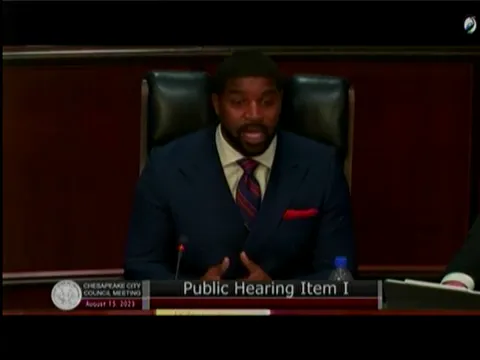
- Early Voting Satellite Locations (Item I): Six speakers addressed the council. Brad Moore (self) spoke in support of the proposed four locations. Dr. Charlotte Worley, Jim Lang, Jennifer Naperala, Dr. Shirley Auguste (Acting President, Chesapeake NAACP), David Washington, and Annette Kelley spoke in opposition, urging restoration of the Cuffey Community Center and Camelot Community Center sites and adding Sunday voting. They argued the removal of these sites disproportionately affects minority and elderly voters.
- Wildlife Crossing Feasibility Study (Item 1): Jeff Staples (Save the Dismal) expressed support for the study but questioned the $300,000 cost and suggested developers should fund it. Vic Nicholls (self) raised concerns about the city's budget priorities and transparency.
- Other Public Hearing Items: No speakers on most items; for Reba’s Rescue (Item F), Kathleen Williams and John Richardson spoke in support; for the tobacco/vape shop text amendment (Item G), Brad Moore spoke in support; for the Commerce Avenue rezoning (Item B), John Harbin (Chesapeake Land Bank Authority) and Frank Hruska (Habitat for Humanity) spoke in support; for Lake Shore Terrace (Item C), Grady Palmer, John Ashcraft, and Kenneth Jenkins spoke in support.
Discussion Items
- Planning Public Hearings (Items A–H): All items were approved unanimously (9-0 or 8-0) with stipulations or proffers as presented or amended. Notable: Item D (Shipyard Road) was continued to October 17, 2023. Item F (Reba’s Rescue) was approved with an amended stipulation to allow outdoor dog runs from 7 a.m. to 7 p.m. daily. Item G (tobacco/vape shops) was approved with a revised version dated July 31, 2023. Item H (notice requirements for public hearings) was approved retroactive to July 1, 2023.
- Non-Planning Public Hearing – Early Voting Locations (Item I): The ordinance designating Major Hillard Library, Russell Memorial Library, Central Library, and Indian River Library as early voting satellite locations for the November 7, 2023 general and special elections was approved 8-1 (Council Member Ward voted no). Discussion included legal constraints (60-day notice requirement, advertising deadlines) and the Registrar’s explanation that the four locations were selected based on availability, cost (a quarter of a million dollars per election), and low turnout at some prior sites. The council could not add or change locations without re-advertising.
- Polling Site Relocation (Item J): Ordinance relocating the Johnson Park precinct from South Norfolk Baptist Church to Rena B. Wright Primary School was approved 9-0. The Registrar confirmed that voters will be notified by mail as required by law.
- Regular Agenda – Wildlife Crossing Grant (Item 1): Resolution authorizing the City Manager to apply for a Federal Highway Administration grant for a feasibility study of a wildlife crossing across Route 17 was approved 8-0. The study is part of due diligence for the Frank T. Williams farm property.
- New Business – Zoning Definitions and South Norfolk Overlay (Items A & B): Two resolutions requesting the Planning Commission to consider amendments to the zoning ordinance were approved 8-0. One addresses definitions of “adjacent” and “abutting” and building height setbacks; the other permits residential development as a conditional use in the South Norfolk Business Overlay District.
Key Outcomes
- Votes: All public hearing items (A–H) approved unanimously or by 8-0. Early voting ordinance (I) approved 8-1 (Ward opposed). Polling site relocation (J) approved 9-0. Consent agenda approved 8-0. Wildlife crossing grant resolution approved 8-0. Two zoning amendment resolutions approved 8-0.
- Directives: Staff was directed to pursue an Integrated Material Recovery Facility (IMRF) and continue expanding drop-off recycling sites. Council Member Carey requested that Electoral Board meetings be advertised on the city website’s homepage and social media. Council Member Newins requested a future review of home daycare oversight by the Virginia Department of Education. Council Member Newins also asked for a fall work session on reducing farm equipment tax and expanding A-1 uses.
- Closed Meeting: The council held a closed meeting at 4:00 p.m. to discuss prospective candidates for City Auditor, and later at 7:58 p.m. to discuss potential economic development opportunities. Both closed sessions were certified by a 9-0 and 8-0 vote, respectively.
Meeting Transcript
Thank you. I want to welcome everyone to our August 15, 2023 recycling workshop. Mr. Manager, please, sir. Thank you, Mr. Mayor. So as you know, uh we made significant changes to the recycling program in the city last year, and we've provided council with quarterly reports per council's direction each quarter since that time. So it's now time for our one-year review, so we'll give you a recap of uh how the recycling program is going here in Chesapeake, and then what we would like to do is close with talking to you a little bit about the future of recycling in the city of Chesapeake. But we're going to start a little bit with some of the uh outcomes that that council desired to achieve, uh move into status report, then talk about the future of recycling. So with that, I'll turn it over to public works director, Earl Sorry. Uh thank you, Mr. Manager, and good afternoon. Uh appreciate the opportunity to share our recycling journey from the past year with you. Um our agenda for today is to kind of give you the year in review, and again uh you've seen the quarterly data, you know, this will wrap that up. Also to share some lessons learned that that we gleaned uh throughout this past year and to talk about you know what the future may hold for us in terms of recycling. So we'll start by uh revisiting the desired outcomes that council has shared with us, and this has kind of been our guiding uh you know for us as we've gone throughout the process. So uh reduced cost, improving the quality of the recycling stream, and providing additional choices, and we'll kind of talk about each in turn as we go through the presentation. So the next series of slides are all slides that you've seen before, but uh I'll get through those quickly. But you know, today in Chesapeake, we have eight recycling drop-off centers that are operating uh throughout the city, and we have one provider uh now providing subscription-based uh recycling uh services. And you can see the map here. Uh those sites are uh geographically dispersed to cover the city, and you know, we have the original seven, and then an eighth site was added at the animal services facility, uh they collect uh aluminum cans only at that location. Uh the next series of photos shows uh the the drop-off sites, and you know what one of the things I'm very proud of is as you look at these sites, they're very presentable, they're very clean, and you know, I I uh you give give credit to staff for that. They've worked very hard to to make sure that uh these sites are are clean and presentable and um you know in good operating order. Uh also uh point you to the uh picture of the municipal center uh site. So that is the relocated site that's on the west side of the uh facility uh over behind the uh Great Bridge Rec Center. Uh and you know, since it's moved from the east side of the facility to the west side, uh pleased to report the activity is very similar to what we had previously, and the volumes collected are very similar as well. So you know, we continue to track the performance at each site, and you can see that the municipal center site leads the way, followed by uh Russell Library and Western Branch and Duke Creek Park and so on. And you know, we use this data uh to right size uh the number of containers at each facility and also to um inform us on the number of collections that need to happen uh at each site. So again, we we talked about site maintenance, but you know these sites are uh visited daily by our waste management staff to include Saturdays and Sundays, our contract hauler GFL. Uh they service uh each site on a regular basis, several times a week. Uh they do not, however, provide Sunday service, and so we do provide uh again clean up uh if there are any overflows at any of the sites, and then they respond on demand whenever we see uh uh demand spikes. Uh so again, when when we were setting these up, there were a lot of naysayers out there. You know, a lot of people said nobody would use these sites, others said they would just turn into trash heaps, you know, by these concerted efforts. Uh they haven't been trash heaps, they've been very presentable. And uh the volumes collected far out far uh exceeded our original expectations. So uh we were able to collect over three thousand tons of recyclables uh since July of last year, and in doing so uh we have been able to uh satisfy that goal of a cleaner recycling stream because the contamination rate is far less at the drop-off sites than what we had with uh curbside recycling. And so again, the program was set up to where I, as the public works director, could authorize private contractors to contract with citizens for you know at-home recycling services. We posted that information on the website. We had three that were providing the service, and then we had a fourth providing uh compost uh collection. Uh today we're down to uh recyclops as the uh sole provider. Uh Happy Planet, uh, they raised their rates to $100 per month in March, and then as of this month, they're no longer providing service in Chesapeake, and then uh similarly uh TFC recycling uh ceased their subscription uh program in Chesapeake in July of this year. So talk a little bit about a little bit about waste management operations. Uh whenever we stopped curbside, we did have to plus up our waste management operations, and we did that uh to account for the additional materials that was no longer in the blue bins but was uh now in the brown bins, and so we expanded our routes uh citywide from 20 to 24, and we utilize existing staff to services new routes, and you know, our our timeliness uh is very similar to what we had you know previously, so you know that that is working for us. Uh and certainly you know, we need to talk about our cost data. So, you know, we've dug into that, and you know, this is a look at our um our last year cost for the drop-off center. So to set the centers up, it was roughly 250,000, and that was to prep the sites to put in the concrete pads to get the electrical service to the fencing, uh the security cameras, and then we had uh ongoing operating costs, and you can see uh 478,000 dollars for our contract hauler, and that was for servicing and transporting the materials, another 136,000 dollars for our in-house labor to monitor the sites and do cleanups as necessary. Uh I did include truck rentals for waste management. So you can see that's uh nearly $770,000. Uh that that's a cost that will eventually come down significantly as we uh update our fleet of vehicles. Uh but since that was an actual cost, I included it here.
openpublica.com