Chesapeake City Council Meeting and Budget Work Session - March 25, 2025
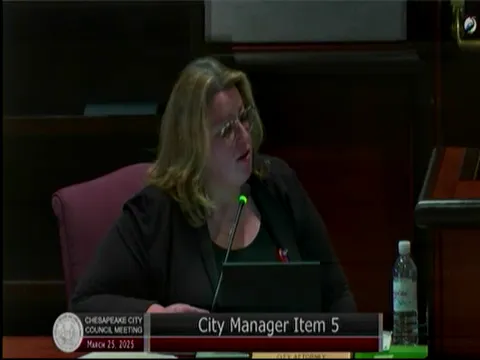
STREAMING COPY IN PREPARATION — RECORDING AVAILABLE FROM THE ORIGINAL SOURCE
Chesapeake City Council Meeting and Budget Work Session - March 25, 2025
The Chesapeake City Council held a work session from 4:30 p.m. to 5:58 p.m. on the FY2026 Operating Budget and Capital Improvement Program, followed by the regular council meeting at 6:30 p.m. on March 25, 2025. The work session featured a detailed presentation by City Manager Christopher Price and Budget Director Jonathan Hobbs. The regular meeting considered a proclamation, a public hearing on school bonds, approval of consent and regular agenda items, citizen comments, and appointments to boards and commissions.
Work Session – FY2026 Budget Presentation
- City Manager Price outlined the budget framework, emphasizing maintaining the city's high quality of life and low tax burden while addressing unfunded public safety needs. The core budget was built at the current real estate tax rate of $1.01 per $100 assessed value; a two-cent increase was advertised to preserve council’s options.
- Key right-sizing actions: reallocating vacant positions, redirecting 0.5% of meals tax revenue to the city lockbox, transitioning to hybrid staffing in some departments, and delaying or canceling certain capital projects.
- Enhanced public safety proposal would add 24 firefighters (to staff Rescue 15 and Medic 11), provide second sets of turnout gear for firefighters, replace Fire Stations and Police Precinct 5, upgrade the animal shelter, and add a data analyst in the fire department.
- Budget Director Hobbs presented revenue projections: real estate tax revenue of $415.8 million (6.5% increase), personal property tax slightly declining to $75.9 million, and sales tax declining 1.3%. City’s contribution to schools is $290.1 million (3% increase) plus $35.3 million in school lockbox.
- Four funding options for enhanced public safety: (A) two-cent real estate increase + redirecting mosquito control personal property tax ($10M/year); (B) two-cent increase + reducing personal property tax by eight cents ($7.4M/year); (C) no rate change, redirect eight cents from mosquito control to public safety ($2.5M/year); (D) combination of revenue increases and cuts.
- Upcoming work sessions: April 8 (enhanced public safety), April 15, and April 22.
Consent Calendar
- Resignation of Scott Bechtold (Airport Authority).
- Acceptance and transfer of $3,456 from Virginia State Police (HEAT Grant).
- Authority to apply for FY2026 Public Safety Answering Point Education Program Grant.
- Authority to apply for FY2025 Byrne Justice Assistance Law Enforcement Equipment Grant. All approved unanimously (9-0).
Public Comments & Testimony
Public Hearing Item A ($113M School Bonds): Vic Nicholls (self) questioned the impact of bond debt on taxes and advocated for voter approval and oversight. No other speakers. The ordinance passed 9-0 as an emergency.
Comments on Agenda Items: Vic Nicholls (self) asked about the nature of lawsuits leading to the $3.1M self-insurance transfer and expressed concerns about parking reductions harming disabled individuals.
Non-Agenda Speakers:
- Glenn Fritz (self) objected to increased property assessments and the proposed two-cent tax increase, suggesting option C (no rate change) as preferable.
- Vic Nicholls (self) criticized spending on new police/fire buildings without data, urged better infrastructure and dispatcher support, and questioned why water/sewer needs are deferred.
- Jennifer Knight (self) supported agriculture and rural preservation, urging the council to adopt an agritourism policy before approving applications, referencing earlier solar policy mistakes.
- Brad Moore (self) described abandoned vehicles on Bainbridge Boulevard, asking the city to address the waste of taxpayer funds on removal and to hold businesses accountable.
- Adam Amick (self) requested a new flag drop box in South Norfolk and an update on the municipal center construction.
Discussion Items
A. Proclamation – National Agriculture Month: Don Roberts (Ag Advisory Commission Chair) and Byron Stonecypher (Farm Bureau President) accepted the proclamation, thanking the council for supporting agriculture through zoning changes, OSAP, and transferable development rights.
A. #25-O-017 – School Bond Ordinance ($113M): Approved as emergency. Council Member Ritter inquired about fund allocation and interest costs (approximately 40% added). She also asked about using part of Crestwood Elementary for community recreation; City Manager Price said discussions with the school superintendent are ongoing.
B. #25-R-026 – School Bond Resolution: Unanimously approved (9-0).
C. #25-O-018 – Self-Insurance Fund Transfer ($3.1M): Approved as emergency. City Attorney Lindley explained the transfer was needed due to an unusually high volume of claims and large pending lawsuits.
D. #25-R-027 – Address Change (1213 Victory Boulevard): Unanimously approved.
E. #25-O-019 – Business License Tax Delinquency: Unanimously approved. Ordinance requires payment of all delinquent taxes before obtaining a business license.
F. #25-O-020 – Interest Accrual Delay on Tax Refunds: Unanimously approved. Delays interest accrual until the assessor receives an application for correction.
G. #25-O-028 – Initiating Resolution on Parking Reductions: Unanimously approved. Requests the Planning Commission to review amendments to Article 19 of the Zoning Ordinance for flexibility in required parking.
New Business: Council Member Newins requested a report on creating an Economic Development subsection for agritourism. City Manager Price announced Planning Director James McNamara's recognition in Virginia Magazine's 40 Under 40. Council Member Ritter noted Chesapeake was named #1 city for first-time homebuyers by Good Morning America. Council Member Ward reported on the Greenbrier Area Plan meeting and successful City Staff Day at Dillard's.
Appointments to Boards and Commissions
- Airport Authority: Micah Hall and Steven Turack appointed.
- Economic Development Authority: Troy Lindsey appointed.
- South Norfolk Revitalization Commission: T.C. Gray appointed; second appointment continued pending a closed session to resolve code eligibility issue.
- City Council Audit Committee: Daniel Whitaker appointed.
- Commission on Health and Well-Being: Shawn Barnwell (CIBH) appointed.
- Community Criminal Justice Board: Shawn Barnwell (CIBH) and Alvetta Alexander (Citizen) appointed.
- Interagency Consortium: Shawn Barnwell (CIBH) appointed.
- Local Emergency Planning Committee: Brooke Strickland (DEQ) appointed. All appointments made by unanimous consent.
Key Outcomes
- All consent and regular agenda items passed 9-0. School bond ordinance and self-insurance transfer were approved as emergencies.
- The budget work session initiated the FY2026 budget review process, with three additional work sessions scheduled in April.
- The South Norfolk Revitalization Commission second appointment was delayed pending a closed meeting on policy eligibility.
- Council directed staff to return with information on an agritourism economic development subsection.
- Public comments raised multiple concerns on taxes, infrastructure, parking for disabled, and agricultural policy.
Meeting Transcript
And we're looking forward to hearing uh what you have to present, Mr. Manager. Thank you, Mr. Mayor. And as always, I'll be joined by our budget director, uh Jonathan Hobbs. Uh he and his team have done an excellent job presenting and preparing uh this this year's budget. And so what we'd like to do is uh go through talking a little bit about how we come to uh make the choices that that we're recommending uh during the budget process. We'll talk a little bit about the process itself. Um ultimately, as we say every year, the purpose of the budget is to achieve um uh council's desired outcomes. We'll go through the numbers a little bit, some of the things we've done to right size the budget, and uh this is a continuation of things we've started several years ago, some of the options and and uh for council's consideration um and then and then go through next steps. One thing I want to reiterate, I'll say it now, but I'll reiterate hopefully later in the presentation is this is an early step in in what's a long process that will play out over the next um the next month or so. So we're gonna present a lot of information tonight. Um and to some extent I know it can be an overwhelming amount of information, but we want to make sure we're also being transparent. So, in so much as people really want to dig through the numbers, we want to make sure that we're straddling that line of providing you with all the information you need to help set the stage um to make choices and and also um not overwhelming you with too much information. Um as the mayor alluded to, very uh difficult choices this year, because one of the things we're talking about is enhanced public safety. We're a very, very safe community today, as council um um heard in your retreat and at your work session last week. We have some critical unmet um needs in public safety. So we really want to talk to you about the budget itself, talk to you a little bit about those needs, and then today we'll leave you with some options for consideration. Um, but at the next work session, we really want to roll up our sleeves and go through priority list of some of those unfunded needs and then some of the council's revenue options or c cost cutting options to give you opportunities to be able to address those needs in a variety of different ways. So as always, we start with this the city's vision. I won't read this slide. Um but it's all about uh making Chesapeake an exceptional uh place to live, learn work, farm, and play, and and how every year, how do we make progress um towards that goal? Um from a decision-making criteria, you've seen this a lot. We have three basic principles that we as staff make all of our decisions based on. Everything we do is designed to help make Chesapeake an exceptional place to live, learn work, farm and play, provide outstanding service to council, our community, our customers, and each other, and ultimately being fiscally responsible and sustainable. So uh we'll talk a little bit as we always do about our budget guiding principles. Those are really unique factors that Chesapeake City Council has identified to make sure that we stay a really fiscally strong um organization and a fiscally strong community. As you'll recall at your retreat in January, we had an opportunity for um to revisit these, council reaffirmed these as our desired outcomes, but you did ask us to to make some tweaks to the objectives that we're trying to achieve. Council reaffirmed these as our desired outcomes, but you did ask us to make some tweaks to the objectives that we're trying to achieve. And so I'm going to quickly highlight some of these because they drive some of the recommendations in the budget. Council asked us to not just maintain but also enhance the city's open for business philosophy. And this really goes to making sure that we're strong in job growth, strong in wave wage growth, strong in tax-based uh growth and job creation. Dr. King brought up the notion we we've had for several years the notion of reducing gun violence in the community, uh, but we also want to pay attention to our overall crime rates. We've actually had some uptick in in property crimes, and so we want to make sure that we're taking a look at the global overall crime rate. Um and then Councilmember Ritters and others have talked about partnering with other organizations. This isn't just the city government, it's not just the police department, it's partnering with the faith-based community and other organizations to make sure that the entire city and all of our partners are aligned to achieve these outcomes. Uh protecting enhancing our water resources and public utility infrastructure. Um, as we were having that retreat in January, council will recall that the city of Richmond was dealing with catastrophic water issues, largely due to their aging water infrastructure. And we have some of those similar challenges here within the city of Chesapeake. So during this budget process, um, you'll get some information about where we are today on our our our utility infrastructure and where we need to be in the future. And then finally, the notion of improving the city's overall environmental health. So we talked about our conservation programs, our preservation programs, but also some things that haven't historically been included as metrics in the budget, like animal welfare. And so you're gonna see some things, particularly with the with the um with our animal shelter, um, things to to really improve the uh animal welfare uh within the community. This is just a graphic that we use to keep our entire team uh and the community aligned about what it is we're trying to achieve and how it all works together. Um so I want to get a little bit into the budget framework. I mentioned this a little bit last week, but I just want to be clear for council and for the community. We have delivered a core budget at our existing tax rate that can accomplish and maintain our existing services that that we're providing today and address some of the public safety needs that including the number one public safety need, which is getting our um fire apparatus um adequately staffed, right? So the core budget and our budget director uh Jonathan Hobbs coined the term continue operations, right size everything. That's really been our practice for a few years, but we really leaned into it every year because I always want to give you an option at our existing uh with our existing revenues, how can how can we make that budget happen?
openpublica.com