Chesapeake City Council Meeting and Work Session - April 15, 2025
STREAMING COPY IN PREPARATION — RECORDING AVAILABLE FROM THE ORIGINAL SOURCE
Chesapeake City Council Meeting and Work Session - April 15, 2025
The Chesapeake City Council held a work session from 4:30 p.m. to 5:22 p.m. followed by a regular meeting at 6:30 p.m. on April 15, 2025. The work session focused on the water/sewer rate sufficiency analysis and budget topics, including public safety funding. The regular meeting included proclamation presentations, eight public hearing items, one new business item, and a closed meeting for Planning Commission interviews. All council members were present.
Public Comments & Testimony
- PLN-TXT-2024-011 (Nonconforming Uses Amendment): Three speakers opposed. Jack Claud (representing Hoggard-Eure) argued the amendment is unnecessary and gives too much power to the zoning administrator. Bryan Plumley (self) called it the "friends or enemies amendment," stating it impairs vested rights, lacks objective standards, and could allow selective enforcement. Nicole Pasho (self) argued it violates state law and the Equal Protection Clause by treating residential and non-residential uses differently, and requested it be sent back to the Planning Commission.
- PLN-REZ-2024-016 (Knicks Reserve): Sam Baraki (agent) spoke in support, highlighting the 77-unit single-family condominium project with community amenities and design revisions based on neighbor input. Vic Nicholls (self) spoke in support, noting the developer listened to neighbors and the low school impact (17 students total).
- PLN-USE-2024-033 (Raceway Fueling Station): Vic Nicholls (self) spoke in support (thumbs up).
- PLN-USE-2024-051 (Backwoods B&B): Vic Nicholls (self) expressed support but raised concerns about guest definition and parking for trailers/bikes.
- PLN-USE-2024-056 (Grizzly Den): Greg Schmitt (applicant/agent) spoke in support, noting the business relocation from Virginia Beach.
- New Business Item A (Wo Shep Mor Partnership Proffer Modification): Vic Nicholls (self) spoke in opposition, stating "We don't need a rezoning in that area."
Discussion Items
- Water/Sewer Rate Study (Work Session): Andy Burdom (Stantec) presented a revenue sufficiency analysis. Current approved rate increases of 2.9% per year through 2027 are insufficient due to 87% increases in chemicals/fuel/natural gas, 41% in salaries, and 33% in construction costs since 2021. Two options were presented: Option A (includes $21M TIF financing for Avalon area water/sewer) would require 3.9% in 2027, then 4.9% annually; Option B (no TIF) would require 4.9% annually starting in 2026. Typical monthly residential bill (5,000 gallons) is currently ~$132. Under Option A, Chesapeake’s portion would increase by $2.26/month in 2026; under Option B, by $3.80/month. The utility currently relies on general fund subsidies; staff recommended returning to a self-sustaining enterprise fund. Council discussed billing issues, meter replacement progress, and tiered rate structures.
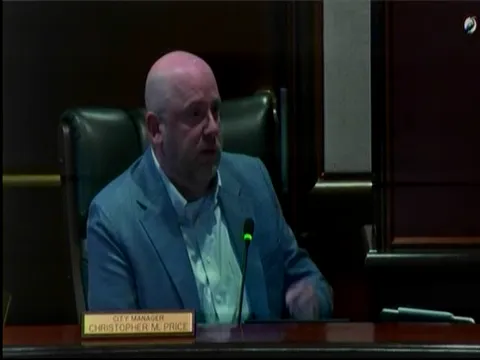
- Budget Topics (Work Session): City Manager Christopher Price presented a funding strategy for public safety Priority A items ($4.9 million). A straw poll showed consensus to: fund Priority A if possible, avoid increasing the real estate tax rate, redirect 8 cents of the personal property tax from mosquito control to public safety, and make the utility self-sustaining. These three actions free up $5.0M (including $500K from budget bottom line) to fund Priority A without a real estate tax increase. The manager recommended this option and will prepare ordinances accordingly. Remaining unfunded items (over $130M in public safety, plus victim witness program, Campus Dela redevelopment, summer youth programs, sportsplex study, real-time crime center enhancements) will be addressed through future proposals from the Commissioner of Revenue, potential data center tax increase, continued federal/state requests, and solid waste fee restructuring.
- PLN-TXT-2024-011 (Nonconforming Uses Amendment): Council debated the revised ordinance (March 25, 2025). City Attorney Catherine Lindley clarified that the zoning administrator is the proper enforcer, the use of "may" allows for working with citizens before violations, and there is no equal protection issue because residential and non-residential uses are not similarly situated. Council Member Ritter expressed concern the issue may end up in court and opined that any expansion of nonconforming uses should be terminated. The motion passed 8-1, with Council Member Newins voting no.
- Initiating Resolution (South Norfolk Density): Council Member Whitaker requested an initiating resolution to direct staff to study increasing the density limit in the urban overlay from 7 to 9 dwelling units per acre for single-family development, consistent with the historic 25-foot-wide lot pattern. Council Member Ritter objected. After discussion, the motion passed 8-1, with Council Member Ritter voting no.
Key Outcomes
- Votes on Public Hearing Items:
- PLN-TXT-2024-011 (Nonconforming Uses): Approved 8-1 (Newins opposed).
- PLN-REZ-2024-003 (Ballahack Lot Rezoning): Approved 9-0.
- PLN-REZ-2024-016 (Knicks Reserve): Approved 8-1 (Vice Mayor de Triquet opposed).
- PLN-USE-2024-033 (Raceway Fueling Station): Approved 9-0.
- PLN-USE-2024-047 (Heartwise Scholars Microschool): Approved 9-0.
- PLN-USE-2024-051 (Backwoods B&B): Approved 9-0.
- PLN-USE-2024-052 (Take 5 Oil Change): Approved 9-0.
- PLN-USE-2024-056 (Grizzly Den): Approved 9-0.
- New Business A (Wo Shep Mor Proffer Modification): Approved 9-0.
- Budget Direction: Council reached consensus to fund public safety Priority A ($4.9M) using $500K from budget bottom line, redirect 8 cents of personal property tax from mosquito control, and make the utility self-sustaining, thereby avoiding a real estate tax increase. The manager will prepare a budget ordinance reflecting this.
- Water/Sewer Rate Options: No final vote; council will consider Option A or B at a future meeting. Staff directed to provide analysis on tiered usage and percentage of customers in each tier.
- Initiating Resolution (South Norfolk Density): Approved 8-1, directing staff to draft an ordinance for planning commission review.
- Closed Meeting: Council unanimously approved a closed meeting (4:00-4:30 p.m. and after regular meeting) to interview Planning Commission candidates, and certified the closed meeting thereafter.
Meeting Transcript
Welcome everyone to our uh work session tonight. We'd like to turn the uh meeting over to our manager to discuss the issues. Thank you, Mr. Mayor. Uh, we're well on our way to getting to uh an adopted uh budget for today. We want to do our water and sewer rate sufficiency analysis. So council uh periodically sees um and hears from our our water, the utility department, but also our our financial consultants about the the viability of the system and and how we're tracking there, similar to what we did with the um toll facilities recently. And then we want to get back to talking about the enhanced uh public safety uh funding strategy. And then uh uh as we talked about last week, there's there's going to be things we don't fund in this this year's budget. That you know, we have a lot of priority needs. Um so what would be the plan to address any unfunded um needs that remain after this uh budget year. So starting with utilities before we get into the um water and sewer um the the rate sufficiency analysis. Um I know you all know this, Chesapeake Public Utilities is our water and sewer provider here within the city. It's a huge system. So we're we're one of the bigger systems in the state, but it's a it's a very, very large system. And it's a large system over a large area, right? So a lot of customers over a very large geographic area. Um we have an aging infrastructure. You all know that we occasionally encounter clay pipes or wood pipes, some of the original infrastructure to the city. Um, and because of that aging infrastructure, we periodically um experience failures. You know, so we'll have pretty significant leaks sometimes in that infrastructure. And unfortunately, because of the age of that infrastructure, sometimes we're into emergency repair situations, which is the most expensive way that we can address some of these facilities. In addition, I think council is very well aware that south of the um of the waterway, um, we don't have a lot of redundancy. So we have an eastern, um, especially on the uh on the water side, we have an eastern service, we have western service, those services, those systems don't connect. So if we had a major outage on one of those routes, there's very limited ability to redirect water to be able to take the care of the needs of our our our customers. So that's been a significant need we've identified um for quite some time. We've taken some steps to address that need, but it's a very, very significant need for a system our large for something that the people rely on like their public utilities. And then in theory and and really in practice for most of our history, but the utility should be self-sustaining, meaning that it's an enterprise fund, it should run like a business, and the utility bills should pay for the utility. For a variety of reasons, going back to the pandemic, we've moved away from that for a little bit. And and so, for example, during the pandemic, if you remember, we had a lot of people that were having difficulties paying their utility bill, and so we use some stimulus money to be able to augment the utility to help folks uh um with those utility bills. Um when you have a major economic development project, it might be appropriate for that project to pay for the utility, a major public facility. You might put the utility um the initial connection into the the pro you know into the project rather than utility. So generally speaking, the utility should be self-sustaining, but occasionally we drift away from that. Um but um it's probably time that we look at re regoing going back to a system where the the utility is self-sustaining. Um so I bring up these things before the the rate sufficiency analysis because many of you have asked me about something that happened in Richmond earlier this year, right? And so I'm showing some headlines on the screen right now. But Richmond experienced a catastrophic water failure, and it left residents of not just the city of Richmond, but surrounding communities that rely on on the Richmond Utility. It left them without water for about a week. And it was a pretty significant challenge for people that live there. And I had people say to me, and I I know David's probably the same way, you know, fortunately this couldn't happen in Chesapeake. It definitely could happen in Chesapeake. Right. This is one of the things that we want to be eyes wide open about you. We have some vulnerabilities in the system that we're taking steps to address over time. But the biggest step we can take to address the viability of the system is have it be a fully funded enterprise fund like it used to be a few years ago. So running through these um headlines here for a little bit. So with that, I will turn it over um to David Jurgens to interview uh to introduce the team to go through the sufficiency analysis. Good evening. We we do every year a revenue sufficiency analysis, but this year we're bringing it forward to also discuss prospective rate increases to match the needs and match the economic conditions that we've been facing the last few years. Uh we've got our rate experts, uh Andy Burdom from Stan Tech Consulting.
openpublica.com