OPENPUBLICA · PUBLIC MEETING RECORD
Record of Proceedings
Clemson City Council Public Hearing and Regular Meeting - September 8, 2026
City Council — Tuesday, September 8, 2026
BodyClemson, South Carolina
SessionCity Council
DateTuesday, September 8, 2026
StatusFILED
Video Record
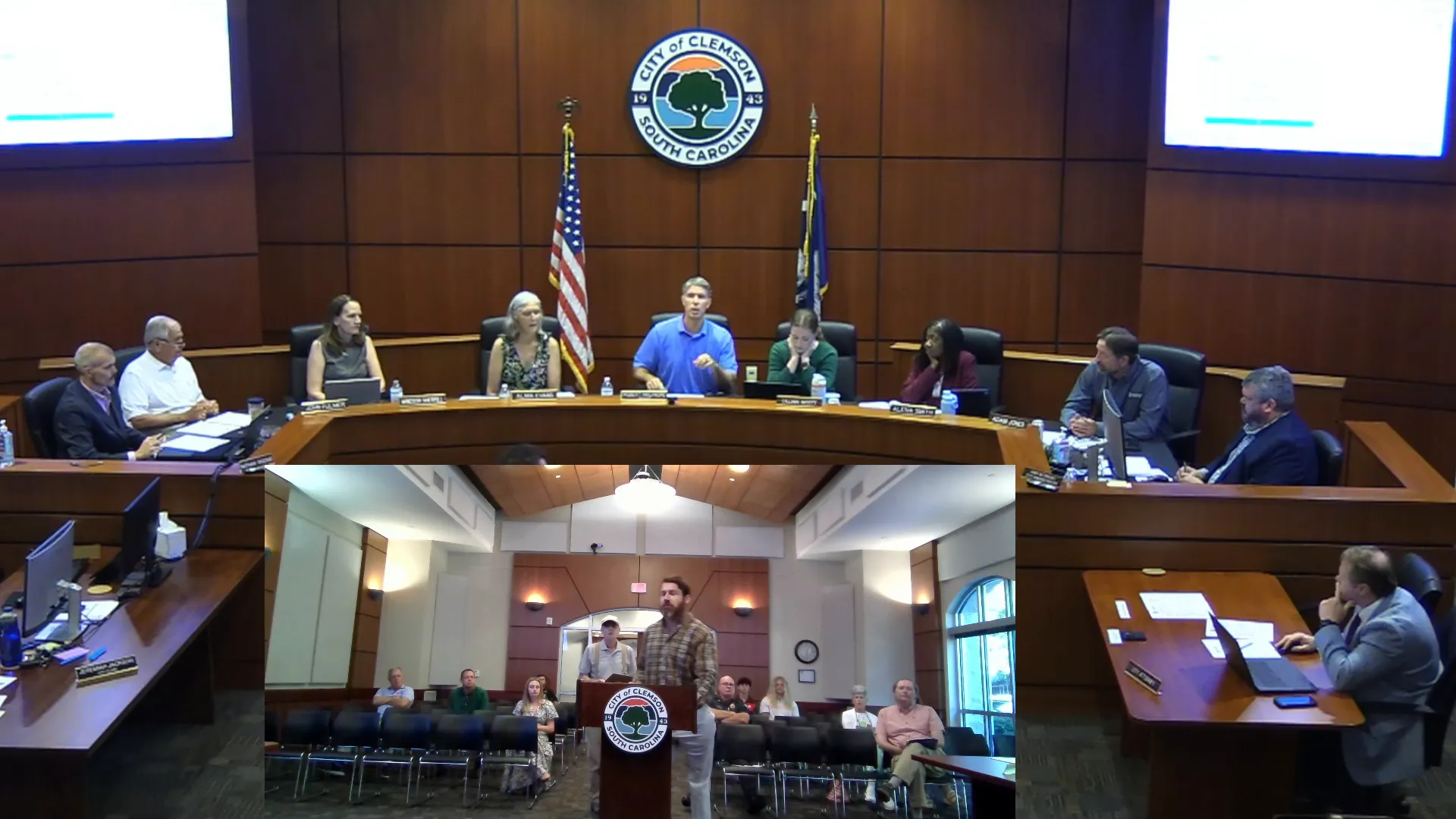
STREAMING COPY IN PREPARATION — RECORDING AVAILABLE FROM THE ORIGINAL SOURCE
Transcript — Verbatim
Speaker numbers apply only to this recording. Names come from transcript evidence. “Possibly” marks uncertain attribution.
Discussion Breakdown — Share of Meeting
Zoning And Land Use43%
Procedural34%
Public Engagement9%
Community Engagement5%
Transportation Safety3%
Technology and Innovation3%
Public Safety2%
Affordable Housing1%
Summary of Proceedings
Clemson City Council Public Hearing and Regular Meeting - September 8, 2026
The meeting on September 8, 2026, started with a public hearing on a proposed text amendment to establish a Student Housing District, followed by a regular council meeting. Key actions included second reading of a rezoning, first readings of two rezoning and two ordinance amendments, and public input on various items.
Public Hearing: Proposed Text Amendment (Student Housing District)
- Jacob Peabody presented the amendment to create standards for a student housing district: residential apartments only (no mixed-use), up to 7 stories, located within half a mile of Clemson University on Highway 93. The district would not be applied immediately to any property but would be available for future use.
- Emily Hunter (Wyatt Avenue resident) expressed support for limiting vehicular access to three stories on Wyatt Avenue and commended the city for getting ahead of developers.
- The public hearing was closed at 5:45 PM.
Public Session (General Comments)
- Cord McCray and James Hallman (Travis Manion Foundation and CSI Fraternity) requested city assistance to publicize a 9/11 memorial 5K run at Nettles Park on September 13, 2026, aiming for 50 participants to establish an annual event.
Reports/Discussion
- Student Housing District Discussion: Council further discussed the amendment, confirming it would not preclude faculty/staff housing and noting historical policy against high-density access through certain neighborhoods.
- Staff Reports:
- Andy reported a received dredging permit from the Corps of Engineers.
- City scored 56 on cybersecurity evaluation (low score indicates good performance).
- 26 hardwood trees (including oaks, tupelos, magnolias) will be delivered in October and planted downtown.
- Accommodations tax applications due September 11, 2026.
Policy Actions
- Second Reading: Rezoning JSCI Property (Highway 93 Parcels): Approved unanimously (moved from high-density residential to CP2 commercial after the Mercy Housing project fell through).
- First Reading: Rezoning North Clemson Avenue Parcels: Approved unanimously (14 parcels rezoned to RN-1 to allow duplexes/townhouses with occupancy limit of 2). A resident raised concerns about setbacks on Hedgerow Lane; staff clarified buffer requirements.
- First Reading: Amending City Ordinance 2-41 Public Hearings: Approved unanimously (limits applicant presentation to 10 minutes, reduces speaker time to 3 minutes, adds 5-minute summary of written comments).
- First Reading: Repealing Ride-Share Parking (18-27(b)): Approved unanimously (deemed unenforceable due to streetscape changes).
Key Outcomes
- All four policy actions were approved unanimously, with no recorded dissenting votes.
- The student housing district text amendment was discussed but not voted on; it remains under consideration for future adoption.
- Public comments were heard on the Travis Manion Foundation 5K event; staff will follow up.
Meeting Transcript
I hope everybody's enjoyed a little bit better weather the last couple of days. So this is a public hearing for just Tuesday, September 8th. It's proposed text amendment student housing district. This proposed text amendment is intended to establish the standards needed for a new student housing district in chapter 9 zoning of city code as drafted. Should the city decide in the future it is appropriate to rezone a property. Oh and that's classes. The district, the amendment itself will make no changes to the zone amount among the items of single housing district. Sorry. The amendment itself will make no changes to the zoning mat among the items addressed by the proposed amendments are. And I know Jacob, you're gonna come and relay these proposed amendments. Is that correct? Okay. Come on up. Yeah. You're ready, you know. We were just like, yeah, yeah. Okay, and then I'll remind everybody about public hearing up. So again, this is part of our whole um you know, push to get ahead of developers and get out of the PD process to create one more tool for residential only. So this is not the mixed use that we see going up and downtown. This is not that type of development. This is for residential apartment buildings only at a at a taller scale and a higher density than what we uh well, I guess comparable to what you see in the mixed use, but without the mixed use component of the commercial, and it is again like we said not to put it on the map at this time, but if we are um if we deem it appropriate or if somebody comes to us looking to do it, we have something in set up. So these are the standards, this is what you're gonna be doing. So we're talking um seven stories potentially, certain areas, maybe taller if you know certain district met good buffers, but it is a student centric district. This is not a middle housing district, this is not a you know affordable housing. This is the implement where we think student housing should go. I don't know what the name of it is. Um Earl Street, Earl Street. Earl Street has commercial too. Okay, so we don't really have to say do we have anything that I mean the biggest that I can give you an example are the lofts over on, but they're still only four stories of the tallest, so they're not really that you know what we're talking about. So um, no, we don't have anything like this to grade that as an option. It seems like there's a series of layers in there. There's in each each variation of it, there's a series of layers and a series of different hype groups. That's correct, different conditions, um, different access points, uh those other things. So it's you know, if you're not you're not going to let you do seven stories if you're going through a neighborhood, you know. That's not happening. But um, if you can get direct access out to a major road, and it's not gonna be a butting up against um properties, then that might be an option. Okay, are you putting the parameters on this really tight when you say located on a CAT bus or other approved mass transit route within one half mile of Clemson University owned portion of highway 93? Yeah, so that is keeping it very close to campus, correct. So uh half mile uh from the university on 93 within a half mile. So that like so I guess an example basically where it reaches out to you know the area that's been called kind of Bob's triangle over there, um Kelly Road. Yeah, okay.
SUMMARIZED BY OPENPUBLICA AI
TRANSCRIPT VIA PUBLIC VIDEO
openpublica.com
openpublica.com