OPENPUBLICA · PUBLIC MEETING RECORD
Record of Proceedings
FY 2025 Budget Workshop: Solid Waste, Public Works, Animal Care, Health – August 15, 2024
City Council — Thursday, August 15, 2024
BodyCorpus Christi, Texas
SessionCity Council
DateThursday, August 15, 2024
StatusFILED
Video Record
STREAMING COPY IN PREPARATION — RECORDING AVAILABLE FROM THE ORIGINAL SOURCE
Transcript — Verbatim
Speaker numbers apply only to this recording.
Discussion Breakdown — Share of Meeting
Public Works22%
Animal Welfare17%
Stormwater Management10%
Recycling Management9%
Public Engagement8%
Public Health8%
Vector Control6%
Wildlife Management5%
Budget Equity Analysis5%
Summary of Proceedings
FY 2025 Budget Workshop: Solid Waste, Public Works, Animal Care, and Health – August 15, 2024
The City Council held a workshop on August 15, 2024, to receive briefings on the proposed FY 2025 budgets for Solid Waste Services, Public Works (Streets and Stormwater), Animal Care Services, and the Health Department. The meeting was informational only; no formal votes were taken, and no public comment was solicited. Council members engaged with department directors on budget proposals, service levels, and operational challenges.
Discussion Items
Solid Waste Services
- Director David Lafeld presented the FY 2025 budget, noting a slight increase driven largely by pass-through costs for water department sludge. The department serves 98,000 residential/commercial customers and recycled over 12,000 tons in the past year.
- Proposed changes to reduce costs: reducing brush collection from four to two times per year, canceling the two-person litter crew program, and reducing the "Recycle Right" lid-flipping inspection program (contamination reduced from 43% to 29%, but program cost now exceeds savings).
- Council discussion focused on glass recycling: a glass crusher would cost $150,000–$200,000; the city has a stockpile of glass but no current recycling route; staff will re-engage with a potential local glass recycling company. The landfill has an expected 170-year life span; recycling contributes only about 4% of diversion.
- Councilman Hernandez questioned overtime budgeting (same amount despite reduced headcount) and the $1.4 million increase in professional services (largely due to sludge handling costs).
Public Works – Streets
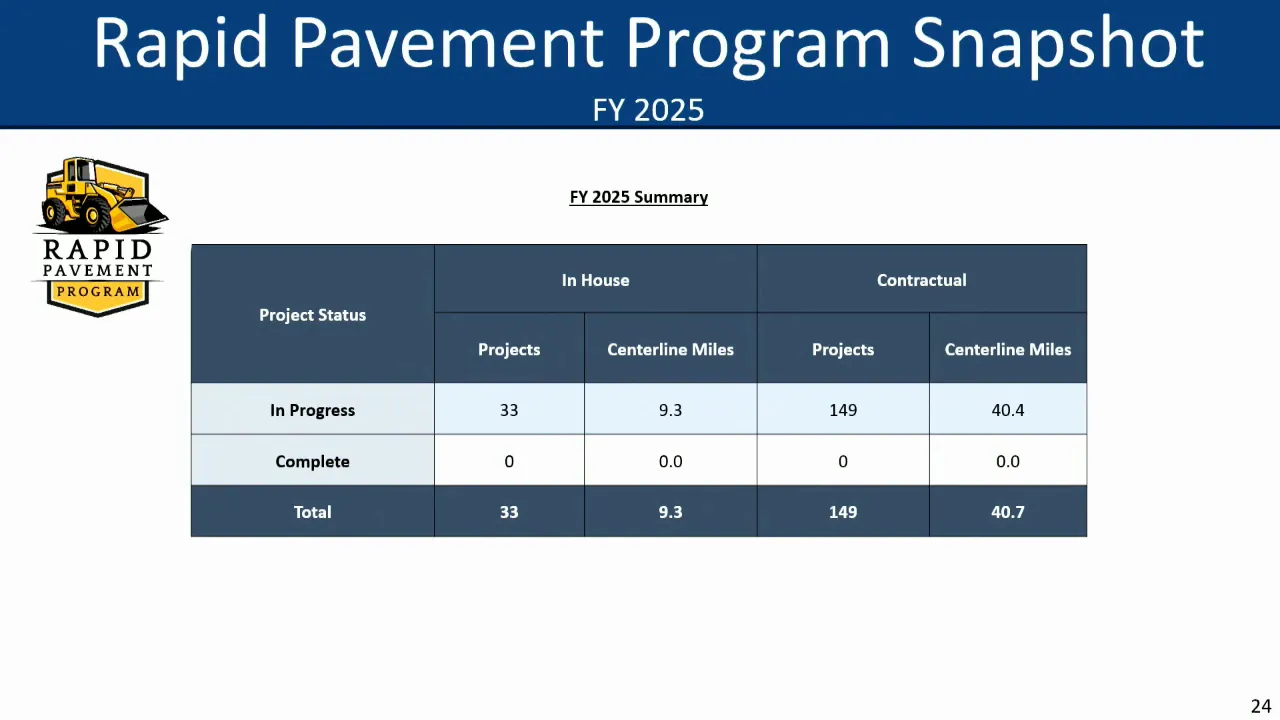
- Director Ernie De la Garza reported that for the first time in five years, all planned residential street work (34 centerline miles) will be completed by fiscal year-end. The department targets a Pavement Condition Index (PCI) of 71.87 by FY 2025, a year early.
- FY 2025 street improvement budget: $129.4 million (12.2% increase from FY 2024), with $32 million for residential streets. An additional $36 million (if a bond passes) would bring total to ~$68 million for residential streets; staff confirmed capacity to execute.
- A new skin patch program (thin asphalt overlay) is being deployed to address streets beyond pothole repair; decision packages request a new paver and materials. This will reduce pothole teams from six to three.
- Council requested a map showing where street funds are spent and better data consistency across city communications.
Public Works – Stormwater
- The stormwater FY 2025 budget is $33.7 million. Proposed enhancements: adding five street sweepers (for a total of 13), creating a nine-person maintenance-of-line crew for underground pipe inspection, and inventorying 35 miles of underground system per year.
- Stormwater rates are proposed unchanged from last year: residential tier 1 at $7.74, tier 2 at $10.32 per month.
- The first-ever citywide drainage master plan was adopted in January 2024. In-house street sweeping removed 1,630 tons of debris; contractors removed an additional 1,400 tons (total 3,000 tons, equivalent to 220 dump trucks).
- Council discussed floatable control devices: three pilot sites (including Cole Park and Waters Edge Park) are testing different technologies; six more are planned pending funding.
Animal Care Services
- Director Kathleen Choppa noted the department, standalone since June 2023, faces staff shortages and facility challenges. A comprehensive operational assessment by Citygate Associates is due for final review in November 2024.
- FY 2025 proposed budget relies 98% on general fund. Key proposal: continue $250,000 spay/neuter program, but reduce two vacant kennel technician positions (from 13 to 11), despite national standards recommending 11 per morning shift. This could strain operations and require pulling officers from field duty.
- Achievements include 17 new rescue partnerships, over 8,000 microchips, 30,000 completed service calls (average 100/day), and transfer of vector control to Health.
- Council discussed the intact pet permit program: only 28 permits issued (far below expected $50,000 revenue); communication with veterinarians needs improvement. Extended hours (noon to 9 p.m. shift) started two weeks ago to improve response times.
Health Department
- Director Dr. Fozia Khan presented the health budget: 80% grant-funded, with a $5.9 million general fund contribution. Key achievements included 10,000+ clinical services, 4,000+ food inspections, and 11,000+ communicable disease samples processed.
- Vector control transferred from Animal Care in May 2024. The department requests four dedicated vector positions and two new foggers (replacing outdated equipment). With six foggers, it takes seven days to cover the entire city. Adulticiding is done at night (8 p.m.–5 a.m.); larviciding is done during the day. The current pesticide cannot be used near water bodies, prompting a search for alternatives.
- Council emphasized better public education on mosquito control and consistent social media messaging. The department will post FAQs and increase outreach.
- Other initiatives: swimming lessons (255 children), CPR training (56 trained), public health summit (157 attendees), and a new community health needs assessment survey launching within a month.
- The county partnership (Nueces County) contract was extended to December 31, 2024, providing $1.8 million (31% of the health department's journal fund). Fee schedule for environmental health services will be updated (first since 2006), projected to generate $167,000.
Key Outcomes
- No formal votes were taken; the workshop was informational.
- City staff will develop a map of street improvement spending by district and ensure consistent reporting of street data across departments.
- Solid Waste will re-engage with a potential glass recycling company and consider a glass crusher.
- Public Works will pre-order a new paver and five street sweepers to avoid long lead times (budget adoption pending).
- Animal Care will develop a communication plan with veterinarians about the intact pet permit ordinance and continue to build volunteer base.
- Health Department will launch a community health needs assessment and improve vector control public outreach, including social media and a FAQ page.
- Council will receive the final Citygate Animal Care assessment in November 2024 for a workshop.
- Next community budget input sessions: August 15 (District 4, Fund Trackers), August 19 (Doc Seafood, Island), August 21 (Railroad Seafood & Brewery, Cal Allen). Next week's workshop (August 22) will cover Police, Fire, and Development Services.
Meeting Transcript
I ask a lot of all of our dogs. This is kind of our reward because she's paid her dues. Let them run, let them do what they're bred to do. The dogs love it because it's a new experience every time you go out. It feels great to get a few ducks, and that's icing on the cake. The family snags a few birds for dinner and hedgehog. It's just another day on the job for Ruby, the retriever. Big group of birds over here. Let's go check them out. Oh look at that flying in. Boom. Cool. And if you watch that dark more fresh eager, he's just running around. Looks like it's gonna fall over at times. It's kind of fun to watch. We're at Bolvar Flat Shorebird Sanctuary on Bolvar Peninsula in Galveston County, and this is a Mecca for birds for water birds for shorebirds that use the Texas coast. Going right down that very first wave. You can always go down to the beach and see anywhere from 15 to 30 species of birds, no matter whether it's in the spring or the hot summer time. And most of the time they'll be just like we're seeing right here. They'll be in little clums. There are birds here for many reasons for foraging, for roosting, and some are even here for nesting. This time of the year we've got least terns and willets. You see it. Oh good, good. Yes. Excellent. You can see that it's pretty small, but notice the white forehead and the yellow bill. These are only turn that's gonna have that very sharp, small yellow bill with that white forehead. The nesting birds here are very sensitive and what we recommend is that you fish, swim and play at 50 yards away. Keep your distance, let the birds have some space. Look in the scope there. There's a baby great eager. You have to look through some wispy limbs. Oh yeah. It's really pretty. That's pretty cool. The rookery here in Highland is unique because it allows bird watchers to get really close. Trails are carved for easy walking. There's platforms and viewing decks that make it really easy to set up your camera or your scope. This here is the great egret. Notice the showy plumes on the back. They're very fluffy plumes that are used for display. Yeah, it's funny to see these spoon bills with their big clumsy spoon bills bring in sticks and gently weave them together to make a platform nest and they're very meticulous. This rookie here is very important to a lot of these birds because it provides them protection with the water around it, and there are not many sites like this for spoon bills and egrets to nest in. Wow, it looks like it's painful. These guys are over a month old, they're gonna fledge any minute. Look at that.
SUMMARIZED BY OPENPUBLICA AI
TRANSCRIPT VIA PUBLIC VIDEO
openpublica.com
openpublica.com