OPENPUBLICA · PUBLIC MEETING RECORD
Record of Proceedings
FY 2025 Budget Workshop: CIP, HOT Projects, and Adjustments – August 29, 2024
City Council — Thursday, August 29, 2024
BodyCorpus Christi, Texas
SessionCity Council
DateThursday, August 29, 2024
StatusFILED
Video Record
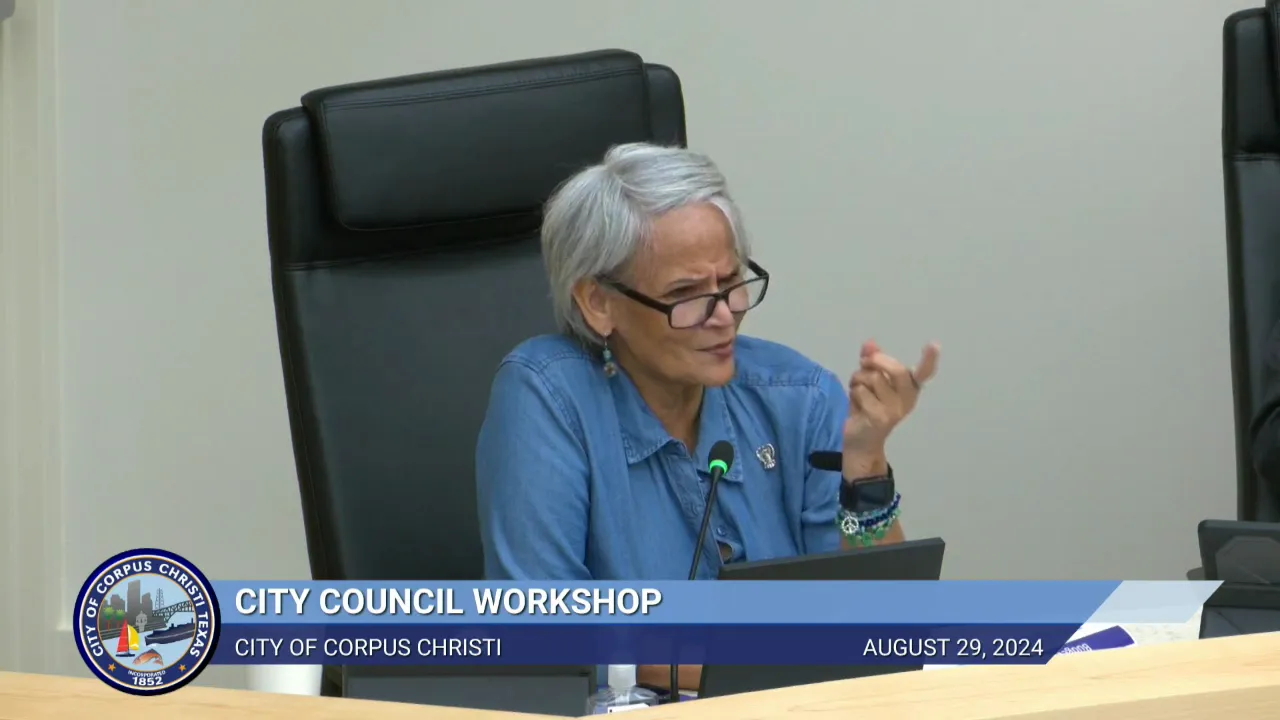
STREAMING COPY IN PREPARATION — RECORDING AVAILABLE FROM THE ORIGINAL SOURCE
Transcript — Verbatim
Speaker numbers apply only to this recording.
Discussion Breakdown — Share of Meeting
Capital Improvement Planning21%
Tourism Public Improvement District20%
Public Works8%
Public Engagement8%
Debt Management7%
Fiscal Sustainability7%
Budget Equity Analysis6%
Public Information Management6%
Wildlife Management5%
Summary of Proceedings
FY 2025 Budget Workshop: CIP, HOT Projects, and Adjustments – August 29, 2024
This City Council workshop focused on the FY 2025 budget, covering the Capital Improvement Plan (CIP) scorecard, Hotel Occupancy Tax (HOT) funded projects, a presentation from Visit Corpus Christi, and potential budget amendments to restore certain cuts using fund balance and additional revenue.
Consent Calendar
- No consent calendar items were considered; the workshop was for informational purposes only.
Discussion Items
- Capital Improvement Plan (CIP) FY25 and FY24 Scorecard: Engineering Services Director Jeff Edmonds presented the FY24 CIP delivery report card. Of 300 FY24 projects, 229 (76%) met planned encumbrances, totaling $524 million – a city record. $703 million was originally planned. Key causes for delays included unforeseen conditions, permitting issues (e.g., Army Corps), bid problems, and external dependencies. The FY25 CIP includes 272 projects totaling over $1 billion, with 175 ongoing, 66 rolling forward from FY24, and 27 new. The scorecard noted strong performance in airport (only 1 delayed), public facilities (92% on schedule), and water/wastewater (80%+ on schedule). Parks and streets had higher delay counts. City Manager Peter Zanoni announced a new performance goal of 80% on-time encumbrance for executives.
- Debt and Rate Impact Discussion: Council members raised concerns about growing debt, especially in the water department (projected $517 million in FY25, mostly debt). Chief Operating Officer Drew Molly acknowledged upward pressure on water rates but noted that SWIFT loans and grants would mitigate impacts. The city’s credit rating was recently reaffirmed, and debt per capita remains low compared to peer cities.
- Hotel Occupancy Tax (HOT) and American Bank Center: Assistant City Manager Heather Hurlburt reviewed HOT rates (9% local, 6% state; 15% total). FY25 HOT revenue is projected at $15.3 million, with total expenditures of $24.5 million (including fund balance). Funding goes to Visit Corpus Christi, local attractions, beach maintenance, and the convention center. $10.6 million is planned for American Bank Center capital improvements, including chiller replacement, electrical upgrades, flood mitigation, and ADA improvements. A $4.8 million carryover is expected in FY26.
- Visit Corpus Christi Presentation: CEO Brett Odding reported on tourism impacts. Summer 2024 was down slightly (0.8%) due to Tropical Storm Alberto and a hurricane, but bookings for future years remain strong. Group business generated a 35:1 return on incentives. Sports, film, and music commissions are expanding. Visit Corpus Christi received reaccreditation with distinction, placing it among 29 cities worldwide with this status. The organization uses transparentcc.com for public financials.
- Potential Budget Amendments: Budget Office Director Eddie Houlihan presented proposed adjustments to restore cuts using additional reductions and fund balance. Key restorations include: 5 code compliance officers ($284,000), partial mowing and demolition funding ($300,000), restoring 40 of 55 hours at Garcia Library, full operations at Oso Bay Learning Center (with a partner expected by January 2025), Greenwood Senior Center operations ($181,000), 2 animal care kennel technicians ($78,000), a community text messaging pilot ($300,000), $100,000 for North Beach Kawanas baseball field, and a second grant writer ($63,000). Funding sources include $1.2 million in additional reductions (e.g., holding two positions vacant in city manager’s office, reducing overtime, vacancy savings) and drawing from fund balance. The city expects $6 million in new IDA revenue in FY26 to cover recurring costs.
Key Outcomes
- Council directed staff to prepare a detailed breakdown of all fund balance uses (one-time vs. recurring) for the Tuesday budget reading.
- Staff will provide a comparison of bond program delivery timelines (2014, 2018, 2022) to show progress.
- Council supported the use of fund balance for one-time restorations, with a plan to transition to recurring funding in FY26 via new IDA revenues.
- Council emphasized the need for improved city communications; a new communications director starts Monday, August 2, 2025, and will conduct an assessment.
- The first reading of the FY 2025 budget, tax rate, and revenue ordinances is scheduled for Tuesday, September 3, 2024; adoption is set for September 10, 2024.
Meeting Transcript
And I heard probably the best in the whole world. Every day I come here three hours from 6 30 to 9 30. Yeah. For over ten years. And I've been here what more than 500 trips. I probably only get a hundred with shopping. So it's a means one shot. It takes five trips. The coast is so rich with bird life. It's great birding year-round, every day of the year. There's so many varied habitats and just so many neat birds. It's one of the number one hot spots in the country, if not in the world, to see birds. It sounds like some science fiction plot. Plant like that could take over the world. We think they are friendly. We welcome them into our neighborhoods. And then. Exotic landscape plants are escaping our yards and invading natural areas. We can see that most of the plants out there, it's green and it's beautiful, but most of the plants out there are logustrum. These plants quickly turn diverse woodlands into places where little else can grow. Here's a the mature logustrum right here. And look at that trunk. Look at that how many stems it has. It's slowly kind of spreading itself, and every foot and a half, you've got a new plant coming in. It's amazing how quickly it can just take over. If you look kind of up in the canopy or up above you, it's completely legustrum. See how dense the shade is. Brought to America as an ornamental and used for erosion control. Salt cedar has wreaked havoc across the Southwest. Salt cedar invades very quickly. They drink up all of the water. They exude salt through the leaves. So it creates a monoculture. It's just not very good wildlife habitat. At Keystone Heritage Park in El Paso, a team works to restore the natural balance. One down, thousand to go. That's what we're trying to do is just remove the non-native plants and put back the natives in. And uh give it a little help here and there with the water. Yeah, it's about six feet. Salinity is 0.4%. It just needs a little jump start. Restoring this landscape's natural history is an extra challenge because of its human history. It's a combination of a natural wetland and a series of archaeological sites dating back to at least about 4,500 years. It's a challenge because we can't dig a hole without having an archaeologist present. We have to screen the dirt, make sure we're not digging into a site, and you can go probably 10 feet in any direction, you'll probably hit something. So you gotta be real careful.
SUMMARIZED BY OPENPUBLICA AI
TRANSCRIPT VIA PUBLIC VIDEO
openpublica.com
openpublica.com