Dayton City Commission Work Session on Civil Citation Program Update – August 12, 2026
STREAMING COPY IN PREPARATION — RECORDING AVAILABLE FROM THE ORIGINAL SOURCE
Dayton City Commission Work Session on Civil Citation Program Update – August 12, 2026
At the August 12, 2026 work session, Dayton city commissioners received a staff presentation on the first nine months of the new civil citation and warning program. Staff and law department representatives outlined compliance data, lessons learned, and proposed amendments to expand the ordinance to structural and zoning violations.
Staff Presentation and Data
- Department of Planning and Neighborhoods Development Director Steve Gonnell introduced the update; housing inspections and law department staff presented.
- Civil process: complaints may come from citizens, inspectors, or other city departments; a warning notice allows 10 days for compliance; if uncorrected, a civil citation is issued; fines double if unpaid after 30 days; recipients may contest in writing and request an administrative hearing.
- Hearing outcomes: 98 hearings were scheduled, 72 people paid after attending, and about 73.5% achieved compliance after participating in a hearing.
- Most common violations included failure to maintain residential properties, sanitation for residential/non-residential/commercial properties, waste container placement/removal, overhanging trees, and grass/trash removal.
- From July 2025 to March 2026, staff issued 795 criminal citations (about 82% compliance), 1,158 cases were abated/corrected, and 578 were pending escalated civil citations. Warnings alone achieved about 41% compliance.
- Total cases: 2,981; 1,825 remained unpaid and unabated. Overall compliance was about 26–27%; residential failure-to-maintain compliance was about 25%; non-residential/commercial compliance was about 28%.
- LLC/business-owned properties: approximately 1,734 civil citations were issued, 314 abated, about 18% compliance. Commercial/non-residential properties: 381 citations issued, 47 escalated, about 21% compliance.
- Staff reported about 37,985 paid citations (1,900 escalated) and about 213,200 unpaid citations (33,000 escalated). Delinquent fees were referred to Montgomery County’s treasurer for property-tax assessment.
- Compliance tools include educational brochures, warning notices, criminal citations through Dayton Municipal Court, disclosure of outstanding citations during property transfers, and neighborhood engagement.
Proposed Ordinance Amendments
- John Musto of the Law Department explained the program was created because the criminal process was slow and difficult to apply to businesses, LLCs, and out-of-state property owners. The first year focused on cosmetic violations to refine the process.
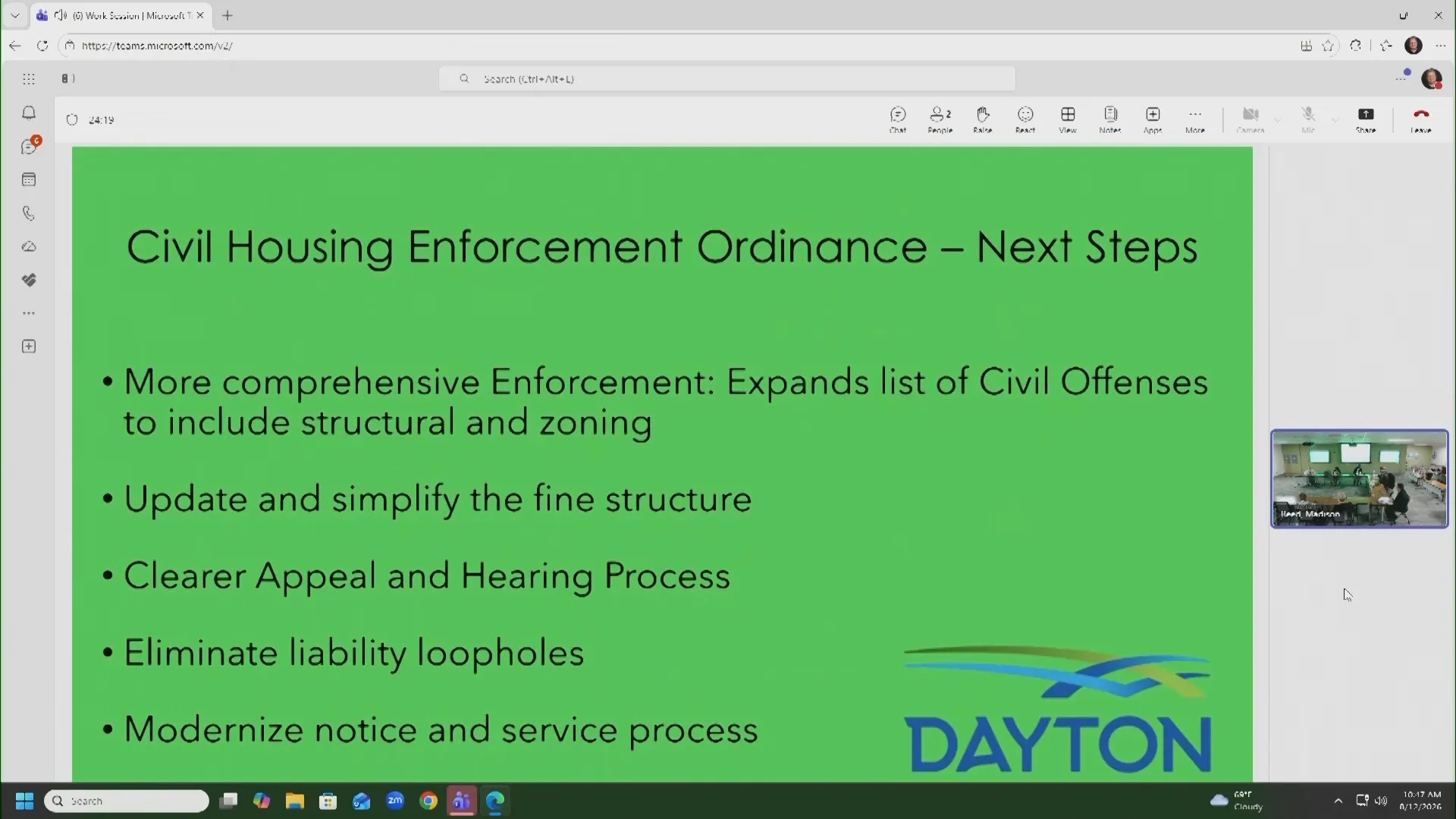
- Proposed changes: add structural and zoning code violations; replace the five-level fine structure with a single fine level to allow software automation and greater discretion for inspectors/hearing officers; require a stated reason when requesting a hearing; make landlords jointly and severally responsible for violations, closing a loophole that shifted responsibility to tenants; and allow electronic signatures and third-party software processing.
- Musto stated the goal is compliance, not revenue.
Discussion
- One commissioner asked if adding zoning would allow enforcement against auto-repair businesses in residential areas; Musto confirmed it would add a faster administrative enforcement path.
- Commissioner Beckham praised the streamlining and accountability, requested slides be provided in future work sessions, and said she looked forward to voting yes on the ordinance.
- A commissioner asked for total citations; staff reported 27,827 total citations for the period, with 1,734 LLC citations.
- A commissioner asked about outdoor storage (e.g., cars, boxes, appliances, furniture); staff said it would be included in the zoning expansion and can already be enforced as failure to maintain property.
- A commissioner suggested complementing the program with rental registration; Musto noted state-level legal uncertainties about municipal rental registries and said the auditor’s office registry is used as a point-of-contact tool. The mayor and staff noted a housing task force subcommittee is examining rental registry and accountability strategies.
Key Outcomes
- No formal vote was taken at the work session.
- Staff will bring the proposed ordinance amendments to the commission for approval.
- Staff were asked to provide the presentation slides in future work sessions.
- A housing task force subcommittee update on rental registry/accountability was requested.
Meeting Transcript
All right. Good morning, Mary Commissioners. This is an update for you with regards to our new civil citation process, which obviously includes warnings. It has been an offer up and operating for about nine months. So we are seeing some really good trends. And it's still informing us on how we continue to reform and make sure that this is this tool becomes as effective and impactful as we envisioned it to be when we started down this path. So I will turn it and I turn it over to you, Mr. Gondel, first for uh to start the next day. Good morning, everybody. Uh Steve Gonnell, director for the Department of Planning and Neighbors and Development. Today I'm joined with uh James McDaniel, our division manager for housing inspections, Daniel Simpson, who is our uh conservation uh supervisor, as well as John Musto from our law department. But I just want to extend gratitude to Farm Dosak Law Director Melissa Schreiner who helped assist with this. So today uh the staff here is going to kind of walk through uh where we are for the last seven months and some of the outcomes and kind of looking ahead as to where we're gonna go from there. So I'm gonna turn it over to Danielle as she uh leads us through the presentation. Good morning, everyone. Good morning. Today we're going to discuss the compliance analysis, the civil warnings and civil citation. The purpose today is to um overview the civil enforcement ordinance to compare the use of civil warnings versus civil citations, um, to evaluate the most common violations and which ones result in compliance and how many citations are being paid and unpaid, and also to determine the number of LLCs that have been cited and compliant. First, I think it's important to go through the process of how we come to this determination. Um, a complaint is usually initiated by a citizen or housing inspector or any other department within the city of Dayton. Once the complaint has been received and observed, um violation exists. We usually send a civil penalty warning notice with a 10-day compliance. After that rough 10 days, the property is checked to see if the violation has been corrected or if it still exists. If it's been corrected, then we close the warning notice. If it has not been corrected, we issue a civil citation. If they um do not pay within 30 days, the fine does double. Um, within that 20 days, they they can contest and um requested administrative hearing, or they have up to 30 days to pay the fee. I mean credit card or debit card, but you can still go to the second floor and pay by cash or check in uh building services. So when you file a hearing for a civil penalty, um you have to request it in writing. Um a letter is sent to the owner or a responsible party informing them of the date and time of the hearing. Um, and then they're allowed to speak in front of the administrative hearing officer, and after the hearing is given the information, the hearing officer determines if a fine can be reduced or if the citation stands. Standardly, about 73.5% achieve compliance after they have participated in a hearing. So we've had 98 hearings scheduled, and 72 of those individuals have paid after attending a hearing. These are current the current civil offenses that we are enforcing under the civil penalty of the most popular waste containers, uh vehicles, uh, failure to maintain properties, um, sanitation and landscaping for non-residential and commercial properties. Of all those violations, these are the most common. Again, waste container uh placement, uh, container uh disruption, uh failure to maintain uh your property, overhanging trees, sanitation for non-residential and commercial properties, and also waste containers for non-residential commercial properties. During the period of beginning, which is July 2025 to January, um, this is a breakdown of uh the most common uh violations issued, which which were failure to maintain for residential properties, um, sanitation for resident and non residential and commercial, and grass and removal for some abandoned properties. And listed here are the counts in association to those. Any subsequent offense goes up as a second offense, which is 100%, 150, 200, and 250. And beyond the fifth offense, it continues to 250 until we obtain. And if it was since the selection, you do receive an additional fee. So just as some definitions, civil penalty warnings are the informal notice that we send to specify the violation on the property. The civil citation is the more formal action that results in the fine. The word abate means that the violations have been corrected, but the ticket may or may not have been paid. Abated and paid means the violations have been corrected and it has been paid. And paid just means the violation, the ticket has been paid, but the violation still exists. When you see open and active, that means that it is still open pending further enforcement and closed means that the citation is due or is going to be issued. This is a comparison between the criminal and the civil process. With criminal, we may issue a warning notice or a courtesy notice, but we are able to go straight to a citation. With civil, we try to issue a civil penalty warning or some other form of warning first.
openpublica.com