Duluth City Council Meeting - May 27, 2025
STREAMING COPY IN PREPARATION — RECORDING AVAILABLE FROM THE ORIGINAL SOURCE
Duluth City Council Meeting - May 27, 2025
The Duluth City Council met on Tuesday, May 27, 2025, at 6:00 PM in the Council Chamber. The meeting opened with a Committee of the Whole presentation on chloride reduction in city streams, followed by the regular council meeting. The council approved a large consent agenda, heard public comments on library funding, a rent repair ordinance, and other issues, and gave first readings to several ordinances. The meeting adjourned at 6:37 PM.
Consent Calendar
- Approved the minutes of the May 12, 2025 meeting (9-0).
- Received an informational report on the Emergency Purchase Report for the Lake Superior Zoo (25-022).
- Received reports from various boards and commissions (25-020).
- Approved Resolutions 25-0416R through 25-0428R unanimously, including:
- Temporary expansions for The Social House and Lemons Reef.
- Temporary on-sale liquor licenses for Northland Newborn Foundation, Grandma's Marathon, Marshall School, and All Pints North.
- Permanent expansion for Zeitgeist.
- Premises permit for Irving Community Association (Little Angie's).
- Confirmations of Timothy Squalls and Rebecca Revier to the Heading Home Advisory Committee, Bettina Keppers to the NQT2SLGBIA Commission, and Shannon Laing and Annie Schwartz to the Community Development Committee.
- Amendments to the civil service classification of City Clerk.
- Sale of property in Lincoln Park to the HRA for nominal consideration.
- Vacation of sections of 125th Avenue West, Second Avenue, and Third Avenue in East Fond du Lac, subject to utility easement and replacement street easement.
- Vacation of an easement for slopes on West Third Street Alley.
- One-year extension of a Minnesota Investment Fund grant contract with Sofidel America.
- Subrecipient funding agreement with Sofidel America Corp.
- Purchase of a 2025 Case 621G wheel loader and bucket from Titan Machinery for $202,974.89.
- Agreement with Ever-Green Energy for a customer energy portal for up to $96,500.
- Amendments to Lakewalk Trail license agreements and escrow agreement with St. Louis and Lake Counties Regional Railroad Authority for railroad crossings near Veterans Memorial Park and 28th Ave E.
- Contract award to Northland Constructors for 6th Avenue East Reconditioning Project for $2,984,400.
- Engineering services agreements for 2025 Street Preservation ($195,260 with MSA), and lead service line replacement projects: Spirit Valley & Central Hillside 2 ($631,804 with MSA), Denfeld ($362,590 with LHB), East Hillside 1 ($381,000 with SEH), and Endion ($309,420 with Northland Consulting Engineers).
- Contract with Cy-Con, Inc. for structural repairs of parking ramps for up to $244,195.
- Second amendment to agreement with Minnesota Historical Society for Waabizheshikana: The Marten Trail Interpretive Plan, extending term to September 30, 2027.
- Exclusive use permit with Bentleyville Tour of Lights for the 2025 holiday season in Bayfront Festival Park.
- Authorization to accept tax forfeit land from St. Louis County for trail and recreational purposes.
Public Comments & Testimony
- Susan Henke (1907 Melrose Ave) and Jennifer Berges (VP, Duluth Library Foundation) spoke in support of continued funding for the Duluth Public Library, citing its importance as a core community service and noting that any budget cuts would lead to reduced hours. Berges highlighted that program attendance is up 28% since the pandemic.
- Barbara Monte (2114 E 5th St) spoke in support of the proposed rent repair ordinance (25-013-O), emphasizing that existing state resources are underutilized and that the ordinance would provide education to tenants, owners, and property managers.
- Brittany Kuschel (president, Duluth Landlord Association; co-chair, Multi Housing Northland) expressed mixed views on the ordinance, noting that many housing providers are concerned about the cumulative effect of recent legislative changes, but she supported education and funding for existing resources.
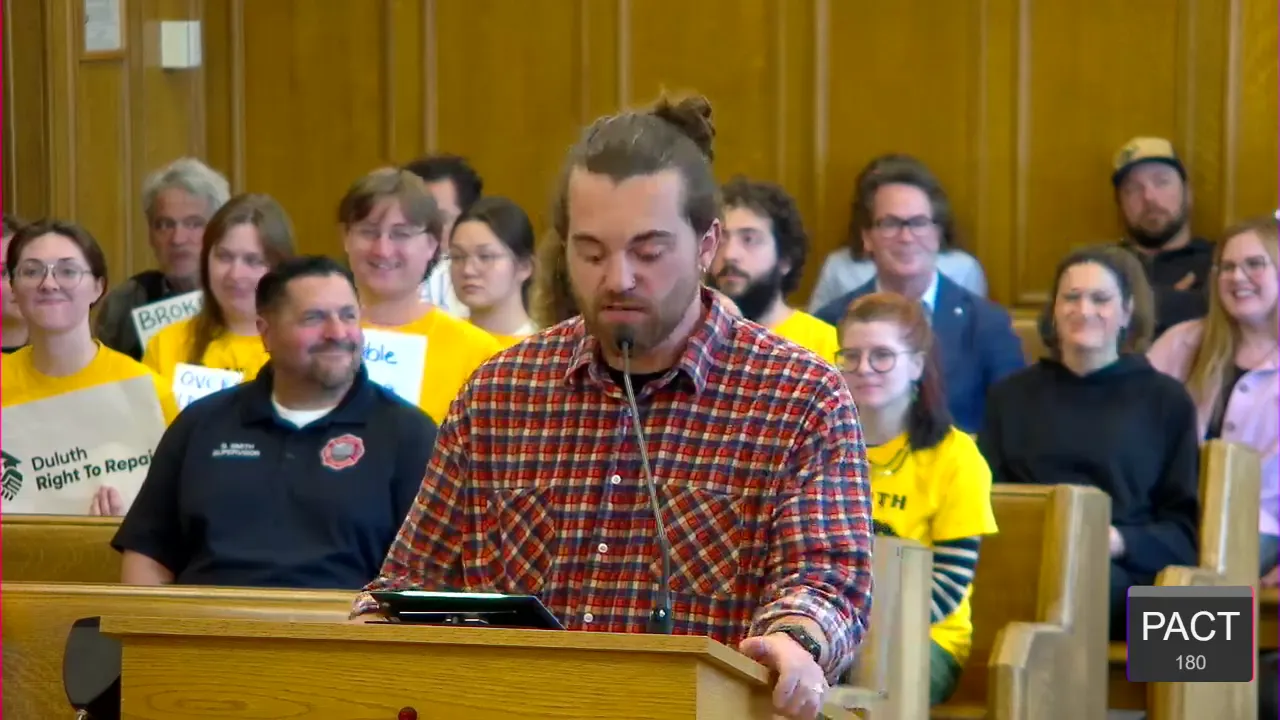
- John Ramos (publisher, Duluth Monitor; 1820 W 3rd St) criticized the new royal blue velvet rope in the council chamber, arguing it limits transparency and access for reporters. He requested its removal.
- Matt Baumgartner (lifelong Duluth resident) spoke in support of the rent repair ordinance, arguing that existing protections are robust and that duplication would be costly and convoluted. He expressed concern that the ordinance could reduce new housing supply and drive up prices.
- Brandon Parker (621 Atlantic Ave) spoke in defense of the Safe Bay site, which was closed following a neighbor's appeal despite unanimous Planning Commission approval. He urged the council to schedule an emergency special meeting to address the closure. He also requested transparency on the Skywalk Working Group study, asking for community input to be centered.
Discussion Items
- Committee of the Whole Presentation on Chloride Reduction: A Minnesota Green Corps member presented a detailed overview of chloride pollution in Duluth's impaired trout streams (Tischer, Miller, Chester, Keene, Kingsbury). Key points:
- The city uses an average of 13,500 tons of salt per year (2009-2022 average; high of 15.6 tons in 2022-23, low of 4,000 tons last year).
- 93% of chloride in impaired streams is due to road salt, primarily from municipal operations.
- The MPCA is developing Total Maximum Daily Loads (TMDLs) due by spring 2026, which will impose waste load allocations on the city.
- Current improvements include calibrated spreaders, electronic controls, pre-wet equipment, brine production, and smart salting training for operators.
- Future needs include additional direct liquid application trucks, road weather information systems, brine storage, low-salt zones, public communication, and potential ordinance requiring smart salting training for private contractors.
- Councillors asked about the variation in salt use, the status of brine applicator equipment on new trucks, and the relationship with St. Louis County operations.
- Safe Bay Appeal: Councilor Mayo asked the city attorney about the process following a council vote. The attorney clarified that if the council affirms the permit, it would be issued immediately, and further appeals would go to court. Councilor Forsman noted that under city code, the land use supervisor could potentially lift the stay, but staff opined the threshold was not met. He also noted that some councilors would be unable to attend a special meeting set for June 5, but a quorum still exists. The 10-day notice provision requires at least 10 days' notice to applicants and appellants before the appeal hearing.
Key Outcomes
- The consent agenda was approved unanimously (9-0).
- First readings were given to five ordinances:
- 25-010-O: Authorizing issuance of taxable grant anticipation revenue notes up to $19,825,965 for water utility improvements.
- 25-009-O: Conveyance of property in Lincoln Park to the HRA for nominal consideration.
- 25-011-O: Rezoning parcel 010-3010-00120 and adjoining rights-of-way from Mixed-Use Business (MU-B) to Residential Traditional (R-1).
- 25-012-O: Granting a concurrent use permit for a skywalk bridge over East 1st Street Alley adjacent to 333 East Superior Street.
- 25-013-O: Adding Article V to Chapter 29A of the city code providing notice to tenants of available resources and protected rights under state law and city ordinance.
- The Safe Bay appeal will be heard at a special meeting on June 5, 2025, or the next regular council meeting (June 9, 2025), depending on scheduling and quorum.
- Councilor Forsman announced a housing code resolution for the next meeting. Councilor Awal announced a streets resolution for downtown revitalization, possibly on June 9.
Meeting Transcript
We will begin with our committee of the whole in one minute. We will begin our committee of the whole, the state of chloride in Duluth. And can we have our presenters come up to the lectern, please? Hi everyone. Right. Hi everyone. Sorry about that. Um, so like I said, uh, I'm a Minnesota Green Corps member. Uh, so my role at the city is uh researching and writing a chloride reduction plan to help outline some strategies the city can use to apply less road salt and um therefore reduce chloride pollution in the impaired streams. Uh, been taking some water samples in the impaired streams and doing some outreach and education events as well. So a quick recap. Um chloride uh road salt, you know, it works by dissolving in water, lowering the um freezing point of water, and um uh it stops working a bit uh after uh the pavement temperature hits 15 degrees Fahrenheit. Um when it melts um when it melts uh snow and ice um or if it gets hit by rain, it washes off as storm water and goes to the streams, causes pollution. Uh what's in those streams, it uh causes problems for fish and aquatic insects and uh vegetation in those streams. And another side of another effect of it is um damage to infrastructure and vehicles and uh uh vegetation. You know, we've all seen plenty of plenty of rusty vehicles and bridges and um damaged uh grass medians, that kind of thing. Uh it's also a permanent pollutant uh because of just how it works chemically. It uh there's no real way to remove it from water. So once it's in the water, it's there pretty much forever effectively. Uh and then chloride uh or excuse me, surface waters are considered impaired for for chloride at uh 230 milligrams per liter. Um if they test that that level uh twice in a three-year period, or if they test um once uh at 860 milligrams per liter in that three-year period. Uh and that's definition from uh the US EPA and was adopted by the MPCA as well. Uh the city uses about 13 and a half thousand tons of salt um per year. That's uh average from uh 2009 to 2022. So it's a pretty good picture of what's uh the average salt use is in the city. Next slide. Um the impaired waters in the city, so there are five impaired trout streams in the city. Uh so it's uh Tisher Creek, Miller Creek, Chester Creek, Keene, and Kingsbury. I know that map shows a few others. That's just uh those are impaired for other things, but that's just the map I was able to uh find from MPCA. So uh TMDLs, so a TMDL, that's the total maximum daily load. So that's the total amount of a given pollutant in uh this case chloride that can be uh that can enter into a surface water body. In this case are impaired trout streams, and uh remain below that 230 milligram per liter uh level. Uh so in the TMDL development for the city of Duluth, which is currently ongoing, uh it's been found that 93% of the chloride roughly in that's causing the uh impairments in the trout streams uh is due to road salt. You know, there's a few other sources, um water softening, fertilizers, and uh uh dust suppressants for gravel roads, but none of those are significant sources. You know, we don't have water soft that much water softening or fertilizer use and any of that kind of stuff. Um of that 93%, most of it is due to municipal street operations. You know, there's there's all of course there's also private contractors in the city and you know, people just putting salt on their sidewalks and uh driveways, that kind of thing. But most of it is due to municipal operations. Uh MPCA expects to complete this TMDL process by next spring. Uh it's gonna come with some new uh new requirements uh in the MS4 city's MS4 permit. Uh so it's gonna be a waste load allocation, so it's gonna be the total amount of salt that the city is allowed to put down in the given impaired watersheds uh in a given year. So it might be say a thousand tons allowed in the Tissure Creek watershed per year, and the city's gonna have to work out how they are going to uh conform to those regulations. Next slide, please. Uh some results. So I mentioned I did uh a bit of chloride uh monitoring, some sample collection throughout the season. Uh these are some of the results we've gotten. You can see all um four out of five of the uh impaired streams uh all tested well above um that 230 um milligrams per liter, and um uh all four out of five were all above that 860 figure um as well. Uh with the exception of uh Kingsbury Creek, which I believe is uh uh kind of uh proves the rule because I didn't get to uh Keene and Kingsburg as frequently as some of the others. So if I had to guess, it probably at least tested probably at least above that 230 milligram per liter level on probably one or two occasions.
openpublica.com