Duluth City Council Meeting – June 9, 2025
STREAMING COPY IN PREPARATION — RECORDING AVAILABLE FROM THE ORIGINAL SOURCE
Duluth City Council Meeting – June 9, 2025
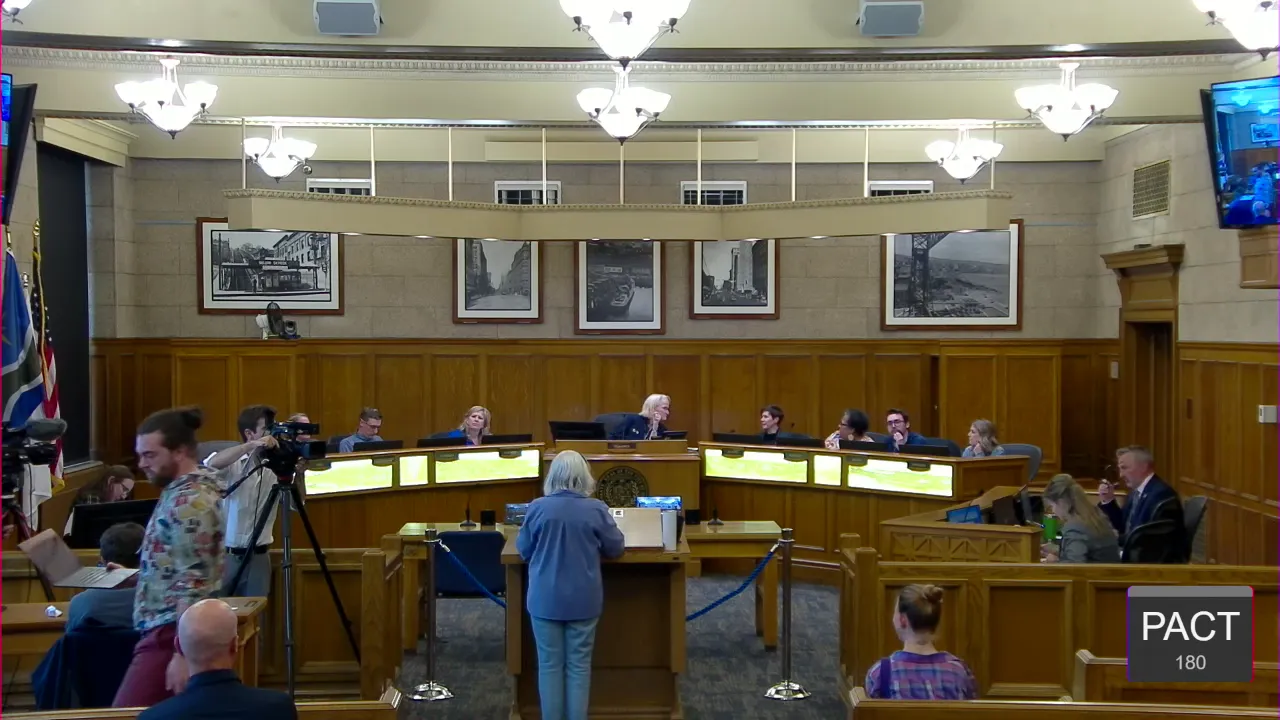
The Duluth City Council met on Monday, June 9, 2025, at 6:00 PM in the Council Chamber. The meeting included a pre-meeting Committee of the Whole presentation from EPA employees, approval of a consent agenda, discussion and tabling of a Tax Increment Financing (TIF) policy resolution, and passage of several ordinances. All nine council members were present.
Consent Calendar
- Resolutions passed unanimously (9-0):
- Authorization of an agreement with MSA Professional Services Inc. for engineering services for the 2026 Street Preservation Project (Gary-New Duluth, Duluth Heights, Kenwood, Chester Park-UMD) for $93,612.00 (25-0466R).
- Authorization of an agreement with SEH Inc. for engineering services for the 2026 Street Preservation Project (Lincoln Park) for $199,975.00 (25-0467R).
- Authorization of an agreement with LHB Inc. for engineering services for the 2026 Street Preservation Project (Morley Heights) for $116,920.00 (25-0468R).
- Purchase of a 2025 Freightliner 108SD 4x4 single axle plow truck chassis from Boyer Trucks for $154,977.83 (25-0472R).
- Acceptance of a $90,250 HIDTA grant from the Office of National Drug Control Policy for the Lake Superior Drug Corridor Initiative (25-0462R).
- Authorization of an agreement with St. Louis County for a Substance Use Response Team Project Coordinator (25-0464R).
- Purchase of handgun and rifle accessories from Streicher’s for $158,500.00 (25-0465R).
- Acceptance of a $150,000 Urban and Community Forestry Program grant from the State of Minnesota for Lake Superior Zoo grounds revitalization (25-0470R).
- Authorization of a subrecipient agreement with the Arrowhead Zoological Society, Inc. for $150,000 to support the zoo grant (25-0471R).
Public Comments & Testimony
- Matt Rosendahl (President, Duluth Library Foundation) urged the council to sustain library funding in the upcoming budget, emphasizing the library’s role in early literacy, job searching, and community enrichment.
- Theresa O’Gara (Duluth resident) spoke about the library’s importance for early childhood literacy, describing how she used library books as a speech-language pathologist, and asked for no budget cuts.
- Jose LaPorte (Parks Commissioner, District 3) advocated for codifying parks as infrastructure in city ordinance, arguing that such classification would enable better capital planning and access to funding tools, citing precedents in Portland, Minneapolis, and Ashland.
- Eric Lindell (Duluth resident) expressed support for the Incline Village development project, cautioning against rooting for its failure, and praised the council for protecting taxpayers through due diligence. He also noted that no TIF money had been disbursed.
- Rachael Anderson (Duluth resident) raised concerns about DTA bus stop accessibility, stating that people with disabilities and seniors must walk up to four and a half blocks to reach stops, and called for collaboration among the DTA, business owners, and the city to improve access.
- Loren Martell (Duluth resident) voiced concerns about the lead promoter of the Incline Village development, citing financial and legal issues, and urged the council to extricate the city from the project before construction begins, warning of a potential repeat of the failed “Red Plan.”
Committee of the Whole Presentation: EPA Duluth Lab
- Nicole Cantello (President, AFGE Local 704, EPA Chicago) and Dr. Carly Lalone, Tom Hollenhorst, Dr. Alexander Cole (EPA scientists, Duluth Lab) presented on the critical work of the EPA’s Office of Research and Development laboratory in Duluth. They highlighted the lab’s leadership in ecotoxicology, Great Lakes research, harmful algal blooms, PFAS studies, and the St. Louis River estuary cleanup. The speakers emphasized that the lab is a world-recognized leader and that its closure would jeopardize long-term data sets, drinking water safety, and the local economy. They asked the council and community to contact EPA Administrator Lee Zeldin and Representative Pete Stauber to oppose mass layoffs and potential lab closure. Council members expressed strong support and asked questions about the lab’s fate, including the status of the research vessel Lake Explorer 2. The presentation was not on the published agenda but occurred as a pre-meeting Committee of the Whole discussion.
Discussion Items
- Resolution 25-0393R – Policy on Development Incentives for Tax Increment Financing (TIF): Councilor Forsman moved adoption. After discussion, Councilor Durrwachter moved to table the resolution for one week to allow time for further research and potential amendments, including adding definitions, evaluation criteria, and neighborhood-specific considerations. Councilor Awal seconded, and the motion to table passed unanimously (9-0). Councilor Kennedy noted that neighborhood-specific TIF policies should be a separate, longer-term conversation. The resolution will be considered at the next meeting.
- Ordinance 25-013-O – Tenant Notice of Resources and Rights: Councilor Randorf presented the ordinance, which adds Article V to Chapter 29A of the city code, requiring landlords to provide tenants with clear notice of their rights under state law and city ordinance, along with contact information for resources like Tenant Landlord Connection and Duluth Life Safety. The ordinance was described as the first step in a two-part package; a second ordinance on rental licensing, inspections, and enforcement (with increased penalties for repeat violators) will follow. Councilors Randorf, Nephew, and Tomanek co-authored the ordinance. It passed unanimously (9-0).
- Ordinance 25-010-O – Grant Anticipation Revenue Notes for Water Utility: Authorized the issuance of up to $19,825,965 in taxable grant anticipation revenue notes for municipal water utility improvements, including lead service line replacements. Councilor Mayo noted the importance of the program amid PFAS loans. Passed 9-0.
- Ordinance 25-009-O – Conveyance of Lincoln Park Property to HRA: Authorized nominal conveyance of real property in Lincoln Park to the Housing and Redevelopment Authority. Passed 9-0.
- Ordinance 25-011-O – Zoning Map Amendment: Reclassified parcel 010-3010-00120 and half of adjoining rights-of-way from Mixed-Use Business (MU-B) to Residential Traditional (R-1). Passed 9-0.
- Ordinance 25-012-O – Skywalk Bridge Permit: Granted Lakeview Properties LLC a concurrent use permit for a skywalk bridge over the East 1st Street alley adjacent to 333 East Superior Street. Passed 9-0.
Key Outcomes
- Consent agenda passed unanimously (9-0), approving nine resolutions.
- Resolution 25-0393R (TIF policy) was tabled to the next meeting (June 16, 2025) by a unanimous vote (9-0).
- Ordinances 25-010-O, 25-009-O, 25-011-O, 25-012-O, and 25-013-O all passed unanimously (9-0).
- Councilor Awal previewed upcoming work on a complete streets policy, a transportation advisory committee, a flow streets working group, and consolidation of boards and commissions.
- Councilor Forsman announced a resolution on comprehensive zoning and code modernization to increase housing supply at the next meeting.
- Councilor Randorf indicated she is working with the city attorney to amend standing rules for quasi-judicial appeals to limit public testimony to the appellant and city.
- Administration report noted 66 graduates from city workforce development programs in 2025.
Meeting Transcript
Good evening. We will begin our present. Good evening. We will begin our presentation in two minutes. We're going to start with the committee of the whole, and we will begin with Nicole Nicantello. Did I pronounce that right? Yes. Thank you. Thank you for being here. Thank you. Council members. Good evening. My name is Nicole Cantello, and I am president of the American Federation of Government Employees, Local Seven O four, speaking out on behalf of one thousand Environmental Protection Agency employees in the Great Lakes. Fifteen hundred ORD scientists have been forced into distressing decisions, offer deals to resign, or voluntarily retire amid threats of mass layoffs and the closure of EPA's research labs across the country. The loss of this scientific expertise jeopardizes ongoing research that safeguards the loose drinking water, fisheries, and outdoor industries. Without ORD scientists, our community will lose its human health and environmental protections and have no way to address emerging contaminants like PFAS, microplastics, and endocrine disruptors. EPA has provided these scientists a cruel and confusing path forward. Employees were urged to apply for new roles at the agency, but there are many fewer positions and scientists who have applied for them, pointing to mass layoffs and an uncertain future for the Duluth Lab. Now our top environmental scientists stand in uncertain limbo, watching their scientific work unravel, no longer able to protect us from dangerous environmental contaminants. I would like next like to introduce Carly Lone. Thank you. Thanks, Nick, and thanks to the council for having us come and speak to you today. My name is Dr. Carly Lalone. I was born in Duluth. I was raised in the area. I did my education, my undergrad degrees come from the University of Minnesota Duluth, where I played softball. And I went away to graduate school only to return back to Duluth. But before I went off to graduate school, I had a very special experience. I was able to join the Duluth Lab, the Office of Research and Development, as a undergraduate researcher, and get my first experience to be able to be in a research laboratory under internationally recognized scientists. I knew at that time that this was a very unique place in that you walk down the halls and you get to interact with the best of the best in their open door policies to be able to share their science and their knowledge. So when I went away to grad school, I came back to Duluth as a postdoc to again continue my research career in the Duluth lab. So now representing AFGE, I've had a 15-year career at EPA in Duluth. And like I mentioned, we have uh internationally recognized scientists, and the reason that we're so successful in that laboratory is because of its location, for one. It wasn't put there by accident. It was you know put there in the 60s and became the EPA lab in the 70s. And the resource that we have right here, the Great Lakes, uh Lake Superior, is actually very useful to our toxicology work. So we can utilize that freshwater resource to run experiments. So we mentioned toxicology, we focus on ecotoxicology, which means that we're looking at impacts of chemicals on the environment, both human health and species that could be impacted by chemicals that get into our environment. And so we do testing in our laboratory historically. We've had a number of guideline tests that are used with aquatic organisms, not just nationally but internationally. And so we are a world-recognized leader in ecotoxicology. We have been since the beginning of our lab, so it's a very unique place in Duluth that we have this research laboratory just on the shore of Lake Superior that the world looks to for a variety of different impacts in ecotoxicology. So what we do at the lab relative to toxicology is thinking about how we can make approaches for understanding chemical toxicity more efficient and more uh reduced resources as well as reduce animal use in toxicity testing so that our regulatory arm of the agency can take that information and uh utilize it to you know make regulatory decisions. And so we develop what are now termed new approach methods that reduce animal use and make more efficient methods, so they're termed high throughput approaches as well as computational approaches. That's actually where my work resides. But also we have a vast area of research in freshwater ecology, and Tom is going to talk more about that, but I'm just going to mention to you some of the key things that we've done around the Duluth area and thinking about protecting the Great Lakes and our resources here. So we have groups within our lab that focus on invasive species. We have groups in our lab that focus on harmful algal blooms. Within the Duluth lab, there's also those that do near shore research out of a research vessel.
openpublica.com