Duluth City Council Special Meeting: Tenant Right to Repair and Alternative Ordinance - July 1, 2025
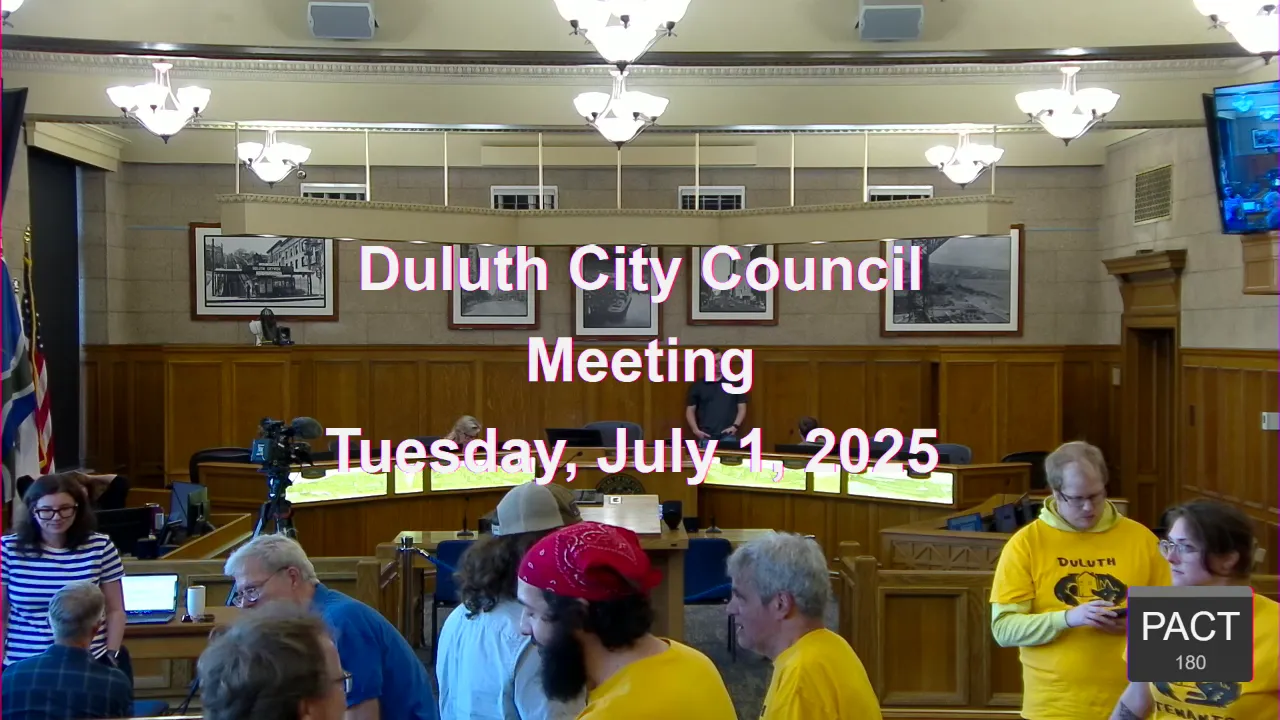
STREAMING COPY IN PREPARATION — RECORDING AVAILABLE FROM THE ORIGINAL SOURCE
Duluth City Council Special Meeting: Tenant Right to Repair and Alternative Ordinance - July 1, 2025
The Duluth City Council held a special meeting on July 1, 2025, at 7:00 PM in the Council Chamber to consider two ordinances: a petition ordinance (25-015-O) proposed by the Duluth Tenants Union and Housing Justice Center establishing a tenant right to repair, and an alternative council-sponsored ordinance (25-016-O) amending Chapter 29A to add landlord training, tenant notification requirements, and timely repair timelines. The meeting included public testimony, extensive council deliberation, and votes on both measures.
Public Comments & Testimony
- Grant Studer, 324 East 8th Street, spoke in favor of the right to repair, sharing his experience as both a former renter and current landlord who prioritizes repairs because he lives on-site.
- Joel Sipress, 2023's Fourth Street, expressed strong support for the right to repair, arguing it empowers tenants to solve problems without bureaucratic delays and contrasts with hiring more inspectors.
- Allan Keir, 12 South 66th Avenue West, opposed the petition ordinance, questioning the 6,000 signatures' validity and noting that existing state law already covers the issues.
- Aaron Rose, 1907 East Fourth Street, a disabled combat veteran, supported the right to repair and opposed the alternative ordinance. He described his landlord's failure to fix a broken lock despite a city inspection, calling the existing system broken.
- Molly MacGregor, 30 East College Street, a renter and Duluth Tenants member, supported the right to repair and opposed the alternative, stating it does not start the repair timeline until a city inspection occurs, unlike the petition which starts when the landlord is notified.
- Nick Demairoribus, 3161 Vernon Street, a Duluth Tenants member, supported the right to repair, noting that 54 volunteers collected nearly 6,000 signatures in seven weeks, and that many landlords also endorsed the measure.
- Matt Benson, 5317 Avondale Street, supported the right to repair and opposed the alternative, citing that 40% of Duluth residents are renters and that similar laws exist in 21 states.
- Lily Boehland-Goeden, 522 East East Street, supported the right to repair, emphasizing that timely repairs are essential and that the alternative ordinance does not address small repairs quickly.
- Chloe Holloway, 118 North 20th Avenue East, supported the right to repair, recounting a six-month delay in fixing a leaking roof that caused mold and structural damage, despite repeated requests.
- Gloria Allen, 4031 Grand Avenue, Chair of the Government Affairs Committee for Lake Superior Area Realtors, opposed the petition ordinance, warning it could disrupt the balance between tenant and landlord rights and create challenges for small landlords.
- Riley Bardnhardt, government affairs director for Lake Superior Area Realtors, opposed the petition ordinance, citing risks of unpermitted repairs, retaliation claims, and legal conflicts without third-party verification.
- Ginka Tarnowski, Fifth District, opposed the petition ordinance, arguing it could harm tenants by creating delays and financial burdens, using the example of a landlord dealing with structural damage from a lightning strike.
- Matt Baumgartner, Duluth Chamber of Commerce, supported the council's alternative ordinance and opposed the ballot initiative, warning that bypassing the legislative process could lead to unintended consequences, referencing St. Paul's rent control that led to a sharp decline in new housing permits.
- Mikaela Williams, a renter in District 3, supported the right to repair and opposed the alternative, noting that tenants felt disgusted, humiliated, and unsafe waiting for repairs.
- Brandon Parker, 621 Atlantic Avenue, strongly supported the right to repair, arguing it is a common-sense policy that empowers tenants and that the alternative ordinances are bureaucratic and slow.
Discussion Items
- Councilor Kennedy shared her personal story as a landlord and former Section 8 recipient, expressing concerns about the petition ordinance's vague language on required repairs, lack of landlord input, and potential liability for tenants who hire contractors. She noted that life safety already handles many issues and that the petition's retaliation provisions could be problematic.
- Councilor Forsman outlined reasons to vote against the petition ordinance: it bypasses representative government, lacks legal review (city attorneys could not provide an opinion due to campaign laws), and is difficult to amend if passed (only by another ballot initiative). He cited examples of provisions outside city jurisdiction (elevator maintenance, outside grounds) and warned of unintended consequences, including potential harm to tenants. He also criticized the role of TakeAction Minnesota, pointing to St. Paul's rent control ordinance that led to a 4-5.5% drop in property values and an 80% decline in new housing permits.
- Councilor Nephew opposed the petition, arguing it could harm nonprofit housing providers and tenants with disabilities, and that simple repairs often become expensive due to old infrastructure. She noted that the alternative ordinance can be amended if needed, unlike the ballot measure.
- Councilor Swenson opposed the petition, stating it threatens long-term housing affordability and supply, citing only 47 formal complaints among 18,000 rental units since 2023 (less than 1%). She supported the alternative ordinance but expressed concerns about its impact on life safety resources during a difficult budget year.
- Councilor Durrwachter supported the petition, arguing that ballot initiatives are democratic and that the alternative ordinance was crafted without renter input. She noted that Chicago's right-to-repair ordinance has been amended multiple times, but council was informed that under Duluth's charter, only a future ballot initiative can amend a successful petition ordinance.
- Councilor Awal supported the petition, emphasizing that the process was democratic and that the Duluth Tenants Union's organizing effort (6,000 signatures in two months) demonstrated strong community support. He argued that the alternative ordinance is being used as a weapon against the right to repair and that he would vote against it for that reason.
- Councilor Randorf supported the alternative ordinance, arguing that the petition places an undue burden on tenants to arrange and pay for repairs, risking legal liability. She stated that the alternative puts responsibility on landlords with city oversight and can be amended if needed.
- President Tomanek facilitated the meeting and moved the alternative ordinance, clarifying that the purpose of the special meetings was to comply with charter timelines for the petition ordinance.
Key Outcomes
- Ordinance 25-015-O (Petition Ordinance): Failed 2-6. Councilors Awal and Durrwachter voted yes; Councilors Forsman, Kennedy, Randorf, Swenson, Nephew, and Tomanek voted no. Per city charter, the ordinance will proceed to the municipal general election ballot in November 2025 for a public vote.
- Ordinance 25-016-O (Alternative Ordinance): Passed 6-2. Councilors Forsman, Kennedy, Randorf, Swenson, Nephew, and Tomanek voted yes; Councilors Awal and Durrwachter voted no. The ordinance amends Chapter 29A of the Duluth City Code to add landlord training requirements, tenant notification requirements, and timelines for repairs. It will take effect after adoption, expected within 30 days. The council did not decide whether to place this ordinance on the November ballot; a future resolution would be required for that.
- Next Steps: The clerk's office will establish a process for petition signers to remove their names, potentially affecting the ballot measure. The council may consider a resolution to put the alternative ordinance on the ballot at a future meeting.
Meeting Transcript
Good evening. We will begin our meeting in two minutes. The meeting of the Duluth City Council will now come to order. Will the clerk please call the roll? Councillor. Councilor Durder. Councillor Foresman. Councillor Randor. Councillor Kennedy. Councillor Swanson. Vice President Nephew? Here. President Timonic. Thank you. Please rise for the Pledge of Allegiance. And to the Republic for which it stands. One nation under God. Indivisible with liberty and justice for all the time. Excuse me. The agenda for this evening's meeting is posted on the bulletin board and copies are available at the rear chambers. For those watching on public access television, the agenda is available on the city's website at WWW.gov. Live streaming can also be found on our website under Council Meeting Media. Citizens in the audience who wish to address the council, please sign the sheet located near the clerk's desk. Please turn off your cell phones while in council chambers. The Duluth City Council promotes the use and adherence of the tools of civility in conducting the business of the council. The tools of civility provide increased opportunities for civil discourse leading to positive resolutions for the issues that face our city. We know that when we have civility, we get civic engagement. And because we can't make each other civil and we can only work on ourselves, we state that today I will pay attention, listen, be inclusive, not gossip, show respect, seek common ground, repair damage to relationships, use constructive language, and take responsibility. Thank you. We will next have opportunity for citizens to be heard. Clerk Denham, can you call our first speaker, please? Sure. Our first speaker is Grant Studer. You will have three minutes to speak, and I'll let you know when you have 30 seconds left. Good evening. Please start with your name and address. Good evening. My name is Grant Studer. I live at 324 East 8th Street, 55805, Heart of the Hillside. And I'm here to speak in favor of passing the Right to Repair ordinance. I also want to say thank you for taking the time and organizing special sessions to hear about this thing that is so critically important to so many people. I am, compared to some folks, a relatively new Duluth resident. Luckily, because I had the fortunate economic circumstances to be able to afford a down payment, I now enjoy a mortgage that is lower than what my rent was and in a substantially nicer home. And so the idea of dealing with a challenging rental company is something that personally impacted me immediately upon moving to Duluth. Moving into a home where we would regularly find piles of broken glass in the yard and getting frustrating non-responses. But to go through and meet and schedule a time with the life safety office, which is something I prioritize to do when I moved into my new home, because I now also hold a valid rental permit, a selling point when we were there. Upon realizing that we had too much house for just my wife and I, we took on a tenant who we rent our upstairs to. And one of the important points that we made when we were discussing that and when we were talking about it was well, the good side of living with your landlord is that if your hot water goes out, your landlord's hot water also goes out. And it was such a distinct assumption that in this town, important repairs are probably going to get kicked down the road because it's not a personal problem, it's a business problem. So for the property owners and the landlords, it's a it's a business thing.
openpublica.com