Duluth City Council Agenda Session – December 4, 2025
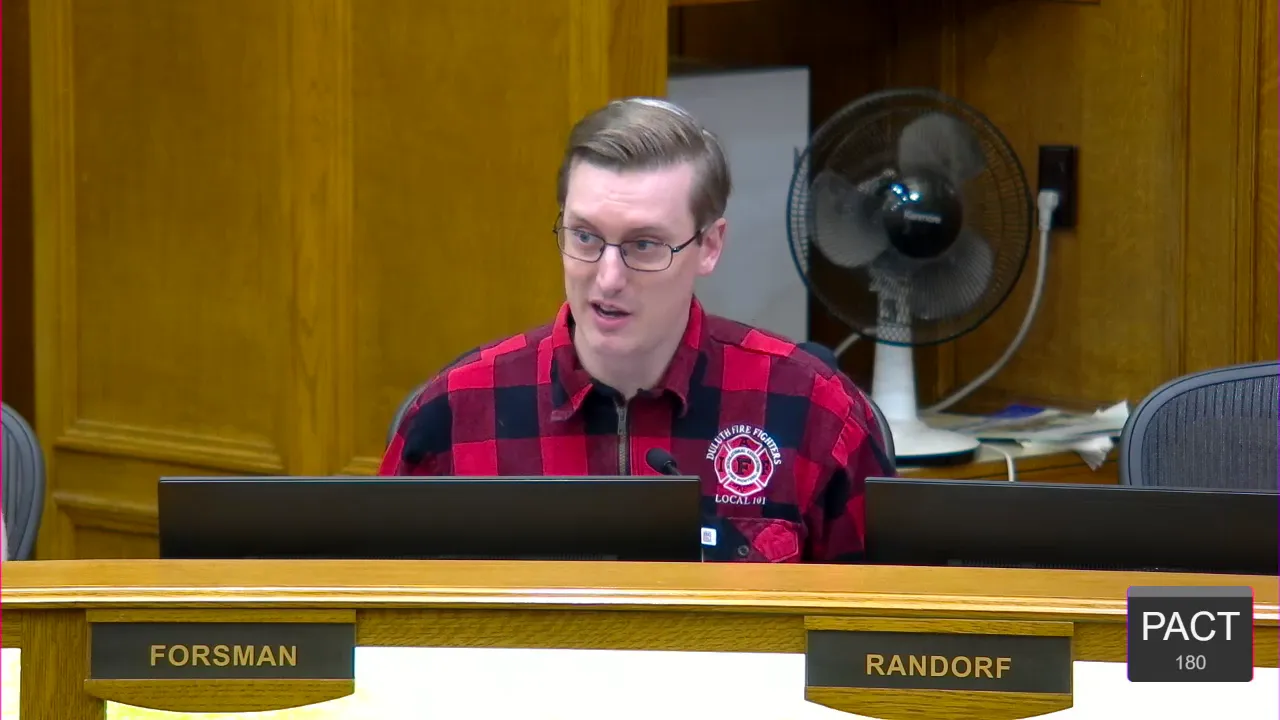
STREAMING COPY IN PREPARATION — RECORDING AVAILABLE FROM THE ORIGINAL SOURCE
Duluth City Council Agenda Session – December 4, 2025
The Duluth City Council held an agenda session on December 4, 2025, to review and discuss numerous resolutions, ordinances, and policy matters scheduled for official action at the upcoming council meeting on December 8. Key topics included the realignment of boards and commissions, the 2026 fee schedule, capital improvement plans, a development agreement and land use study for the Lester Park neighborhood, a flow streets proposal, 2026 legislative priorities, the 2026 budget and levy, and the Duluth Transit Authority's budget and levy request. Council members asked questions, received staff updates, and proposed amendments. Several items were advanced to the next meeting with modifications.
Consent Calendar
- Routine approvals and actions without debate included resolutions authorizing revolving lines of credit for the Duluth Airport Authority ($10 million) and the Duluth Entertainment Convention Center Authority ($4 million), approving the 2026 operating budgets for the Duluth Airport Authority and Duluth Transit Authority, accepting a state reimbursement for police ballistic vests, and awarding multiple public works contracts (e.g., Railroad Street Rehabilitation, Hillside Culvert Repairs, water tower reconditioning, and CIPP sanitary sewer lining). These items were presented and moved to the consent calendar with no objections.
Discussion Items
- Boards and Commissions Realignment – Personnel Chair Councilor Owell reported on progress to consolidate or restructure city boards and commissions. The NQ Commission has voted to become a committee under the Human Rights Commission. Administration and the chair agreed that appointees to the committee will still go through the mayor and council process. Discussions continue about combining the Natural Resources Commission with either the Energy Plan Commission or the Parks Commission. Natural Resources commissioners preferred combining with Energy, not Parks. Other proposed mergers (e.g., Public Arts with Heritage Preservation, Community Development with Heading Home, Parking with Transportation) were not viable due to legal or operational conflicts. The chair also proposed streamlining the interview process for board appointments and embedding conflict-of-interest questions into applications. A formal list of which commissions require interviews will be provided.
- 2026 Fee Schedule (Resolution 883) – Councilor Owell raised concerns about the $400 fee for protests that do not give 30 days’ notice, arguing it could chill First Amendment rights. City staff noted that each special event permit is reviewed case by case, but Owell worried about equity and bias. Councilor Durwachter asked about fees for vacant buildings and short-term rentals that sit empty. Councilor Swenson asked how parks rental fees are set (destination vs. smaller parks). No decisions were made; the fee schedule is subject to council approval.
- Lester Park Development Agreement and Land Use Study (Resolution 949) – The resolution authorizes a development agreement with the Duluth Economic Development Authority (DITA) to convey certain property in Lester Park and allow DITA to spend up to $200,000 on a land use study. Councilor Owell questioned why the conveyance is happening before the study, contrasting with the prior 37‑acre process. Director Van Tassel explained that DITA is funding the study and pre‑development work; the actual closing will occur after the study. Councilor Forsman noted that the previous 37‑acre transfer is stalled due to overly prescriptive conditions inserted by two former councilors. Councilor De Luca supported the process, citing the need to avoid over‑specification that blocks development. The ordinance requires a four‑fifths (8/9) supermajority to pass.
- Flow Streets Resolution (Item 15) – Councilor Owell introduced an updated resolution requesting that the Transportation Commission consider converting First Street (from 26th Avenue East to 6th Avenue West) into a “flow street” to improve safety and mobility for all users. The original concept was to create a working group; it now asks the Transportation Commission to lead the study. Councilor Swenson suggested extending the boundary to 26th Avenue East to connect with the Lakewalk. Councilor Owell agreed to amend the boundary and noted that extensive resident and business outreach has been done along the corridor. The resolution was scheduled for Monday.
- 2026 Legislative Priorities (Resolutions 914, 915) – Senior Policy Advisor John Dukich presented the city’s 2026 state bonding requests, including $25 million for the water treatment plant (up from $21 million), continued support for the medical district (regional exchange district), and $1 million for the Lake Superior Zoo. Councilor Owell asked to add funding for the Spirit Valley Community Center and the downtown library (for planning), arguing the library building needs immediate attention regardless of a future regional library system. Dukich preferred a narrower list to be strategic. Councilor Owell indicated she would offer an amendment to include the library on the additional initiatives list. Councilor Kennedy noted the library lacks a specific plan or cost estimate. Councilor Forsman asked about the state bonding appetite; Dukich cited a $2.5 billion surplus but a divided legislature, predicting a bonding bill of $700 million to $1 billion.
- 2026 Budget and Levy (Ordinances 34–38) – Councilor Owell proposed amendments to increase the levy from 4.13% to 5.13% to fund several positions and initiatives: (1) moving the blight mitigation specialist from fee revenue to the general fund ($151,000); (2) a lead housing inspector promotion and training ($15,964); (3) a library supervisor or librarian position ($175,000); (4) an administrative position in the clerk’s office ($99,000); (5) board and commission honorariums ($45,000); and (6) $2,000 for Human Rights Commission outreach. Administration supported only the blight mitigation amendment, with Administrator Staling noting other priorities (e.g., an IT position, a litigation attorney) were not included. Library Director Powers and Administrative Services Director Colhane confirmed they were prepared to operate with reduced positions. Councilor Owell declined to split the amendment, arguing all items are essential. Vice President Nephew and others asked for splitting. The final vote will occur Monday.
- Duluth Transit Authority Budget and Levy Request – DTA General Manager Beldon presented an updated budget that reduces the levy increase to $747,119 (32.17% increase over 2025). The reduction of about $250,000 likely comes from discontinuing the Twin Ports Trolley service, subject to public comment and Title VI analysis. The trolley previously had 80,000 annual riders, 60% tourists; free fares increased ridership fourfold. Beldon noted the DTA is focusing on the “better bus blueprint” network redesign, which has yielded a 40% ridership increase post‑pandemic. The council will vote on the DTA levy on December 8.
Key Outcomes
- The NQ Commission’s transition to a committee under the Human Rights Commission will be presented for first reading; appointees will continue through the mayor/council process.
- The flow streets resolution was updated to cover First Street from 26th Avenue East to 6th Avenue West; scheduled for Monday.
- The Lester Park ordinance (conveyance to DITA) requires a supermajority vote (8 of 9) on Monday.
- Councilor Owell’s levy amendment will be voted on Monday; administration supports only the blight mitigation portion.
- The DTA levy resolution was revised to a 32.17% increase, with a planned public process to discontinue the trolley; vote Monday.
- Appointments to the Housing and Redevelopment Authority (resolution 951) were postponed to December 15 to allow for interviews.
- Councilor Owell will offer an amendment to add library planning to the additional legislative priorities list.
- The 2026 fee schedule will be considered for adoption on Monday; several councilors flagged concerns about protest fees and vacant building fees.
- The agenda session concluded with a reminder that the next regular council meeting begins at 5:00 p.m. on Monday, December 8.
Meeting Transcript
Myself as personnel chair and then the administration has done and kind of give a perspective on what has been done and so that the work is not kind of duplicative, kind of understanding what has been the process, what are the considerations, what boards and commissions we've looked at. So I just wanted to run through what has been done for the last few years or a few months and take any questions and then what my suggestions would be to move forward and what might be coming forward to you tonight, and then also in the next coming council cycle too. So back in February, January, February, when I started the as personnel chair, one thing we were discussing was we had passed a resolution addressing the realignment of boards and commissions back two years ago. That work was kind of left unfinished. So when I came in, I made the commitment to pick that up and really look at boards and commissions and what's working and what's not working. So the administration advisor John Dugic and myself and Dr. Marsha Lou, we've met a couple of times to go through all of the boards and commissions and what could potentially be combined. So this is kind of just an assessment of what we've explored to give some ideas. So the work that we've already explored does not have to be duplicated next next round. So I can start with the most basic one that has already kind of appeared forward in front of you regarding the human rights commission. So when we were looking at the um protected class-based commissions and realized you know what the struggles were, I've kind of already spoken about what the benefits are of it moving into a committee under the human rights commission and what that structure looks like. So tonight you'll see the NQ Commission has formally adopted to become a committee under the Human Rights Commission. There have been some added um in the agenda, you'll see there's been some added um uh suggestion points from administration as well. One was which uh the appointed member from the commission to go to the committee will still come through the council cycle. Originally we had discussed that it was would be the human rights commission appointing um the members of the committee, and that committee choosing their chair, their designee to be the voting member in the human rights commission. Uh the administration and I decided that you know it would be still best to make sure the human rights commission still went through the council process so the mayor would still have purview over the uh individual applicant that goes on to the human rights commission. Um of course, any of the other commissions can join at any moment uh or any time that they take a vote to incorporate, and then um the human rights commission has been also exploring the committee formations of potentially an Asian American um committee uh formation and a Latinx committee formation as well. So those are in conversations, and you might be seeing that um in the coming years. So, and then um let me quickly also go through what has been discussed. Right now, some of the things that we have spoken about was potentially the public arts combining with the um the heritage preservation fund. That was not going to move forward because of a protected class that the heritage preservation fund has. Um that was something we explored, but in order essentially when the state uh state has we have a heritage preservation district, instead of going through the state process, the city of Duluth with our unique committee structure can go through the heritage preservation committee. If we were to combine that with the public arts, that might put that uh line in jeopardy. So we did not move forward with that suggestion. Another one we looked at was the citizens, sorry, um the community development committee alongside the um the heading home advisory committee or the uh housing trust fund committee. Both of these committees have a partnership between uh sorry, the heading home advisory committee uh community uh committee and the housing trust fund review committee. Both of them had an equal partnership with the city appointee, St. Louis County appointees, as well as um uh some uh private sector and community members as well and nonprofits. That was a suggestion we had considered to put potentially partner those two together. That was not going to be able to move forward just due to some logistics on how the timelines worked for those committees. Um there were a couple of other we explored, also the parking commission with the transportation commission, the nature of the parking commission being under the police department and the transportation commission being established potentially under engineering um or um you know planning that was not going to mesh well, so that was not something that was not gonna um move forward. So that was not something that was not gonna move forward. I think throughout my observations on all of these committees, as we've been talking about them, exploring, talking to the to the, you know, um the the departments is the departments, these are very unique committees that there's there's a struggle to combine. I'm just gonna be frank. Some of these that I thought were going to be work a lot smoother together to be combined, is going to end up there was a lot of pushback on like the process and what the risks were in those combinations. The one that potentially on top of the human rights commission that will be coming in front of you potentially this coming cycle is actually the natural resources with a potential combination with the energy plan commission. Um the other one we looked at pairing that with was actually the the parks uh the parks commission. Um the administration and I had we were discussing how there's a lot of synergy between the parks commission with the Natural Resources Commission, and thought that they would be a good pairing together if we are looking at condensing the number of committees we have. On further review, um, there were some concerns from the Natural Resources Commission that if they were to be combined with the parks, their intent was to protect or to really look at natural resources, potentially look at land that could be developed sold or developable or look at energy projects, look at overall sustainability. The natural resource commissioners, their kind of their perspective is that combining with parks would couple them under parks in a way that might not be productive in talking about natural resources in the sense like is this land should it be developed, should it be retained, what is the protected class status on this, or what are the the statuses of energy around you know our um uh uh in in sustainability essentially. So that conversation is still ongoing right now, and I'm just if that were not to come forward, you know, this cycle as we finish the year, that might be something that I would recommend the next personnel chair commit uh com counselor to continue to explore with with the um with the the energy the energy plan commissioners and the natural resource commissioners and the parks commissioners. We were trying to get a meeting together with all three heads and just all three chairs, and just wouldn't was not able to be successful in setting up that meeting. So conversation is still on way to see if the energy plan commission, which is uh which was um really developed with a goal of addressing um uh the the goal of reducing the city's greenhouse gas emissions by 80 percent by 2050. They had met given recommendations, those recommendations are kind of they feel like they've done some of their goals and they're still wanting to pursue that. Some of the works you know, we can say may have been paused because the uh sustainability officer position is on a hold. So um this Energy Plan Commission potentially looking at adding a sustainability element on top of it with um uh and then coupling that with natural resources. So energy, natural resources, um, and sustainability as the mission that might be driven by the um the uh sustainability director. So that's the conversation still happening. The other thing I wanted to say is I've been working with the clerk's office to address the interview process. We have a list that I will email out of uh kind of determining, you know, we've had a lot of struggle on what commissions should be interviewed, what commissions not being interviewed.
openpublica.com