Duluth City Council Meeting – February 23, 2026: Tischer Creek Fish Kill, ICE Resolutions, and Ordinances
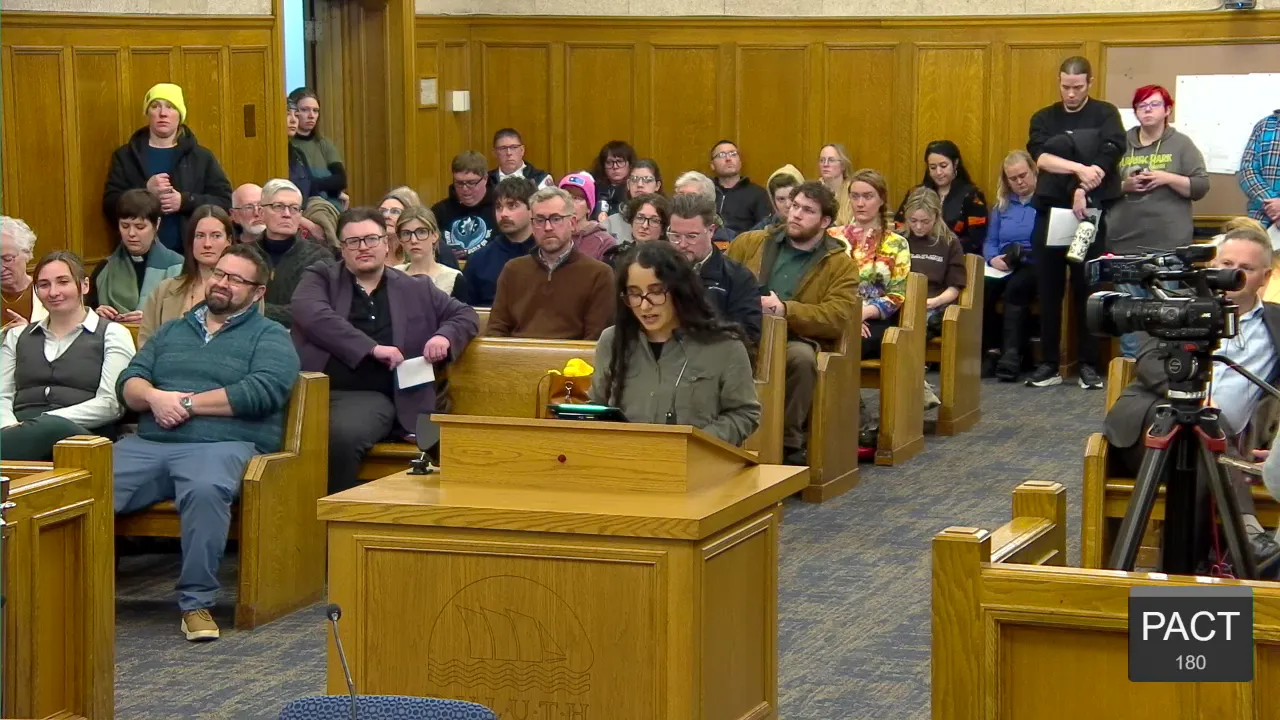
STREAMING COPY IN PREPARATION — RECORDING AVAILABLE FROM THE ORIGINAL SOURCE
Duluth City Council Meeting – February 23, 2026
The Duluth City Council held its regular meeting on Monday, February 23, 2026, at 6:00 PM in the Council Chambers. The meeting began with a pre-meeting subcommittee-of-the-whole presentation on the August 2024 Tischer Creek fish kill caused by a city water reservoir discharge. The council then heard extensive public testimony, debated two competing resolutions on financial assistance for families impacted by Operation Metro Surge, and adopted numerous resolutions and ordinances, including a stipulation agreement and natural resource damage assessment for the fish kill, a pay equity report, and zoning changes.
Consent Calendar
- Resolution 26-0113R – Revising the list of high priority bridges in Duluth. Adopted unanimously.
- Resolution 26-0115R – Awarding a contract to Veit & Company, Inc. for the Lead Service Line Replacement – Spirit Valley project (not to exceed $5,960,738). Adopted unanimously.
- Resolution 26-0118R – Authorizing an agreement with MSA Professional Services Inc. for engineering administration for 2026 lead service line replacement projects ($1,564,265). Adopted unanimously.
- Resolution 26-0122R – Awarding a contract to Northland Constructors for the Palm Street Stormwater Pond Improvements project ($7,087,000). Adopted unanimously.
- Resolution 26-0124R – Awarding a contract to Hanco Utilities for the 2026 Gas Blanket Project ($1,329,885). Adopted unanimously.
- Resolution 26-0125R – Awarding a contract to Hanco Utilities for the Lead Service Line Replacement – East Hillside 1 project (not to exceed $8,972,447.50). Adopted unanimously.
- Resolution 26-0128R – Authorizing purchase of Dresser gas meters from Natural Gas Solutions North America, LLC ($131,039). Adopted unanimously.
- Resolution 26-0127R – Requesting the Governor and State Legislature allocate additional emergency financial assistance to support individuals and families impacted by Operation Metro Surge. Adopted unanimously.
- Resolution 26-0131R – Authorizing application for a Federal Recreational Trail Program grant (up to $200,000) for Cross City Trail construction. Adopted unanimously.
- Resolution 26-0132R – Authorizing application for a Regional Trail Program grant (up to $300,000) for Cross City Trail construction. Adopted unanimously.
- Resolution 26-0133R – Authorizing application for a Federal Recreational Trail Program equipment grant (up to $75,000) for a pump at the River Station for Spirit Mountain Nordic Center snowmaking. Adopted unanimously.
- Resolution 26-0134R – Authorizing application for a Federal Recreational Trail Program equipment grant (up to $75,000) for a pump at the Main Station for Spirit Mountain Nordic Center snowmaking. Adopted unanimously.
The consent agenda was approved unanimously by voice vote.
Public Comments & Testimony
Twenty-five members of the public spoke. Comments addressed a wide range of topics:
- Accessibility and civility: Several speakers (Ginka Tarnowski, Lee Cutler, Eleanor Dolan, Brandon Parker, Alex Panovich, Barb Montee) discussed the need for respectful discourse, accessible meetings (including reinstating virtual participation), and the importance of listening to all voices. Some criticized the council’s handling of public comment and efforts to control speech.
- Tischer Creek fish kill: No public comments specifically on the fish kill, but it was addressed during the pre-meeting presentation.
- ICE enforcement and immigration-related resolutions: Multiple speakers (Corinne Freedman Ellis, Ken Loeffler-Kemp, Ahnika Berg, Harry Redmann, Tabby Helgeson, Marcus Edjete, Andrea Hanek, and others) urged passage of Resolution 26-0105R (eviction moratorium) and Ordinance 26-005-O (limiting city collaboration with federal immigration enforcement). They emphasized the need for strong protections for immigrant families, citing fear, trauma, and the threat of eviction. Some speakers also supported Resolution 26-0127R but called it weaker. Labor union representatives (Ken Loeffler-Kemp, Andrea Hanek) noted union support for an eviction moratorium.
- Other: Roy Hamlin expressed concern about a vape shop opening next to his music academy; Anne Sivertson raised issues about the Skywalk study and HRA board appointments; Asher Estrin denied accusations made against a citizen and criticized a council member’s claims; Julia Covert and Rachael Anderson expressed general concerns about city governance; Eric Lindell defended council members against personal attacks; Denise Lavoie recounted an uncomfortable encounter with a council member’s partner; Joel Sipress (former councilor) urged the council to model respectful behavior and criticized efforts to limit public speech; David Lewis thanked the council for allowing civil discourse.
Subcommittee-of-the-Whole Presentation: Tischer Creek Fish Kill
Before the regular meeting, the council heard a detailed presentation from Jim Benning (Public Works & Utilities Director) and Ryan Granland (Utility Program Coordinator) regarding the August 2024 discharge of approximately 1.7 million gallons of potable water from a Woodland reservoir into Tischer Creek via a direct storm sewer connection. The water contained chlorine (1.6 ppm, while trout toxicity is 0.038 ppm) at a discharge rate of 10.7 cubic feet per second, while the creek’s base flow was only 0.19 CFS. The release killed over 1,500 brook trout of various size classes and caused significant ecological harm. The city has since implemented prevention measures: tag-and-lockout on reservoir drains, dechlorinating diffusers for hydrant flushing, alternative discharge methods, GIS notes, training, and a new standard operating procedure (SOP) integrated into the city’s MS4 permit.
Two related resolutions were presented:
- Resolution 26-0120R: Stipulation agreement with the Minnesota Pollution Control Agency (MPCA) for alleged violations of state water quality standards, with a civil penalty of $12,000 and potential oversight costs up to $25,000 (though staff said those are not expected).
- Resolution 26-0121R: Natural Resources Damage Assessment (NRDA) agreement with MPCA and Minnesota DNR for $190,000 to fund restoration projects. The funds will support: (1) removal of a low-head dam on West Lewis Street to improve fish passage; (2) restoration of Tributary 7 near Hartley Nature Center for water quality and spawning habitat; (3) a youth and adult brook trout fishing program through Hartley Nature Center ($50,000). The DNR estimates recovery of the fishery will take about eight years. The city will partner with agencies and the Natural Resources Commission on project selection.
During Q&A, Councilor Randorf asked about past incidents – staff noted that while water main breaks have occurred, this event highlighted the risk. Councilor Desotelle asked why the stormwater utility fund was covering the costs rather than the water utility; Director Benning explained the water fund faces a $42 million capital improvement program and the stormwater fund could better absorb the expense without impacting projects.
Discussion Items
- Resolution 26-0105R (Operation Metro Surge – Eviction Moratorium): Councilor Clanaugh moved to remove from table (approved unanimously). Councilor Durrwachter moved to adopt, seconded by Clanaugh. Supporters (Clanaugh, Durrwachter) argued the moratorium is targeted and needed to prevent displacement while financial assistance is processed. Opponents (Desotelle, Randorf, Forsman, Johnson, Kennedy, Nephew) cited concerns from affordable housing providers, unintended consequences for small landlords, and the administrative complexity of a state law change. They favored Resolution 26-0127R as a faster, more effective path for rental assistance. A roll-call vote failed 2-7 (Clanaugh and Durrwachter yes; others no).
- Resolution 26-0127R (Emergency financial assistance – Metro Surge): Originally on consent, passed unanimously. Several councilors noted this was a stronger, more practical approach.
- Ordinance 26-005-O (Stewardship of city resources – immigration enforcement): Second reading and final vote. Councilor Randorf explained the ordinance codifies limits on city collaboration with federal immigration enforcement, allows cooperation on criminal matters via joint task forces, and was developed with city attorney and police chief. Passed unanimously.
- Ordinance 26-003-O (Zoning map amendment – Duluth Heights): Reclassifies parcels from R-1 to R-P to allow townhome development. Councilor Forsman praised the developer for building without city subsidies. Passed unanimously.
- Other resolutions: All remaining resolutions (26-0110R, 26-0129R, 26-0130R, 26-0126R, 26-0112R, 26-0117R, 26-0109R) were adopted unanimously with brief discussion. Resolution 26-0112R (pay equity implementation report) passed with thanks to HR staff.
Key Outcomes
- Tischer Creek fish kill resolutions adopted: 26-0120R (stipulation agreement, $12,000 civil penalty) and 26-0121R (NRDA, $190,000 for restoration) both passed 9-0.
- Resolution 26-0105R (eviction moratorium) failed on a 2-7 roll-call vote.
- Resolution 26-0127R (emergency rental assistance) adopted unanimously as part of consent agenda.
- Ordinance 26-005-O (immigration enforcement limits) adopted 9-0 on second reading.
- Ordinance 26-003-O (Duluth Heights zoning amendment) adopted 9-0.
- All other unanimous actions as listed above were approved.
- Next steps: The city will work with MPCA and DNR on restoration projects; the SOP for water releases will be implemented; ongoing advocacy for state funding for ICE-impacted families; council will consider a law enforcement policy as suggested by Councilor Durrwachter.
Meeting Transcript
To order um Mr. Benning is here with um not sure Mr. Granland. Mr. Granlin um and the subcommittee of the whole regarding Tisher Creek. Um please begin and I I think we'll save questions till the end. Counselors, thank you. Go ahead, Mr. Benning. Sure, Kennedy, uh thank you. I wish I was here for under different circumstances. Unfortunately, I'm not. Um tonight we're gonna talk about the the water release in the Tisher Creek that happened in 2004. Give a brief summary of what happened, uh, what the two resolutions are that are on the agenda tonight, what you will uh be voting on, and then uh we'll talk about what we have done to prevent this from ever happening again in the future. So with that, I'll turn it over to Ryan Graham. Yeah, thanks. Um Ryan Granland, I'm uh utility program coordinator here. Uh work under Jim in the public works and utilities uh department. Um so like Jim had mentioned, we're here to talk about the water release that happened in August of twenty twenty-four um by public works staff and the subsequent fish kill in Tisher Creek. Um just to kind of describe my role very briefly in this, um deal with primarily stormwater related items um and utility infrastructure, stormwater utility infrastructure stuff and see, and as this was elicited discharge the storm sewer, I'm here to kind of describe our actions that we went through to um locate and uh make sure this doesn't happen again for the pot of water discharge. So, like I said, um in August 2024, uh City Duluth uh utility operations staff were performing maintenance on a water reservoir uh in the woodland neighborhood. Um at that time in order to gain inspection access into the water reservoir. Uh they began draining the the um potable water system. Um around 1.7 million gallons of drinking water. Uh so it's just potable drinking water that was part of the distribution system was drained into Tisher Creek via the storm sewer. Um so I'll get into that a little bit closer uh further on in the presentation here. Um this discharge to Tisher Creek did cause significant ecological harm. Um, as you've seen stated in the exhibits provided as part of the resolutions for the natural resource damage assessment. Uh around 1500 plus brook trout of different size classes were impacted and a lot of other um fish and macro invertebrates um because of the impact the drinking water had on the uh trout stream. So just very briefly I wanted just kind of touch base for everyone. Um the city does operate four different utilities here, water, gas, of course, but um like I said, you know, storm sewer and sanitary sewer are two other utilities, and storm sewer is the one that kind of conveyed the potable water to the trout stream. Now the differentiation I want to make here is just that it did not go into the sanitary sewer system, which is a separate closed system that would have went to um WSSD for treatment. You know, in this situation, uh the water reservoir was directly plumbed to the storm sewer, which drains to not treated to receiving waters, public waters throughout the city, which is typical of most storm sewer systems in any city. Again, our stormwater utility. Um we authorized discharge to public waters through our MS4 permit, which is one of the things I am tasked with um implementing here at the city. As part of that, there's different uh control measures that we need to implement to make sure that this uh water that we're discharging out of the storm sewer is not impacting these public waters. Part of that is our illicit discharge and detection elimination and working with our municipal operations. So as part of this, seeing as a discharge to the storm sewer uh was illicit by our own operations. I've been tasked with while working with our groups to make sure this doesn't happen again. Now I just want to give another maybe brief background uh or description of the water utility system for anyone who uh may not know. Many of you folks probably already do. We have an age system. We have a lot of topography in Duluth, so we have a pretty unique system where we have a lot of reservoirs that are actually built underground versus the typical water tower that you'd see in in the average municipal setting in Minnesota. We use a disinfection chlorine, monochloramine, which is a stabilized form of chlorine to ensure that the water is disinfected and safe for users and customers at the tap. You know, we use this stabilized form of chlorine because our distribution system is so large. We have some 30 miles from intake at the Lakewood plant to its you know some of our outerly portions of our community, like in Fond du Lac. So we need uh um resilient uh disinfection all the way to the tap, even through this long distribution network. Um that comes into play about how the chlorine or the when the water was discharged, it just did not degasify as quickly as it normally would have. So this water was released from a reservoir at the woodland um water treatment or water distribution area, water reservoirs at woodland. Um this is an area that we have for storing potable drinking water for distribution uh to residents and customers.
openpublica.com