Eagan City Council Special Meeting: Budgets, Parks Master Plan, and LAHA Support – October 14, 2025
STREAMING COPY IN PREPARATION — RECORDING AVAILABLE FROM THE ORIGINAL SOURCE
Eagan City Council Special Meeting: Budgets, Parks Master Plan, and LAHA Support – October 14, 2025
The Eagan City Council held a special workshop meeting on October 14, 2025, starting at 5:30 PM, to discuss the 2026-2027 enterprise and special revenue fund budgets, a joint meeting with the Parks and Recreation Commission (APRC) covering the parks master plan and capital improvement plan (CIP), and a proposal to use Local Affordable Housing Aid (LAHA) funds to assist homeowners in the Widgen Woods Housing Improvement Area (HIA) project facing unexpected cost overruns.
Public Comments & Testimony
- No members of the public spoke during the "Visitors to be Heard" portion of the meeting.
Discussion Items
- 2026-2027 Enterprise and Special Revenue Fund Budgets: Finance Director Josh Feldman presented the two-year budgets, covering sustainability, public utilities (water, sewer), recreation enterprise funds (Civic Arena, Cascade Bay, Community Center), ETV, tree mitigation, opioid prevention, and LAHA funds. Key points included a proposed 9.5% utility rate increase for the average residential water user (Eagan ranked 9th lowest out of 36 metro communities), a $500,000 request from General Fund reserves to support the Civic Arena, and a $1 increase in daily attendance fees at Cascade Bay (first increase since 2022). The council expressed support for the proposed budgets and rate adjustments.
- Joint Meeting with APRC – Parks Master Plan and CIP: Kevin Clark of HKGI presented a 10-year parks master plan update, highlighting 25–30 playground replacements over the next decade, potential for additional dog parks and splash pads based on community ratios, and the need to address athletic field capacity through partnerships. Park Superintendent Chris Fleck then outlined the 2026 CIP, including Northview tennis court reconstruction (with pickleball overlay and lighting), Quarry Park shelter building replacement (integrating a sun shelter), and a maintenance shed at Central Park. The council supported the plan direction and the proposed 2026 project list.
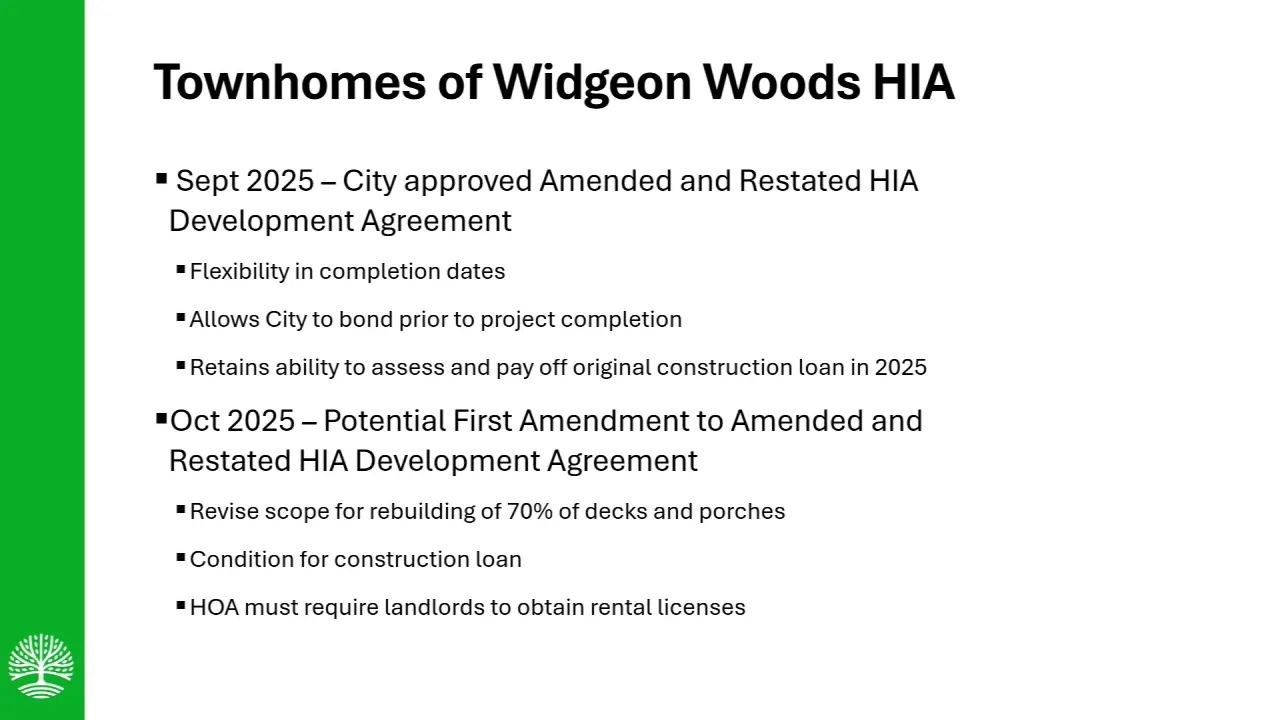
- Local Affordable Housing Aid (LAHA) Support for Widgen Woods HIA: Economic Development Director Jill Hoogacker presented options to assist low- and moderate-income homeowners in the Widgen Woods townhome HIA, where a $2.4 million deck and siding replacement project uncovered structural water damage requiring an additional up to $1.2 million. Three LAHA-financed tools were discussed: (A) a deferred HIA fee loan for households at or below 115% of area median income (AMI), deferring the first three years of the annual $6,820 fee; (B) an additional $5,000 deferred loan for households at or below 80% AMI to help with a lump-sum payment due in November 2025; (C) a $5,000 loan for households that previously prepaid their HIA fee (at 80% AMI), with no interest for five years and a five-year repayment plan thereafter. The Dakota County CDA would handle income certification. The council supported all three options and agreed to waive staff administrative fees for this project, but directed staff to explore mechanisms to capture costs for future projects.
Key Outcomes
- The council expressed consensus support for the 2026-2027 enterprise and special revenue fund budgets, including utility rate increases.
- The council supported the direction of the parks 10-year master plan and the 2026 park CIP projects, with staff to bring them forward for formal approval at a regular meeting.
- The council directed staff to move forward with LAHA assistance options A, B, and C for Widgen Woods homeowners, with income certification via the Dakota County CDA, and to waive staff administrative fees for this initial program while evaluating cost recovery mechanisms for future HIAs.
Meeting Transcript
All right. This is our second workshop meeting or our first workshop meeting of the month of October. Um, is uh likely delayed in traffic, but we'll uh anticipate her joining us later on in the meeting. Uh we have a fairly uh substantive but I hope efficient uh set of topics for tonight's meeting. So I'll start with uh uh adoption of the agenda. Uh Ms. Miller and then changes the agenda tonight. No, Miss Mayor. Councilman changes the agenda. Motion Hansen for motion. The agenda is in it. Second. That's moved and seconded. Uh any digital discussion on the agenda. Seeing none, all in favor. Opposed, nay. That motion carries, and we have an agenda. I want to check before we get on to the substance of that agenda. Are there any visitors to be heard tonight on items that are not on the agenda? Uh seeing none. Uh I'll move right to uh item number one uh of our meeting tonight. That's the 2026 to 2027 enterprise and special revenue fund budgets. Uh I'll go to our finance director, uh Josh Feldman. All right, Josh, welcome. Thank you, Mayor. Um, I'm happy to be here tonight to present the 2026 and 27 enterprise and special revenue fund budgets. Uh in your packet is is certainly much more detail uh than what I'm gonna present tonight. I've got 33 slides, trying to keep it fairly high level. If you do have questions, though, we do have staff available here that uh uh manage those uh departmental budgets. So feel free to to interrupt and uh ask questions as you wish. So I'll move forward here. So the funds we're gonna cover tonight are uh well, we're gonna look at enterprise funds and special revenue funds. Enterprise funds. Uh you can see that they're public utilities, water sewers. We're not gonna be covering um uh I'm sorry, no, we're gonna be looking at street lightning storm drainage and water quality, all in kind of one massive package, if you will, called the public utilities fund. Uh and then we do have the Civic Arena, Cascade Bay, and community center, those are considered recreational uh enterprise funds, and then special revenue funds, ETV, sustainability, tree mitigation, opioid prevention, and laha, or local affordable housing aid. And uh we do have a topic later uh on the agenda too regarding the Laha, but we'll cover what we have uh for the budget in this in this presentation. And for the less informed masses watching at home, the difference between enterprise fund and a special revenue fund is well that's you're read ahead or you at least I know that what you're gonna ask, you know, the question. Uh enterprise funds support are supported by user fees. Uh you know, all our funds here are meant to provide services. We're not here to make money, uh, but what we are here to do is is provide service and uh in some cases you'll see operating gain, operating loss, uh you'll see capital spending, you'll see some of those words in these presentations here. Um but we're here to provide services, and we need revenue to do that, and uh especially in enterprise funds. So you'll see that special revenue funds uh supported by defined sources of funds that typically have spending constraints. Um so they these are kind of governed by governmental accounting principles and so forth. So we'll get into some of that. Um opioid funds, Laha funds, these are funds that are distributed to the city and they have spending constraints. So we'll talk about those here in the presentation. This is the first year of a two-year budget. Uh, I think in your packet, I think there's a little bit of a typo. Uh it's it's second year, but this is the first year.
openpublica.com