Eagan City Council Workshop: Public Works & CIP - May 12, 2026
STREAMING COPY IN PREPARATION — RECORDING AVAILABLE FROM THE ORIGINAL SOURCE
Eagan City Council Workshop: Public Works & Capital Improvement Plan
On May 12, 2026, the Eagan City Council held a special workshop meeting focused on public works topics, including the electric vehicle transition study, Highway 3 corridor study, winter trail maintenance, special assessment policy updates, and the five-year Capital Improvement Plan (CIP) for 2027-2031. Councilmember Fields was absent. The meeting included staff presentations, consultant reports, and council discussion, with several items scheduled for formal action at the June 2 council meeting.
Electric Vehicle Transition Study
- Consultants Marcella Boyd and Dan Reichman of Mercury Associates presented findings from a fleet electrification assessment. They identified 24 light-duty vehicles as strong EV candidates, with 17 potentially replaceable by 2030 based on age. Projected life-cycle savings of $201,000 and CO2 reduction of 54 tons over 20 years were estimated.
- Challenges include limited electrical capacity at some facilities, fragmented charger management systems, and need for fleet data oversight. Consultants recommended a phased approach: no additional chargers needed until around 2029, but a fleet data analyst position should be considered sooner. Electric fire engines were not recommended due to high costs and limited return on investment.
- Council questions covered EV firmware backdoor access for public safety vehicles, maintenance outsourcing, and the potential to train existing staff rather than hiring a dedicated EV manager. A formal report will be presented for acceptance at the June 2 council meeting.
Highway 3 Corridor Study
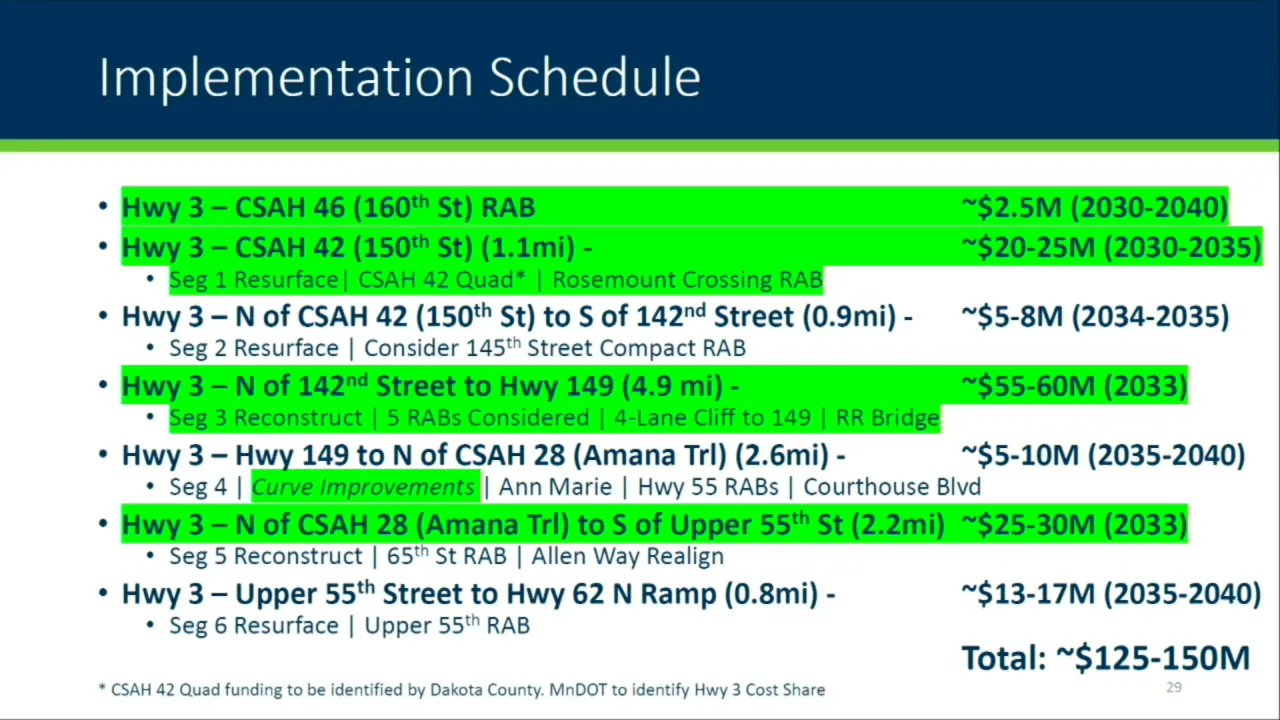
- Joe DeVore of KLJ presented draft recommendations for the Highway 3 corridor from 160th Street to Highway 62, focusing on Eagan segments. Public input from three open houses (over 120 attendees each) showed opposition to a four-lane divided option and support for roundabouts at Diffley, Cliff, Bon Air, and Connamara.
- Recommended improvements include multilane roundabouts at Diffley Road and Cliff Road, hybrid roundabout at Highway 149, flashing yellow arrow at Red Pine Lane, and right-in/right-out access for many driveways. A Highway 149 realignment concept (estimated $25-30 million) was not recommended due to cost and impact.
- Implementation is tied to a major pavement project in 2033, with estimated cost of $55-60 million for the Egan section. Federal or state funding will likely be needed. The final study will be brought forward for future council action.
Winter Trail Maintenance
- Tim Plath presented 10 trail segments for consideration in the 2026-27 winter maintenance program. Staff recommended adding 9 segments: 3 new construction (segments 2, 3, 4 at Thompson Rider redevelopment and Westcott Road), 1 staff recommendation (short segment on Lexington Avenue near Goat Hill Park), and 5 transit-oriented segments (Blue Gentian Road, Lone Oak Road, Lexington Avenue, Town Center Drive, Diffley Road).
- New construction segment 1 (residential concrete sidewalk) was not recommended. Council approved the staff recommendations and transit considerations but voted to delay segments 2 and 3 for one year pending development progress. All other new construction segment 4 and the remaining recommendations were approved.
Special Assessment Policy / Pavement Management Program
- Aaron discussed updates to the pavement management program, including extending street life expectancy to 100+ years through strategic maintenance. A new product, pavement rejuvenator (applied one year after overlay), is proposed to be included as an assessable cost, similar to the curb and gutter policy change adopted last year.
- The rejuvenator is estimated to add about $60 per average residential property and generate approximately $108,000 annually in additional assessment revenue over the next five years. Council expressed support and directed staff to bring the policy update to the June 2 meeting.
Public Works 5-Year CIP (2027-2031)
- Russ and Josh Feldman presented a $156 million CIP, developed through extensive collaboration between public works and finance. Key components include $42.9 million for major street projects (including $6 million in bonds), utility rate increases (13% proposed), and capital improvement bonding for street reconstructions.
- Notable projects: Cedar Grove parking garage (funded through major street fund, reimbursed by TIF in 2028), street reconstructions in 2030-31 (Lafondrea, Cedar Grove), fire hydrant Storz fitting retrofitting slowed to 30-year schedule to save costs, and ongoing utility improvements at water treatment plants.
- Future refinements include seeking state/federal grants (e.g., Safe Streets for All), exploring privatization of utilities in HOAs/commercial areas, and continued assessment policy adjustments. The CIP is expected to be formally approved at the June 2 meeting.
Key Outcomes
- EV Transition Study: Will return for formal acceptance on June 2.
- Highway 3 Corridor Study: No action required; final report to be presented later.
- Winter Trail Maintenance: Approved with modifications (delayed segments 2 and 3).
- Special Assessment Policy: Council support for including rejuvenator costs; item to be on June 2 agenda.
- 5-Year CIP: Scheduled for adoption on June 2; first two years of improvements to be initiated.
Meeting Transcript
Welcome over to the May twelfth um uh workshop meeting of the Egan City Council. Um we are here in public works night, unfortunately, uh Councilmember Fields uh couldn't join us for the momentus activity uh tonight, but I'm sure she uh is missing it greatly. Um that said uh we have a very uh update focused uh agenda tonight. Um Ms. Miller they change the agenda. No, Mr. Mayor. Move adoption of the agenda of the second. Any further discussion of the agenda. Seeing none, all in favor aye, closed nay, motion carries, and we have an agenda. Uh let me check in and see if there are any visitors to be heard on items not on tonight's agenda. Seeing none. Uh we'll jump right in to our first item. Uh and it is the electric vehicle transition study. Uh and Tim, I believe you're gonna lead us into this. So mayor, members of the council. Um the climate action plan includes a goal of converting twenty-five percent or more of our gasoline vehicle vehicles and our fleet to electric vehicles by twenty thirty-five. And in order to achieve that goal, um, a team of city staff, including Jeff Brooker, our superintendent of streets and fleet, Julian Costano, our sustainability manager, Brian Thom, Chief Mechanic and Shop Supervisor have been working with the consultant, Mercury Associates to uh identify a strategy and put together a plan to achieve that goal. So with us this evening is Marcella Boyd and Dan Reichman from Mercury Associates. They're gonna be joining us here um virtually to provide an update on the status of that report and receive any feedback from the council that you may want to have incorporated into that plan. So I'll turn it over to Marcella and Dan for our presentation. Hi, yeah, good evening. Thank you all so much. Can everyone see the screen okay? Yes, we can. Okay, perfect. So uh my name is Marcella, I'm a consultant with Mercury Associates. Again, I'm joined by Dan and I'll let him introduce himself. Uh good evening, I'm Dan Reichman, um Mercury Associates Director of Advisory Services and uh thank you for the opportunity. And I will let Marcella do the rest of the speaking, hopefully. So it's back to you, Marcella. All right, perfect. So for those of you who don't know, uh Mercury is a fleet consultancy that was engaged by Egan. Uh we partnered with Swatch Labs for this project, which is a fleet electrification software firm to assess where the city is at in terms of fleet electrification and their actual charging readiness. What we'll walk through today is where the city stands, what kind of opportunities exist, and how to move forward in a way that is practical. If you have any questions throughout the presentation, feel free to stop me because my plan right now is just to run straight through. So feel free to interrupt. The purpose of this assessment, though, was to evaluate how ready the city is to transition part of its fleet to electric and to support the city's climate action plan goal of electrifying 25% of the light duty fleet by 2035. So to do this, we reviewed fleet operations, we reviewed the vehicle suitability, uh, infrastructure readiness, financial impacts, and any long-term operational considerations. So the result that we came up with is a phase plan that shows how the city can transition vehicles while making sure the infrastructure infrastructure and operations are ready to support it. So what we evaluated, um we approached this from a really real world practical perspective. So for us, that meant understanding how the fleet is actually used, um, identifying what vehicles are good candidates for electrification, uh and determining what infrastructure is needed to support them, including looking at the electrical capacity at each facility. During this process, we met with departments, we conducted site visits to see how things are functioning on the ground. And then because the city doesn't currently have any telematics, uh we used fuel transaction data from the last year to analyze the different vehicle utilization and usage patterns for them. Uh, we also looked at cost and emission impacts associated with electrification. And here is what we found. So at a very high level, electrification is very achievable for the city, especially based on how the different light duty vehicles operate. Uh, we identified 24 vehicles as strong EV candidates, with 17 of those potentially being able to be replaced by 2030 just based off of their age alone. Uh by transitioning these vehicles, the city is projected to save about 201,000 in life cycle savings, along with a reduction of about 54 tons of CO2 emissions. So the good news is this can all be done through more of a phased approach where we can target specific vehicles and locations without requiring a large upfront investment from the city.
openpublica.com