OPENPUBLICA · PUBLIC MEETING RECORD
Record of Proceedings
Vanderburgh County Data Center Research Committee Meeting - October 27, 2026
City Council — Tuesday, October 27, 2026
BodyEvansville, Indiana
SessionCity Council
DateTuesday, October 27, 2026
StatusNEW · FILED
Video Record
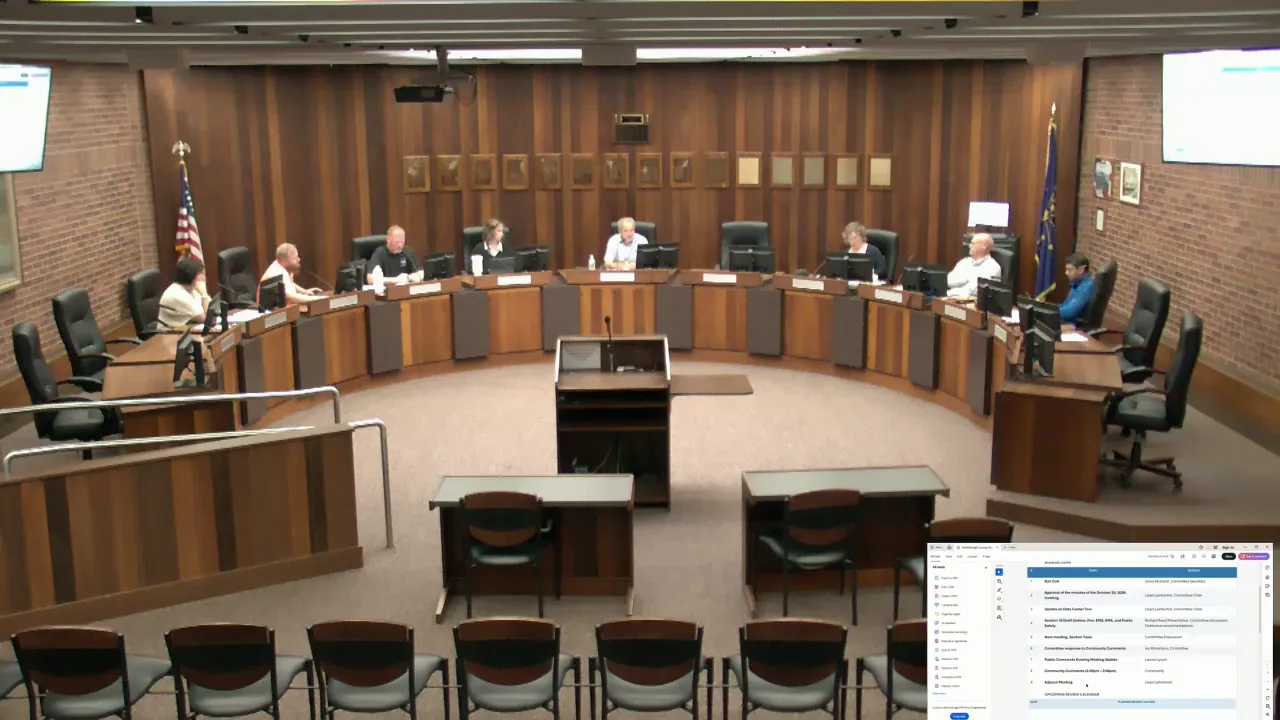
STREAMING COPY IN PREPARATION — RECORDING AVAILABLE FROM THE ORIGINAL SOURCE
Transcript — Verbatim
Speaker numbers apply only to this recording.
Discussion Breakdown — Share of Meeting
Fire Safety31%
Data Center Infrastructure19%
Public Engagement15%
Technology and Innovation7%
Environmental Protection7%
Procedural5%
Public Safety5%
Public Works5%
Economic Development3%
Summary of Proceedings
Vanderburgh County Data Center Research Committee Meeting - October 27, 2026
The Vanderburgh County Data Center Research Committee met Tuesday, October 27, 2026, from 1:00 to 3:00 PM in Room 301 of the Civic Center Complex in Evansville, Indiana. Chair Lloyd Lamberton led the meeting. Committee members present included Jason Nabb, Scott Ambrose, Tom Settler, Jenna Richardt, Lauren Lynch, John Bates, John Dykoff, John Robertson, Richard Reed, Chai Mamadala, Susan Hardwick, and Mark Murray; County Commissioner Mike Gable also attended. The committee approved the prior minutes, reviewed fire/EMS/EMA/public safety recommendations, began planning an evening public comment session, heard community comments, and discussed research on health impacts of data centers.
Consent Calendar
- Roll call was completed.
- The October 20, 2026 meeting minutes were approved by voice vote after a motion and second. The minutes text was not included in the source material provided.
Public Comments & Testimony
- Melanie McDowell thanked the committee for its due diligence, suggested using a cell phone recording on Facebook and the 4-H Center as a larger venue, and asked whether the ordinance would require millions of dollars in decommissioning and cleanup because the technology may be outdated in three to seven years. She said communities in Warrick and Posey counties do not want data centers, expressed concern about cancer rates and air quality in the Ohio River Valley, and predicted that most public comments will be opposition.
- Mike Gable, Vanderburgh County Commissioner, thanked the volunteer committee and said the commission needs its support. He acknowledged the room is small, said recording at the library can be expensive, cited a recent $2,500 event-recording cost, and said the commission might revisit recording if the committee thinks it is important.
- Margaret Connolly suggested contacting Vicky Small about the League of Women Voters recording arrangement shown on WNIN, and about possible library recording equipment.
Discussion Items
Data Center Tour and Amazon Outreach
- Lloyd Lamberton reported that he had contacted Amazon representatives for the South Bend-area facility and South Bend officials, and was waiting to hear back about a possible committee tour. He had also spoken with Amazon staff at a public event and formally requested a tour.
- Committee members who attended the Amazon open house reported a large Amazon team answered questions on many topics. Lloyd said he spoke with economic development and environmental staff, including about South Bend's pretreatment program and challenges. One member learned the South Bend facility's actual wastewater discharge was substantially less than its permitted amount, that water use is seasonal because air cooling is used in the winter, and that backup power comes from diesel generators with limited annual run hours. Members noted the words emergency and temporary may need to be defined, and questioned why natural gas was not used instead of diesel; infrastructure differences were cited as a likely reason.
Section 16: Fire, EMS, EMA, and Public Safety
- Richard Reed presented on fire, EMS, EMA, and public safety. He said the National Fire Protection Association (NFPA), building codes, OSHA, the Area Planning Commission, and county road use agreements/INDOT already govern construction, suppression, egress, and traffic. He said existing local employers such as Cook, Sterling, AstraZeneca, power plants, refineries, and Toyota have internal response teams, emergency action plans, and standard operating guidelines.
- Reed identified the main gap as the absence of an ordinance requirement for live, hands-on training, site tours, and developed standard operating guidelines before a data center starts operating. He recommended requiring developer/operator-funded training and planning, including during construction before testing and power-up, and said this should include communication about specialty equipment needed by responding departments. He noted many nearby counties are still developing ordinances and that South Bend had not responded to his inquiries.
- Committee discussion supported an all-of-the-above approach: existing regulations, ordinance language, and development contracts should all require adequate fire safety, planning, and training, especially because large data-center developers may not be local companies. Members broadly agreed that any additional fire resources, such as firefighters, trucks, or stations, should be funded by the developer rather than shifting costs to property taxpayers.
- A member cited the Louisville Powerhouse campus, described as 157 acres and 400 to 402 megawatts, with $12.5 million provided to Pleasure Ridge Fire Department. Reed suggested comparing facilities on a per-megawatt basis and noted that county councils and economic development agreements handle many funding decisions.
- Members discussed lithium-ion battery risks, including hydrogen fluoride and hydrofluoric acid, and the need for air quality sensors, fixed or third-party monitoring, and training for all local fire departments. Reed agreed and cited refinery boundary monitoring as a model.
- Members discussed possible city/county mutual aid or contractual fire protection for facilities outside the city. Reed said he had general talks with Chief Knight, and mutual aid agreements are feasible. Lauren Lynch advised that formal arrangements with the city would be negotiation points for county commissioners, although the committee could include a recommendation in its document.
- Reed and members acknowledged that an ordinance must be supported by legal authority. The committee agreed to list desired best practices holistically rather than write ordinance language, and Reed agreed to draft a living document on SharePoint for committee comment.
- A member raised property setbacks, noting the Vanderburgh County draft had a 20-foot residential setback compared with Posey County's 1,000-foot setback. Property value impacts on nearby homeowners were also identified as a public concern to address.
Community Comments and Correspondence
- John Robertson was absent, so the committee deferred its response to emailed community comments. Members discussed the need to acknowledge comments and respond to them, and John was expected to collate and report comments at the next meeting. Lauren Lynch also said some public comments had gone to spam folders and planned to follow up with IT.
Evening Public Comment Session Planning
- Lauren Lynch said the committee identified two potential dates, November 10 or November 17, 2026, at 5:00 to 6:30 or 7:00 PM. Option 1 was Room 301 at the Civic Center, with the county's normal live streaming and recording, commissioner-funded security, and roughly 76-person capacity. Option 2 was the Evansville Public Library Browning Room A, with about 98-person capacity and commissioner-funded security, but no county recording or live streaming; she initially said the library was only available on November 17.
- Lynch noted recording and streaming are not legally required because the committee has no decision-making or fiduciary authority, but she recommended recording so remote residents can participate.
- Some members were unavailable on each date, so the committee agreed to poll the full committee and use majority preference. Members said they would look for another date or venue if fewer than 60 percent of members were available. They also considered the Old National Events Plaza and 4-H Center.
- The committee planned two-minute speaker limits, first-come/first-served signup, and encouraged written copies of statements. They agreed to state at the outset that the committee is not deciding whether to site a data center or reviewing a proposal, but is seeking input related to its research and recommendations.
- Discrepancy note: Later in the meeting, a statement was made that Browning Room A was already reserved for November 10 and that Lauren would check with Vicky Small about recording equipment. This conflicts with Lauren's earlier statement that the library was available only on November 17. The transcript does not resolve the conflict.
Health Impacts Research
- Mark Murray, speaking personally and not on behalf of his employer Ascension, summarized three research studies posted to SharePoint.
- Washington State/Quincy study: modeled diesel exhaust from four data centers and estimated an additional lifetime cancer risk of 11 per million for 2016 operations, projected to rise to 19 per million in future operations. Murray said this is not statistically insignificant but not major, and he connected it to possible requirements for disclosure of generator count, fuel type, emissions, and allowable non-emergency testing hours.
- Virginia study: residents near data centers reported disrupted sleep, migraines, and reduced outdoor enjoyment; complaint-related measurements were in the 40 to 59 decibel range including low-frequency background noise. Relevance included residential setbacks, nighttime testing restrictions, low-frequency noise monitoring, and pre-construction modeling with post-construction verification.
- Arizona study by Pima County Health Department and Johns Hopkins researchers, dated August 2026, screened exposure pathways across construction, operation, and decommissioning, including diesel and upstream power emissions, water use, noise, waste heat, light pollution, and equipment disposal. Relevance included a life-cycle checklist, baseline measurements, and comparing facility disclosures to actual implementation.
- Discussion included Amazon's New Carlisle facility, described as having 910 diesel generators, a large backup-power capacity, and six million gallons of stored fuel. Members discussed battery storage as cleaner and quieter but noted its footprint, cost, and difficult decommissioning. Several members favored setting strong standards and using contracts to encourage good-neighbor operators rather than directly banning specific technologies. Air emissions permitting and enforcement is handled by IDEM, not the city or county. Memphis was cited as having documented health impacts from diesel generation. Decommissioning was again identified as a critical future topic.
Key Outcomes
- The October 20, 2026 minutes were approved.
- Richard Reed will draft Section 16 fire/public safety recommendations and best practices, post a living document to SharePoint within about seven days, and incorporate committee comments before the next meeting.
- The committee will poll members to choose the evening public comment session: November 10 in Room 301 with streaming/recording, or November 17 at the Evansville Public Library Browning Room A without county streaming/recording, subject to the noted availability discrepancy. The selected date and venue will be publicly announced.
- John Robertson will report on emailed community comments and responses at the next meeting. Lauren Lynch will follow up on spam-folder issues with IT.
- Jenna Richardt will present on electric/energy at the November 10, 2026 meeting, and Mark Murray will also cover backup generation.
- Upcoming dates: November 10, 2026; November 17, 2026; December 8, 2026, for a public comment meeting and committee discussion; and December 15, 2026, for the final meeting to vote on recommendations to the County Commissioners.
Meeting Transcript
Okay, I'd like to bring the meeting to order. First order on the business is roll call. Jason Nabb, Scott Ambrose, Tom Settler, Lloyd Lamerton. Here. Jenna Rickhart here. Lauren Lynch. Here. John Bates. Here. John Dykoff. John Robertson. Richard Reed. Here. Chai Mamadala. Here. Susan Hardwick. Here. Mark Murray. Here. That was really loud. Next item on the agenda is the approval of the minutes of October 20th, 2026 meeting. Everybody had an opportunity to look at them. Any questions or comments? Motion to approve. Second. All those in favor? Okay. Okay. The next thing I wanted to do is update the committee on my work at trying to find a site to tour. I have talked to the representatives from Amazon for the facility near South Bend. And they will be getting back with me. I've also spoke with the people at South Bend as well. So I'm waiting to hear back from them. So next thing we wanted to do is discuss items related to Section 16 of the draft outline. It looks at fire, EMS, EMA, and public safety. And Richard Reed is going to go ahead and give us a little presentation and then hopefully we can have some discussion on it. Thank you, sir. I'm not as flashy with PowerPoints and a lot of handouts. So this is very passionate, not just to me, but being the representative selected from our fire community as you might uh label them across not just uh Vanderburgh County but the state. So I put all my thoughts down so I stay focused and don't drift because like I said, I'm very passionate about it. But I believe I should be able to keep this very short and sweet and on this topic. Uh while it is very important, uh it should be easily addressed, I believe, compared to our power, the water, our environmental impacts, uh, and those sections that we'll have later uh that will be a little more in depth and impactful. Uh we have a lot of governing bodies that already will set a lot of our fire and what it needs by way of suppression through the uh I I can give you you were asking about acronyms and initials.
SUMMARIZED BY OPENPUBLICA AI
TRANSCRIPT VIA PUBLIC VIDEO
openpublica.com
openpublica.com