Everett Budget & Finance Committee Meeting – May 21, 2025
STREAMING COPY IN PREPARATION — RECORDING AVAILABLE FROM THE ORIGINAL SOURCE
Everett Budget & Finance Committee Meeting – May 21, 2025
The Budget & Finance Committee of the Everett City Council met on May 21, 2025, to review year-to-date budget performance through March, discuss budget priorities for 2026, and examine a 10-year history of general government full-time equivalent (FTE) staffing. The meeting was chaired by Council President Schwab, with Finance Director Heidi Berlantez and Assistant Finance Director Jamie Lee Graves presenting.
Discussion Items
Year-to-Date Budget Performance (March Financial Report)
- General government revenues exceeded projections by approximately $1.2 million as of March 31, 2025, with total revenues for the month just over $580,000. The increase was largely due to timing of operating transfers and Business & Occupation (B&O) tax receipts.
- B&O tax receipts were $522,627 (11.5%) above budget, currently $49,194 above forecast. Largest quarterly payments are received in January, April, July, and October.
- Sales tax receipts (reported on a two-month lag) showed mixed results: wholesale trade and information came in above budget; retail, construction, accommodation/food services, and manufacturing fell short. Construction activity was trending below forecast due to winter seasonality.
- General government expenditures through March were approximately $4.1 million below budget, attributed to timing of construction and street maintenance projects.
- Councilmember Bader asked whether the fall 2024 Boeing strike was impacting revenues. Finance Director Berlantez responded that more impact would be seen in April quarterly receipts, which will be shared at the next budget committee meeting.
Budget Priorities Discussion
- Berlantez presented the five budget priorities that shape the 2025 adopted budget: Safe Community (59% of general government budget), Responsive & Responsible Government (19%), Housing, Transportation & Infrastructure (10%), Economic, Workforce & Cultural Vitality (9%), and Engaged & Informed Community (3%).
- Councilmember Wolkley requested a breakdown of the police department's share within the 59% Safe Community priority. Berlantez noted that the budget book provides dollar amounts but not percentages, and staff can provide percentages if needed.
- Councilmember Bader asked when the first 2026 budget forecast would be available. Berlantez indicated that the June budget committee meeting will present preliminary 2024 year-end results, which will inform the 2026 forecast.
- Councilmember Owen inquired about the status of the SAMHSA grant (earmarked by Senator Murray for the alternative response team). Berlantez explained they are requesting an extension because the SAMHSA program requires spending within one year, which is impractical. She reported that city lobbyists believe the extension will be successful due to the grant's congressional earmark nature.
General Government Full-Time Equivalent (FTE) 10-Year History (2015–2025)
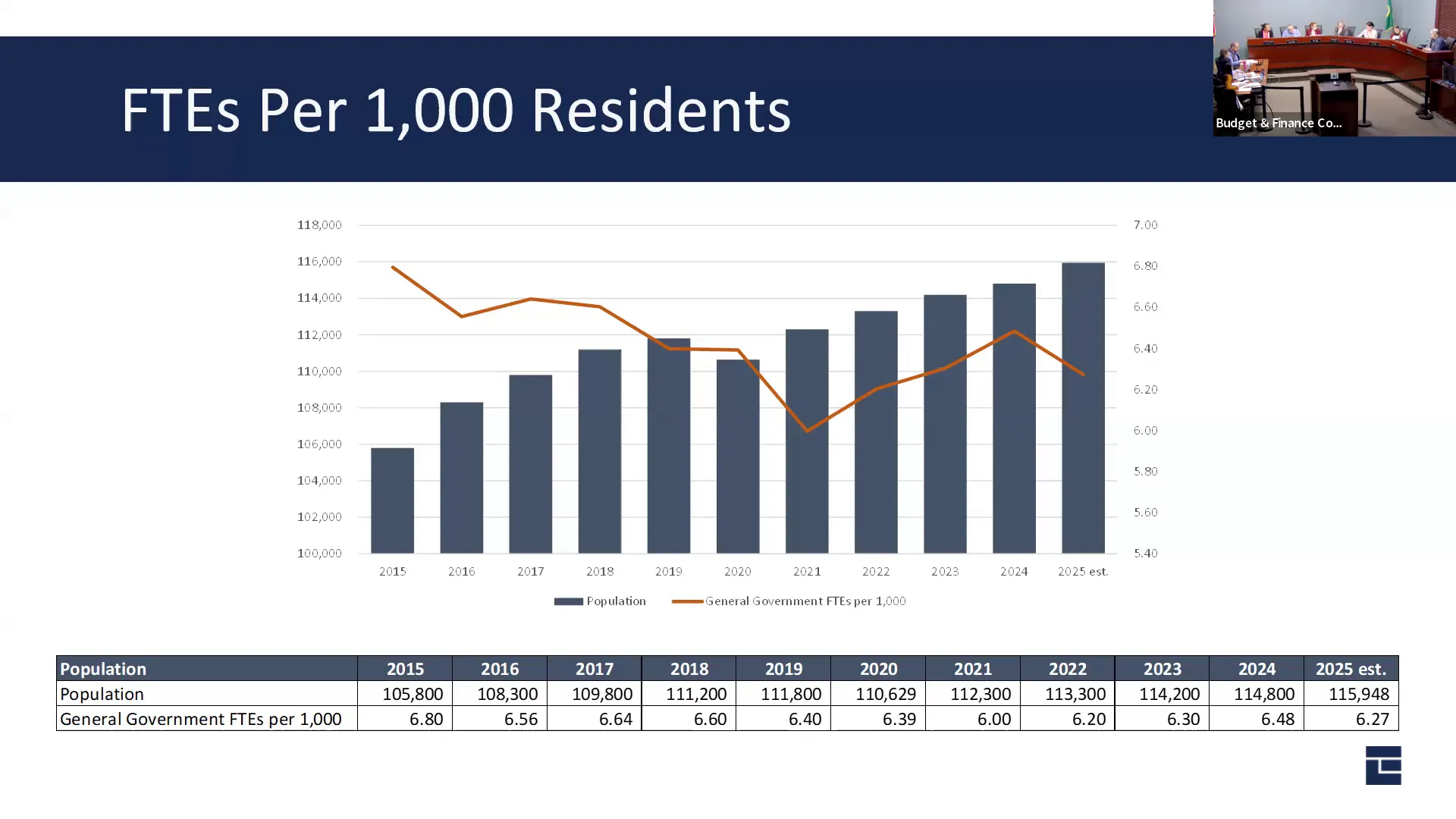
- Population grew by 9.6% over the decade, while general government staffing decreased from 6.8 FTEs per 1,000 residents in 2015 to 6.27 FTEs in 2025.
- Key department trends: Administration FTEs declined from 12.9 to 6.2; Communications & Engagement increased to 4 FTEs in 2019; Community Planning & Economic Development increased due to grant-funded positions (social workers, comp plan); Police added 11 FTEs in 2023 (partially COPS grant-funded) but civilian staff were reduced; Fire decreased due to transfer of EMS positions; Library, Parks, and Facilities saw reductions.
- Councilmember Fossey asked about current vacancy rates. Berlantez noted that most vacancies are in the police department, citing competitive hiring challenges.
- Councilmember Ryan asked how Everett compares to other cities on FTEs per resident. Berlantez explained that because Everett is a full-service city (library, fire, animal services), direct comparisons are difficult; department-level comparisons are more meaningful.
- Councilmember Bader noted that from 2015 to 2025, the city added only 8 authorized positions while adding 10,000 residents, calling it a significant metric of tight staffing.
- Councilmember Wolkley questioned the clarity of police FTE changes related to the COPS grant. Berlantez clarified that the COPS grant requires one-to-one hiring without supplanting; first 8 officers were added in 2021, with additional hires in 2023 and 2024.
- Councilmember Bader requested that staff add explanatory notes to the PowerPoint before posting it online, so viewers understand the context (e.g., the fire FTE reduction due to EMS transfers). Staff agreed.
- Mayor Lingenfelter noted that attracting police officers is challenging due to competition from other cities offering large bonuses.
- Finance Director Berlantez confirmed that civilian reductions in the police department were partly offset by transferring social workers to community development, illustrating realignment of resources.
Key Outcomes
- No formal votes were taken; this was a committee meeting for discussion and information.
- The committee will receive the 2024 year-end financial results at the June budget committee meeting, which will inform the 2026 budget forecast.
- Staff will add explanatory notes to the FTE history PowerPoint before public posting.
- The city will continue to monitor revenues, especially construction and Boeing-related impacts, and report back.
Meeting Transcript
Well, welcome everyone to the City of Everett budget and finance committee for May 21st, 2025. On our agenda is three items, main items. Year to date budget performance, including the March financial report, budget priorities discussion, and the general government full-time employee um data history. So it's welcome for those of you who may be watching online. We'll begin with our report. Um who would like to start? Mayor, did you at this point need to start today? Are you just here? Be part of this. I appreciate you being here really much so. Okay. Heidi, take it away. Thank you. Uh good evening, Mayor and City Council. Uh Heidi Berlantez Finance Director. And joining me today is Jamie Lee Graves, our assistant finance director. This evening, as President Schwab stated, uh, we will start with an overview of our year-to-date budget performance as of March 31st. Following that, uh, we will pause for council discussion before moving to our next topic, the city's budget priorities. Finally, we'll conclude with a summary of the general government full-time equivalents or FTE trends over the past decade from 2015 to 2025. Uh so I'll now pass it to Jamie Lee and she'll begin the presentation with year-to-date budget performance. Hello, mayor and city council. Uh, we start the year-to-date budget performance review with general government revenues. Through March, general government revenues exceeded projections by approximately 1.2 million dollars, with total revenues for the month just over $580,000. This increase is largely due to the timing of operating transfers in and business and occupation or BNO tax revenues. BO tax receipts through March reflect an increase of $522,627 or $11.5% over budget. As mentioned in the past, we receive our largest BNO payments on a quarterly basis in January, April, July, and October. And currently 49,194 above the forecast. Sales tax receipts are received on a two-month leg. So March collections represent economic activity from January. It takes a closer look at the six largest sales tax categories, showing not only the percentage each category contributes, but also how each is performing relative to the budget. At the end of March, wholesale trade and information came in above budget, while retail, construction, accommodation and food services, and manufacturing fell short. We've seen that construction activity is currently trending below forecast. One contributing factor is the seasonality of the industry. Construction is uh construction typically slows down during the winter months. And because sales tax receipts are reported on a two-month leg, what we're seeing now reflects activity from January when weather conditions are um when weather conditions can significantly limit project starts and progress. We'll continue to monitor this closely as we move further into the construction season and as data begins to reflect spring and summer activity. Uh moving on to general government expenditures. Expenditures through March are approximately $4.1 million below budget. As mentioned in previous presentations, expenses can fluctuate due to timing of certain expenditures, such as construction projects or street maintenance work. As highlighted in our previous presentation, departments have consistently shown strong fiscal responsibility, maintaining expenditures below budgeted levels. We placed a clear focus on sound financial stewardship, and we commend the proactive steps our team have taken to manage resources. Overall, we ended the first quarter on a strong note. As we move forward, we'll continue to closely monitor both revenues and expenditures, keeping in mind that trends can fluctuate throughout the year. Before moving on to the next topic, are there any questions on the year-to-date budget review? Councilmember Bader. Thanks, Council President. Again, maybe pre premature here yet, but uh we do we see any impacts of last fall's Boeing strike working their way through. I mean, as the uh 17,000 drop in uh manufacturing, uh like one airplane that didn't get delivered or something. I don't know. Just kind of curious where we are with the with knowing that impact.
openpublica.com