Everett City Council Budget & Finance Committee Meeting - August 20, 2025
STREAMING COPY IN PREPARATION — RECORDING AVAILABLE FROM THE ORIGINAL SOURCE
Everett City Council Budget & Finance Committee Meeting - August 20, 2025
The Budget & Finance Committee of the Everett City Council met on August 20, 2025, to review the year-to-date general government budget performance as of June 2025, discuss financial forecasting and its impact on the budget deficit, and review the contingency reserve (rainy day fund). Presentations were delivered by Finance Director Heidi Berlantez and Assistant Director Jamie Lee Graves. Committee members asked questions and discussed the city's fiscal position, including revenue trends, expenditure discipline, and the structural deficit.
Discussion Items
-
Year-to-Date Budget Performance (June 2025): Revenues exceeded year-to-date projections by $2,253,177 (2.8%), driven primarily by Business and Occupation (B&O) tax receipts which were up 7.9%. Sales tax receipts were 1.5% below projections. Expenditures were $4.8 million (5.8%) under budget. Overall, B&O tax comprises 13% of general fund revenue, sales tax 24%, and property tax 25%. Council President Schwab commended the finance team for conservative forecasting. Councilmember Fogley inquired about the breakdown between brick-and-mortar and online sales tax collections. Councilmember Ryan clarified that online sales tax is based on delivery location, but B&O tax on local operations remains.
-
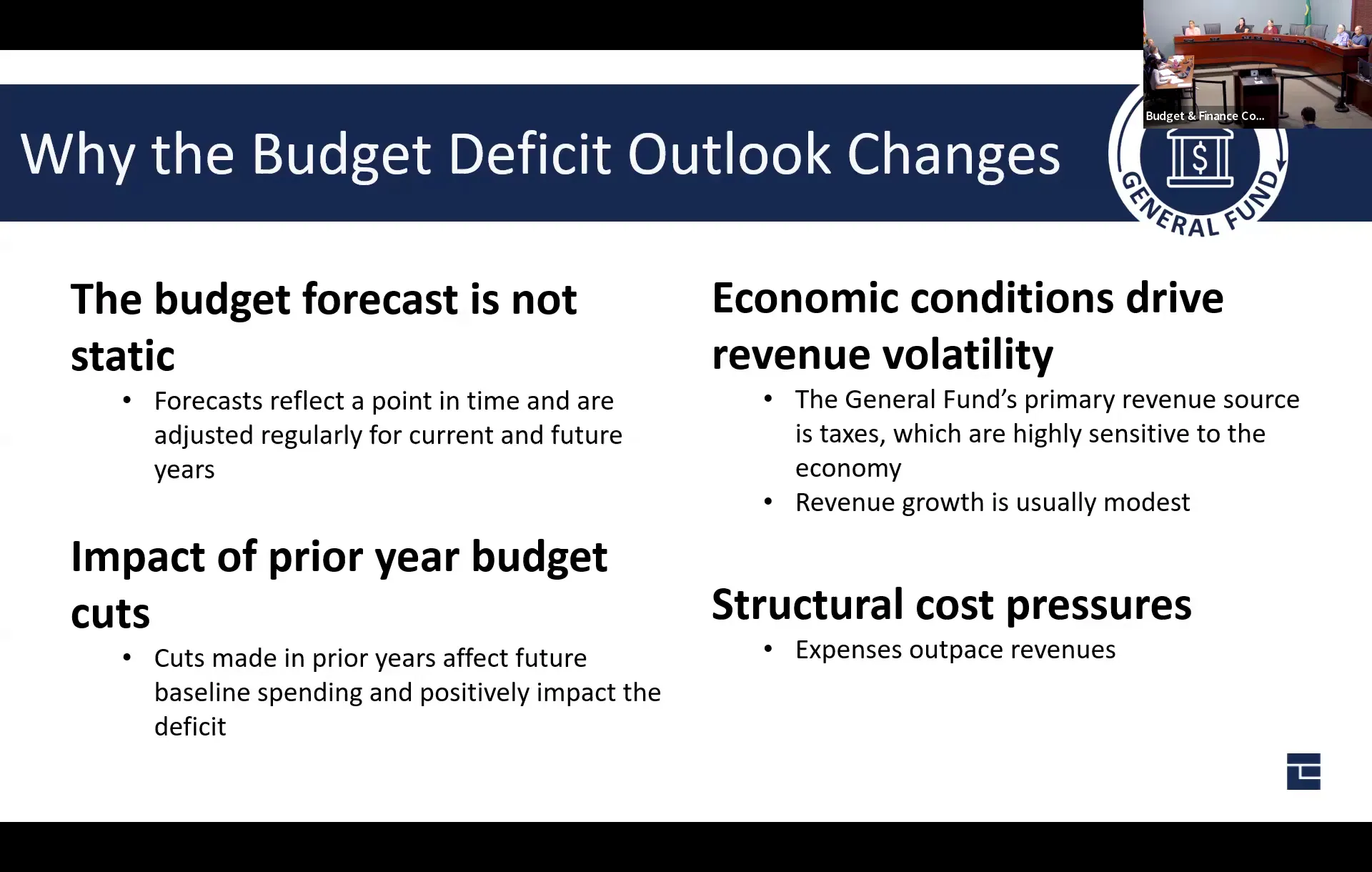
Financial Forecasting and Budget Deficit: The presentation showed how the projected deficit has evolved since 2021. A red line illustrated the deficit would have grown each year without action, while a green line showed the deficit decreasing to zero in 2025 due to annual budget adjustments. Reasons for changing projections include: forecasts are not static; prior cuts carry forward; economic conditions drive revenue volatility; and structural cost pressures cause expenses to grow faster than revenues. Councilmember Mazarello discussed the 1% property tax limit compared to CPI and construction cost indexes, noting that city costs often outpace revenue growth.
-
Contingency Reserve (Rainy Day Fund): The estimated 2025 balance is approximately $3.87 million, separate from the 20% general government ending fund balance requirement. The legal cap under RCW is 37.5 cents per $1,000 of assessed value, equating to roughly $10 million. Councilmember Single noted that short-term cuts can be destructive to municipal operations. Councilmember Bogley asked about funding mechanisms (original budget or amendment). Councilmember Salingo suggested reviewing historical usage over the past 20–25 years to inform future policy. Council President Schwab noted that setting a rainy day fund policy would be a future conversation after addressing the structural budget deficit.
Key Outcomes
- The committee received the presentations and discussed the city's financial status. No formal votes or decisions were taken.
- The finance team will provide an updated six-year financial outlook in the September budget committee meeting.
- Council members expressed interest in developing a formal policy for the rainy day fund, with potential targets up to the statutory cap, contingent on resolving the structural deficit.
Meeting Transcript
Okay, well, thank you. We'll begin. This is August 20th, 2025. This is the Everett City Council budget committee meeting. We're actually having this meeting before the council meeting. So those of you who might be watching, I encourage you all to attend in person or I'm thankful that you're watching this via remote or via recorded. So we have three things on our item for items today on our agenda. Year to date general government budget performance for June 2025. Financial forecasting and impact on the budget deficit. And our third agenda item is contingency reserve. We're going to cover our rainy day fund and do a review of that of that fund. So to begin, we'll start with administration if they would like to begin. Yes, I'll just um mention that uh finance director Heidi and Assistant Director Gameli are here, and they're she's getting up to screen in a second to do the presentation and just walk through all of those topics as kind of one briefing. So thank you very much. Great. Uh good evening, Mayor and City Council. Uh Heidi Berlantez Finance Director joining me as Jamie Lee Graves, our assistant finance director. Um Council President Schwab already listed all of our agenda items. So we'll just get started on the year-to-date budget performance review as of June 30th. All right, starting off with general government revenues as of June 30th, revenues exceeded year-to-date projections by 2,253,177 or 2.8%. This increase is driven primarily by B and O tax revenues, along with strong performance in grants and other tax categories. Overall revenues ended the second quarter on a strong note. Taking a closer look at our major revenue streams, business and occupation tax receipts are up 734,271 or 7.9% year to date. Our largest B and O payments are received quarterly in January, April, July, and October. Sales tax receipts are closely aligned with the budget, coming in just 283,489 or 1.5% below projections year to date. As you know, sales tax receipts have a two-month leg. So June receipts reflect April activity. This table lists our six largest sales tax categories. The percent each category makes up of total sales tax receipts based on June 30th results, as well as how each one is performing relative to budget. Wholesale trade, manufacturing and information came in above budget, while retail construction and accommodation and food services have fallen short. As mentioned, sales tax receipts are tracking close to budget, which is a strong position compared to what some of our peer jurisdictions have reported recently. We continue to see certain categories impacted by broader national economic pressures, things like trade policy shifts, interest rates, and tariffs. At the same time, some categories are performing above expectations. Those gains are helping to offset the shortfall in other categories, which is why overall our sales tax revenues remain largely on target. Moving on to general government expenditures, just like with revenues, we base our monthly expenditure forecasts on historical trends, which helps us plan for the natural ebb and flow of expenses throughout the year. We ended the first half of the year in a good position. Year-to-date expenditures came in $4.8 million or 5.8% under budget. Departments have shown commendable fiscal discipline, consistently keeping expenditure below budget. Looking ahead, expenditures are expected to align more closely with the budget as the annual pavement maintenance overlay project is now underway. Next on the agenda. Excuse me, Council President. And before you move on from that, I I think that really uh sums up kind of our our June financial report. And I just wanted to add that we have a truly exceptional finance team that has done an amazing job of forecasting, uh, not just this year, but in previous years as well. And I think that has really helped us in comparison to some of our other cities. So we have that B and O tax to buffer kind of the some of the ebbs and flows in sales tax. But truly, this team has done a great job of being very conservative with their forecasting, so that when we do see lulls that um we're in a we're still in a good position as a city. So I just wanted to publicly say that and thank you and your entire team for the really good forecasting work that you continue to do for us. Thank you. Thank you. Councilmember Fogley.
openpublica.com