Budget & Finance Committee Meeting - September 17, 2025
STREAMING COPY IN PREPARATION — RECORDING AVAILABLE FROM THE ORIGINAL SOURCE
Budget & Finance Committee Meeting - September 17, 2025
The Budget & Finance Committee met to review the July 2025 financial report and receive a preview of the 2026 general government budget and balancing measures. The presentation covered a projected $7.9 million deficit for 2026 and a set of proposed expenditure reductions and one-time revenue uses to achieve balance. Council members asked detailed questions and discussed the implications of the measures, particularly the reliance on one-time COVID relief funds and the need for ongoing solutions to the city's structural deficit.
July Financial Report
- General government revenues exceeded year-to-date projections by $2,147,681 (2.3%) as of July 31, 2025, driven primarily by B&O tax receipts along with strong performance in grants and other tax categories.
- Business and occupation tax receipts were up $836,210 (5.4%) year to date. Sales tax receipts came in $296,926 (1.3%) below projections, with wholesale trade, manufacturing, and information outperforming while retail, construction, and accommodation/food services fell short.
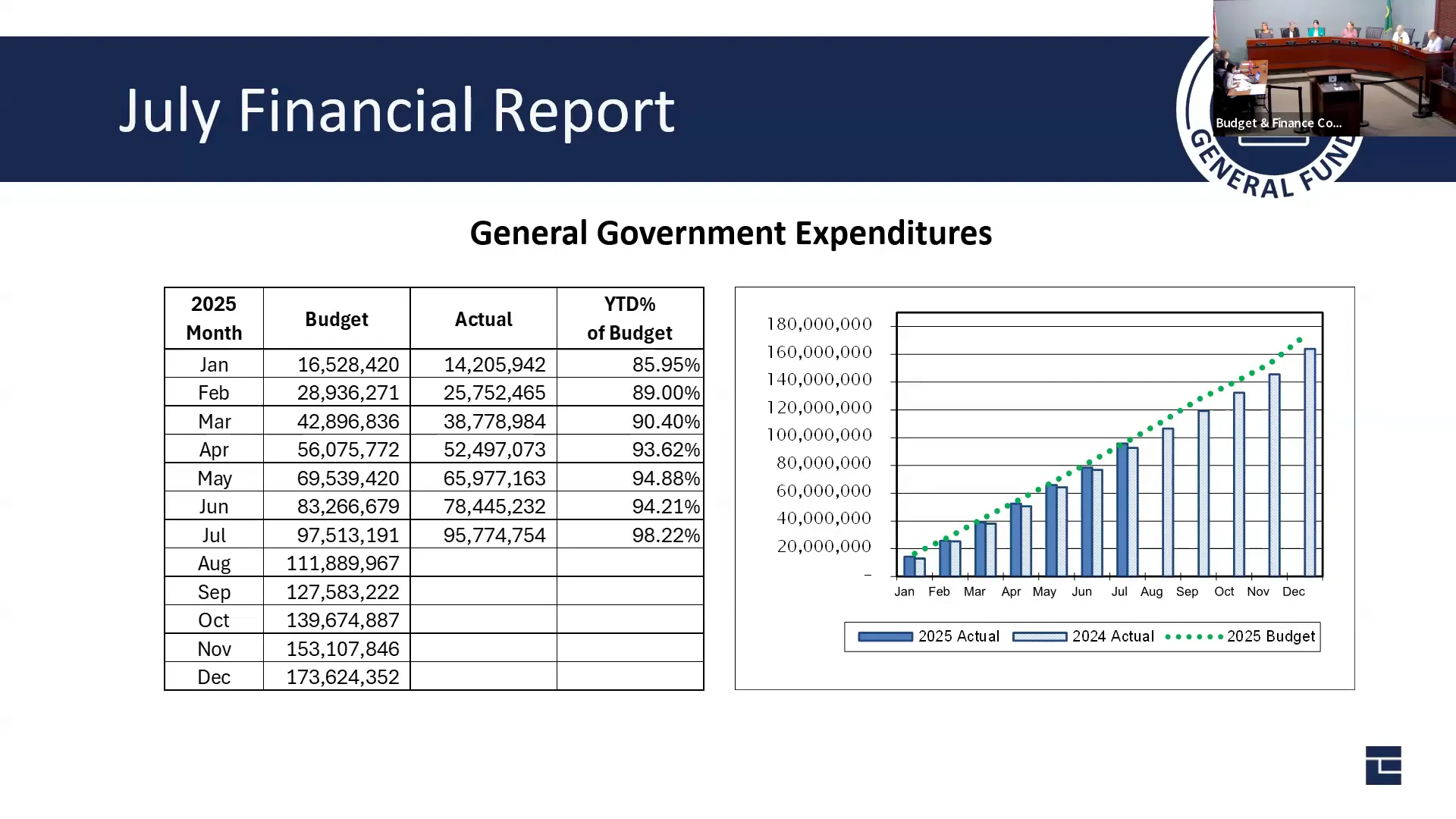
- General government expenditures were $1,738,437 (1.8%) under budget, reflecting good financial management across departments.
2026 General Government Forecast and Proposed Balancing Measures
- The long-range financial outlook as of August 2025 projects a budget deficit of $7.9 million in 2026. A spike in 2031 is tied to the police and fire LEOFF 1 pension funds reaching their actuarial funding target in 2030, assuming no further contributions after 2030.
- Proposed balancing measures (both expenditure and revenue) closed the $7.9 million deficit:
- Continued suspensions: General government contributions to police and fire pension funds (no deficit in funds for several years); $1 million reduction in the general government contribution to the street overlay program (program still receives $2.4 million from car tab fees, property tax, and other sources).
- Expenditure reductions: Eliminating the standard 2% growth in departmental maintenance and operations budgets ($213,000 savings); using Senior Center Reserve Funds for the Volunteers of America Community Center Management Contract ($200,000 in 2026); reducing human needs programs by $308,000 while retaining $300,000 for human needs grants and $50,000 for Claire's Place supportive housing.
- Revenue and fund transfers: Using lodging tax revenues for city-led events and the Everett Performing Arts Center contract (up to $334,957); transferring $1,067,725 from the criminal justice fund (supported by the 0.1% criminal justice sales tax) to fund the police department's violent crimes unit (six full-time employees); using $1,068,150 from a SAMHSA congressional grant extension for the alternative crisis response program.
- Use of unallocated COVID relief funds: $2,296,117 in unallocated and unspent local COVID relief funds to help balance the 2026 budget; additionally, reallocating $2 million previously set aside for daytime service access (no operational partner found), $256,139 for the Clean Everett program, and $300,000 for tree planting (now funded by a federal grant from Snohomish County Conservation District).
Discussion Highlights
- Council members asked about the impact of the Boeing strike on revenues (manufacturing B&O and sales tax), noting a two-month lag; the finance team indicated the strike's effects may appear in future reports.
- Questions were raised about the pension fund contributions and the option to extend the funding target beyond 2030; the finance director noted that annual actuarial valuations are available and that pre-funding is more conservative than the pay-as-you-go approach used by many cities.
- Councilmember Thuli expressed concern that using nearly $5 million in one-time COVID funds to balance the 2026 budget does not address the structural deficit in future years and urged early conversations about ongoing solutions.
- Councilmember Ryan suggested that some COVID funds might be used for one-time community investments beyond deficit reduction.
- Councilmember Bader clarified that if COVID funds are redirected to other uses, equivalent cuts must be found elsewhere; the mayor stated that city departments cannot absorb further reductions.
- Councilmember Bogley asked about the impact of the increased minimum wage; staff responded it primarily affects seasonal employees.
- Councilmember Schwab (president) noted that while he is not enthusiastic about reducing the street overlay program, that and other measures require considering alternative cuts or revenue solutions.
- The mayor acknowledged that the city has closed a cumulative budget gap of approximately $99 million between 2018 and 2025 through multiple rounds of voluntary separation, public-private partnerships, technology investments, and other efforts.
Key Outcomes
- No formal votes were taken; the presentation was informational. The 2026 budget is projected to be balanced on paper using the proposed measures.
- The committee will hold a separate revenue workshop in the following month to delve deeper into revenue options.
- The council indicated that further discussions are needed to identify ongoing solutions for the structural deficit beyond one-time measures.
Meeting Transcript
Well, welcome. This is the City of Everett budget City Council Committee meeting for September 17th, 2025. Um, for those of you watching live and maybe recorded, we appreciate your interest in city business. And so we'll begin with our administrator Jennifer Gregerson to talk about our agenda. Well, I will just um turn it over to our budget finance team here that has a presentation for you. Um starting with monthly report and then building into general government forecast. Thank you. Good evening, mayor and city council, Jamely Graves, Assistant Finance Director, and with me is Heidi Berlantes, Finance Director. Um, we are going to begin with a review of our year-to-date budget performance uh through July 31st, followed by an update to the development of the 2026 general government budget. Starting off with general government revenues, as of July 31st, revenues exceeded year-to-date projections by 2,147,681 dollars or 2.3%. This increase is driven primarily by BNO tax revenues along with strong performance in grants and other tax categories. Taking a closer look at our major revenue streams, business and occupation tax receipts are up $836,210 or 5.4% year to date. Our largest BO payments are received quarterly in January, April, July, and October. Sales tax receipts continue to be aligned with the budget, coming in just 296,926 or 1.3% below projections year to date. As you know, sales tax receipts have a two-month leg, so July receipts reflect May activity. This table lists our six largest sales tax categories. The percent each category makes up of total sales tax receipts based on July 31st results, as well as how each one is performing relative to budget. Wholesale trade, manufacturing, and information came in above budget, while retail construction and accommodation and food services have fallen short. Sales tax revenues are currently tracking close to budget, which puts us in a relatively strong position. While we are seeing some categories affected by broader economic conditions, other sectors are outperforming expectations. These stronger than anticipated gains are helping to offset weaker performance in other areas, allowing us to stay largely on target with overall sales tax collections. I'll just stick with uh our revenue. Do you have um our B and O tax divided up in a categories? Um yes, I I don't have that with me, but we do have um it divided out by sectors. You don't, I know you want to be perfect in the numbers, but what's the biggest uh it'd be manufacturing is our largest manufacturing B and O tax. Okay, thank you. Any other questions on revenue? Okay, thank you. Oh, council member. I just want to apologize if I'm jumping the gun here. But where if the impact of the Boeing strike is still working its way through, where where is that at? Where do we see that? Um, if we've seen if we see it, if we saw a drop in revenue that would cause by that. Uh, you would see it in uh our business taxes and sales tax under the manufacturing category. So thanks, Mayor. So we're not really seeing that at this point then uh because it looked like manufacturing was uh actually up over We saw it a couple of months ago, is that correct? I think um we'll probably see it earlier this year uh because of the two month lags. Gotcha. So that that lag is now worked its way through and okay. Thanks. Thank you. Okay. Great. Uh moving on to general government expenditures, just like with revenues, we base our monthly expenditure forecast on historical trends, which helps us plan for the natural ebb and flow of expenses throughout the year. Year-to-day expenditure came in 1,738,437 or 1.8% under budget. Departments continue to remain below budget, showing good financial management. We'll now transition to the second portion of the presentation, focusing on the 2026 general government budget update. Developing a budget is an essential process that requires careful planning, forecasting, and balancing of revenues and expenditures. The budget serves as a roadmap for how funds will be allocated to support essential services, maintain infrastructure, and invest in the future. This process has two key components revenues, the sources of funding and expenditures, how the funds are used.
openpublica.com