Everett City Council Budget & Finance Committee Meeting - March 18, 2026
STREAMING COPY IN PREPARATION — RECORDING AVAILABLE FROM THE ORIGINAL SOURCE
Budget & Finance Committee Meeting - March 18, 2026
The Everett City Council Budget & Finance Committee met on March 18, 2026, from 5:30 PM to 6:15 PM in City Council Chambers. The primary agenda item was a Utility Tax Overview, presented by Interim Finance Director Mike Bailey, to address the city's projected structural deficit of over $15 million. The committee also received a brief Monthly Finance Update and discussed future agenda items.
Utility Tax Overview
- Interim Finance Director Mike Bailey presented a proposal to transition the city's current 6% payment-in-lieu-of-tax (PILOT) on enterprise fund activities (in place since 1983) to a utility tax, a tool used by virtually every other city in Washington State. He noted that a utility tax has clearer legal authority than the PILOT approach.
- The administration recommends a 12% utility tax (a 6% increase), which would generate approximately $7.5 million annually for the general fund, a significant step toward closing the $15+ million structural deficit.
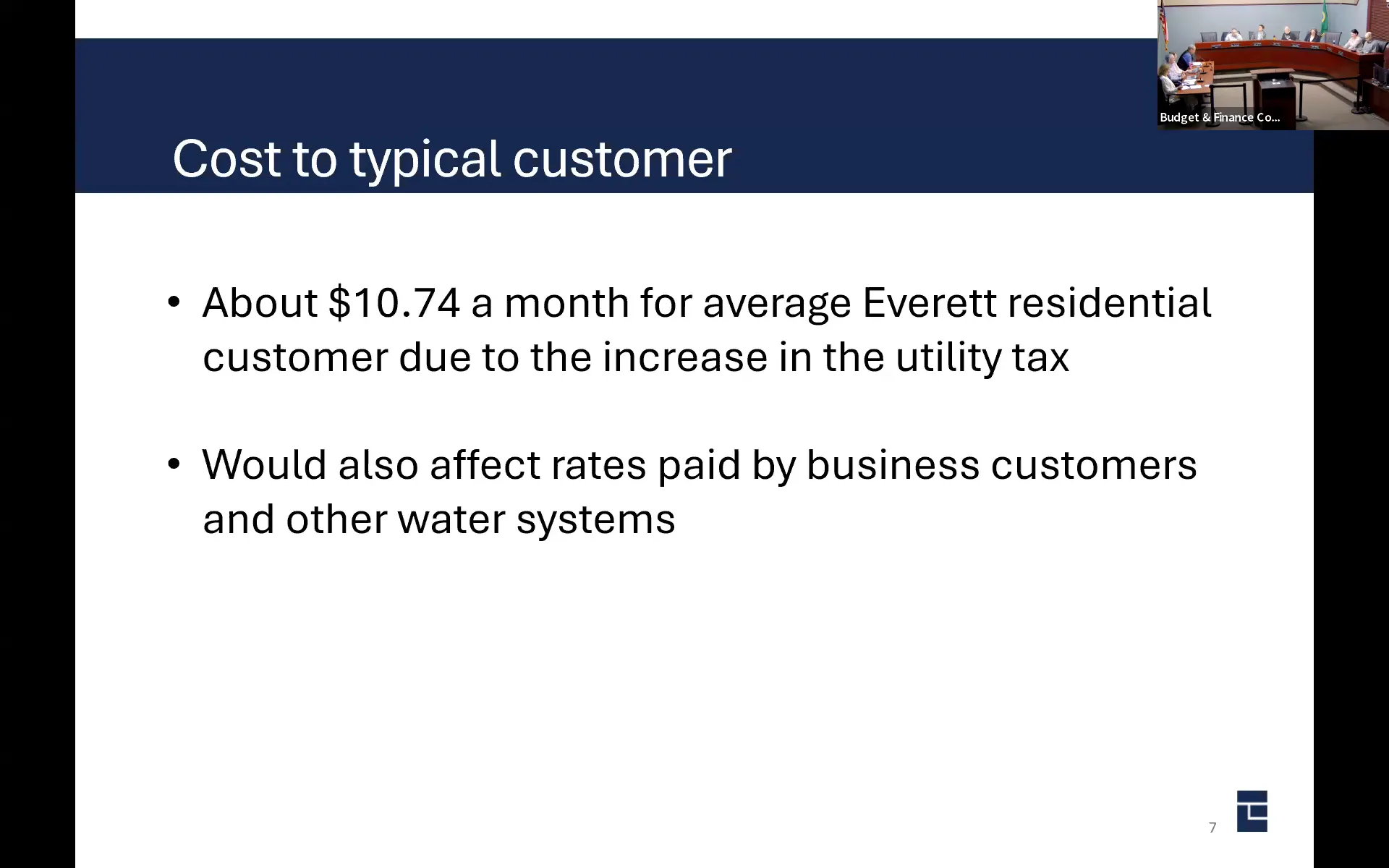
- The tax would apply to city-provided utility services (water, surface water, etc.) both inside and outside city boundaries. Costs would be passed through to all ratepayers, including wholesale water customers (e.g., Marysville, Lynnwood, Edmonds). For a typical residential user, this would result in an estimated rate increase of $10.74 per month.
- Councilmembers asked about impacts on low-income and senior customers. Bailey responded that staff would revisit and enhance assistance programs and conduct outreach, similar to existing property tax relief programs.
- The tax would appear on customer bills as a line item stating that a 12% utility tax is included in the rate.
- Bailey stated that an ordinance would be brought to the council for three readings, likely in April or early May, with a goal of mid-year implementation.
- Councilmember Zarlingo and Councilmember Ryan expressed support for prioritizing the utility tax as a transparent, timely step, consistent with the council retreat priorities.
Monthly Finance Update
- Bailey advised that no monthly financial report was provided for January or February because early-year data is not meaningful due to lags in sales tax receipts (two-month lag) and property tax timing. Trends are not yet reliable.
- The next monthly report will be produced in April for March, using a new format that will also include the status of vacant positions, as requested by the council.
- Staff are currently finalizing the 2026 budget, closing out 2025, and preparing for the audit. Any urgent issues would be brought to the council immediately.
Key Outcomes
- The committee agreed to move forward with the utility tax proposal as recommended, with an ordinance to be introduced in April or early May for first reading.
- Future agenda items will include further revenue options discussed at the retreat (in priority order), the effects of the newly passed municipal fire authority (MFA) legislation on the budget, and analysis of state legislative impacts on the city's finances.
- The council plans to schedule a visit from the city's lobbyist in April to discuss state budget effects.
Meeting Transcript
Okay, well, good good evening or afternoon, depending when you watch this. Welcome to Everett City Council Chambers. We are hosting the City of Everett budget council meeting for March 18, 2026. And we are scheduled for 5 30 p.m. to 6 15. On the agenda items, we have utility tax overview and monthly finance update. And I'll like to hand the mic over to administrative Jennifer Gregerson. Thank you. I will just pass it over to Interim Finance Director Mike Bailey as he gets his presentation up. And looking forward, this was a I identify it as the kind of unified top priority to explore this tool at your retreat. So happy to perhaps folks bring it forward to you tonight. Okay, welcome. Oh, thank you. And with that, uh I am uh Mike Bailey, and we're going to talk about the uh revenue options. Uh this is a continuation from the uh council retreat we had, where we started off by framing the issue uh that the city is facing a structural deficit on a going forward basis with next year's deficit forecasted currently at um somewhat over 15 million dollars. So with that, as a context at the retreat, we talked about alternative approaches to address that structural deficit uh from the revenue uh side and uh expenditure side will be addressed, of course, as part of a budget process as it is every year. So with that, um tonight we'll talk about the payment in lieu of tax, or what's commonly known as the pilot and kind of some of our learning that occurred as we explored that further, and some of the things that we anticipate recommending to the council in the very near future. So the city has been implementing a 6% payment in lieu of tax or pilot. I'll refer to it as a pilot going forward. Um, on the enterprise fund activities uh in the city since 1983. Uh, this was implemented uh at that time via a resolution. And uh that certainly includes the uh utility services that are provided by the city to residents and beyond. Uh so inclusive of the utilities that are provided outside our borders, which we'll talk about more in just a moment. The um as we looked at the uh background for the payment and loaf tax, a pilot uh and and looked at what other cities around the state are doing of the same nature, virtually every city in the state has a um imposition of this sort uh in almost every case, that imposition is in the form of a utility tax. So instead of a payment in lieu of tax, which typically refers to a mutual agreement between two parties uh where one is an is a non-property taxpayer, such as the housing authority or something that of that sort, but relies on the general government for services, they agree to pay a payment in lieu of a property tax, which they otherwise wouldn't have to pay. So the use of a pilot in the city of Everett for its utility, what would be a utility tax kind of purpose is is unique. Um and so we explored that further with the help of the city's uh legal team. They did some uh consultation with some outside legal folks, and uh on a going forward basis, it's our recommendation that the city utilize the same approach that's used by virtually every other city in the state, a utility tax in lieu of a payment in lieu of tax. And so um, and so in looking at that uh the rationale for such a tax on utilities, there really is no other uh tax of this nature on city utilities, such as there are on non-city utilities, such as electric, telephone, natural gas, that kind of a thing. There's a similar tax of this nature in those circumstances, and there's no sales tax, nothing of that sort. So payment for for the um use of the city general government provided amenities really doesn't exist, but for a utility tax, such as as we're recommending. And again, the city has had one in place, like again, mostly all cities in Washington State do since 1983. So what we're gonna be proposing then is that we discontinue the use of the payment in lieu of tax methodology. Uh, it's not as uh as strongly uh defensible from a legal standpoint. There's clear legal authority in the statutes in case law for the city to use the utility tax approach. That's less much less clear with respect to the payment in lieu of tax approach. So we'll be recommending that we transition from a payment and law of tax to a utility tax uh uh authority. We talked at the retreat about the um kind of what's happening in neighboring jurisdictions. We'll take a look at that in just a minute. And again, this as a revenue tool to help address that structural deficit. So uh looking at uh what increases to the to the utility tax above the 6% would do with respect to to the revenue alternatives and and the administration will be recommending a 12% utility tax. So in lieu of the current 6%, increasing it by six to get to a total of 12%. If we were to approve, uh the council were approve such an increase, uh that would generate um about seven and a half million dollars uh to the city's general fund. These these revenues are permissible to be used for any general governmental purpose at the council's discretion. And um, and as you know, it's seven and a half million. We talked about 15 plus million structural deficit. That's a significant um, you know, uh step in the in the right direction in terms of helping address some of that uh revenue imbalances that we were talking about at the retreat. So I talked about the neighboring jurisdiction, and we've got in your materials uh a number of the neighboring jurisdictions uh and kind of what they've done in this space. Um again, uh in every case, they use uh a utility tax. I will point out you may see uh in some materials that Marysville publishes that they'll call it a pilot as well.
openpublica.com