Everett Budget & Finance Committee Meeting - July 16, 2026 (Date Discrepancy Noted)
STREAMING COPY IN PREPARATION — RECORDING AVAILABLE FROM THE ORIGINAL SOURCE
Everett Budget & Finance Committee Meeting – July 16, 2026
Note: The agenda and transcript indicate the meeting occurred on July 15, 2026, but the provided instruction states the date is July 16, 2026. This summary uses the instructed date while noting the discrepancy.
The Budget & Finance Committee met to review the city's 2025 budget performance and outline the 2027 budget process. Finance Director Chris Godwin, recently appointed, presented the financial results and led the discussion. Council members raised questions about fund balances, capital improvement plans, and priorities for the upcoming budget.
Discussion Items
- 2025 Budget Performance: Chris Godwin reported that 2025 revenue came in at $170 million against a forecast of $169.6 million (a variance of 0.25%). Expenditures were $8.5 million (4.81%) under budget due to department savings. Sales tax revenue fell short by $1.3 million, but the city ended the year in a slightly better position overall.
- Capital Improvement Plan (CIP) Funds: Godwin detailed four CIP funds. CIP1 (established 2016, $3 million annual general fund contribution) had a projected fund balance of $21 million; major projects include the main library HVAC replacement, police property room renovation, and boathouse replacement. CIP2 is fully dedicated to debt service; CIP3 (funded by second quarter percent of REET) had a $9.1 million balance, funding projects like Edgewater Park playground and Garfield playground renovations; CIP4 (lease revenue) had a $737,000 balance.
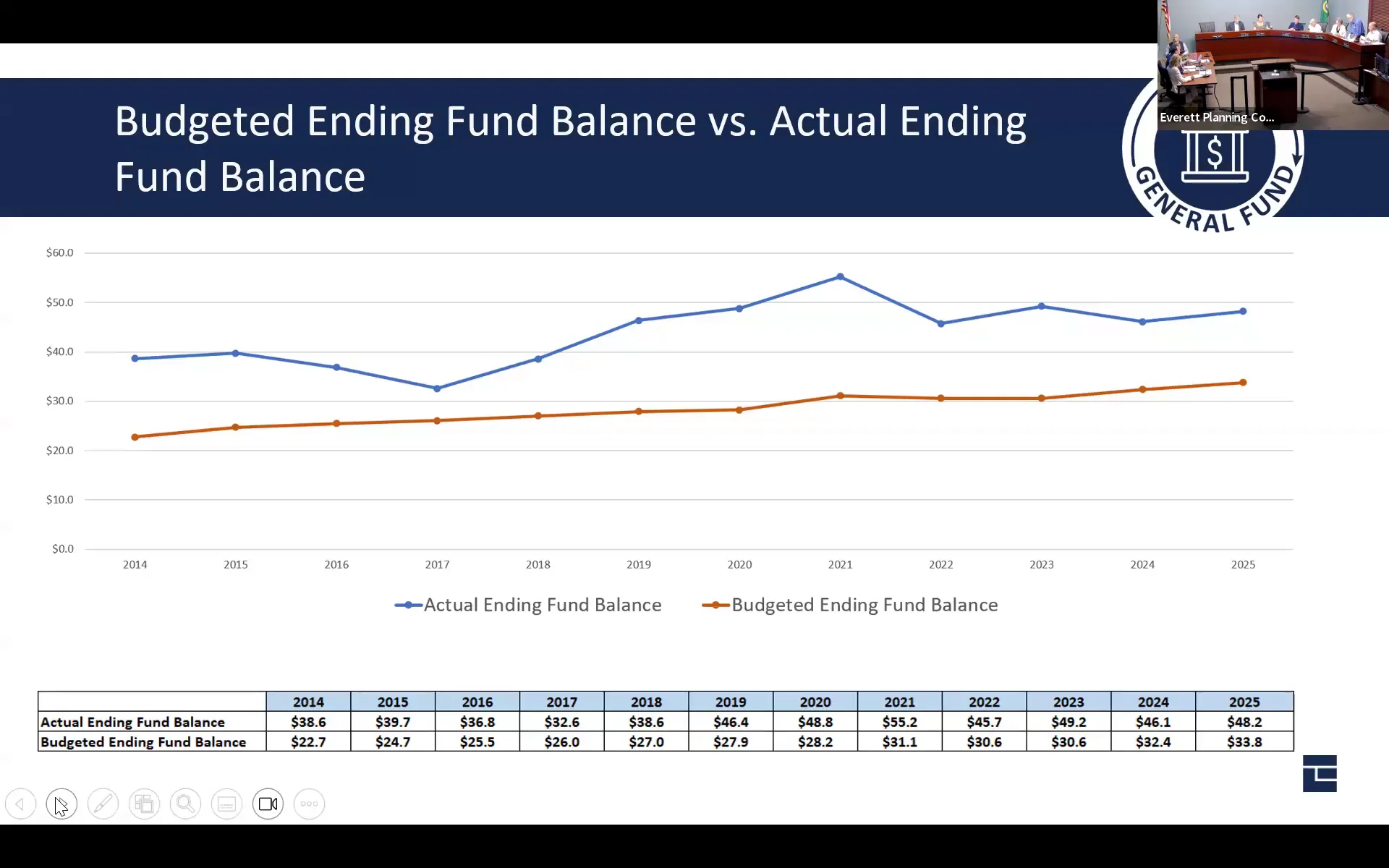
- Fund Balance and Rainy Day Fund: The general fund balance target is $33.8 million (20% of anticipated revenues). The actual fund balance exceeded the target due to expenditure savings. The city's rainy day fund (separate) holds about $3.8 million. Councilmember Ryan expressed support for using the excess fund balance to meet the 2027 budget gap rather than making cuts, arguing that holding excess taxpayer dollars is not prudent. Councilmember Bader cautioned against using the surplus without ensuring future revenue adequacy but suggested using it for investments that generate revenue, such as permit processing improvements.
- 2027 Budget Process: Godwin presented the budget calendar, starting with May department instructions, June department submissions, July committee hearing, August guidance, September hearings on 2026 budget amendment 2 and a revenue workshop, October mayor's budget presentation and proposed budget release, November hearings (1st, 2nd, 3rd readings), and December approval by December 2nd. Councilmember Ryan noted that the third reading on November 18 conflicts with the National League of Cities Conference, suggesting a date change. Council President Schwab raised the issue of understaffing in building inspection and planning, which is delaying permits and stifling revenue and growth; she proposed considering a budget amendment to address the permit process. Councilmember Bader supported using surplus funds for such revenue-generating investments. Councilmember Burris mentioned a grant-funded AI resource for permitting intake.
Key Outcomes
- No formal votes were taken; the meeting was a discussion and information session.
- The committee will next meet on September 2, 2026, for the first reading of the 2026 budget amendment 2, and on September 16, 2026, for a discussion on balancing the 2027 budget.
- Councilmembers expressed interest in using the fund balance surplus to close the budget gap and in prioritizing permit process improvements as a revenue-generating investment.
- The date discrepancy between the source materials (July 15) and the instructed date (July 16) is noted; the committee chair (Council President Schwab) adjourned the meeting as July 15, 2026.
Meeting Transcript
Okay, well, um, we'll begin. This is a City of Everett Budget and Finance Committee for July 15th, 2026. Um, I'd like to begin with a presentation um from Chris Kidwin, our brand new finance director. Or maybe I'll pass it over to Candy for an introduction. That's great. Thank you. Good evening, counsel. I'm so pleased to introduce Chris Godwin, our new finance director. Chris has an extensive public sector finance background. He previously spent nearly five years as finance manager at the Seattle Department of Transportation, where he led long-range financial planning and budget development. Before that, Chris held senior finance roles with Seattle Public Utilities, San Francisco's budget and legislative analyst uh office, and the Maryland Department of Budget and Management. Um, and he also worked for the Washington State Senate. Chris holds a master's in public administration from the University of Washington, and he has a bachelor's in political science from Oregon State University. His track record and financial modeling, multi-year forecasting, and translating technical data into clear insight, make him especially well suited to support tonight's discussion on the city's budget. Please welcome Chris. Thank you, Chris. Thank you, Candy. Um, Council members, it's nice to meet all of you. And for the record, I'm Chris Godwin, the finance director for the city of Everett. Um our first presentation tonight. I'm just gonna kick uh launch the presentation. So we have two subjects um for the agenda. One is the budget performance. Yep. And then the 2027 budget budget process. Um and there is a calendar in the budget process, and each of you should have a handout that we gave you in a larger format so you can play along at home. Um as we this is a typical step in our budget process where I come and present uh a high-level summary of what our 25 performance was and then in process, and and we'll start with performance. Um in 2025, our revenue forecast was 169.6 million dollars, and that was measured against the performance of 170 million. Um, as you all know, which is a variance of 424,000 or 0.25%, which for our purposes here is you know spot on. As you all know, the the beneath that number is a constellation of revenue streams, each of which performed to varying levels of overperformance or underperformance. In 2025, um, we saw higher than anticipated revenues and grants and in internal service charges that offset some shortfalls in sales tax revenues. And you would have heard about that in the monthly reporting last year that our sales tax revenues fell about 1.3 million dollars short. The good news is that we ended the year in a slightly better position. And in our year-to-date monitoring of the sales tax, we have not seen a significant drop-off like we did last year. We are right on track to meet our projection for 2026. Moving on to expenditures. That's a variance of 8.5 million or 4.81%. This is um in line with the performance that we've seen in prior years and is largely reflective of every department's initiative to monitor their budget and to try to pinch pennies as much as possible where possible. Um, we saw uh savings across the board, um, and we remain committed to good financial stewardship as we move forward. All right, getting into the CIP a little bit. Um all CIP projects come before the council for approval and are included in whole or in part in one of the four funds that you see on the screen. Um going through them one by one. CIP1 was established in 2016 to fund major repairs, renovations, and replacements of existing city facilities. We contribute $3 million in general funds to that CIP every year. Um in 2024, we did have to defer that, but we anticipate making the same contribution in 2026 and 27. Heaven, um we currently estimate that we will end the year with a fund balance of 21 million to pay um as after paying for current year costs and to pay for future year projects that are already approved by the council. Major projects in that CIP include the main library and HVAC replacement, uh, the police and some police projects, including the property room renovation, the bathroom renovations and headquarters, and the boathouse replacement. Uh moving on to CIP two, CIP2 is funded with the first quarter percent of real estate excise tax revenues. Um and at this point, CIP2 is wholly paying for debt service that we have incurred on prior issued bonds and debt. Um you may recall that last year we issued long-term general obligation debt to pay for things like the Edgewater Bridge replacement, the Eclipse Mill Park Project, low lowell riverfront trail improvements in the every municipal building.
openpublica.com