Fayetteville City Council Work Session - May 1, 2023
STREAMING COPY IN PREPARATION — RECORDING AVAILABLE FROM THE ORIGINAL SOURCE
Fayetteville City Council Work Session - May 1, 2023
The Fayetteville City Council met on May 1, 2023, at 5:00 PM in the Lafayette Conference Room for a work session. Discussions covered public safety training and mental health response models, budget and bond financing, a request for Cape Fear Regional Theater funding, the PWC commissioner appointment process, and a proposal to establish an Office of Community Safety and Mental Health. The council reached several consensus agreements.
Public Safety Strategic Items Update
- Police Chief presented training initiatives completed and underway: April 2023 Crisis Intervention Training (CIT) for 28 officers (10 from Fayetteville), department-wide autism awareness training (2022), mental health first aid, and ICAT de-escalation training (two trainers within department).
- CARES unit (Community Assistance Response, Engagement, and Stabilization) integrates homeless liaison, mental health liaison, and other resources.
- Councilmember Benavente raised concern that staff had not provided the Durham HEARTS model analysis requested six months prior (November 2022 council direction). City Manager acknowledged the gap and committed to returning a full comparison within two weeks, including costs and Durham model overlay.
Budget Discussion and Revised Calendar
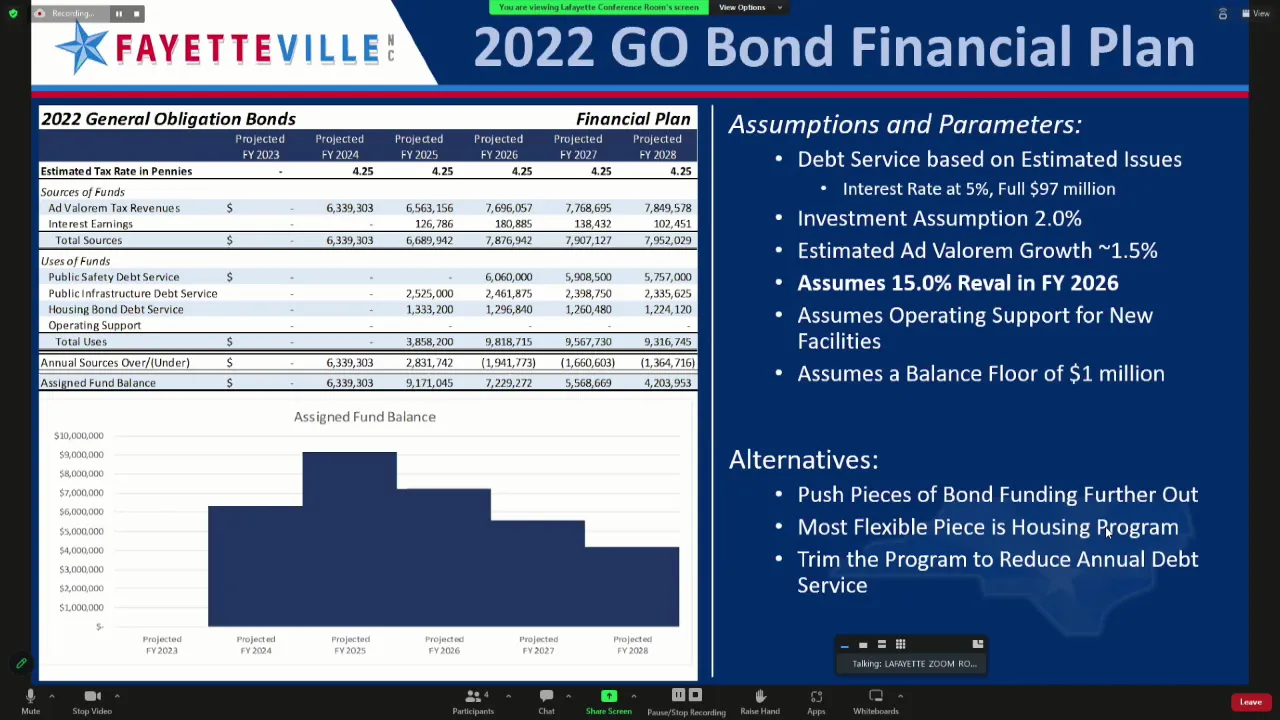
- Assistant City Manager Jeff Yates reviewed fund balance breakdown (unassigned balance of $33.74M, with policy goal of 12% and commitments leaving ~$5.3M available), ARPA funding ($40.3M total, $27.8M unspent), and Parks and Recreation Bond financial plan (assuming 1.5% growth, 15% rebound in 2026, debt service based on 5% interest rate for GOs and 6% for taxable housing bonds).
- Council requested clarification on specific ARPA-funded projects (e.g., Johnson Street corridor infrastructure) and staff will follow up.
- Council discussed the 2022 GO Bond financing plan; alternatives include delaying housing or trimming program.
- Councilmember Ingram requested $2.5 million ($500,000 annually for five years) for Cape Fear Regional Theater capital project. After debate about priorities and leapfrogging existing commitments, the council gave consensus for staff to incorporate the request into the CIP and return with options. The vote appeared unanimous.
PWC Commissioner Appointment Process
- Councilmember Hondros proposed beginning the appointment process on August 1, 2023, instead of waiting for the typical September cycle, to allow more time for selection before the incumbent term expires September 30, 2023.
- Policy Committee Chair Jensen noted the current policy calls for appointments in March and September. After discussion, the council gave consensus to direct staff to return with a proposal for accelerating the process. Vote: 7-2.
Office of Community Safety and Mental Health
- Councilmember Jensen, citing personal experience and the lack of after-hours mental health resources ("after six o'clock, there is nobody to help"), proposed creating an Office of Community Safety and Mental Health with at least one dedicated director/coordinator to research models (e.g., Durham HEARTS, Greensboro) and develop a plan.
- Councilmember Ingram noted that residents had previously raised similar needs. City Manager cautioned that this is a complex issue requiring mapping of services and funding commitments.
- The council reached unanimous consensus to add the item to the budget "parking lot" for further development during the FY2024 budget process.
Key Outcomes
- Public Safety: Staff to return within two weeks with a detailed comparison of the Durham HEARTS model versus current Fayetteville programs, including costs.
- Cape Fear Regional Theater: Consensus to include a $2.5M CIP earmark ($500K/year for 5 years); staff to bring options.
- PWC Appointment: Consensus to accelerate the process; staff to present a proposal at next meeting.
- Office of Community Safety and Mental Health: Consensus to pursue establishing the office; added to budget "parking lot."
- Budget Calendar: Recommended budget to be presented around May 22, with adoption by fiscal year end (June 30).
Meeting Transcript
It up versus us doing a trial run for the same amount of money, what we know we're getting stats. That just makes more sense to me. And uh our I'm sure they have a date of deployment site. This was contemplated by councils being a one-year contract, and uh we are um probably uh very close to initiating this chief and uh indicated. So I would say that um switching gears at this time uh would be something that I would not recommend and don't know that we would do so without incurring penalty. All right, thank you. Uh Chief, will you go forward with mental health training slide, please? And then counselor will go if you have questions about anything for we can entertain those chief. So as we talk about uh trainings that the police department has that help and how we respond to that. Uh I wanted to uh start by saying in just this month, uh, April 2023, MP hosted uh a course of CIT course where we trained over 28 officers from our Southeast region, 10 of those specifically being Fainable Police Officers. Uh the CIT program stands for the crisis intervention training, and it's what we're trying to incorporate across uh the entire department. Currently have our uh mental health liaison uh is a CIT trainer, and we're actually implementing these classes so that uh uh without disrupting the control operations, get everybody up to uh up to trained up on CIT. Addition to that, in 2022, the entire department went through autism awareness. Uh this training was an online training, and it walked the officers through what to expect when encountering someone with autism, how to tell where they're at on a spectrum and gave uh recommendations on how to deal with those individuals about triggering an unwanted response. So we completed that uh department-wide fourth quarter of 2022. The entire department completed our mental health first aid training. This is again it's another training where you know how we initially respond, how do we evaluate and deal with persons that are in mental crisis? Uh but it's a skills-based training course that teaches participants uh about mental health substance abuse issues. Finally, uh the training that we're trying to implement city wide uh throughout the department, ICAT stands for integrating communication assessment and tactics. It's put on it's sponsored and put on through PERF, the police executive research form. Uh this is sort of a de-escalation technique that teaches us how to use those tactics uh not to get too close, how to utilize cover, how to effectively communicate and get the person to uh de-escalate or effectively respond to the commands of the officer before attempting to go handle. We also have two train the trainers uh within our department. This is another program that we're trying to integrate throughout the department, but we're happy to take it in phases that's not to disrupt the day-to-day operations with everybody off the road to do these trainings uh up to date. Uh we're trying to also integrate it as our academies come out, so the brand new officers are equipped with these skills and these trainings as soon as they hit the road. So uh those are the trainings that we've currently completed and are working on uh for 2023. In addition to that, we want to talk about our community assistance response, engagement, and stabilization airs and acronym as we uh implemented our homeless liaison, uh our mental health liaison. Uh we were what what was the purpose and goal of those actual units? Uh the goal of the CARES units to help the most vulnerable uh in our community to connect to resources, establishing long-term stability in the payable area, show through safety, health, wellness of individuals, their loved ones within the community. That's a long statement of saying, Hey, we needed that we knew that there needed to be someone a liaison out there that was able to deal with the homeless community and be able to connect them with the resources that were out there. We needed someone that that could bridge that gap, that mental health piece between the police department and the service providers out there in our community. So you know they helped track those calls for service force, they help uh prevent us from having to go out to a second call for service. We can call them out, and they're able to contact the family, get them the help they need or get them back on their medications. Uh this is the unit that we we took several of the elements that we have throughout the department and said how do they all work together? And as we add into our homeless officer that we used to uh that we have, uh they all provide some same or similar services, so we wanted to create a unit that they can all be housed in so they had the uh working knowledge of what each other were doing on a day-to-day basis. All right. So thank you, sir. Um questions, uh, Councilmember Benavente, round one. I don't know if you can zoom in on that graph at all. Um, but I just wanted to direct to the bullet point. Fadeville Care's presents mental health model of Faithville City Council. Uh if I can recall correctly, um, who is the the the chair, not the chairperson, but the director of that department? Not Miss Brax, not Miss Marcus, but who's in charge of them? Oh, Deanna Husk. I believe Ms. Husk and at the time Chief Hawkins presented um on that in the in November of 2022. Is that what that bullet point is is referencing Faithville Care's presents mental health model to city council? Actually, this was sorry, under Chief Hawkins and uh private her. And and this may be a question for staff, but at that presentation that's bulleted in this very specific um item. A motion, a consensus motion was made at the time. And I just want to read it verbatim from the minutes so that we get it right, and I want to know why.
openpublica.com