Fayetteville City Council Work Session - August 3, 2026: Data Center Briefings, Strategic Plan, and Public Forum
STREAMING COPY IN PREPARATION — RECORDING AVAILABLE FROM THE ORIGINAL SOURCE
Fayetteville City Council Work Session - August 3, 2026
The Fayetteville City Council held a work session on August 3, 2026, starting at 3:00 PM. The meeting included educational presentations on data center permitting, adoption of the FY2027 Strategic Plan, a speed limit reduction request, a downtown convention center feasibility study, parking program recommendations, and several council member agenda items. The meeting recessed at 6:00 PM for recognitions and a public forum, then resumed. The public forum featured 50 registered speakers, with many urging a moratorium on data center development. The meeting adjourned after the remaining items.
Consent Calendar
- The agenda was approved unanimously (Item 5.0).
Public Comments & Testimony
- Data Centers: Numerous residents and activists expressed strong opposition to data center development, calling for a 12-month moratorium to allow for more thorough study of environmental, water, and noise impacts. Speakers cited concerns about PFAS chemicals, grid strain, job promises not materializing, and lack of transparency. Several referenced the proposed TerraNexus project and urged the council not to rush UDO changes. A motion to extend the public forum beyond the one-hour limit failed 5-5, leaving seven speakers unheard.
- Other Topics: Residents also spoke on traffic safety (Blanton Road speed reduction, cut-through traffic in Sherwood Park), a proposed pickleball sports tourism facility, and coordination of feeding programs for the unhoused. A written comment summarized concerns about the city's brand and the need for a moratorium.
Discussion Items
- 6.01 Data Center Educational Presentations: Dr. Ben Rachunok (NC State) and David Payne (NCDEQ) provided technical details on air and water permitting, closed-loop cooling systems, and state authority. Clarence Briggs (AIT, local data center operator) emphasized the need for community-defined standards, transparency, and key performance indicators (PUE, TUE). Councilmembers explored municipal authority, PFAS risks, and the importance of a decommissioning fund.
- 6.02 Adoption of FY2027 Strategic Plan: Andy Brayboy (Office of Strategic and Performance Analytics) presented the plan, consolidating six goals into five, and introduced a “strategic alignment crosswalk” linking budget actions to priorities. Council discussed the timing of the planning cycle, with several members advocating for a fall retreat to allow planning before budgeting. The plan was approved with a request that staff return with recommendations to improve the timeline.
- 6.03 Blanton Road Speed Limit Reduction: Staff recommended keeping the 35 mph limit, citing traffic studies showing average speeds of 38 mph and no crash pattern. Councilmember Hare moved to reduce to 25 mph, emphasizing resident safety and a daycare center. The motion passed (opposed by Councilmembers Green, McMillan, and Ferguson).
- 6.04 Downtown Convention Center Feasibility Study: Andrew Mansell outlined a potential $100,000 study with a 3–4 month timeline. Council discussed options, including a second phase. A motion to adopt Option 3 (authorize phase one with a ceiling for phase two, subject to a second vote) passed unanimously.
- 6.05 Parking Program Recommendations: Brian Bryan proposed increasing special event rates at the Hay Street deck, raising citation fees, and converting a permit lot to paid parking. Council received the report as information, with staff to bring recommendations from the new parking contractor in December/January.
- 6.06 Work Session Start Time: The policy committee recommended moving the start time from 3:00 PM to 2:00 PM. The motion passed, with Councilmembers Jones and McMillan voting in opposition.
- 6.07–6.12 Council Member Agenda Items:
- 6.07 (Ferguson) “Fay Connect” robust notification system – supported; staff to report back.
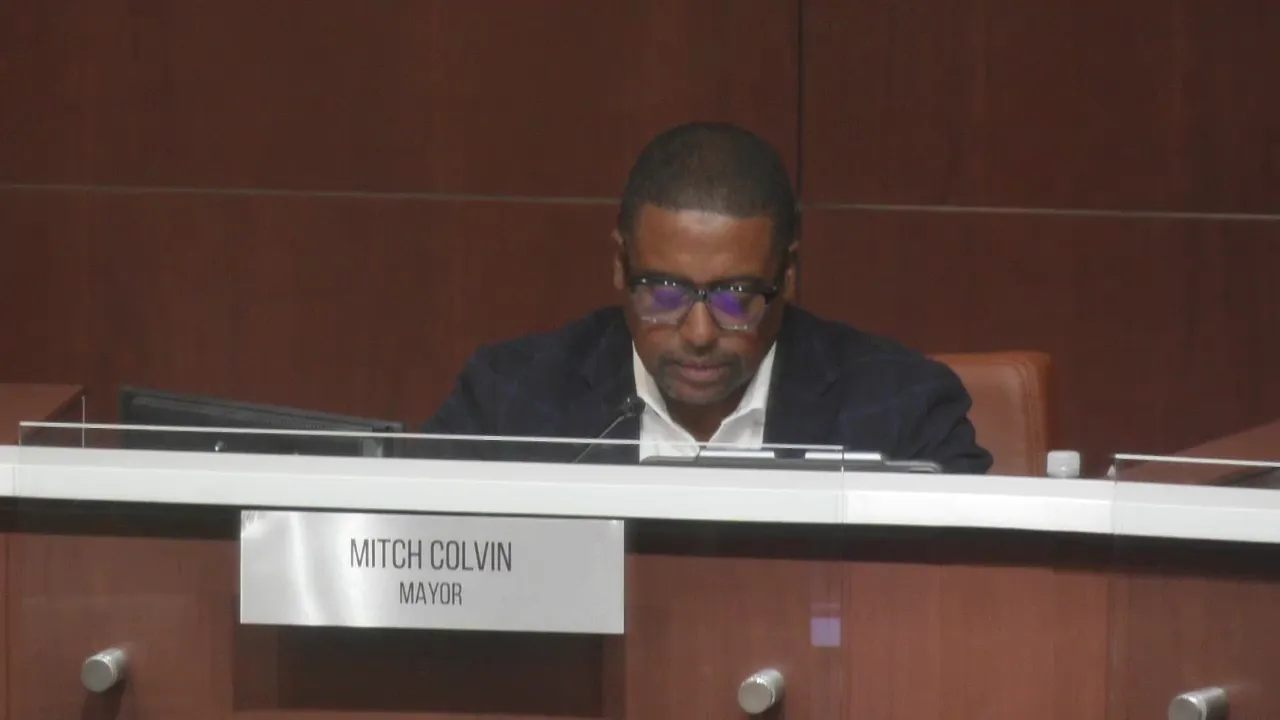
- 6.08 (Mayor Colvin) Coordination of feeding programs – supported; staff to work with partners.
- 6.09 (Mayor Colvin) Cliffdale West fire hydrant placement – supported; staff to conduct a citywide assessment.
- 6.010 (Ferguson) CIP funding sources/prioritization – supported; staff to research and present prioritization criteria.
- 6.011 (Jones) Single/dual axle trailer restrictions – supported; staff to explore exceptions for utility trailers.
- 6.012 (Jones) Storage distinctions between LI and HI – supported; staff to clarify definitions.
Key Outcomes
- FY2027 Strategic Plan adopted unanimously, with direction to consider earlier fall planning sessions for future cycles.
- Blanton Road speed limit reduced from 35 to 25 mph (vote: 5-3).
- Downtown convention center feasibility study approved (Option 3) unanimously.
- Parking program recommendations received as information; final action deferred pending new contractor input.
- Work session start time changed to 2:00 PM (passed with opposition).
- All six council member agenda items received support for further staff review and reporting.
Meeting Transcript
All right. Okay. How about now? Okay. All right. Won't touch it. So lots of different things that we would work directly with the developer, the contractors. A lot of the big companies that we're seeing like Amazon or another blue chip, they're going to have a lot of independent consultants and engineers that are going to work with them. Another thing that we can see is that a lot of times people will try to take an avoidance, we call that, sort of set their emissions at a cap that prevents a higher level of permitting. Sometimes you'll call that a synthetic miner, sometimes you'll call that any number of things, but it's essentially saying I'm going to put in some scrubbers or I'm going to set my hours at a limited number, so I'm not crossing over and emitting certain chemicals and particulates into the air that are going to trigger an additional layer of permitting, again, Title V or PSD. That's when you start to see developers and applicants need to have a public hearing or a public comment period just because the level of new emissions is so great that you know the Clean Air Act mandates that. You might have seen recently we had our hearing in Richmond County for the Amazon facility. That was a requirement of both the Clean Air Act for the public comment period, and then by the discretion of the division of air quality director to hold a public hearing so that the community could come and make its thoughts known. So we carried that out last week. Additionally, what we would say about air permitting is that if gas fire generation is necessary, sometimes we've seen proposals for gas-powered facilities or hybrid power facilities that bring in some gas. It can also mean a new pipeline or compressor station to get that gas to the facility. And each of those pieces of hardware can have its own permitting workflows and can take some time to get through and approve the plans. Some of those may also have their own air permits. So these can quickly become complicated regulatory frameworks and workflows. However, these are also things that we are no strangers to. So between the Fayetteville office and the Raleigh Central Office, this is something that can be pretty uh pretty easily navigated with the right advanced conversation with the right relationships. Again, we like to begin conversations early and often to avoid surprises. So again, you'll hear me say this a lot tonight. If you have a development in mind, please send them our way, just so everybody is avoiding surprises, and we can talk with them about the required permits. Another question that we like to ask is Is water actually involved? Chances are there is going to be some level of water involved. Um, but as my colleague from NC State was saying, not everybody uses a lot of water for cooling if they use cooling at all. Some are fully air-cooled, and he was able to speak pretty fluently about the the interplay between water and and electricity use and how one rate would go up and how one rate would go down, depending on the technology applied. Of course, the evaporative cooling, we also call that open loop, uses a lot more water. And I'll tell you anecdotally, um, for what it's worth, the proposals that we have seen for the most part over the past six to eight months, um, just about all of them are proposing closed loop systems. And so again, there are additives, you know, put in that water. There are different things that some facilities are able to do to reclaim and reuse that water. Um again, local utilities are going to be the front line in receiving that discharge if in fact it is discharged. And so again, we go back to PWC and their permits to the plant. And then, of course, you know, we as the permitters of those sewer plants would have some involvement in reviewing a draft permit, but our ability to directly regulate those discharges is limited unless they become a discharge to surface waters. And so if we talk about the Cape Fear or any other basin, a lake or a river throughout the state, there's gonna be what we typically call loading limits. Um if that water is impaired and there's been a rulemaking process that says you can't add any more of this chemical or this nutrient, that's gonna be much more difficult for us to write a permit for that discharger to the surface waters. Because to discharge to a river or a lake, you're essentially getting the same level of permitting, an MPDES permit or national pollutant discharge elimination system permit that we would write to a sewer plant to do the same for their own treated water. So with a private user, that's gonna be just as difficult to do because there's modeling and things like that. It can take a couple of years to write those and gather all the data that we need to make a good decision. Um but again, those are very rare proposals. I've only seen one in North Carolina over the past two years, and that project was withdrawn as a proposal. Um so again, we talk about uh, you know, the cooling water, but we also know that a lot of these are going to use sanitary sewer. There's gonna be staff, there may be toilets, kitchens, things like that that are gonna have some type of discharge. Um I have seen several proposals statewide, you know, they're gonna need some new uh new lines run, you know, new sanitary sewer lines run and things like that. We obviously permit those, but we're not seeing the level of of major impact on the wastewater side as we would if somebody was using you know a major open loop cooling system. Uh and again, I'll I'll skip a little bit of the particulars on the cooling system types. Again, my colleague from NC State did a great job on that. So we talk about you know what's in the water, things to prevent corrosion and rust, uh, things to prevent legionnaires disease as well. We see viruses and things become a uh consideration, although that's obviously more of a health department thing at the local level to regulate.
openpublica.com