City of Frederick Mayor and Board of Aldermen Workshop - July 31, 2024
STREAMING COPY IN PREPARATION — RECORDING AVAILABLE FROM THE ORIGINAL SOURCE
City of Frederick Mayor and Board of Aldermen Workshop - July 31, 2024
The Mayor and Board of Aldermen held a workshop on July 31, 2024, at 3:00 PM in City Hall. The meeting covered two major agenda items: a discussion of proposed amendments to Section 608 of the Land Management Code concerning parks and open space, and a presentation of the Westside Regional Park Action Plan. The board approved the minutes from July 17, 2024, and received public comments on both items.
Consent Calendar
- Approval of Minutes (July 17, 2024): Motion by Alderman McShane, second by Alderwoman Nash. Approved 3-0-1, with Alderwoman Kazemchak abstaining and Alderman McShane not present.
Public Comments & Testimony
- Item 1 (Section 608 amendments): Jim Smurston, a downtown resident, spoke in favor of adding flexibility to the criteria for qualifying city parks and suggested the city develop a five-year plan for using accumulated fee-in-lieu funds.
- Item 2 (Westside Regional Park):
- Lance English: Expressed disappointment that the plan focused on a community center rather than traditional park amenities like an aquatic center and soccer fields; suggested renaming it “Westside Regional Community Center.”
- Steve Jakupsic (downtown resident): Commended the consultants for developing a financially feasible plan under the given parameters; expressed hope that future phases beyond the community center would be realized.
- Chris McDonald (Executive Director, Golden Mile Alliance): Thanked the Osherman Family Foundation and the board; offered full support and urged adoption of the plan.
Discussion Items
-
Item 1: Discussion of Opportunities to Amend Section 608 (Parks and Open Space)
- Gabrielle Callard (Planning Department) presented several alternatives: allowing fee-in-lieu funds to be used for park improvements and connectivity, accepting parkland dedications smaller than three acres, revising the waiver process, scaling dedication requirements by unit type, setting fees by resolution rather than appraisal, adjusting the timing of parkland acceptance, and permitting acceptance of land with higher percentages of environmentally sensitive areas.
- Board positions:
- Alderwoman Nash questioned the rational nexus between using fees for improvements rather than land acquisition, though she supported using fees for pathways to parks.
- Alderwoman Kazemchak expressed support for a broader definition of capacity and for streamlining modifications to accept floodplain land, noting that such changes would provide certainty and reflect updated city values.
- Alderman McShane favored project-specific phasing plans over a blanket 75% threshold for parkland acceptance and emphasized the need for clear parameters when granting discretion to the planning commission.
- Alderwoman Russell raised concerns about the cost of maintaining smaller parks and suggested the board regularly review the fee structure; she also asked that affordable housing projects be considered in the changes.
- Staff will begin drafting ordinance language and consult with the Parks and Recreation Commission.
-
Item 2: Westside Regional Park Action Plan
- Mark DuCampo (Director of Strategic Planning) introduced the plan, developed over six months with community engagement and consultant support from Sports Facilities Companies (SFC).
- Dan Morton (SFC) presented three main options:
- Option 1 – Community Center (≈$7.8 million): 24,000 sq ft facility with one basketball court (multi-purpose), flexible community space, two multi-purpose grass fields, a Little League field, and trails. Expected to require operational subsidy.
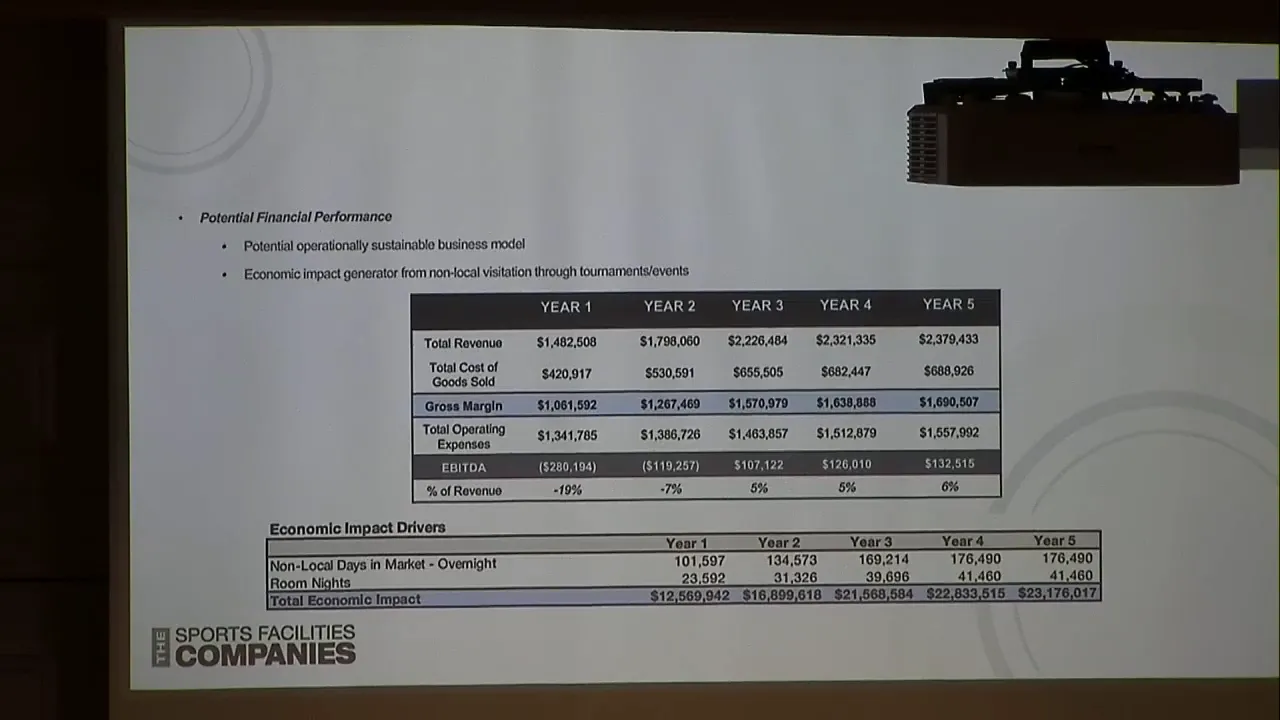
- Option 2 – Community Center Plus (≈$61.7 million): 101,000 sq ft with additional court, fitness center, indoor aquatics, medical lease space, and turf fields; projected to be operationally sustainable after a 2–3 year ramp-up.
- Option 3 – Sports Tourism Fields (≈$26.2 million): 10 multi-purpose turf fields (with baseball/softball capability) and supporting infrastructure; could generate 41,000 room nights and $23 million in annual economic impact.
- Additional private development opportunities (e.g., indoor recreation, pickleball entertainment, stadium, mixed-use) were outlined, requiring public-private partnerships and potential rezoning.
- Board positions:
- Alderman McShane strongly advocated for moving forward with Option 1 immediately, citing available funding and land, and expressed skepticism that larger options would materialize soon.
- Alderwoman Russell and Alderman McShane agreed on treating Option 1 as Phase 1, with future phases as additions, not alternatives.
- Alderwoman Nash requested a full accounting of past expenditures on the property.
- The consensus was to proceed with Option 1; staff will issue an RFP for the two fields and begin design of the community center. A resolution to formally adopt the plan was discussed but deemed unnecessary by some members; the mayor will consider bringing one forward.
Key Outcomes
- Item 1: Staff directed to begin drafting a text amendment for Section 608, incorporating feedback from the board, and to engage the Parks and Recreation Commission.
- Item 2: The board gave clear direction to move forward with Option 1 (Community Center) as the first phase of Westside Regional Park. Staff will:
- Immediately revise designs and issue RFPs for the two multi-purpose fields and the Little League field.
- Begin pre-design and community engagement for the community center using the $7.5 million already budgeted.
- Explore a public-private partnership (P3) advisor to evaluate future phases and financing options.
- Alderwoman Nash requested a complete accounting of all city expenditures on the Westside Regional Park property from 2009 to present.
- No formal vote was taken on the action plan, but the board’s consensus was recorded as sufficient to proceed.
Meeting Transcript
Good afternoon, and welcome to the Mayor and Board of Allman Workshop for the 31st of July. We begin with a Pledge of Allegiance. I pledge allegiance. Welcome back to the boardroom. It's nice to be back in this space. And as a result of the water damage that was done, it got a little bit of a facelift with some brighter paint and hopefully feels a little bit more something. So thank you for bearing with us. Pardoning our dust. We have minutes to approve from July 17th, 2024. Move to approve. Second. Motion by Altamont Shacker, second by Audder Woman Nash. All those in favor. That is three zero and one abstention from Alderwoman Kazemchak with Alderman McShane not present. Two items on our workshop agenda today. Item number one is discussion of opportunities to amend Section 608 of the land management code entitled Parks and Open Space. Good afternoon, Mayor McMart, Gabrielle Callard with the planning department. So this is a discussion about issues that have come up in a number of conversations that we've had on whether it's related to fees or the land management code or specific applications that we brought to you. And that is are we best making use of our parkland dedication requirements and the fees that we acquire through that? Through our evaluation of staff, we've kind of expanded the scope a little bit, and we've provided the board with a list of alternatives and opportunities that we see to better make our regulatory components line up with our goals of our comprehensive plan, some of the um ideas out of the parks and rec master plan, and really to kind of evolve to best meet our land use needs now as we see more dense development, more in fill development. So my plan was to run through the different alternatives and options that we've identified. Um and then, of course, if anyone has any questions, I'm happy to answer those. So one of the concerns we've heard is the fee in lieu of parkland dedication. So when a developer cannot reasonably provide a dedication of public parkland that's required based on the number of units they have, those fees that we acquire uh currently are to go towards either buying new parkland or paying the debt down on previously acquired parkland. One of the options that we think is appropriate to consider is the application of those fees to uh parkland that's deficient to making parkland improvements that would serve that neighborhood. Um this is really important in a lot of infill situations where we might not see the availability for new parkland acquisitions to immediately benefit the residents, but there are parks that maybe are not optimal and and improvements could be made that increase the capacity to reflect that new density. Um in this paragraph, we do talk about the fee for infill development is at that or uh the downtown areas basically is a thousand dollars per unit, whereas the fee is set uh outside of those areas at related to the the market rate of the property. Uh tied to that, an option that we want to consider is the ability to have the developer construct their own improvements with that money. So instead of handing over the money to us for park improvements to be able to fund and construct as part of their development project, those improvements. Uh, a lot of times the that would be much faster than uh us acquiring the money, developing CIPs, and then doing those projects ourselves if a developer is motivated and mobilized to construct to use those fees with plans approved by the city, of course, uh, to construct those improvements. It has the benefit, I think, to the development community of being able to turn over a project where their residents are immediately served by the benefits of those dollars spent. The other thing, and I think it's come up in these conversations previously about our current structure is the ability to use the fees to improve connectivity to parks and residential developments to parkland. Uh, that's another alternative under that under our current code we don't have, but that we could uh build language in that would allow us to use the money to build paths and sidewalk systems and different connections that enhance the access to parkland for those residents. The other area we see some improvement is to make sure that we have a very specific and stated ability to accept parkland dedications that are less than three acres in size. Under the current regulations and our current practices, we generally do not want to accept dedications if they're less than three acres in size. I think that's a very antiquated approach that reflects greenfield development on the periphery of the city where there would be ample land to dedicate and where accessing it would be a challenge for our parks and staff. We are seeing more and more infill and redevelopment opportunities, and we want parkland to be close to those residents, but three acres is going to be a heavy lift in a lot of our infill situations. In doing that, some things that we'd want to look at from a regulatory perspective, we would want to make sure that the intent isn't circumvented. We wouldn't want somebody who has a great three-acre park to give us or four acre park to give to just propose a bunch of piecemeal dedication. So you'd want to write your code in a way that uh created enough review authority to identify if the dedication less than three acres is indeed optimal to serve the community. Um and then, of course, we should always be mindful of the fact that uh as we shift our our approaches to things, it may create added impacts on costs and operations and maintenance that that has not traditionally been experienced. There is currently a provision for a waiver of the parkland dedication requirements in the code altogether. So before you even looking at section 608, uh a developer can ask for simply a waiver where there is not a need for parkland dedication and the developer is providing reasonable recreational outdoor spaces on their property, so they can request to the mayor and board that you just waive the requirement altogether. Encourage the board to think about the value of that, if especially if we're changing the structure to acquire fees that could be now be used to improve parks. Um the the viability of a waiver may not be appropriate anymore because uh the development is going to be creating an impact. Uh, we want to make sure that they're providing something commensurate to that impact to help support the system. If we now have a fee that can be used per towards improvements and doesn't just have to be used to parkland, we may not think it's valuable to have a waiver provision anymore, and we may want to exercise our right to have the the developer comply with those. Uh, adding the the language about those smaller parkland dedications also opens the opportunities broader so that someone may have an option to dedicate a smaller area. So the question is do we want to waiver when we're opening the door to alternative options to support the parkland requirements that the project would would generate. Um, at a minimum, if we keep the waiver, we do have to do some updates because the LMC references a map that's no longer in the comprehensive plan.
openpublica.com