Browse by city
Date range
Search help

Search titles, summaries, topics and stored transcripts together. Keywords may match separately; put the whole query in double quotes for a phrase. Matching follows word analysis, so punctuation is not exact. Both dates are included. Documents are not searched.

SHOWING 1–10 ENTRIES
01
NEWNOV 2, 2026 · FREDERICK, MARYLAND · CITY COUNCIL COMMITTEE MEETINGS
City of Frederick Government Operations Committee Workshop on Property Disposal, Elections, and Vacancies – November 2, 2026

The City of Frederick Government Operations Committee met on November 2, 2026, in a workshop session listed on the agenda for 3:30 p.m., to discuss disposal of city property, election charter considerations, and council vacancy provisions. Committee members heard from Stuart Harvey and Mark Mitchell of the city elections board, reviewed draft edits to Resolution 12-02, and identified next steps for forwarding charter items to the full council. No formal votes were taken on policy items; the committee approved prior meeting minutes and directed follow-up work. Consent Calendar - The committee approved the minutes of September 28, October 5, and October 12, 2026, on a motion and second with no objections heard. Public Comments & Testimony - No members of the public offered comments during the meeting. Discussion Items Public Property Disposal (Resolution 12-02) - Committee members discussed draft changes to Resolution 12-02 prompted by the Husky Park discussion raised by a District 3 resident. The committee was agnostic about whether the final form should be a charter change, resolution, or ordinance. - Peter, one of the committee participants, said the existing resolution does not call for council involvement early enough in the sale process. The draft would require city council approval both before listing surplus land for sale and at the final sale-agreement stage; leasing would remain largely unchanged. - The draft also added a right of first refusal for nonprofit organizations and would require the city facilities manager to maintain an updated list of surplus city properties. During discussion, members agreed the list should also include vacant city-owned land, such as the Airport Park property at Bowman Farm Road and Airport Drive East, and that responsibility should be assigned more broadly to the mayor and city staff rather than the facilities manager. - Next step: staff review of the draft before it goes to a full-council workshop. Election Charter Considerations - The committee reviewed ranked-choice voting, open primaries, nonpartisan elections, election timing, mobile voting, redistricting, and related charter-cleanup items. - Stuart Harvey and Mark Mitchell said the elections board was interested in ranked-choice voting but wanted to research costs, administration, and pilot-program experiences in places such as Portland, Arlington, Virginia, Washington, D.C., and Takoma Park before recommending adoption. They also noted open-primaries and nonpartisan-election choices are tied to ranked-choice voting. - Several committee members expressed support for ranked-choice voting and for eliminating the primary election in favor of a single general election. One member favored open primaries and keeping city elections separate from gubernatorial and presidential cycles; the board representatives agreed that separate timing avoids being buried on state ballots and state deadlines. - A committee member said research from the prior charter board showed turnout in nonpartisan elections was slightly lower than in partisan elections, although another member found that counterintuitive. - Mobile voting did not gain support; one member called it redundant with mail-in voting, and another was not ready to pursue it. - One member noted Alaska voters were being asked to repeal ranked-choice voting in the current election, adding to the need for more research. - The committee agreed to ask the elections board to research ranked-choice voting and open-primary models and to present findings to the full council, with a rough target of the first of the year. Redistricting will be brought back after the board can provide input following the November election and state certification. - Committee members also noted unresolved items including non-citizen candidate language cleanup and financial-contribution considerations related to elections. Vacancy Provisions - Stuart Harvey suggested a model: if a vacancy occurs in the first two years of a council term, hold a special election; if it occurs later, the council appoints a replacement of the same party as the vacating member. - The committee chair said she did not favor council appointment, and another member expressed similar concerns about party central committees filling vacancies. Harvey and legislative staff pointed to a menu of regional vacancy provisions, including Frederick County's practice of party-based appointment after 12 months and examples from Rockville, Gaithersburg, and Baltimore City. - A participant estimated the last city election cost close to $400,000, raising concerns about special-election expense and logistics. - The board representatives indicated they would review the vacancy-option menu and report back with any preferred approach; no decision was made. Old Business / Charter Amendments - The committee noted that most charter items are poised to move out of the Government Operations Committee to the full council, with some operations items still outstanding and scheduled for the next week. Key Outcomes - Minutes from September 28, October 5, and October 12, 2026, were approved. - The committee agreed to move the Resolution 12-02 property-disposal draft through staff review and then to a full-council workshop. - The committee will send a memo to the full council summarizing its election-charter discussion and will schedule a future work session when the elections board completes its research, targeted around the first of the year. - Redistricting will remain with the Government Operations Committee pending elections-board input after the November election and state certification. - No formal policy votes were taken on property disposal, election changes, or vacancy provisions.
02
OCT 27, 2026 · FREDERICK, MARYLAND · CITY COUNCIL COMMITTEE MEETINGS
City of Frederick Public Works Committee Meeting - October 27, 2026

The Public Works Committee met on October 27, 2026, at 3:30 p.m. to approve the previous meeting minutes and hold initial workshop discussions on updates to the Moderately Priced Dwelling Unit (MPDU) ordinance and the Park Facility Impact Fees ordinance. No public comments were offered, and the substantive items were discussion-only, with no final ordinance votes. Consent Calendar / Approval of Minutes - The committee reviewed and unanimously approved the October 13, 2026 Public Works meeting minutes by voice vote. Public Comments & Testimony - No members of the public offered comments on either workshop topic. Workshop: MPDU Ordinance Update (Initial Discussion) - The committee's initial MPDU update goals include retaining the option to accept in-lieu fees while also incentivizing construction of MPDU units. The presiding member noted this was a significant topic in District 3, where there was discussion about whether to forbid in-lieu fees and require developers to build affordable units. - Staff feedback described MPDU in-lieu dollars as a core catalyst for funding affordable housing development in Frederick and noted that developers face economic difficulty building MPDUs, so additional city incentives should be considered. - A council member added that homebuyers also face costs such as electricity and water, and said the city must advocate for equitable housing opportunities while working with developers' business models. The council member said in-lieu fees offer flexibility for LITEC projects and low-interest loans and give the city room to incentivize developers who meet its goals. - Proposed changes include exempting 100-percent affordable housing developments from MPDU program requirements, creating incentives, and clarifying the MPDU definition so it applies to dwelling units constructed within market-rate housing developments and sold or rented under the City of Frederick MPDU program. - The committee discussed lowering the MPDU threshold from developments of 25 or more dwelling units to 10 or more dwelling units at one location, as suggested by the Mayor's Affordable Housing Task Force. A 10-unit threshold would still trigger the 12.5 percent MPDU obligation. - The committee also discussed using Frederick County-specific Area Median Income standards rather than the HUD-designated Washington AMI. LITEC projects must still use the HUD definition, while city projects may have more flexibility. One council member advocated for eventually developing the city's own AMI criteria using local data, and another agreed. Workshop: Park Facility Impact Fees Ordinance (Initial Discussion) - The committee reviewed proposed definitions and an editorial restatement requiring payment of a park facilities development impact fee before a certificate of occupancy is issued; the draft also says no final inspection or certificate of occupancy may be approved unless the section has been satisfied. - A proposed exemption would apply to residential developments where 100 percent of dwelling units are affordable and occupied by households at or below 80 percent of AMI, with affordability restrictions running with the property for the duration of the affordability covenant. The Department of Housing and Human Services would verify eligibility. Asked why 80 percent was chosen, the presiding member explained that 80 percent is the top of the range of incomes the city has discussed helping, including 80, 70, 60, 50, and 30 percent AMI. - The committee discussed moving the impact fee amount out of the ordinance and into the city's fiscal fee schedule to allow annual review. The fee calculation is based on the assessed cost of new development on existing and future park development improvements. One council member expressed hesitation, preferring to observe the fees for a few years and noting that reviewing housing fees as part of a larger fee schedule has challenges. The presiding member said developers look for certainty, not stability, and that keeping fees in the ordinance provides that clarity. He also said the goal is not to add fees but to cover the city's part of park costs. - Additional proposed edits include making the Chief Operating Officer, rather than the Director of Public Works, responsible for appeals; expanding eligible uses of impact fee proceeds to include design, construction, purchase, and installation of park improvements and amenities; and staff clarified that this fee is separate from the park fee-in-lieu and is specifically for amenities. - Park location standards discussed would prioritize parks where not less than 75 percent of new dwelling units are within one-quarter mile, measured in a straight line, provided the distance is not interrupted by an arterial street or freeway. The committee debated whether arterial streets such as Monocacy Boulevard should block eligibility, and one member was uncertain about treating them as a significant barrier. Next-nearest parks measured in a straight line would also be eligible. - A proposed expenditure process would require Parks and Recreation to develop a draft plan, post it online for at least three weeks of public comment, notify neighborhood advisory councils and Main Street organizations with MOUs, hold no fewer than one public meeting, give substantial weight to public feedback, and bring the final plan to City Council for review and vote. The presiding member noted that District 3 residents said the process has sometimes been skipped in practice, so it is being codified in the ordinance. Key Outcomes - Approved the October 13, 2026 Public Works meeting minutes. - No ordinance amendments were adopted; both items are at the initial workshop discussion stage and will continue to be refined.

PARKS AND RECREATION 49% · AFFORDABLE HOUSING 34% · PROCEDURAL 13% · MODERATELY PRICED DWELLING UNITS 4%
03
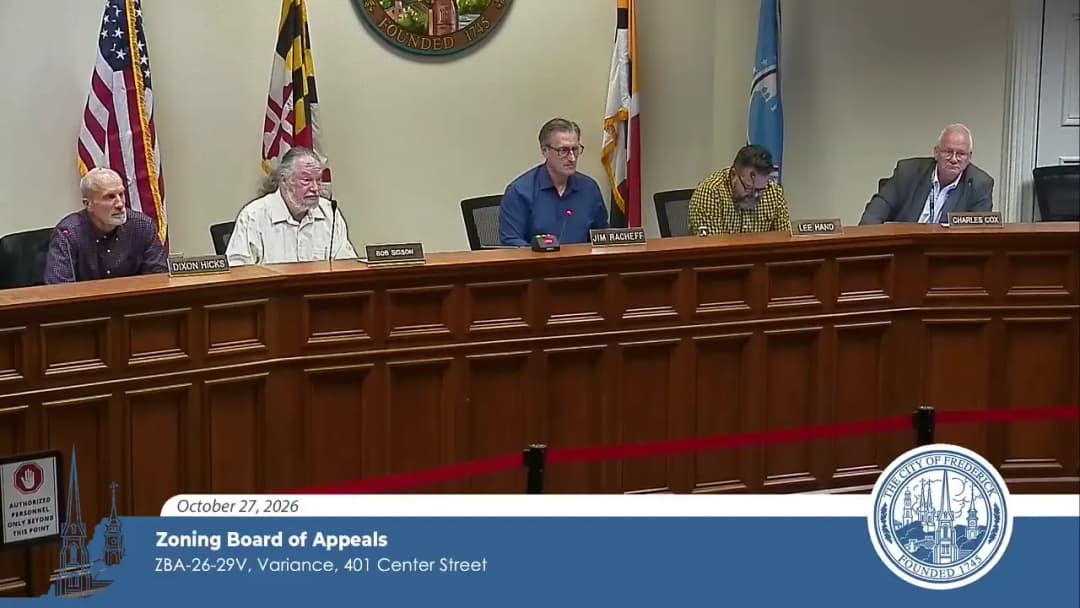
OCT 27, 2026 · FREDERICK, MARYLAND · ZONING BOARD OF APPEALS
City of Frederick Zoning Board of Appeals Meeting – October 27, 2026

The Zoning Board of Appeals (ZBA) met on October 27, 2026, at 7:00 p.m. at City Hall. The chair announced that future meetings would begin at 6:00 p.m. The board had one agenda item: a variance request (ZBA-26-29V) for property at 401 Center Street. After hearing a staff report, applicant testimony, and public comment, the board voted 4-0 to approve the variance. Consent Calendar - Approval of Minutes: The board approved the minutes from the August 25, 2026 meeting as written on a motion by Bob Sisson, seconded by Dixon Hicks. All members present voted in favor. Public Comments & Testimony - Evan Krager (400 Center Street) spoke in support, stating that the applicant’s improvements have greatly enhanced the neighborhood and that the property had been neglected by the previous owner. - Anna Bandini (38 East Second Street), mother of the applicant, spoke in support, highlighting her son’s efforts to navigate the permitting process and his commitment to restoring the home. - Brian Vay (403 Center Street) expressed support, noting that the addition is a positive improvement and does not negatively impact adjacent properties. He also remarked on the historical context of the neighborhood and advocated for maintaining the original structure. Discussion Items - ZBA-26-29V – Variance for 401 Center Street: The applicant, Julian Bandini, requested a variance to reduce the required 25-foot front setback along Sherman Avenue to 7 feet 8 inches to permit an enclosed porch addition (69 square feet) that had been constructed without a permit. - Staff Report: Planner Sherry Kelly presented the staff report recommending denial. She noted that while the addition does not extend beyond the existing building footprint, the property shares characteristics with other lots in the zone, and the applicant had created the non-conformity by building without a permit. Staff found that the variance criteria were not met, particularly because the lot conditions are not unique and a rear addition could be possible. Staff also noted that the landing and stairs would comply with encroachment allowances if the variance were granted. - Board Questions: Board members asked clarifying questions about the building envelope, the distinction between open and enclosed porches in the code, and the applicant’s timeline of permit applications. The board also discussed the fact that the original porch was three-sided and that the enclosed wall did not move closer to the street. - Applicant Testimony: Mr. Bandini acknowledged his mistake in building without a permit but emphasized that the property (a 587 sq ft home built in 1932 on a 39-ft wide corner lot) offers limited expansion options. He argued that the variance is the minimum necessary and that he would complete all required permits and inspections. He addressed each of the seven statutory criteria, asserting that the constraints of the site justify relief. - Board Deliberation: The board discussed the uniqueness of the property (pre-dating current zoning, corner lot conditions) and balanced the staff’s concerns against the applicant’s demonstrated need and the support from neighbors. Chair Racheff made a motion to approve the variance with modified findings, citing that the variance is not contrary to public interest, the lot’s circumstances are unique, the variance is the minimum necessary, and the applicant did not create the underlying condition (the original house and porch placement). Key Outcomes - The board approved variance ZBA-26-29V, reducing the Sherman Avenue front setback from 25 feet to 7 feet 8 inches, by a vote of 4 in favor, 0 opposed. (Members voting: Hicks, Sisson, Hand, and Colar.) - The approval was conditioned on the applicant working closely with the planning department to obtain permits and inspections for the completed work. - The board’s decision departed from the staff recommendation, finding that the combination of the property’s age (1932 construction), corner lot configuration, and the limited buildable area constituted unique practical difficulties that justified the variance.

ZONING AND LAND USE 67% · PUBLIC COMMENT 15% · PROCEDURAL 9% · HISTORIC PRESERVATION 5%
04
OCT 19, 2026 · FREDERICK, MARYLAND · PLANNING COMMISSION
Frederick Planning Commission Workshop – October 19, 2026

The City of Frederick Planning Commission held a workshop on October 19, 2026, at 2:00 PM in City Hall. Commissioners discussed four agenda items: architectural reviews for Kellerton and Worman’s Mill Court Apartments, a zoning text amendment for environmental assessments, and a preliminary plat and site plan for Renn Quarter Lot 2. Public comments were received on the environmental assessment ZTA and the Renn Quarter proposal. No formal votes were taken; discussions focused on refining proposals before future hearings. Public Comments & Testimony - Section 700 Environmental Assessment (PC26-226ZTA): Adam Apostoli (NAC 12 coordinator and Renn Quarter resident) expressed strong support for the amendment, stating it protects residents by requiring documentation of soil contamination. He argued that the public deserves the same information banks require, and that placing documents in the public record (FOIA-able) would enable informed decision-making. A second speaker (unidentified, likely a citizen scientist) noted that the Brickworks controversy (1250 residential units) involved five soil studies showing high contaminant levels that would not have been disclosed without citizen pressure. He criticized the city for returning EPA brownfield funds years ago, leaving environmental assessments unperformed. - Renn Quarter Lot 2 (PC26-104PSU/FSI): Rob Thompson (806 Bond Street) praised the overall plan but opposed the drive-through, calling it an eyesore given multiple drive-throughs less than a mile away. He requested a unidirectional traffic flow in the common alleyway shared with 20 townhomes to improve safety for children. Adam Apostoli noted that commercial space in the project was reduced from 15% to 4.2% and questioned the lot split (2A/2B) and phasing lines, calling the design more like a strip mall than a community center. He suggested reducing parking and adding more buffer between retail and residences. Discussion Items - Kellerton Architectural Review (PC13-195-15PND): Edward Mangold (Keystone Custom Homes) presented two new home types: the Nottingham Normandy (two-story) and the Berkeley (single-story). The package included a modification request for a square accent window (1:1 ratio) on the Berkeley’s dormer to break up roof mass. The applicant stated the design meets at least six of nine design guidelines (B: main entrance, G: exterior finishes, H: windows/entryways, I1: elevations/vista, I2: high visibility, I3: landscaping). Commissioner questions focused on coordination to avoid identical facades, square footage differences (Berkeley base 2,224 sq ft, optional up to 3,700 sq ft), and garage window treatments. Staff had no additional comments. - Worman’s Mill Court Apartments Architectural Review (PC23-1057-05MU): Jody Walker (Harris Smariga) and Megan Lukin (Hickok Cole) presented 306 affordable apartment units in three four-story buildings and one one-story non-residential building. The design emphasized breaking down mass through changes in wall plane, brick/fiber cement mix, pitched roofs, balconies, and pedestrian connections. Commissioner questions addressed disagreements with staff over facade modulation (building divisions exceed 60 ft), noise mitigation (STC-upgraded windows on affected facades), and the ground-floor grade relationship (landscaping to soften grade changes). Staff noted the applicant had responded to their comments on October 17, 2026, and would review further before the hearing. - Section 700 Environmental Assessment ZTA (PC26-226ZTA): Council Member Brehm presented his proposed zoning text amendment requiring Phase I and Phase II Environmental Site Assessments (ESI) for developments on sites with potential industrial contamination. Key points: the ordinance would not mandate participation in the state’s Voluntary Cleanup Program (VCP), only documentation of ESAs. Commissioners raised concerns about staff expertise to review ESA reports, thresholds for applicability (redevelopment vs. new development), validity timelines (Phase I valid 180 days), multi-phase developments, and continuing obligations after property sale. Staff explained they lack resources for substantive environmental review and see the role as transparency only (collecting and filing documents). Commissioner Montez suggested the Phase II trigger be moved earlier than certificate of occupancy to allow public input. The applicant indicated he would consider exemptions (e.g., industrial sites already covered) and refine language. The public speakers supported the amendment. - Renn Quarter Lot 2 Preliminary Plat and Final Site Plan (PC26-104PSU/FSI): Brian Moore (Mountain Companies) and Vince Burke presented a plan for 30,000 sq ft of retail in four buildings, with 176 parking spaces (minimum 120, maximum 200). The design emphasizes walkability: 14-foot sidewalks, 9 pedestrian connection nodes, nearly one acre of pocket parks/open space, double the required number of trees (121 vs. 73). The main point of contention was a drive-through in Building 4, set back 54–58 ft from the right-of-way (code max: 35 ft). Commissioners expressed mixed feelings; Commissioner Montez stated the drive-through seemed out of character for the dense Renn Quarter neighborhood. The applicant argued the drive-through diversifies the tenant mix and does not detract from the public realm. Commissioners also questioned parking reduction potential, the lot split (2A/2B) and phasing, and the safety of the shared alleyway. Staff noted pedestrian connectivity to existing Renn Quarter networks. Key Outcomes - No formal votes were taken; all items are scheduled for future public hearings after revisions. - Kellerton: The commission seemed favorable; the applicant will address minor design questions before the hearing. - Worman’s Mill Court: Staff will review updated submitted materials (received Oct. 17) and may have follow-up questions; applicant to provide landscaping visualizations. - Section 700 ZTA: Council Member Brehm agreed to work with staff on language to define thresholds (redevelopment, phasing, exemptions), clarify documentation requirements vs. reports, and address timing of Phase II submittal. The commission will consider its recommendation to the City Council at a later date. - Renn Quarter Lot 2: Commissioners did not reach consensus on the drive-through. The applicant committed to providing stacking capacity data and exploring signage to deter cut-through traffic in the alley. The item will return for a formal hearing, likely with further revisions.

ENVIRONMENTAL PROTECTION 22% · ARCHITECTURAL DESIGN 20% · URBAN DESIGN 15% · PUBLIC ENGAGEMENT 8%
05
OCT 15, 2026 · FREDERICK, MARYLAND · CITY COUNCIL COMMITTEE MEETINGS
Community & Culture Committee Reviews 2026 United Way ALICE Report on October 15, 2026

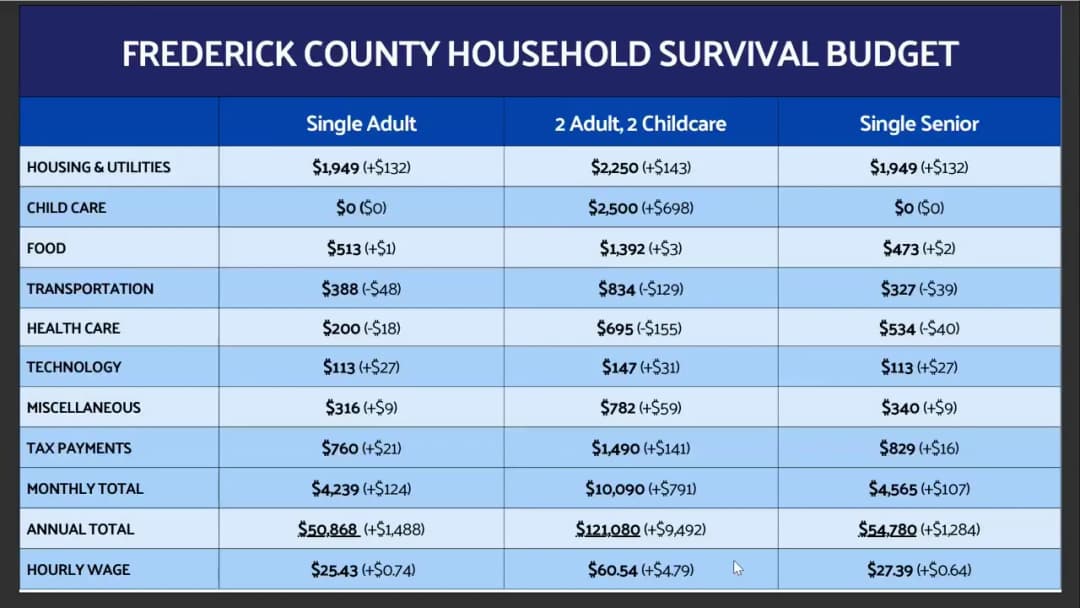
The Community & Culture Committee of the City of Frederick met on Thursday, October 15, 2026, at 3:00 p.m. to receive a workshop presentation on the 2026 United Way ALICE Report and discuss its implications. The report uses 2024 data. The committee approved the September 17, 2026 meeting minutes 2-0. Minutes Approval - Councilmember Hemplermani moved to approve the September 17, 2026 minutes; Councilmember Shockford seconded. The motion carried 2-0. Presentation: 2026 United Way ALICE Report - The presenter reported that in 2024, $62,400 was twice the federal poverty line for a family of four (two working adults, two children) and was the qualification threshold for many federal assistance programs such as SNAP and housing vouchers. The ALICE survival budget for a family of four in Frederick County was $121,080 for housing, child care, food, transportation, health care, phone, and taxes, with nothing for savings and zero debt assumed. - Frederick County had about 108,000 households. The presenter said 32% of county households were ALICE, split between 6% in federal poverty and 26% above the federal poverty line but below the basic cost of living, or about 34,465 households. Median household income was $122,000; the county population was 299,317; and the labor force participation rate was 71%. - County ALICE and poverty rates were below state averages: 26% of county households were ALICE versus 29% statewide, and 6% were in poverty versus 10% statewide. - Total households grew from 83,964 in 2010 to 108,330 in 2024. The percentage of ALICE households was relatively stable, but the total number grew as the county grew. Between 2023 and 2024, the presenter reported a net decrease in ALICE households and a net increase of about 2,090 households above the ALICE threshold. - Survival budgets cited were $50,868 for a single adult, $121,080 for a family of four, and nearly $55,000 for a single senior. Gaps between 200% of the federal poverty line and survival budgets were $21,000 for a single adult, $58,680 for a family of four, and about $25,000 for a single senior. The family-of-four gap increased by $7,000 in one year. - The presenter linked these budgets to required hourly wages of $25.43 for a single adult and about $27 for a senior. - The monthly child care estimate for two children was $2,500 in 2024; the presenter called that an underestimate likely closer to $3,000 today and noted a $698-per-month increase from the prior measurement year. - Housing consumed 46% of a single adult's survival budget ($1,949 of $4,239) and 43% of a single senior's budget, while the family of four spent about 20% on housing. The presenter said spending 30% or more of income on housing is considered cost-burdened. - The presenter cited the county housing study: about 31,000 new homes are needed by 2035, roughly 3,500 per year, with affordability defined at 60% of area median income. More than 20,000 households, about one in five, are currently cost-burdened. - On the county map, ALICE concentrations were highest in rural areas and municipalities. Urbana had the lowest concentration at 17%, Brunswick the highest at 48%, and the City of Frederick was at 45% with about 35,000 households. - The presenter flagged that 50% of American Indian and Alaska Native households were ALICE, but this was based on only 262 households, making the percentage sensitive to small changes. - Single mothers remained disproportionately affected: 75% of single-mother households were ALICE. Single fathers increased to 51%, and married dual-income households with children were at 13%. - The presenter explained that the ALICE Essential Index, which strips luxury goods from the consumer price index, has risen faster than the federal CPI, meaning federal assistance tied to CPI is not keeping up with essentials such as housing and child care. Recommendations and Council Discussion - The presenter urged the city to apply an ALICE lens to policies and fees, noting that fees are often passed through to ALICE families. - He described the existing Sold on Frederick program as providing up to $25,000 interest-free toward down payment and closing costs with no payments until the home is sold, and recommended sustaining and expanding it alongside matched-savings programs. - He recommended expanding transportation and technology support. He cited that 83% of 5,500 Chromebook recipients did not otherwise have a computer at home, and that technology now costs $147 per month in the survival budget. - The presenter offered to provide the city a deeper demographic and geographic look at its ALICE data if additional resources were available. - The presenter said United Way's Pathway to Home Ownership has helped 35 graduates buy their first home with zero defaults over 10 years. The program requires budget coaching, credit counseling, HUD-authorized homeownership training, and $3,000 in personal savings. Frederick County permits up to three homeowners per year through the partnership; United Way averages 3.5 graduates per year and hopes to expand to 10. - On transportation, the presenter praised TransIT's system improvements and said the Ride United Network provides 9,000 to 10,000 free rides per year. Veterans can access rides by calling 211, and rides are also distributed through nonprofit partners. The program began with a pilot in 2023 and has room for expansion. - The presenter also said red-light and speed-camera tickets can have an undue effect on ALICE households, potentially preventing them from renewing their driver's licenses or car registrations. A councilmember who identified as a district representative responded that speeding is a frequent constituent complaint, expressed openness to discussing alternatives with the traffic enforcement team, and noted that state-level license-related reforms are under discussion. - Councilmembers said the ALICE data should remain at the forefront when crafting policy and allocating budget resources. Key Outcomes - The committee approved the September 17, 2026 minutes by a 2-0 vote. - No formal action was taken on the ALICE presentation; it was received as a workshop item. - The committee heard the United Way's offer to explore additional city-specific data and councilmembers expressed support for considering ALICE impacts in future decisions.

AFFORDABLE HOUSING 24% · ECONOMIC DEVELOPMENT 22% · FOOD ASSISTANCE PROGRAMS 21% · TRANSPORTATION SAFETY 9%
06
OCT 15, 2026 · FREDERICK, MARYLAND · CITY COUNCIL
Frederick City Council Public Meeting - October 15, 2026

The City Council of Frederick, Maryland, held a public meeting on October 15, 2026, beginning at 6:00 PM. The meeting included a proclamation for Domestic Violence Awareness Month, approval of a consent agenda, public hearing items for various purchases and a hangar lease, second readings of land use ordinances, and introductions of bond and data center moratorium ordinances. Consent Calendar - The Council approved the minutes from the October 1, 2026, regular public meeting. - Special Ordinance S-26-21 was approved, amending the FY 2027 budget to accept a Governor’s Office of Crime Prevention and Policy (GOCPP) BJAG grant for Frederick Police Department technology. Public Comments & Testimony - Ordinance G-26-13 (Forest Conservation Warranty): Three speakers representing development and building interests opposed the proposed five-year maintenance warranty period for afforestation projects. - Jonathan Pembroke (Frederick County Land Use Council): Argued the warranty adds significant costs (an estimated $1,600 per acre), which are passed on to homebuyers, and requested reconsideration. - Steve Allison (Rogers Consulting): Opposed the five-year period, stating incremental regulatory changes contribute to rising housing costs, and cited industry data that regulatory compliance accounts for 26.4% of the final cost of new housing nationally. - Danielle Adams (Frederick County Building Industry Association): Opposed the five-year warranty, characterizing it as a barrier to affordability and requesting the Council reduce it to three years or conduct further study. Discussion Items - Proclamation (Domestic Violence Awareness Month): Mayor O’Connor and the Council presented a proclamation recognizing October as Domestic Violence Awareness Month. The proclamation cited CDC statistics that one in three women, one in four men, one in three teens, and one in two LGBTQ+ individuals experience violence in an intimate relationship. Nikki Thrash, Executive Director of Heartly House, accepted the proclamation, noting the organization has served survivors for over 47 years. - Force Metrics Software Agreement: Commander Corey Borns requested approval of a three-year software services agreement to integrate police data systems. Councilmember Hempelerani raised concerns about contractual language regarding data sharing and generative AI. Commander Borns clarified the system uses a secure cloud-based platform for internal data analysis only. - Solar Feasibility Study: Airport Manager Andrew Moore presented a proposal to conduct a feasibility study for solar panels at the Frederick Municipal Airport, funded by a Maryland Energy Administration grant, and incorporating a potential battery storage component for operational resilience. - Cabana Air Hangar Lease: Airport Manager Andrew Moore presented a 42-year ground lease for a 33,000-square-foot aircraft hangar involving a 1.5% annual escalation clause. The hangar will be privately funded and constructed. - Ordinance G-26-12 (Home-Based Businesses): Gabrielle Collard presented an ordinance to rename and update regulations for home-based businesses, modernizing standards and reducing administrative barriers for no-impact businesses. - Ordinance G-26-13 (Forest Conservation): Gabrielle Collard presented amendments adding mitigation for specimen tree removal, increasing the maintenance warranty period to five years, and establishing non-compliance fees of $3.64 per square foot. A debate ensued regarding the five-year warranty; Councilmember Atkins proposed an amendment to reduce it to three years, which failed for lack of a second. Key Outcomes - Consent Agenda: Approved unanimously. - Purchases & Agreements (Public Hearing): Approved unanimously: B2GNow software ($65,151); ForceMetrics agreement; Delta Airport Consultants amendment ($215,000); Solar Feasibility Study final contract ($53,476); Cabana Air hangar lease. - Ordinance G-26-12 (Home-Based Businesses): Approved unanimously (6-0). - Ordinance G-26-13 (Forest Conservation): Approved unanimously (6-0) with the proposed five-year warranty period. The amendment to reduce the warranty to three years failed for lack of a second. - Ordinance G-26-14 (Fee Schedule): Approved unanimously (6-0). The fee-in-lieu of afforestation was increased from $0.30 to $3.64 per square foot. - Ordinances Introduced (for future public hearing): Ordinance G-26-15 (authorizing up to $39 million in public improvement bonds) and Ordinance G-26-16 (establishing a moratorium on data center land use categories and authorizing a study) were introduced. No action or public comment was taken. Council Business & Comments - Councilmember Hempelerani provided an update on a Council-funded medical clinic run by the Asian American Center, reporting it served 136 people (55 walk-ins), and that 69% of recipients were persons of color and 70% were female. He also shared closing remarks on community events. - Councilmembers shared closing remarks recognizing the Arch memory center opening, the Maryland School for the Deaf renovations, and breast cancer awareness month.

FOREST CONSERVATION 39% · TECHNOLOGY AND INNOVATION 17% · PROCEDURAL 8% · AIRPORT MANAGEMENT 8%
07
OCT 13, 2026 · FREDERICK, MARYLAND · CITY COUNCIL COMMITTEE MEETINGS
Public Works Committee Meeting – October 13, 2026

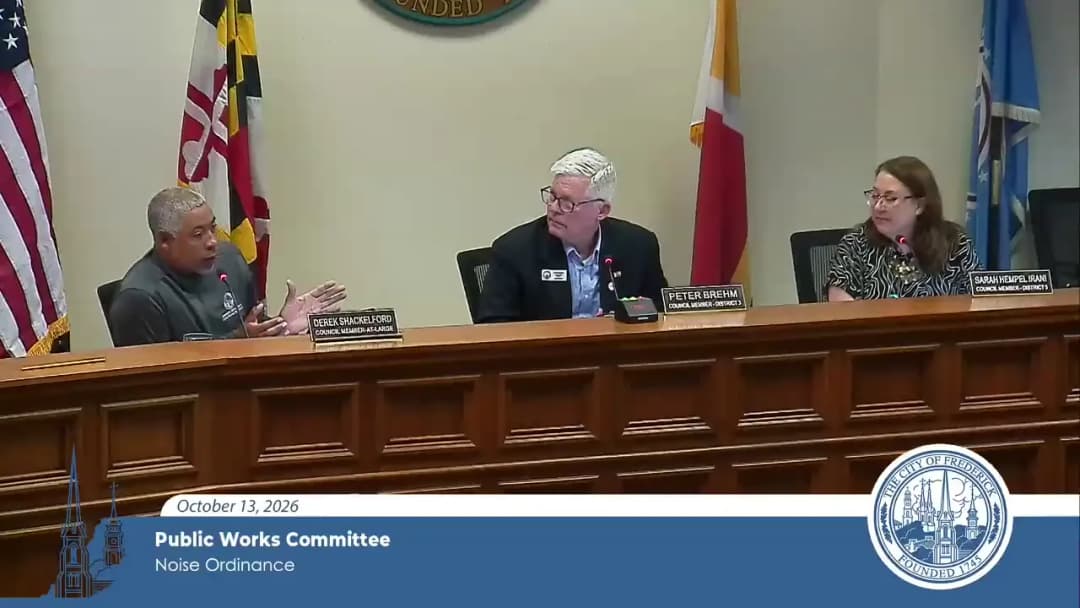
The Public Works Committee met on October 13, 2026, to discuss three major ordinance updates: the Rental Licensing Ordinance, the Housing Solution Fund, and the Noise Ordinance. The meeting began with approval of prior minutes and included public testimony on the housing fund. Key outcomes included moving the rental licensing ordinance to a full council workshop, while the housing fund and noise ordinance remained under discussion without formal votes. Consent Calendar - The minutes from the September 22, 2026, Public Works Committee meeting were approved by a vote of 3-0. Public Comments & Testimony - Kevin Sellner (East History Street) commented on the Housing Solution Fund, emphasizing the need for adequate staffing to administer the programs and urging the council to find creative ways to hire additional personnel. - Neil Donnelly (West 2nd Street) expressed support for the Housing Solution Fund but requested that the ordinance prioritize households at 30% AMI (Area Median Income) rather than the proposed 80% AMI, noting that lower-income residents are completely locked out of the housing market. He advocated for subsidies for that tier. - Ann Ryan (Frederick Housing Solutions Task Force) strongly supported establishing the City Housing Solutions Fund and recommended three improvements: (1) make residents with the lowest income (below 30% AMI) an explicit priority; (2) set aside funding for smaller, innovative solutions such as cottage clusters and accessory dwelling units; (3) strengthen public reporting with a quarterly dashboard showing revenues, expenditures, commitments, and income levels served. She also urged a predictable annual city contribution. Discussion Items 1. Rental Licensing Ordinance Update - Staff presented updates including a requirement for a local representative within 50 miles of Frederick, provisions for inspections with warrants or consent, and a new fee structure (administrative costs plus 10% for displacement). The fund could also assist smaller landlords (fewer than 10 units) with maintenance costs. - Councilmembers discussed concerns about resident safety and trust when city inspectors enter homes, particularly for vulnerable populations. Staff clarified that inspections require consent or a court-issued administrative search warrant, often accompanied by police. The committee agreed to move the ordinance to a full council workshop for further deliberation. 2. Housing Solution Fund Ordinance - The draft establishes a fund using MPDU (Moderately Priced Dwelling Unit) proceeds and any other revenues designated by the City Council. Purposes include affordable housing development, home buyer assistance, home repair, rental assistance, and eviction prevention. - Councilmembers debated whether to set percentage caps for each category to ensure flexibility without depleting the fund for large projects. Staff noted that HHS (Health and Human Services) requested flexibility. Councilmember Hempel Rani was tasked with gathering current spending data from HHS before moving forward. No formal motion to advance was made. 3. Noise Ordinance Update - Major changes included addition of decibel (dBC) tables based on other municipalities, a new definition of vibration, language on motor vehicle noise (pending), and revised penalties (individuals vs. businesses). The committee discussed variances versus a mitigation approach for ongoing business operations and special events. - Councilmembers expressed concerns about strictness, enforcement of portable devices, and potential impacts on downtown vibrancy. A proposal emerged to convene a formal stakeholder group (businesses, residents) to provide input and avoid unintended consequences. The ordinance was not advanced to council workshop at this meeting. Key Outcomes - Minutes approved (3-0). - Rental Licensing Ordinance moved to a full City Council workshop for further discussion. - Housing Solution Fund Ordinance – no vote; councilmember to gather data on current spending and parameters before next steps. - Noise Ordinance – no vote; committee agreed to consider a stakeholder group and continue refining the draft.

NOISE ORDINANCE 37% · RENTAL ASSISTANCE 24% · AFFORDABLE HOUSING 23% · PUBLIC SAFETY 7%
08
OCT 12, 2026 · FREDERICK, MARYLAND · CITY COUNCIL COMMITTEE MEETINGS
Government Operations Committee Considers Menstrual Products, Elections, and Property Policy - October 12, 2026

The Government Operations Committee of the City of Frederick met on October 12, 2026, to review several proposed ordinances and charter amendments. Topics included a mandate for free menstrual products in city-owned public restrooms, overhauls of the city's election system (open primaries, nonpartisan elections, and ranked choice voting), a potential change to the election cycle, and a right-of-first-refusal policy for nonprofits on city land sales. The meeting featured deliberation among council members and public testimony. Discussion Items & Public Testimony Menstrual Products Ordinance - The committee reviewed a proposed ordinance requiring the City of Frederick to provide free and accessible menstrual products in city-owned public restroom facilities. The ordinance was drafted by Councilmember Kelly, modeled after existing laws in other jurisdictions. The committee noted that some city restrooms already have these products available. - The committee voted unanimously (3-0) to move the ordinance to the full city council for consideration. Election System Reforms (Open Primaries & Nonpartisan Elections) - The committee discussed two potential charter amendments: creating an open primary system and establishing a nonpartisan election system. - Councilmember Kelly expressed support for the concept of open primaries but acknowledged legal complexities regarding compelling parties to open primaries to unaffiliated voters. She presented the options as: do nothing, pursue open primaries, or switch to a nonpartisan system. - Councilmember Atkins stated she was not in favor of open primaries, arguing it forces voters into a party or allows strategic cross-over voting. - Councilmember Bram suggested that ending the primary system entirely and moving to a general election with ranked choice voting (RCV) could save money and increase voter focus. He questioned the benefit of retaining party labels next to candidate names if primaries are eliminated. - Public commenter Jim Smersel noted the state law threshold for recognized political parties (10,000 signatures) and raised concerns about the definition of "principal political parties" in the context of an open primary. - The committee agreed to await the upcoming Ranked Choice Voting presentation and input from the Board of Supervisors of Elections before forwarding any election reform proposals to the full council. Staff was asked to provide clarity on the legal barriers to open primaries. Election Cycle Change - Councilmember Frame proposed a charter amendment to change the city election cycle, suggesting an off-cycle election would focus attention on local issues rather than national or state-level politics. - Councilmember Atkins and Councilmember Kelly both expressed a preference for keeping the current local cycle, accepting lower turnout in favor of voters more engaged with city-specific issues. Nonprofit Right of First Refusal on City-Owned Property - The committee discussed a potential charter amendment to require a right-of-first-refusal period for nonprofit organizations before the city can sell or dispose of surplus property. - Councilmember Atkins requested the right be restricted to nonprofits based in Frederick County. - Councilmember Bram asked about the specific process for the right of first refusal and the city council's role in property disposition. A 2012 resolution (12-02) was shared outlining the council's role, and the committee agreed to schedule a deeper dive into the document. - Public commenter Jim Smersel recommended using "may" instead of "shall" in the property language and creating a standardized process for the nonprofit preview period. - The committee decided to gather staff feedback and review existing procedures before advancing the amendment. Key Outcomes - Menstrual Products Ordinance: Approved (3-0) for full council consideration. - Election Reforms: No vote. The committee will wait for the RCV presentation and Board of Elections feedback. - Election Cycle: No vote. The committee majority preferred maintaining the current cycle. - Right of First Refusal: No vote. The committee will review existing property disposition policies and gather staff input. - Schedule: The October 26, 2026 meeting was canceled; the next meeting is consolidated with the November 2, 2026 session.

ELECTIONS 33% · NONPROFIT GOVERNANCE 26% · PUBLIC FACILITIES 25% · ELECTION PROCEDURES 7%
09
OCT 6, 2026 · FREDERICK, MARYLAND · CITY COUNCIL
Frederick City Council Public Meeting - October 6, 2026

The Frederick City Council held a public meeting on October 6, 2026, addressing appointments, consent agenda items, a resolution on housing action, announcements of annexation petitions, introductions of ordinances, and public comments. The meeting began with the Pledge of Allegiance and approval of the September 17, 2026 minutes. Consent Calendar - Release of Surety: Approved release of $21,000 cash surety posted by FCSCTF, Inc. for the 109 West 13th Street project. - Request to Serve Alcohol on City Property: Approved alcohol consumption on the City Market Square Lot adjacent to the Church St. Parking Garage on October 10, 2026, for the White Rabbit Oktoberfest event. Appointments and Reappointments - Fair Housing Commission: Melissa Cooper appointed for a three-year term (October 2, 2026 to October 1, 2029). Approved 6-0. - Planning Commission: Kathryn Stewart appointed to complete an unexpired term ending September 4, 2030. Approved 6-0. - Parks and Recreation Commission: Rob Fox reappointed for a three-year term (October 2, 2026 to October 1, 2029). Approved 6-0. - Ethics Commission: The reappointment of Phil Bowers was tabled after Council Vice President Nash raised concerns about Bowers' residency, citing evidence that Bowers is registered to vote in Florida and may not meet the city residency requirement. The motion to table passed 6-0, with the item rescheduled for the next council meeting on October 15, 2026. - Neighborhood Advisory Council 3: John Cetrone reappointed for a two-year term (October 2, 2026 to October 1, 2028). Approved 6-0. - Weinberg Center for the Arts Board: Marlene Barge, Shuan Butcher, and Chris Parsell appointed to three-year terms (October 2, 2026 to June 30, 2029), each approved 6-0. Discussion Items - Resolution 26-15 Concerning Housing Action: Council President presented an amended resolution that formally accepts the city's housing task force conclusions. Amendments included a section calling on Frederick County to develop policies to incentivize housing growth, a section addressing infrastructure needs, and a request to develop a Frederick County AMI that better reflects city residents' income. After brief discussion, the resolution was approved 6-0. - Announcements of Annexation Petitions: The city announced two petitions: (1) annexation of approximately 156.446 acres west of US Route 15 north of Sundays Lane, requesting Medium Density Residential (R8) zoning; (2) annexation of approximately 200.011 acres north of Winpenny Drive and Yellow Springs Road, requesting Low Density Residential (R4) zoning. These will be subject to future public hearings. - Introduction of Ordinances: Three ordinances were introduced for first reading (no discussion or public comment at this time): - Ordinance G-26-12: Amending home occupation standards and definitions. - Ordinance G-26-13: Amending forest conservation standards to align with state code. - Ordinance G-26-14: Amending the FY2027 fee schedule to include a fee in lieu of afforestation. Public hearings will be scheduled later. Council Business and Comments - Councilmember Hempel Rani celebrated the dedication of Yellow Springs Elementary School, noting the previous school was 140% over capacity and now students can walk or bike to school. - Councilmember Atkins highlighted a city open house on North Market Street bike lane planning, gathering public input. - Councilmember Brem invited the public to the Weinberg Center's 100th anniversary open house on October 10, 2026, featuring free entertainment, crafts, and tours. - Council Vice President Nash addressed a past incident where he intervened about illegal signs on Route 40, leading to a police call but no charges, reiterating his commitment to neighborhood issues. - Councilmember Shackelford discussed the United Way's latest ALICE report, noting that over 40% of city households (about 1,400) cannot afford basics, with child care now the leading expense. He announced plans to bring forward an affordability agenda addressing rent, fees, water bills, child care, and housing. Public Comments & Testimony - Kathy Anderson: Urged ethics reform, detailing 26 failures in the current process, including lack of transparency, no appeals, and conflicts of interest. She asked the council to pause the current process to fix it openly and fairly. She also noted that her records request showed other applicants for the Ethics Commission that were never presented. - Adam Apposoli: Raised concerns about the Highland Trail development (100 townhomes with only two garage parking spaces per unit and 16 on-street spots, insufficient for 3-4 bedroom homes). He also alleged a discrepancy between city staff statements and residents' claims about police reports regarding noise complaints at a Zoning Board of Appeals meeting, urging the council to investigate. - Jonathan Pembroke (Frederick County Builders Association Land Use Council): Expressed continued concern about the proposed forest conservation ordinance, stating that while the association supports tree preservation, the city's draft is more restrictive than the state's model ordinance in several areas, adding unnecessary time and cost to housing projects and contradicting affordability goals. Key Outcomes - Phil Bowers reappointment tabled (6-0) pending residency verification. - Resolution 26-15 approved (6-0) to advance housing action priorities, including county coordination and infrastructure considerations. - Consent agenda items approved as routine. - All announced annexation petitions and ordinance introductions will proceed to future public hearings.

ETHICS COMPLAINTS 26% · BOARD APPOINTMENTS 16% · PUBLIC ENGAGEMENT 14% · AFFORDABLE HOUSING 13%
10
OCT 5, 2026 · FREDERICK, MARYLAND · CITY COUNCIL COMMITTEE MEETINGS
Frederick Government Operations Committee: Police Accountability, Mobile Voting, and City Studies – October 5, 2026

The Government Operations Committee met on October 5, 2026, for a workshop on Frederick County Police Accountability Board operations, a mobile voting pilot proposal, and councilmember reviews of recent city studies. The agenda listed a 4:00 P.M. start. No votes on the workshop items are reflected in the transcript. Police Accountability Board Update - A county staff member supporting the Police Accountability Board (PAB) presented the structure required by the Maryland Police Accountability Act of 2021: counties must maintain a PAB, meet quarterly with law enforcement agencies, appoint civilians to the Administrative Charging Committee (ACC) and trial board rotation list, receive and review misconduct complaints, and submit an annual report. - The ACC reviews completed investigations and decides whether to administratively charge an officer; if charged, it recommends discipline consistent with the statewide disciplinary matrix. Trial boards adjudicate cases when officers reject recommended discipline and are composed of an active/retired administrative law judge, a civilian appointed by the PAB, and an officer of equal rank. Proceedings are public, and opinions are due within 45 days. - Covered law enforcement agencies are the Frederick Police Department, Frederick County Sheriff's Office, Brunswick Police Department, and Thurmont Police Department. The Frederick Police Department came under PAB jurisdiction on July 1, 2024, after its collective bargaining contract ended. - The county established the PAB in April 2022; the inaugural board was appointed July 5, 2022, and first met in August 2022. Meetings were monthly initially and later became quarterly. In 2025, the PAB held four regular quarterly meetings, two administrative meetings for appointments, annual report filing, and two special meetings. - The 2025 annual report is due by December 31 and goes to the county executive, county council, and the mayors of Frederick, Brunswick, and Thurmont. - Complaint data presented for 2025: 44 complaints were received, with 12 applicable complaints coming directly to the PAB and 32 filed directly with a law enforcement agency. The ACC reviewed 37 complaints, including carryovers from 2024, and recommended administrative charges in six cases, mostly alleged violations of agency policies and standards. - The 2025 report's recommendations include better complaint tracking, geographic and demographic trend analysis, record retention clarification, county and state policy alignment, tracking outreach impacts on reporting behavior, and considering state amendments to allow the ACC to recommend mandatory training even when no administrative charge is issued. - In Q&A, staff said state law supersedes local law, complaint numbers appear low compared with Baltimore City's more than 500 backlogged trial boards, jurisdiction-level breakdowns are available in the annual report, and officers may appeal trial board outcomes to circuit court. Mobile Voting Pilot Presentation - Brace Bennett, grassroots director of the Mobile Voting Project, presented a proposal to add secure smartphone voting as an optional voting method. The Mobile Voting Project is a nonpartisan nonprofit that provides grants and technical support for mobile voting pilots. - Bennett cited local turnout: in November 2025, roughly 14,000 of nearly 60,000 registered voters participated in Frederick's city election, about one in four; more than eight in ten of those who voted did so from home by mail or drop box. - He said mobile voting could help military and overseas voters, people with disabilities, survivors of domestic violence, and voters facing scheduling or last-minute obstacles, and could provide an option if mail-in voting is further restricted. He also noted Frederick runs its own elections through the Board of Supervisors of Elections and the City Clerk, making a municipal pilot possible. - Case studies cited: Denver's 2019 municipal pilot for military voters and overseas civilians doubled turnout, and 100% of survey respondents preferred smartphone voting; a King County Conservation District election near Seattle tripled turnout, with 94% of voters returning ballots electronically even though mail and drop-box options remained available; Nevada has used electronic voting since 2014 and 20% of voters are now eligible to vote electronically. - The process described uses an app or secure link, multi-factor identity verification, an accessible multilingual ballot interface, encryption before the ballot leaves the phone, offline decryption, paper ballot printing, and a public bulletin with tracking numbers so voters can verify their ballot arrived and was counted. The core software is free and open source. - Bennett said the technology is designed to detect tampering, fake ballot insertion, and deletion attempts; no successful hacking attempts had been reported. Initial software costs can be $10,000 or less, and the Mobile Voting Project can provide grants for startup costs. - Bennett requested that Frederick partner on a pilot for the 2029 city election and urge the state legislature to pass authorizing legislation. He said Frederick previously sent a letter supporting SB 727 and HB 1066; Senator Karen Lewis Young was the lead sponsor and Delegate Ken Kerr was a co-sponsor. - In response to councilmember questions, Bennett said existing voting methods would remain available, mobile voting would be opt-in or proactively offered, no AI is baked into vendor systems, and the project is a nonprofit funded primarily by philanthropist Bradley Tusk, not by software vendors. Public Comments & Testimony - Stuart Harvey, a Frederick resident at 2020 Butterfield Overlook and a member of the city's Board of Supervisors of Elections, expressed skepticism about mobile voting. He said he would want to hear from officials in Denver, West Virginia, and Alaska about what worked and what did not. He noted that SB 727 and HB 1066 had a hearing but did not advance out of committee, and that Common Cause was among the opponents. He said mobile voting is speculative until authorizing legislation passes and may make the most sense for military and overseas voters because overseas mail ballots are often late and problematic. City Studies Discussion - The committee flipped agenda items B and C, so the mobile voting presentation came before the city studies discussion. - Green Streets study: a councilmember reported the plan is still in draft and the proposed ordinance/study is expected to come to the council by the end of the year. Goals include reducing heat islands, increasing tree canopy cover, stormwater management, environmental site design, improving water quality, reducing local flooding, meeting MS4 permit requirements, and building community character and health. The councilmember pointed to Appendix C for recommendations. - Housing Gap study: a councilmember said they are not opposed to affordable housing and know it is needed, but called some study numbers wonky. Over the last five years, Frederick County built about 3,500 fewer units than historically typical; the county built 296 multifamily units while the city permitted just over 2,100, making the city responsible for 87% of multifamily permitting during that period. The councilmember said the city needs to talk with the county about providing support if county production remains around 500 units or fewer per year and the bulk of housing falls to the city. - Tree Canopy study: a councilmember recommended inviting the sustainability team, city arborist, and Mobilize Frederick to comment on recommendations A-F. These include maintaining a broad age distribution and variety of trees, community education, integrating tree canopy data into planning decisions, investing in LIDAR, reassessing the canopy every three to five years, and using field data collection to complement the assessment. The councilmember noted Frederick's tree canopy percentage is lower than Baltimore's, partly because the city annexed cornfields with little existing tree cover in the 1970s, 1980s, and 1990s; afforestation began around 1992. Key Outcomes - No formal motions, votes, or resolutions on the workshop items were reflected in the transcript. - The committee received the Frederick County PAB update for information, with the annual report due by December 31. - Mobile voting was discussed but no decision was made; state authorizing legislation is needed before any pilot, and the request was to partner on a 2029 pilot. - City studies were informational: Green Streets is expected before the council by the end of the year, housing gap findings point to county coordination, and tree canopy follow-up would involve city staff and Mobilize Frederick.

POLICE ACCOUNTABILITY 40% · VOTING METHODS 39% · TECHNOLOGY AND INNOVATION 11% · PUBLIC COMMENT 4%
0102
NEXT →
OPENPUBLICA · PUBLIC MEETING INDEXUPDATED DAILY · openpublica.com