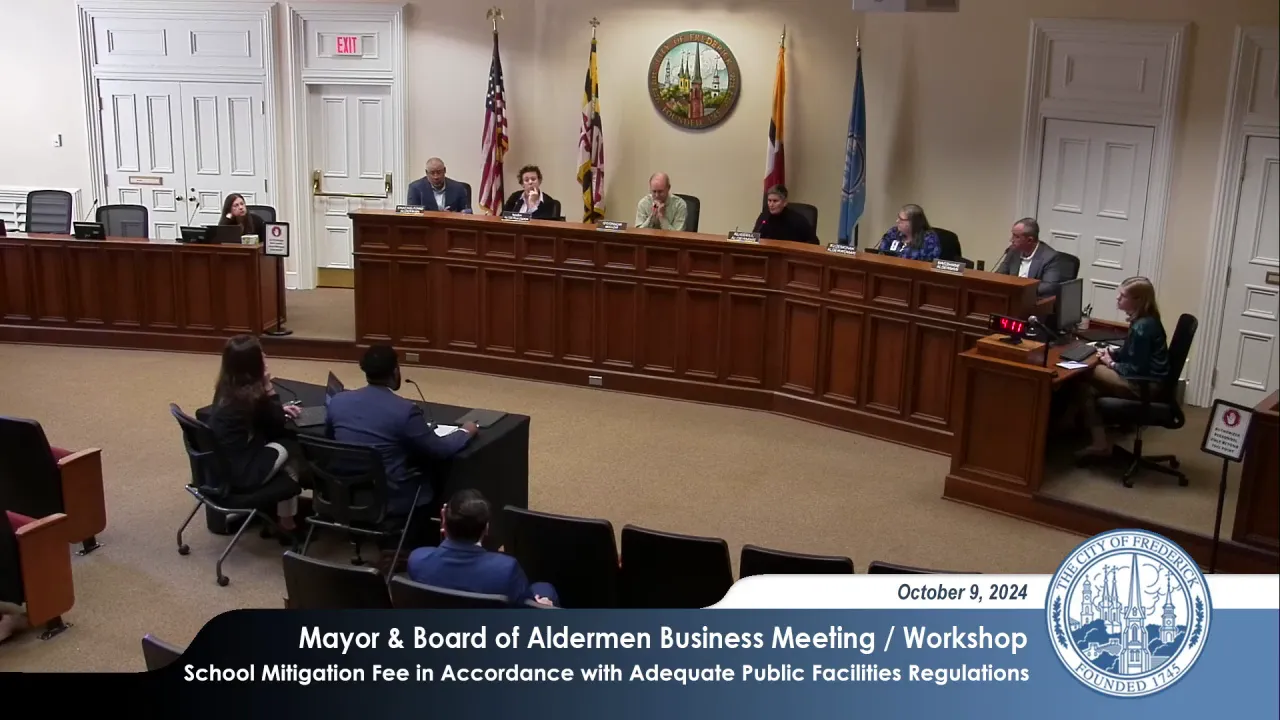
Mayor & Board of Aldermen Business Meeting and Workshop - October 9, 2024
STREAMING COPY IN PREPARATION — RECORDING AVAILABLE FROM THE ORIGINAL SOURCE
Mayor & Board of Aldermen Business Meeting and Workshop
On October 9, 2024, at 3:00 PM, the Frederick Mayor and Board of Aldermen held a combined business meeting and workshop. The meeting began with the Pledge of Allegiance and approval of the September 25, 2024, minutes by a 5-0 vote. The consent calendar approved the release of two surety bonds totaling $347,811.22 for Riverside Technology Park projects. The workshop focused on two main agenda items: the school mitigation fee policy and a fee-in-lieu of parkland dedication for the 7615 Hayward Road Apartments development. Public comment was heard on the school mitigation fee. The board discussed potential adjustments to the fee and future use of collected funds, but no formal votes were taken on policy changes. The meeting concluded with elected officials' comments and adjournment.
Consent Calendar
- Approval of Minutes (September 25, 2024): Motion by Alderman Shackelford, second by Alderwoman Kazemchik, passed 5-0.
- Release of Surety: Two Hanover Insurance Company bonds released: $178,996.94 for Riverside Corporate Park Lot 257A and $168,814.28 for Lot 256R. Approved 5-0.
Public Comments & Testimony
- Bruce Dean (McCurdy Dean & Gratitore): Representing himself as a drafter of the original 2011-2012 school mitigation ordinance. He argued that retaining the fee is critical to allow housing development in Frederick City, noting that the county's elimination of its mitigation fee has shifted 70% of residential building permits to the city. He urged the board to continue the fee to avoid worsening the housing affordability crisis.
Discussion Items
1. School Mitigation Fee Policy
- Staff (Clara) presented the current fee structure, set in 2011. Fees range from $3,870 per single-family unit (elementary failure) to $5,411 adjusted for inflation (2024 dollars). The county’s comparable fees are higher (e.g., $10,393 for elementary) but no longer applicable to new development.
- Alderman McShane argued the fee is “disingenuous” because it is collected for school capacity failures but not used to build new seats. He supported raising the fee but only if funds are directed to school construction, possibly via the county.
- Alderwoman Kazemchik opposed sending funds to the county, fearing city residents would lose control and face double taxation. She advocated using the money for educational enrichment programs within city schools, citing her own experience as a teacher and low-income student.
- Alderman Russell stressed the need to allow development to proceed and favored keeping the fee as a tool to incentivize growth, but acknowledged the difficulty of balancing housing needs with school overcrowding.
- Alderwoman Nash agreed with McShane that the fee should be tied directly to school capacity solutions, but also noted the importance of partnering with FCPS to expedite school projects. She supported raising the fee but wanted policy clarity on spending.
- Alderman Shackelford and the Mayor reinforced the program’s original intent—to allow city-controlled development rather than ceding to county decisions. The Mayor suggested gathering data on state-rated capacity changes and the county’s school construction timeline.
- No formal vote was taken. Staff was directed to research fee adjustment options (inflation, county rates, other jurisdictions) and explore with FCPS whether existing funds ($2.1–$2.5 million) could accelerate a school project like Hillcrest Elementary.
2. Fee in Lieu of Parkland Dedication – 7615 Hayward Road Apartments
- Staff (Sherry Kelly) presented the request: a 112-unit multifamily project requires 56,000 sq ft (1.29 acres) of parkland, but parcels under 3 acres are not accepted. The applicant proposes a fee-in-lieu of $95,000 based on an appraisal of unimproved land. The Planning Commission conditionally approved the site plan subject to board approval of the fee.
- Alderwoman Nash noted that a broader policy review of the 3-acre threshold and parkland fees was already underway (text amendments expected in coming months).
- Andrew Welker (Oshman Properties) confirmed no unusual aspects. No public comment or opposition was raised.
- The board did not hold a formal vote; the discussion indicated general acceptance pending the ongoing policy revision.
Key Outcomes
- No formal votes on either workshop item; policy changes require future legislation.
- Direction to staff: Research school mitigation fee adjustment options (inflation, county rates, etc.) and engage with Frederick County Public Schools on using existing funds to expedite a school construction project.
- Parkland fee: The $95,000 fee-in-lieu for Hayward Road Apartments is expected to be approved as part of the broader parkland dedication policy update. Staff will return with text amendments.
- Continued collaboration: The board reaffirmed participation in ongoing school construction work groups (state delegation and urban schools compact design).
Meeting Transcript
Good afternoon, and welcome to the mayor and Board of Alderman Business Meeting and Workshop for the 9th of October. We begin with the Pledge of Allegiance. I pledge the changes to the flag for the United States of America. And to the Republic for existence. Underground. We have minutes to approve September 25th, 2024. So moved. Motion by Alderman Shackerford, second by Alder Woman Kazemchick. All those in favor. That is five-zero. Thank you very much. We have a business meeting today. Items on the business meeting agenda are considered routine by the mayor and board heard at the workshop pursuant to the rules of procedure of the Board of Alderman. They'll be approved in one motion without separate discussion of each item, unless a person, any person present request an item be removed, an item that is removed will be considered separately, either at the end of the business meeting or at a regular public meeting. So move. All those in favor, that is five-zero. Thank you very much. Two items on our workshop agenda today. Item number one, discussion of school mitigation fee paid by developers qualifying projects in accordance with the adequate public facilities ordinance regulations of chapter four of the city code. Up that she's provided to you all. It is an option available to a developer when the project is when the project is tested for APFO and any of the schools serving the proposed project are above 100% of the capacity, but below 120% of the state rated capacity. So projects that only fall on that threshold, it's an option, it's not mandatory. Uh, we have had a project in the past say I could pay the fee, but I just want to wait the five years. Um it was three years at the time, um, but that that is an option. There's also the option that a developer can always propose a mitigation plan. So they could actually propose something to bring about adequacy. I will build you a new school. Um that has not happened to date, obviously. Um, so most projects that are eligible uh elect to pay the fee. No one is trying to build us a school, unfortunately. Um the other important thing to note is that a project that is um applying for and receives uh low-income housing tax credits, if they they still get tested, so they're still subject to the APFO. If they are above 100% but below 120%, they have the option to pay the fee, but the fee is legislated as zero dollars. Um so they are not exempt from the APFO in in that sense, they still go through, they still get tested. Uh if they were over 120% of the the state rated capacity, they would not have an option. Uh they would just be on hold or propose to build school. Um so that is a nuance that's important to note. In the executive summary today, uh, we did provide the current fees, which are the fees that were set in 2011. Um just for starting point in terms of options. If the the will is to increase them, um, you know, there's always the basic option of just increasing to 2024 or almost 2025 dollars. Uh the the fee from 2011 is probably um out of date and and could be increased just based on inflation alone. Uh, the other option uh that we presented was to mirror the county's uh fees. The interesting thing about the county's school mitigation fee process is that it no longer really applies to new development applications, they ceased that option, it only applied to projects during certain years that were locked in under agreements. Um they have since taken that out off the table as an option for projects that fail the school test, um, but they do revisit those fees every year, and they are based on school construction costs, and we've provided those as well. I think that hits the high points. I'm happy to answer any questions about kind of the mechanics of how we um test and apply or the existing fees, um, how we collect them just real quickly. We do collect uh for multifamily units, we collect those at the time of permit. So when they apply for the permit, we add that fee. And now, and this is lovely with open gov, um we are actually able to program that. That was a manual process that we had to go through that someone actually had to get the permit, look and go, oh, this isn't a development that has to pay the fee, and then go in and add the fee. Now, ahead of time with the technology that open gov provides, we can actually flag that fee on a location.
openpublica.com